Starting a Hot Sauce Business From a Home Recipe
Turning a beloved kitchen recipe into a commercial hot sauce business requires shifting from informal cooking to regulated food manufacturing. To legally sell your sauce, you must standardize your formula by weight, verify its acidity for shelf stability, produce it in an approved commercial kitchen or co-packing facility, and register with federal and local health authorities.
While the culinary craft begins at your stove, building a sustainable brand depends on mastering food safety, accurate costing, and scalable production.
Many home cooks assume they can simply bottle their favorite pepper blend and sell it at a local farmers market.
Because hot sauce is an acidified food a product where acid is added to lower the pH and prevent dangerous bacterial growth it is subject to strict food safety regulations that rarely allow home-kitchen production.
Understanding these requirements early saves money, prevents legal setbacks, and sets your brand up for retail growth. Entrepreneurs exploring food and beverage startups should prioritize product validation, regulatory compliance, supply chain planning, and sustainable profit margins from the beginning.
Validating and Standardizing Your Home Recipe
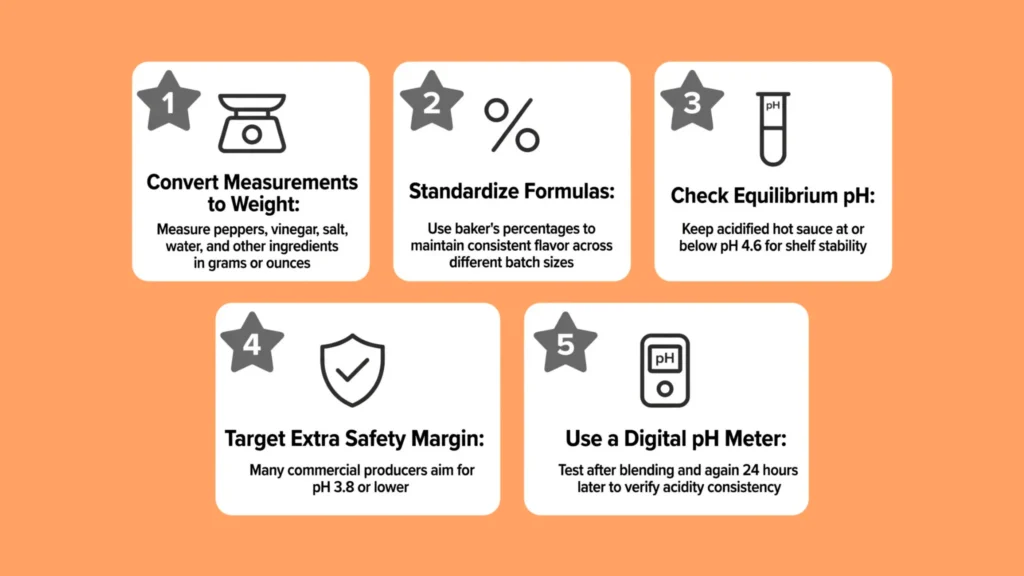
A home recipe relies on volume measurements like cups, tablespoons, and rough handfuls of fresh peppers. Commercial hot sauce production requires exact weight measurements in grams or ounces so every batch tastes identical and meets safety specifications.
Converting Volume to Weight
Peppers vary wildly in size, moisture content, and capsaicin levels from season to season. Weigh every single ingredient including vinegar, water, salt, aromatics, and fresh produce on a digital scale.
Converting your recipe into baker’s percentages (where each ingredient is expressed as a percentage of the total batch weight) allows you to scale a 1-liter test batch up to a 50-gallon kettle without losing flavor balance.
Testing pH and Shelf Stability
Measure your sauce at room temperature after blending, and test it again 24 hours later once the acids have fully penetrated any solid pepper particles. Professional shelf-life testing can also help determine how long your finished product maintains its safety, quality, and flavor under specified storage conditions.
Buy a calibrated digital pH meter rather than relying on paper test strips, which are not accurate enough for commercial food safety. Measure your sauce at room temperature after blending, and test it again 24 hours later once the acids have fully penetrated any solid pepper particles.
Legal and Food Safety Requirements
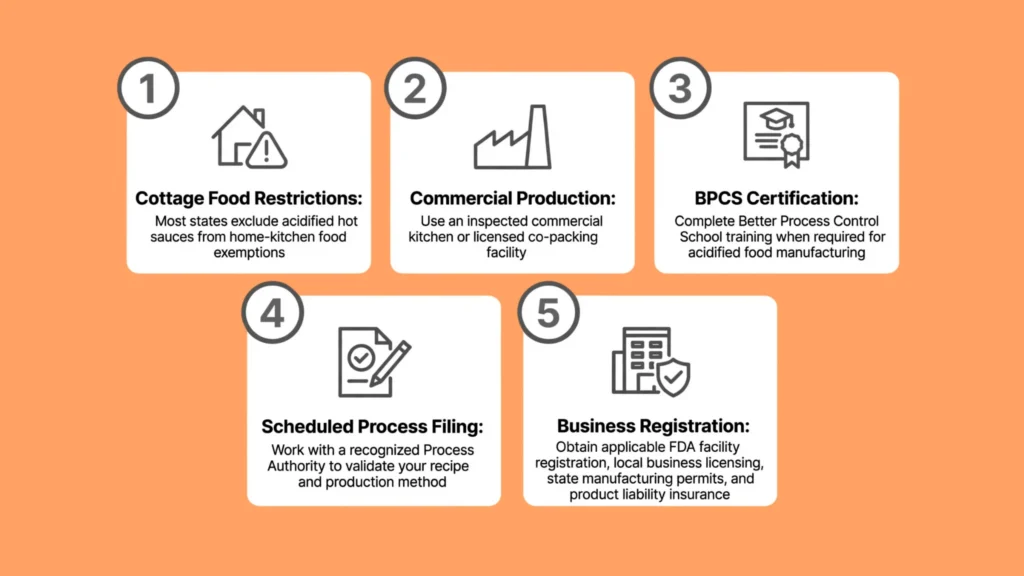
Before selling a single bottle, you must satisfy federal, state, and local food manufacturing laws. In the United States, acidified foods fall under the jurisdiction of the Food and Drug Administration (FDA) as well as state departments of agriculture or health.
Why Cottage Food Laws Rarely Apply
Cottage food laws allow entrepreneurs to make low-risk foods like baked goods, jams, and dry spice mixes in a home kitchen.
However, most states exclude acidified sauces, salsas, and fermented condiments from cottage food exemptions due to the risk of improper acidification. Verify your state’s specific rules before investing in equipment, as you will almost certainly need access to a licensed facility.
Essential Certifications and Registrations
Better Process Control School (BPCS): If you manufacture acidified foods yourself, at least one person on your team must complete an FDA-recognized BPCS course to understand thermal processing, pH control, and recordkeeping.
Scheduled Process Filing: You must submit your recipe and production method to a recognized Process Authority (often housed at a university food science department). They test your sauce and issue a Scheduled Process letter, which you then file with the FDA.
Facility Registration and Business Licensing: Register your production facility with the FDA, obtain a local business license, secure a state food manufacturer’s permit, and purchase product liability insurance.
Choosing Your Production Model: Small Batch vs. Co-Packing
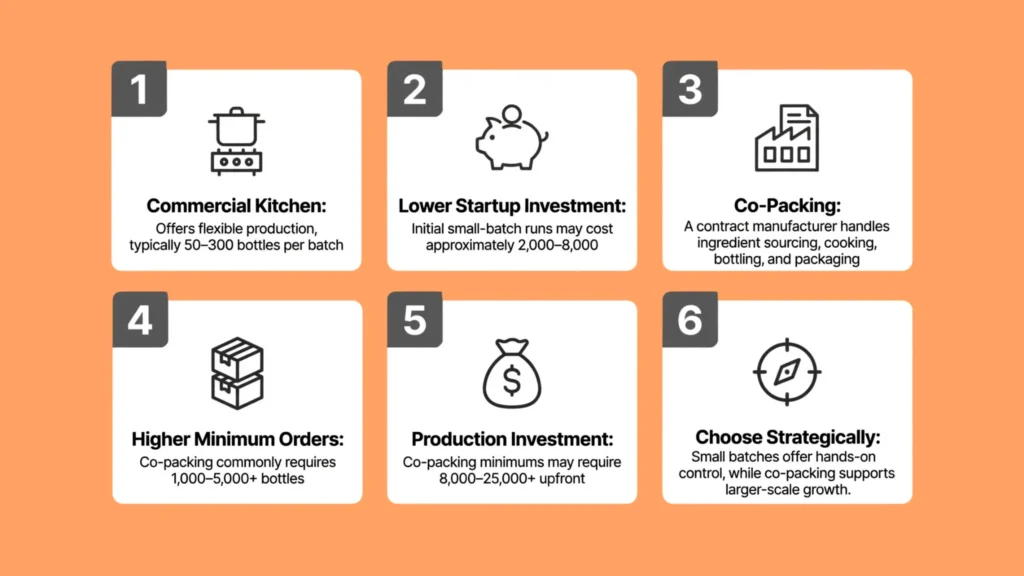
Once your recipe is validated and approved, you need a licensed space to make it. Most founders choose between renting commercial kitchen space for small batch sauce manufacturing or hiring a contract manufacturer (co-packer).
| Factor | Self-Manufacturing (Commercial Kitchen) | Co-Packing (Contract Manufacturer) |
| Upfront Cash Required | Lower ($2,000–$8,000 for initial runs) | Higher ($8,000–$25,000+ for minimums) |
| Minimum Order Quantity | Very flexible (50–300 bottles per batch) | High (typically 1,000–5,000+ bottles) |
| Time Commitment | High (you cook, bottle, label, and clean) | Low (you focus on sales and marketing) |
| Recipe Control | Complete hands-on control over every batch | Managed via strict spec sheets and QA |
| Cost Per Bottle | Higher ingredient and packaging unit costs | Lower unit costs through bulk purchasing |
Renting a Commissary or Shared Commercial Kitchen
A commissary kitchen rents certified commercial equipment such as steam-jacketed kettles, immersion blenders, and three-compartment sinks by the hour or shift. Choosing a licensed commercial kitchen allows food entrepreneurs to access professional equipment without investing heavily in their own manufacturing facility.
This route works well if you want to bootstrap your hot sauce business, test local demand at farmers markets, and keep startup risk low. The trade-off is physical labor: you handle every step from chopping peppers to sanitizing bottles and logging pH records.
Partnering With a Co-Packer
A co-packer takes your standardized recipe, sources bulk ingredients, cooks and bottles the sauce in their FDA-registered facility, and delivers finished cases ready for sale. Finding the right food co-packer requires evaluating production capabilities, food safety standards, minimum order quantities, and quality control procedures.
Understanding Sauce Bottling Costs and Pricing
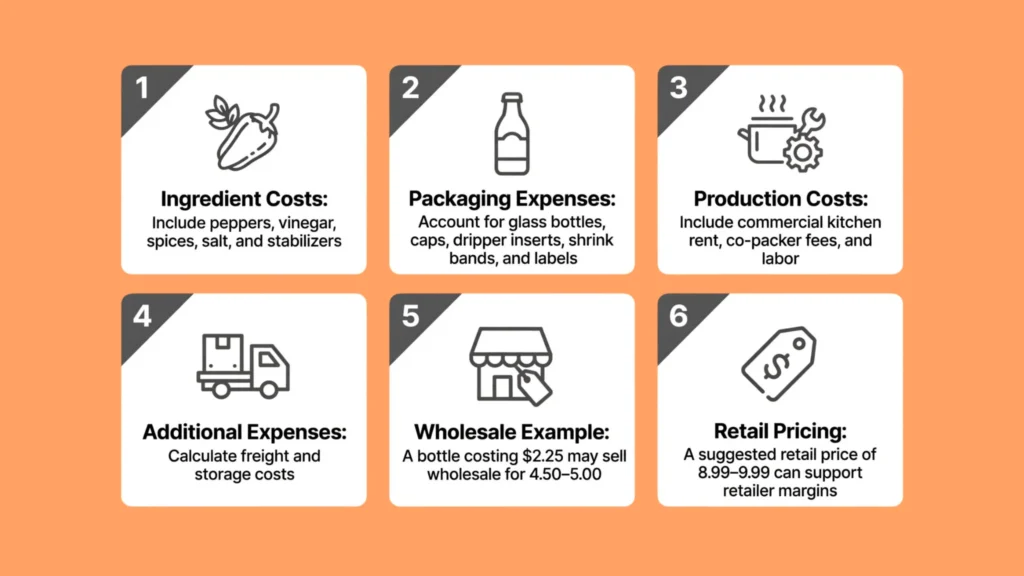
Accurate unit economics determine whether your brand survives past its first year. Many new founders underprice their bottles because they only calculate the cost of peppers and vinegar, forgetting packaging, labor, and distributor margins.
Breaking Down Cost of Goods Sold (COGS)
Your sauce bottling cost includes every physical component required to produce one sellable unit:
Ingredients: Fresh or mashed peppers, vinegar, spices, salt, and stabilizers like xanthan gum.
Primary Packaging: Glass woozy bottles (typically 5 oz), orifice reducers (dripper inserts), shrink bands for tamper evidence, and screw caps.
Labels: Waterproof, oil-resistant labels printed on synthetic materials like BOPP so vinegar drips do not ruin the ink.
Kitchen Time and Labor: Hourly commissary rent or co-packer filling fees, plus your own labor rate.
Freight and Storage: Shipping heavy glass bottles from suppliers to your kitchen and from your facility to customers.
Setting Wholesale and Retail Margins
A standard 5 oz bottle of craft hot sauce typically costs between $1.75 and $3.50 to produce in small batches. To sell through retail stores and distributors, build your pricing backward from the retail shelf price:
Cost of Goods Sold (COGS): $2.25 per bottle
Wholesale Price (to retailers): $4.50 to $5.00 per bottle (targeting a 50% gross margin)
Suggested Retail Price (MSRP): $8.99 to $9.99 per bottle (giving retailers their standard 45% to 50% markup)
If your production cost is $4.50 per bottle, you cannot profitably sell wholesale at $5.00. Keeping COGS low enough to support wholesale margins is essential even if you start by selling direct-to-consumer at full retail price.
Packaging, Labeling, and Branding Essentials
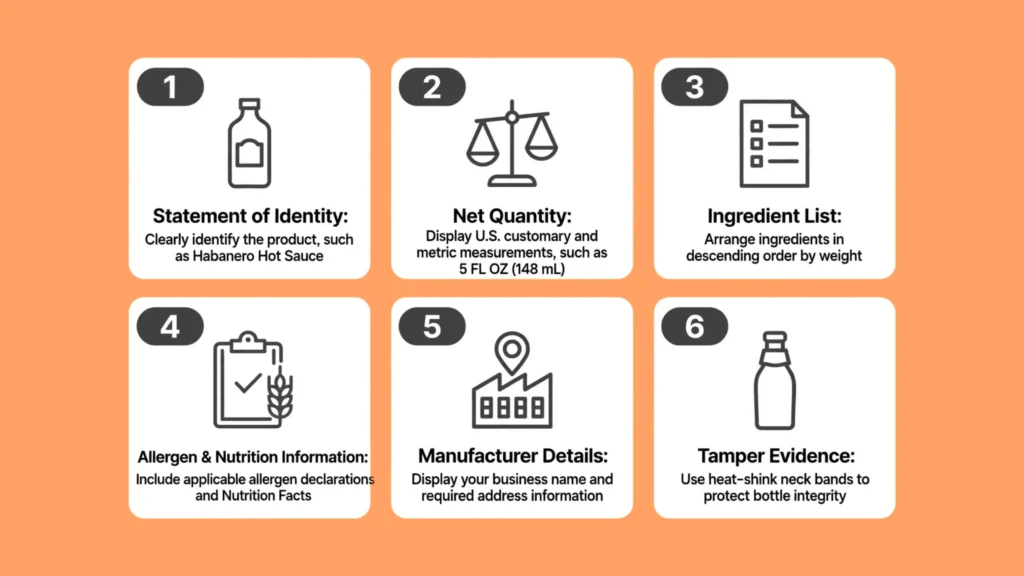
In a crowded condiment aisle, packaging communicates quality before a customer ever tastes the sauce. Your labels must balance visual appeal with strict regulatory compliance.
FDA Mandatory Label Elements
Every commercial food label must include specific information in designated locations and minimum font sizes. Understanding nutrition labeling requirements helps ensure your packaged product meets applicable regulatory standards and is ready for retail distribution.
Statement of Identity: The common name of the product (e.g., “Habanero Hot Sauce”) on the front display panel.
Net Quantity of Contents: Both metric and U.S. customary weight or fluid volume (e.g., “5 FL OZ (148 mL)”) in the bottom third of the front label.
Ingredient List: Listed in descending order by predominance of weight, including any sub-ingredients.
Allergen Declaration: Clear identification of major allergens if present.
Nutrition Facts Panel: Required once your business exceeds small-business exemption thresholds, though many retailers expect it from day one.
Manufacturer Name and Address: Your business name and physical street address (or city, state, and ZIP code if listed in a public directory).
Bottle Selection and Tamper Evidence
The classic 5 oz glass woozy bottle remains the industry standard because it fits standard bottling equipment, shipping dividers, and retail shelves. Always include a heat-shrink tamper-evident neck band over the cap. Most farmers markets, grocery buyers, and insurance providers require visible tamper protection on all bottled condiments.
Common Mistakes to Avoid When Launching
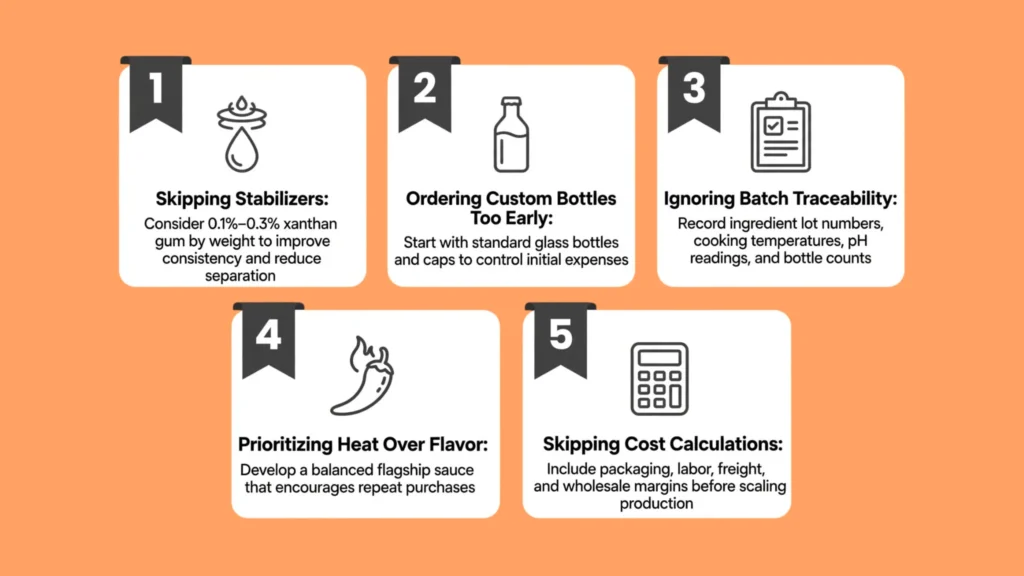
Skipping Xanthan Gum or Emulsifiers: Natural hot sauces made solely from peppers and vinegar often separate into a layer of watery liquid and thick pulp on the shelf. Adding a tiny amount (usually 0.1% to 0.3% by weight) of xanthan gum keeps the sauce uniform and improves pour consistency.
Ordering Custom Bottles Too Early: Stick to stock glass bottles and standard caps for your first few thousand units. Custom glass molds cost tens of thousands of dollars and complicate co-packer compatibility.
Ignoring Batch Traceability: Keep detailed batch logs recording ingredient lot numbers, cooking temperatures, equilibrium pH readings, and bottle counts. If a quality issue ever arises, lot codes printed on every bottle let you isolate a single batch rather than recalling your entire inventory.
Scaling Heat Over Flavor: Novelty ultra-hot sauces generate one-time impulse buys, while balanced, flavorful sauces drive repeat purchases. Build a flagship sauce people reach for every day before launching extreme-heat limited editions.
Frequently Asked Questions
How much does it cost to start a hot sauce business?
Starting a small-batch hot sauce brand out of a shared commercial kitchen typically costs between $3,000 and $10,000. This covers business registration, Better Process Control School certification, Process Authority testing, liability insurance, initial packaging supplies, and your first ingredient run. Working with a co-packer generally requires $10,000 to $25,000 or more to meet minimum order quantities.
Can I legally make and sell hot sauce from my home kitchen?
In most U.S. states, no. Because hot sauce is classified as an acidified food that carries a risk of botulism if improperly formulated, state cottage food laws almost universally prohibit making hot sauce in a residential kitchen for commercial sale. You must produce your sauce in an inspected commercial kitchen or licensed co-packing facility.
What pH level does hot sauce need to be shelf-stable?
The FDA requires acidified foods to maintain an equilibrium pH of 4.6 or below to prevent the growth of Clostridium botulinum. However, most commercial hot sauce makers and Process Authorities target a pH of 3.8 or lower to ensure safety, preserve color, and extend shelf life without refrigeration.
Do I need a nutrition label on my hot sauce?
Small businesses with fewer than 100 full-time employees and under 100,000 units sold annually may qualify for an FDA small-business nutrition labeling exemption, provided you file a notice with the FDA and make no nutrient claims on the bottle. Even when exempt, adding a Nutrition Facts panel is recommended because many specialty grocers require one before stocking your product.
How long does bottled hot sauce last on the shelf?
Properly acidified and hot-filled hot sauce typically has a shelf life of 18 to 36 months unopened. While high vinegar and salt content keep the product safe from spoilage long after opening, natural colors and bright pepper aromas gradually fade over time, which is why most brands print a two-year “Best By” date on the bottle.
Should I ferment my peppers or use fresh peppers with vinegar?
Both methods produce great sauces, but fresh-cooked vinegar sauces are faster and easier to scale when launching. Fresh peppers cooked with vinegar can be blended, bottled, and sold within days, whereas fermented pepper mashes require weeks or months of temperature-controlled storage and specialized vessels before bottling.
Final Thoughts
Launching a hot sauce business from a home recipe succeeds when culinary creativity meets disciplined manufacturing. Start by converting your kitchen notes into exact weights, verify your pH with a Process Authority, and calculate your true bottling costs including packaging, kitchen time, and wholesale margins before committing to large inventory runs.
By mastering food safety and unit economics in small batches first, you build a credible, compliant brand ready to grow from local markets onto retail shelves.
About The Author