Selling Packaged Food on Amazon and Etsy: Rules and Margins
Launching an e-commerce food brand can be exceptionally lucrative, but navigating the compliance requirements and operational costs of selling food online on Amazon and Etsy requires a clear strategy. While both platforms offer access to millions of active shoppers, they serve fundamentally different market segments, enforce distinct onboarding rules, and produce vastly different profit margins.
Amazon operates as a high-volume marketplace built around shelf-stable staples, dietary brands, and consumer packaged goods (CPG). Etsy, on the other hand, is an artisan destination designed for small-batch producers, handcrafted treats, and customized gift items.
Succeeding on either channel demands a firm grasp of regulatory compliance, platform-specific policies, and unit economics, particularly when building an online food business designed to reach customers beyond local markets.
Regulatory and Compliance Requirements for Online Food Sellers
Before opening an online store on either platform, food business operators must establish legal compliance at the local, state, and federal levels. Selling edible products carries strict liability, making regulatory adherence non-negotiable.
Federal and State Regulations
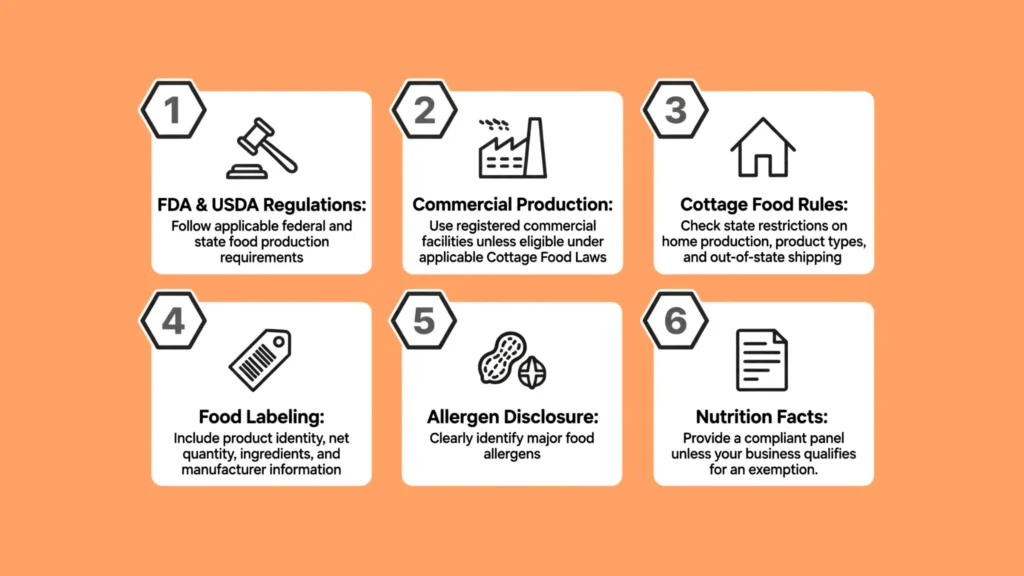
In the United States, commercial food production is governed by the Food and Drug Administration (FDA) and the Department of Agriculture (USDA), making it essential for entrepreneurs to understand applicable food business regulations before launching.
All packaged food sold online must be produced in a registered commercial facility, unless governed by state Cottage Food Laws.
Cottage Food Laws allow individuals to prepare non-potentially hazardous foods—such as baked goods, jams, and dry spice blends—in home kitchens for direct sale. However, cottage food regulations vary by state, and many restrict out-of-state shipping, which directly impacts online sales channels.
Essential Food Labeling Standards
Every packaged food item must comply with standard FDA labeling guidelines, including applicable nutrition labeling requirements, ingredient declarations, and allergen disclosures. Required label elements include:
Statement of Identity: The common or usual name of the product.
Net Quantity of Contents: Expressed in both U.S. Customary and Metric units.
Ingredient List: Listed in descending order of predominance by weight.
Allergen Disclosures: Clear identification of major food allergens (milk, eggs, fish, crustacean shellfish, tree nuts, peanuts, wheat, soybeans, and sesame).
Manufacturer Info: Name and place of business of the manufacturer, packer, or distributor.
Nutrition Facts Panel: Required unless qualified for small-business exemptions.
Amazon Grocery Seller Requirements and Platform Rules
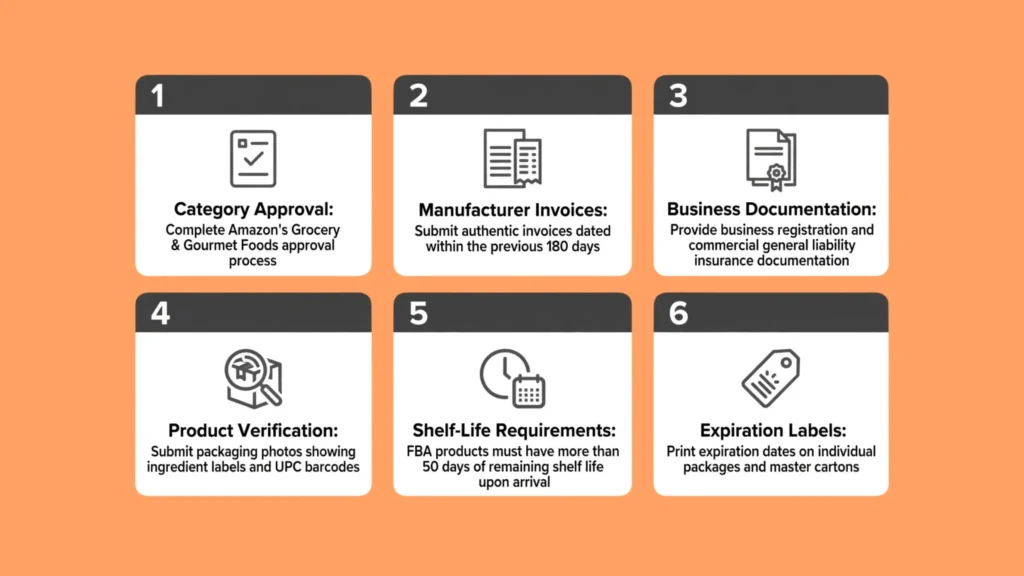
Selling consumable products within Amazon’s Grocery & Gourmet Foods category requires explicit approval and adherence to strict operational standards to protect customer safety.
Category Ungating and Verification
Food is a restricted category on Amazon. To obtain selling privileges, sellers must complete the category ungating process. This typically requires submitting authentic invoices from an FDA-registered manufacturer or distributor dated within the last 180 days, documentation verifying business registration and commercial general liability insurance, and photos showing product packaging with clear ingredient labels and UPC barcodes.
Shelf Life and Expiration Date Policies
Amazon enforces rigid inventory rules for perishable and shelf-stable goods:
Minimum Remaining Shelf Life: Products sent to Fulfillment by Amazon (FBA) must have a remaining shelf life greater than 50 days at the time of receipt.
Expiration Formatting: Expiration dates must be clearly printed on both the master carton and individual packaging in MM-DD-YYYY or MM-YYYY format.
Meltable Inventory: Heat-sensitive items (such as chocolates) are only accepted at FBA warehouses between October 16 and April 30.
Etsy Food Rules and Guidelines
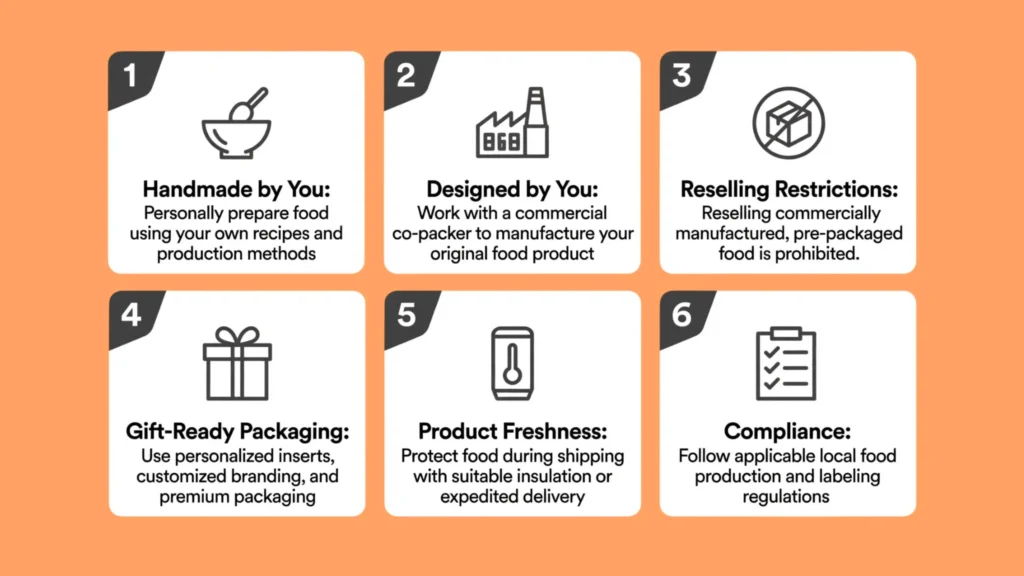
Etsy maintains a specialized marketplace environment tailored to handmade goods and small-scale food creators. While Etsy’s seller onboarding is more accessible than Amazon’s, its category rules are strictly enforced.
Qualifying as a Handmade Food Seller
To list food items on Etsy, the products must qualify under Etsy’s Handmade Policy. Food sellers must fall into one of two categories:
Handmade by You: You personally craft the food items using your own recipes and production methods.
Designed by You: You contract a commercial co-packer to produce custom food items using your unique, original recipe.
Reselling pre-packaged commercial food items manufactured by third parties is explicitly prohibited on Etsy.
Etsy Packaging and Shipping Expectations
Etsy buyers expect curated, high-touch packaging, making creative food packaging ideas particularly valuable for small-batch producers looking to create memorable unboxing experiences.
Because many Etsy food purchases are intended as gifts, sellers benefit from investing in personalized unboxing experiences, customized inserts, and premium packaging materials. Sellers must ensure that all items arrive fresh and intact, using appropriate thermal insulation or expedited shipping services when handling perishable artisan goods.
Platform Comparison: Amazon vs. Etsy for Food Sellers
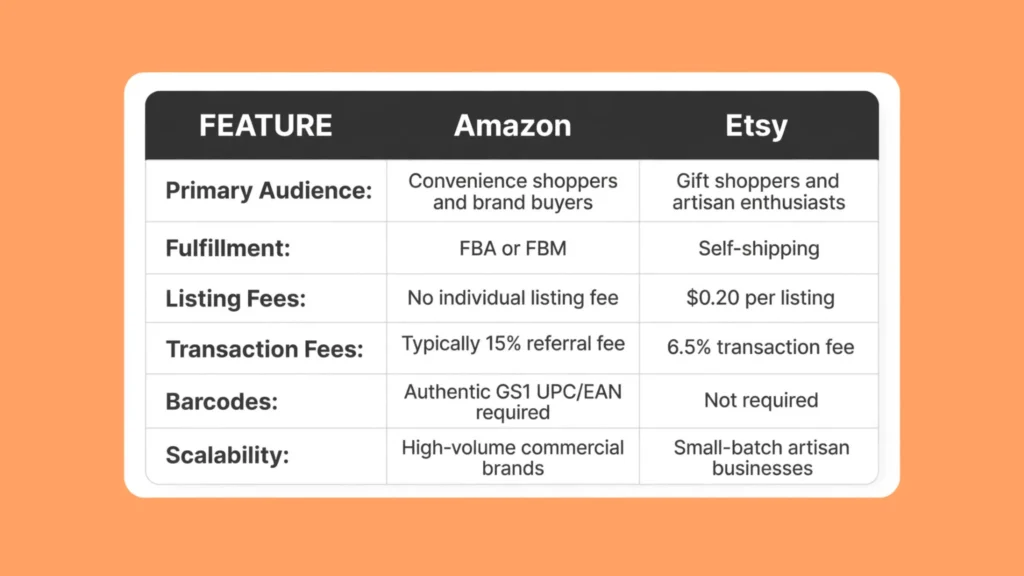
Choosing the right platform depends on your business model, production capacity, and target customer demographic.
| Feature / Metric | Amazon (Grocery & Gourmet) | Etsy (Food & Drink) |
| Primary Audience | Convenience shoppers, brand buyers | Gift shoppers, artisan enthusiasts |
| Fulfillment Options | FBA (Fulfillment by Amazon) or FBM | Merchant Fulfillment (Self-shipping) |
| Listing Fees | No listing fee ($39.99/mo plan) | $0.20 per listing (renews every 4 mos) |
| Transaction Fees | 15% referral fee for Grocery | 6.5% transaction fee + payment processing |
| Barcodes Required | GS1 UPC/EAN barcode mandatory | Not required |
| Scalability | High (Built for mass scale) | Moderate (Constrained by batch size) |
Financial Analysis: Online Food Margins and Cost Structures
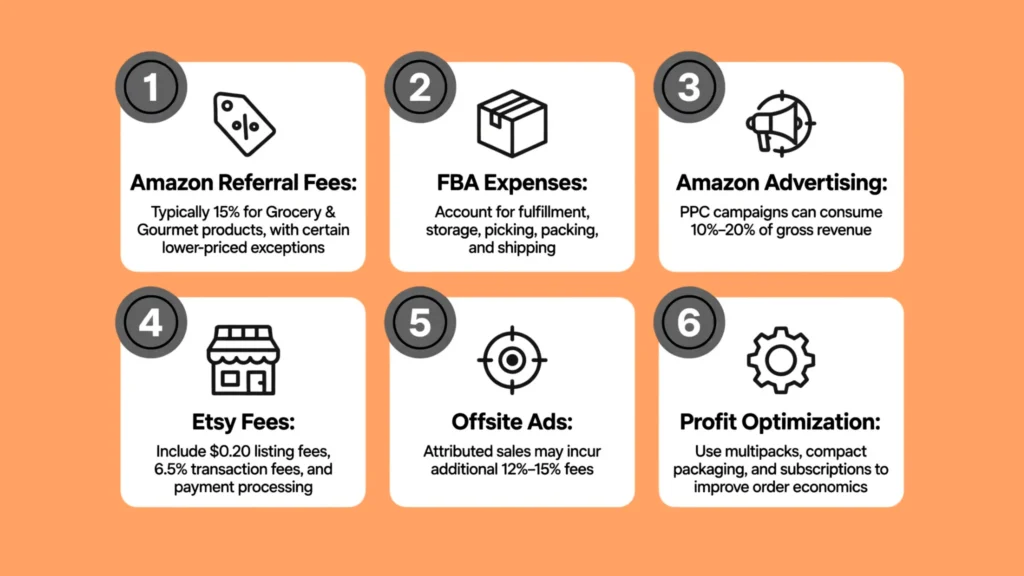
Maintaining healthy online food margins requires accounting for all fulfillment, packaging, platform, and marketing costs. Gross margins in consumer packaged goods typically range between 40% and 60%, but net margins heavily depend on the sales channel used.
Cost Breakdown on Amazon
Selling on Amazon involves several recurring fees:
Referral Fee: Amazon charges a standard 15% referral fee on Grocery & Gourmet items (reduced to 8% for items priced under $10 in certain subcategories).
FBA Pick & Pack Fees: Costs depend on weight and dimensions. FBA fees cover storage, picking, packing, and shipping.
Storage Fees: Monthly storage costs per cubic foot, with long-term storage fees applied to unsold inventory after 180+ days.
Advertising (Sponsored Products): Customer acquisition on Amazon relies heavily on Pay-Per-Click (PPC) advertising, which can consume 10% to 20% of gross revenue.
Cost Breakdown on Etsy
Selling on Etsy features lower upfront overhead, though payment costs accumulate:
Listing Fee: $0.20 per item listing.
Transaction Fee: 6.5% of the total item price (including shipping charged to the buyer).
Payment Processing: Typically 3% + $0.25 per transaction (varies slightly by region).
Offsite Ads Fee: Etsy automatically advertises items across external channels. If a sale results from an Offsite Ad, Etsy charges a 12% to 15% fee on that transaction.
Optimizing Unit Economics
To preserve margins, food brands should consider the following strategy metrics:
Multipacks and Bundling: Selling single units under $15 often erodes profit margins due to flat pick-and-pack fulfillment costs. Bundle items into 3-packs, 6-packs, or variety kits to raise the Average Order Value (AOV).
Dimensional Weight Control: Design packaging to fit compact shipping tiers, reducing fulfillment costs.
Subscriptions: Leverage Amazon’s Subscribe & Save program to increase Customer Lifetime Value (LTV) and stabilize recurring order volume.
Common Mistakes to Avoid When Selling Food Online
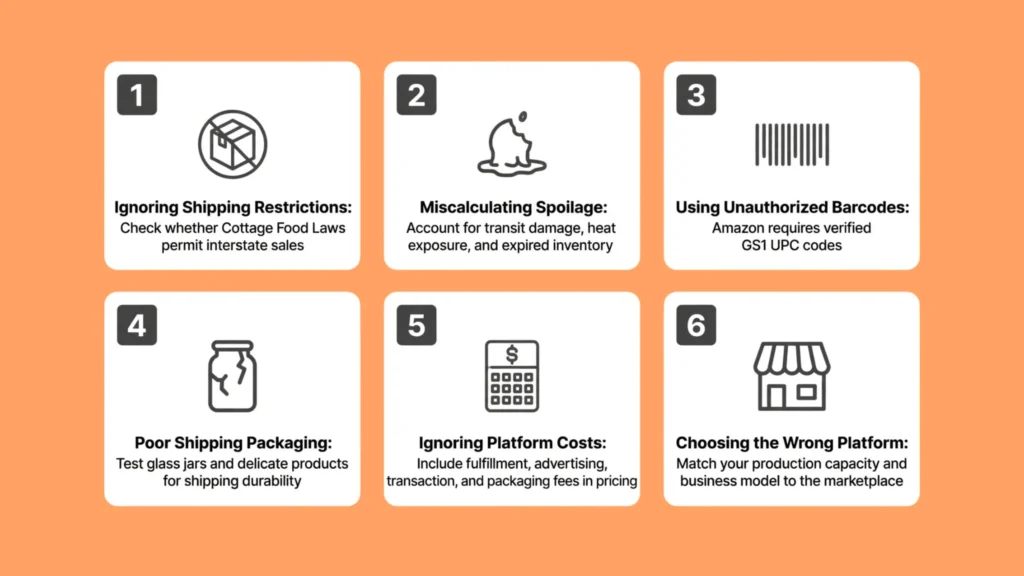
Ignoring State Shipping Limitations: Operating under home-kitchen Cottage Food Laws while shipping products across state lines violates federal regulations. Ensure your facility matches your distribution scale.
Miscalculating Perishable Loss: Failing to factor in transit spoilage, heat damage, or expired inventory disposal destroys net profitability.
Using Non-GS1 Barcodes: Amazon requires verified GS1 UPC barcodes. Using cheap third-party reseller barcodes can result in listing suppression or account suspension.
Inadequate Packaging for Transit: Food items face rough handling during transit. Glass jars and delicate baked goods require rigorous drop-testing before launch.
Frequently Asked Questions
Can I sell homemade food on Amazon?
No. Amazon requires all food products to be produced in licensed commercial kitchens or FDA-registered manufacturing facilities. Products made under home-based Cottage Food Laws do not qualify for sale on Amazon.
Do I need an FDA registration to sell food on Etsy?
It depends on your production scale and local regulations. If you produce food in a registered commercial facility, FDA regulations apply. If you operate strictly under local Cottage Food Laws, you must comply with your state’s specific home-kitchen licensing and labeling requirements.
What is the average profit margin for selling packaged food online?
Gross profit margins for packaged food typically range from 40% to 65%. However, after factoring in platform referral fees, shipping costs, packaging, and marketing expenditures, average net profit margins usually land between 10% and 20%.
Do I need UPC barcodes to sell food on Etsy?
No, Etsy does not require UPC barcodes to create product listings. Amazon, however, strictly requires authentic GS1 UPC barcodes for every distinct item variant.
How do I handle expiration dates when using Amazon FBA?
All inventory sent to Amazon FBA must display an expiration date on both the master carton and individual packaging. Amazon requires items to have a minimum remaining shelf life of more than 50 days upon arrival at the fulfillment center.
Final Thoughts
Selling packaged food online across Amazon and Etsy opens up powerful revenue streams, but each platform targets a distinct business model. Amazon excels at scaling commercial CPG brands that rely on automated fulfillment, standard packaging, and high volume. Etsy provides the ideal launching pad for artisan producers crafting small-batch treats with personalized branding.
By securing proper commercial licensing, ensuring flawless labeling compliance, and structuring product pricing to protect your net margins, you can build a sustainable, profitable online food business.
About The Author