Catering Pricing: How to Quote Per Head Without Losing Money
Setting your catering pricing per head is one of the most critical decisions you will make for your food service business. Quote too high, and potential clients will book a competitor. Quote too low, and you will find yourself working a 14-hour event only to discover that food inflation, last-minute staff overtime, and hidden operational expenses wiped out your entire profit.
For entrepreneurs starting a catering business, understanding these expenses early helps establish sustainable pricing strategies and avoid unnecessary financial losses. Mastering this balance ensures every event you cater covers its expenses and yields a healthy, sustainable profit.
The Basics of Catering Pricaing Per Head
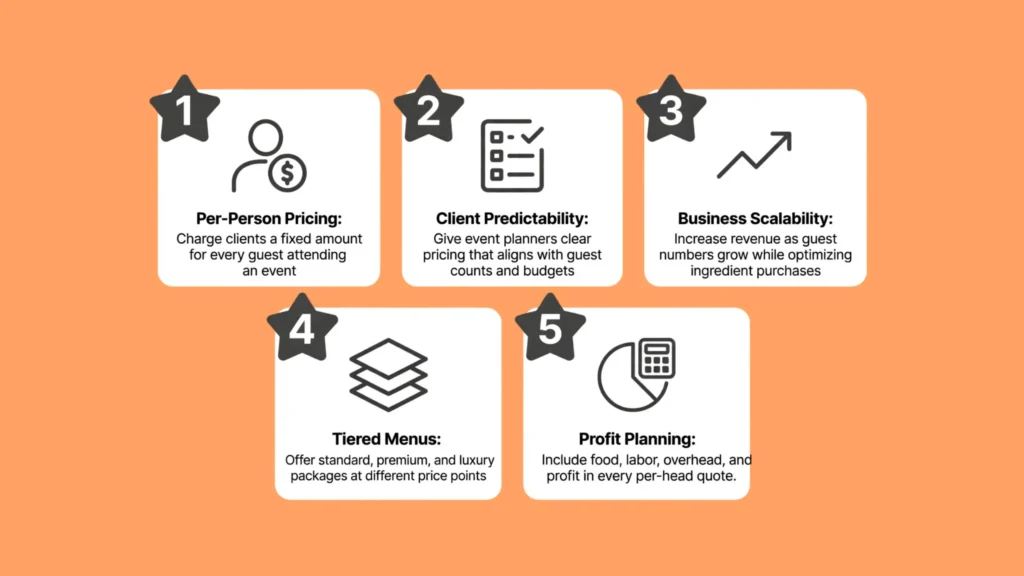
At its core, catering pricing per head (also called per-person pricing) is a model where clients pay a set fee for each guest attending the event.
Unlike fixed-fee catering, where a client pays a flat rate for a generic spread, per-head pricing scales automatically with guest counts. However, offering a simple per-person rate to a client requires a firm grasp of the underlying expenses built into that single number.
Why the Per-Head Model Works Best
Predictability for Clients: Event planners and couples love per-head quotes because they align directly with their guest lists and budget spreadsheets.
Scalability for Caterers: As guest counts increase, your overall revenue scales linearly, allowing you to bulk-purchase ingredients and optimize staff hours.
Clear Value Proposition: It allows you to offer tier-based menus (e.g., standard, premium, luxury) with transparent pricing levels.
The Core Formulas: Breakdown of Event Food Costing
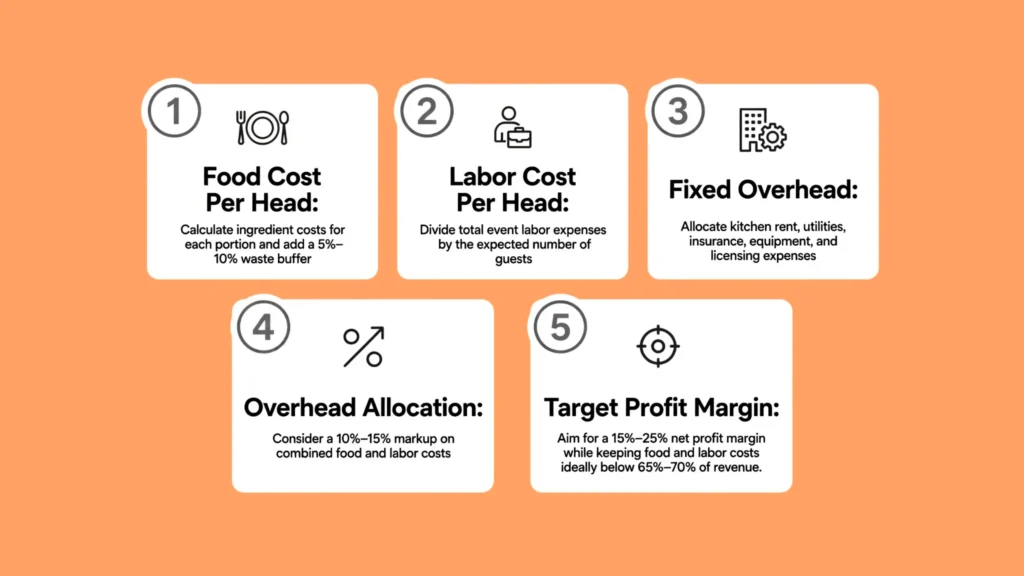
Before you present a final figure to a client, you need to conduct a thorough catering quote calculation. A reliable per-head price is composed of four distinct layers:
1. Raw Food Cost Per Head
Understanding your overall food cost percentage also helps you identify ingredient waste, maintain consistent portion sizes, and set profitable menu prices.
Example: If a chicken entree, side dish, salad, and dessert cost $8.50 per person in raw ingredients, your base food cost is $8.50.
2. Labor Cost Per Head
Labor encompasses more than just the servers working the banquet hall floor. It includes kitchen prep time, loading, travel, setup, service, and post-event breakdown.
Multiply total estimated staff hours by their hourly rates, then divide by the expected guest count:
3. Fixed Overhead Contribution
When calculating your monthly overhead, account for commercial kitchen rental costs alongside equipment leases, utilities, insurance, and other recurring expenses.
To account for these, divide your total monthly overhead by the average number of guests you serve per month, or add a standard percentage markup (typically 10% to 15%) to your combined food and labor base.
4. Catering Margin Target
Comparing your targets with typical small business profit margins can provide additional context when evaluating your catering operation’s financial performance.
A healthy caterer generally targets a net profit margin of 15% to 25%, though prime cost (food + labor) should ideally stay under 65% to 70% of total revenue.
Step-by-Step: How to Calculate a Per-Head Catering Quote
Here is how to put these calculations into practice for a real-world catering scenario.
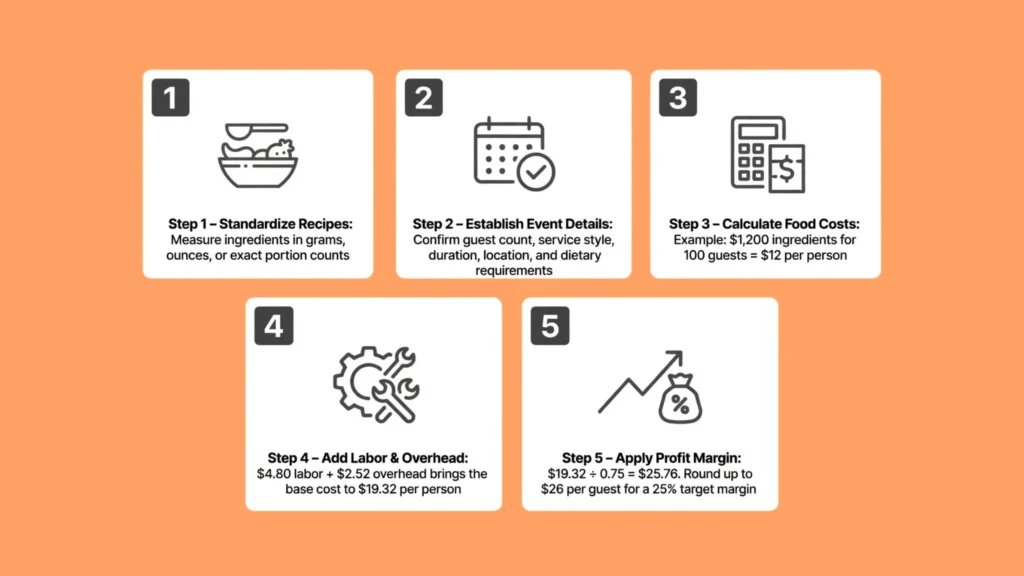
Step 1: Standardize Your Recipes
You cannot quote per head accurately if your kitchen measures ingredients by eye. Standardize every recipe down to grams, ounces, or exact portion counts so your raw ingredient costs remain consistent across events.
Step 2: Establish the Event Profile
Gather key details from the prospective client before providing any pricing:
Total estimated guest count
Service style (plated dinner, buffet, family-style, food stations, or passed hors d’oeuvres)
Duration and location of the event
Dietary accommodations required
Step 3: Run the Numbers (Sample Scenario)
Imagine you are quoting a buffet dinner for 100 guests:
| Expense Category | Total Cost | Cost Per Head |
| Raw Ingredients (including 5% waste buffer) | $1,200 | $12.00 |
| Kitchen Prep & On-Site Labor (4 staff for 6 hours @ $20/hr) | $480 | $4.80 |
| Kitchen Operations & Overhead (15% allocation) | $252 | $2.52 |
| Total Base Cost Per Head | $1,932 | $19.32 |
To achieve a 25% target net profit margin, use the margin formula:
Rounding up gives a final quote of $26.00 per head, generating total revenue of $2,600 and a net profit of $668.
Service Styles and Their Impact on Per-Head Pricing
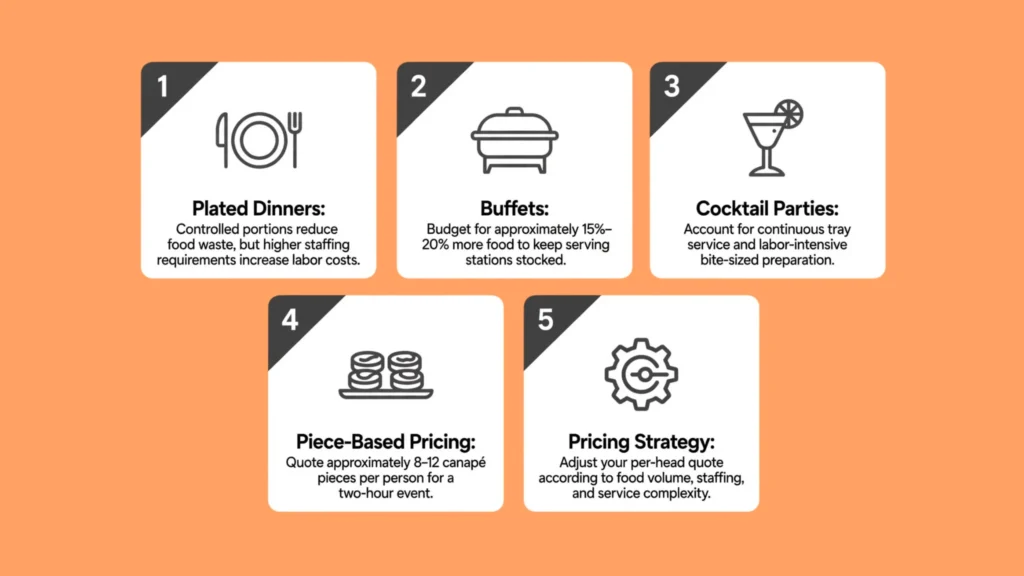
The service format dramatically alters your labor-to-food ratio. A menu that looks inexpensive on paper can quickly become loss-making if the service style requires double the staffing.
Plated Dinners
Food Cost: Lower to Moderate (controlled portions, predictable food quantities).
Labor Cost: Very High (requires a large team of culinary finish cooks and trained banquet servers).
Pricing Adjustment: Charge a higher per-head premium to cover labor intensity.
Buffets
Food Cost: Higher (requires 15% to 20% more food volume to ensure pans look full throughout service).
Labor Cost: Moderate (fewer servers required on the floor).
Pricing Adjustment: Factor larger food volumes into your base ingredient calculation.
Cocktail Parties & Passed Canapés
Food Cost: Moderate.
Labor Cost: High (requires continuous tray-passing and complex bite-sized prep work).
Pricing Adjustment: Quote based on piece counts per head (e.g., 8–12 pieces per person for a 2-hour event).
Common Mistakes That Erode Catering Profit Margins
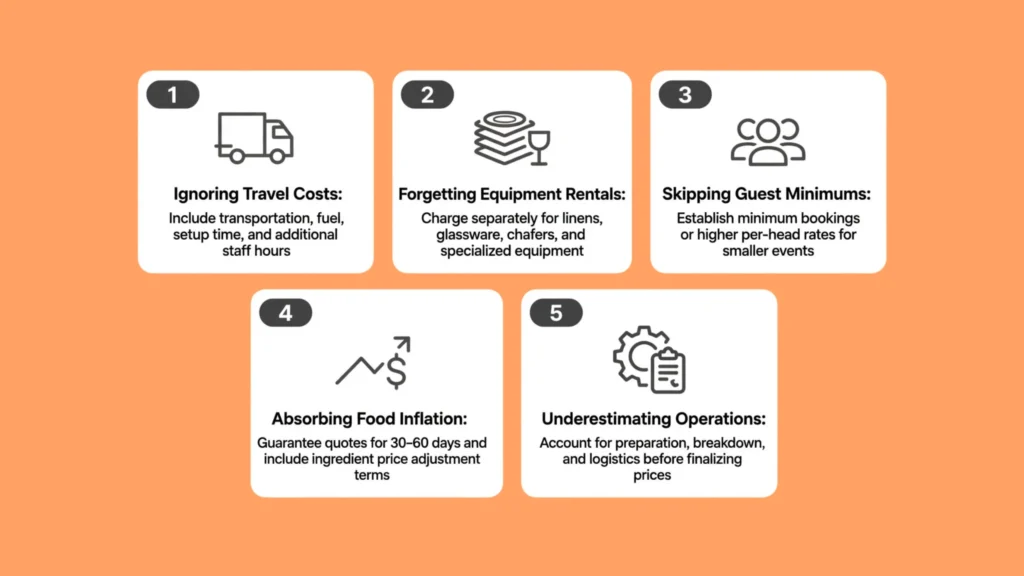
Even experienced caterers fall into pricing traps that strip away profitability. Protect your business by steering clear of these common errors:
Ignoring Travel and Setup Logistics:Similar cost-control principles apply to other mobile food operations, where tracking food service operating expenses such as fuel, labor, equipment maintenance, and supplies is essential for protecting profitability. Always include a separate travel fee or build destination logistics directly into the per-head quote.
Forgetting Equipment and Rentals: If an event requires specialized rentals (linens, glassware, warming chafers, or outdoor cooking equipment), list these items separately or add an equipment surcharge. Never absorb rental costs into your menu price.
Failing to Set Minimum Guest Counts: Fixed operational costs remain the same whether you cater for 20 people or 100 people. Establish a strict guest minimum (e.g., minimum 30 guests) or charge a sliding-scale per-head price for smaller groups.
Absorbing Inflationary Ingredient Spikes: Food prices fluctuate continuously. Include a clause in your contracts stating that quotes are guaranteed for 30 to 60 days, after which ingredient costs may be adjusted based on market rates.
Frequently Asked Questions
What is a typical catering margin?
Most successful catering businesses operate on a gross profit margin of 60% to 70% and a net profit margin of 15% to 25% after all labor, food costs, overhead, and taxes are paid.
Should I include beverages in my per-head food quote?
It is best practice to keep beverage packages separate from food packages. Offer tiered beverage add-ons (e.g., non-alcoholic streams, basic bar, premium bar) at their own distinct per-head rates to prevent beverage costs from eating into food margins.
How do guest count minimums work?
Guest count minimums protect caterers from taking on low-volume events that fail to cover fixed setup and prep costs. If a client falls below your minimum requirement (e.g., 40 guests), you can either charge for the minimum headcount or increase the individual per-head price to preserve profitability.
Is service charge the same as a tip or gratuity?
No. A service charge (typically 18% to 22%) is an administrative fee added to the invoice to cover background administrative labor, insurance, wear-and-tear on equipment, and operational overhead. Gratuities are voluntary tips paid directly to service staff. Be sure to clarify this distinction on client proposals.
How far in advance should clients confirm their final head count?
Require a final, non-refundable guest count 7 to 14 days prior to the event date. This provides adequate time to order ingredients in exact quantities without risking over-purchasing or food waste.
Final Thoughts
Accurate catering pricing per head comes down to knowing your exact numbers. By standardizing your recipes, accounting for total staff hours, allocating fixed overhead expenses, and building in a firm net profit margin, you eliminate guesswork from your proposals.
Clear, transparent quoting builds trust with clients while protecting your bottom line, ensuring your catering business remains profitable and resilient with every event you serve.
About The Author