Finding the Best Business Bank Account for Your Startup: A Founder’s Guide
Key Takeaways
No-Fee Modern Checking: Modern startup accounts offer zero dollar monthly maintenance and no transaction fees.
Separation Protects Liability: Keeping personal and business funds apart preserves legal protections.
Earn Yield on Idle Cash: High-yielding treasury management lets startups earn interest on working capital.
Budgeting Sub-Accounts: Digital platforms let you bucket funds easily for taxes, payroll, and profits.
Are you still mixing personal expenses with your brand-new startup’s finances? Opening a dedicated account is one of the most important first steps you can take as a founder. The right account keeps your books organized, simplifies tax prep, and protects your business entity status. Choosing the best business bank account comes down to finding low fees, great integrations, and tools that help your cash flow grow.
At reliablestratup.com, we regularly track how modern financial platforms serve new companies so you can pick the right banking setup with total confidence.
Choosing the best business bank account for startups means picking a partner that offers zero dollar monthly fees, smooth accounting integrations, and high-yield savings. In 2026, modern platforms like Mercury, Relay, and Bluevine dominate the space with flexible digital features, extended FDIC coverage, and sub-accounts for easy budgeting. Picking the right setup keeps your operational cash organized and growing.
Why Every Startup Needs a Business Checking Account Early
Have you ever wondered what happens if you pay a company vendor using your personal debit card? Mixing funds breaks down your corporate veil, a common legal mistake that can put your personal assets at risk if legal trouble ever arises. Beyond legal protection, having a dedicated business checking account makes your venture look professional to investors and clients alike.
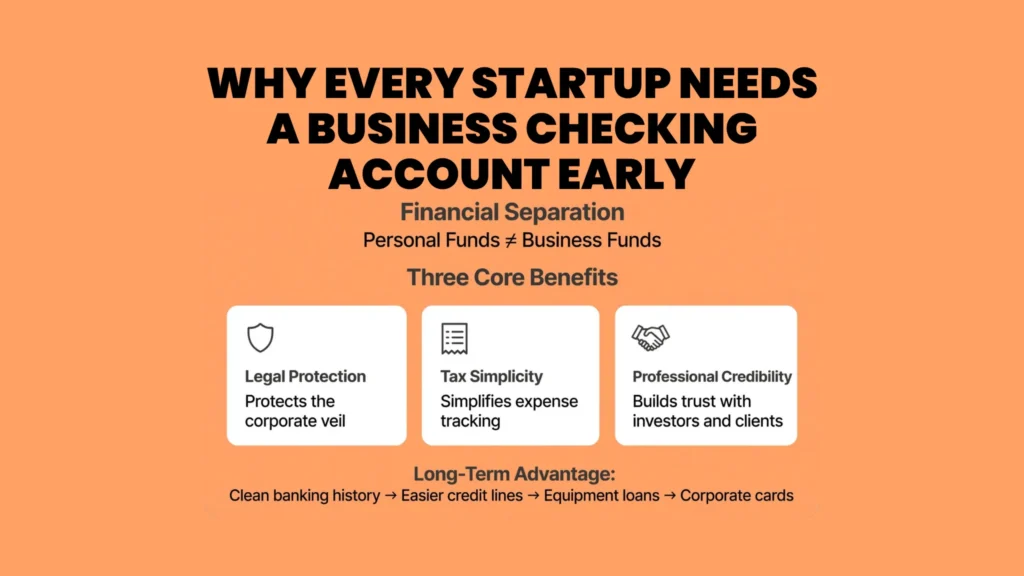
A separate account makes tax season significantly easier. You do not have to spend hours digging through receipts to figure out which dinner was a personal meal and which was a business meeting. Modern platforms sync directly with accounting software like QuickBooks or Xero to keep your numbers clean.
Starting early with a solid small business bank account establishes a financial history for your company. This track record becomes vital when you want to apply for credit lines, equipment loans, or corporate cards down the road.
Setting up a dedicated business checking account also creates a clean financial trail that makes audits straightforward. When your personal and business transactions are tangled together, proving business deductions to tax authorities becomes a massive headache. Separating your money right from day one ensures that every deductible expense is clearly documented and backed by clean bank statements.
Furthermore, investors and venture capital firms will insist on seeing dedicated corporate accounts before handing over seed funding. They want to know that their capital is going straight into a controlled environment designed specifically for company growth. Having a clean small business bank account ready shows investors that you treat your startup as a serious enterprise rather than a hobby.
Key Benefits of Early Financial Separation
Separating your personal and commercial finances provides three foundational benefits for every new founder.
Legal Protection: Preserves your corporate veil to keep your personal assets safe if your business faces legal trouble.
Tax Simplicity: Automates tracking for business deductions without requiring manual expense sorting during tax season.
Professional Credibility: Builds confidence with vendors, clients, and future investors from day one.
Top Platforms for Startup Banking Compared
Finding the right partner depends on how your team operates daily. Some companies need physical branches to deposit cash, while online-first tech teams want treasury yield on venture funds.
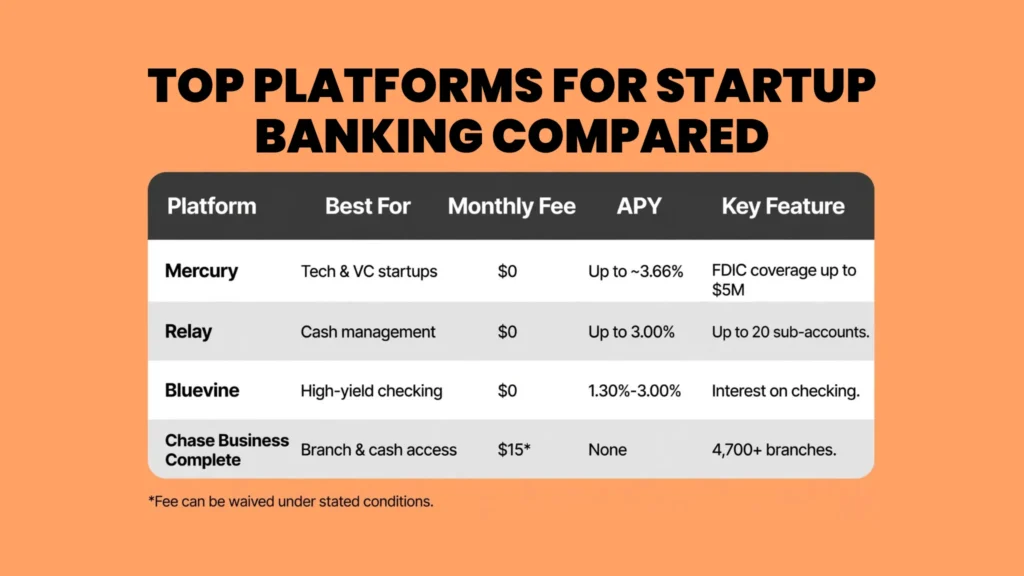
| Banking Platform | Best For | Monthly Fee | APY Offered | Key Features |
| Mercury | Tech & VC-backed startups | $0 | Up to ~3.66% on Treasury | Extended FDIC up to $5M, zero minimum balance |
| Relay | Multi-account cash management | $0 (Starter plan) | Up to 3.00% on savings | Up to 20 sub-accounts, team card controls |
| Bluevine | High-yield checking | $0 (Standard plan) | Up to 1.30%–3.00% | Interest on checking, optional credit line |
| Chase Business Complete | Branch access & cash deposits | $15 (waivable) | None | 4,700+ physical branches, card processing |
Mercury: Built for Tech and Digital Founders
If you run a tech company or plan to raise capital, Mercury is often a top pick. They offer zero monthly maintenance fees, free domestic ACH transfers, and smooth digital workflows. Their treasury products allow teams holding larger balances to earn competitive returns on idle cash. Modern software startups love the sleek interface and custom API controls that allow developers to automate payment triggers directly from their software products.
Relay: Master Your Operational Cash Flow
Relay shines for founders who like organizing cash into dedicated buckets. You can open up to 20 individual checking accounts under one main login. This structure makes it easy to set money aside for payroll, taxes, and quarterly profits. Being able to assign specific virtual Visa debit cards to employees with strict spending caps means you never have to worry about rogue team expenses again.
Bluevine: Earning Yield Directly on Checking
Want your main working capital balance to earn interest without constantly moving money into savings? Bluevine provides an impressive APY on checking balances for users who hit simple debit or deposit activity criteria each month. This platform is ideal for growing service agencies and online retail stores that maintain high working capital balances throughout the month.
Chase Business Complete: Traditional Security and Cash Support
For startups that accept cash payments, deal with physical checks, or prefer face-to-face service, Chase remains a standout option. With over 4,700 physical locations across the country, you get the security of a massive traditional bank alongside integrated payment processing tools. While there is a monthly maintenance fee, it can easily be waived by maintaining a minimum daily balance.
At reliablestratup.com, we generally recommend listing your top three operational features before committing to any single platform.
Detailed Evaluation of Modern Financial Features
Choosing between online fintech platforms and traditional legacy banks requires understanding what each option brings to the table. Modern fintech providers focus on digital speed, automated software integrations, and yield generation on idle balances. Legacy banks offer physical branch networks, in-person teller interactions, and broad lending options like equipment loans and commercial mortgages.
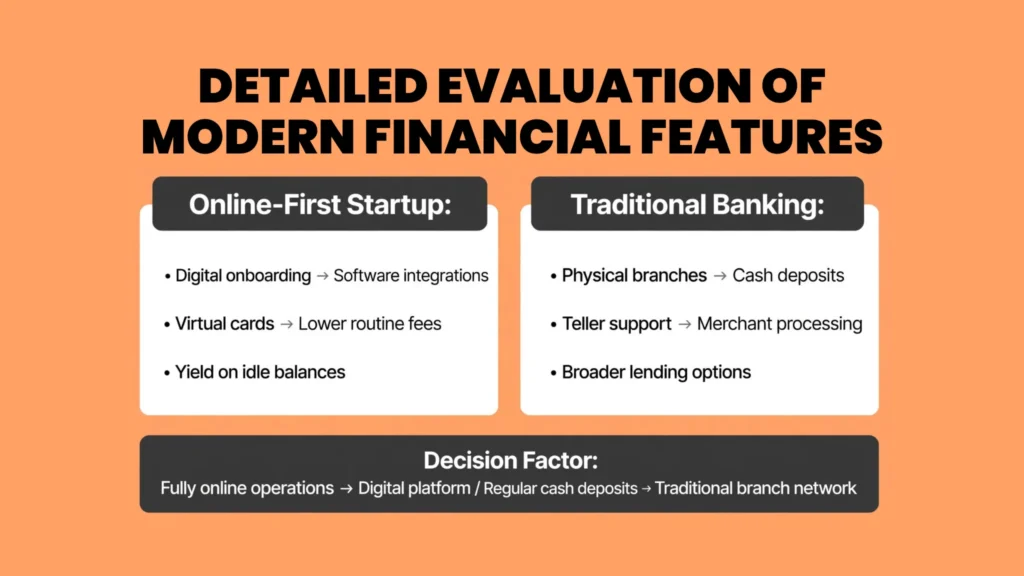
If your business operates entirely online, a digital platform generally offers a faster onboarding experience and lower overall fees. You can issue virtual debit cards instantly to remote contract workers, track subscriptions in real-time, and transfer funds without paying wire fees. On the other hand, if your operations require regular cash deposits, physical safe deposit access, or specialized merchant processing, picking a traditional bank with local branches remains a necessary move.
What to Look for in a Startup Banking Partner
Not all startup banking platforms are built the same way. What works well for a local restaurant might not fit a remote software team. Focusing on a few core areas helps you avoid hidden costs down the road.
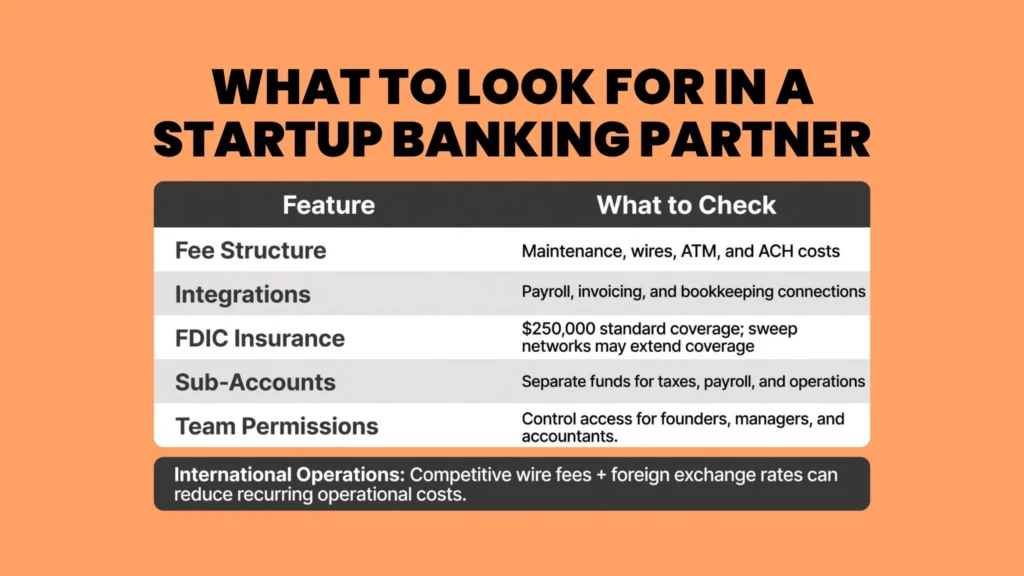
Fee Structures: Watch out for monthly account maintenance fees, wire transfer charges, and out-of-network ATM costs. Modern platforms usually offer zero dollar monthly fees for standard digital services.
Integrations: Check if the business checking account connects smoothly to your invoicing app, payroll platform, and bookkeeping tools. Direct integrations save hours of manual data entry every month.
FDIC Insurance Limits: Standard FDIC insurance covers up to $250,000 per institution. Many modern platforms use sweep networks across multiple partner banks to extend coverage into millions of dollars.
Sub-Accounts and Issuing Cards: Look for platforms that let you create virtual debit cards with spending limits for employee expenses.
Understanding wire transfer costs is especially important for companies hiring international contractors or dealing with overseas suppliers. Traditional banks often charge steep incoming and outgoing international wire fees alongside inflated foreign exchange rates. Startup-focused platforms frequently offer free domestic wires and competitive foreign exchange markup rates, keeping your international operational costs manageable.
Another critical aspect is account accessibility for multi-member teams. As your startup expands, you will need to grant specific administrative rights to your co-founders, bookkeepers, and operational managers. Platforms with strong permission settings allow you to grant read-only access to tax professionals while keeping full movement controls strictly with company executives.
How to Open Your Account in 4 Simple Steps
Opening a small business bank account online is much faster today than it used to be. In most cases, you can submit your application within 15 minutes if you have your company documents ready.
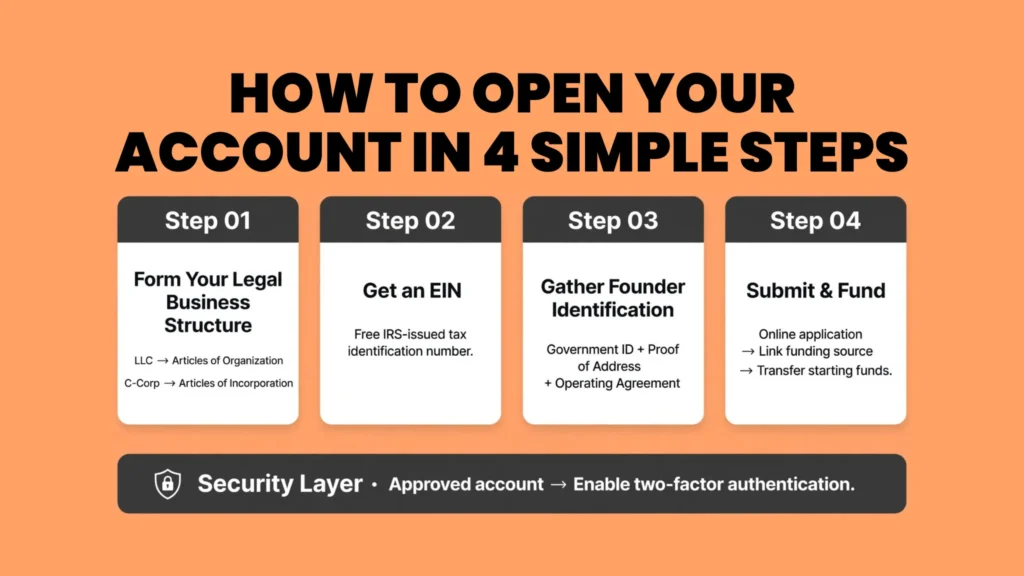
Step 1: Form Your Legal Business Structure
Before applying, register your business entity with your local state government. You will need your official Articles of Organization (for an LLC) or Articles of Incorporation (for a C-Corp).
Step 2: Grab an Employer Identification Number (EIN)
You can get a free EIN directly from the IRS website in minutes. Modern platforms require this number to verify your company’s tax identity during onboarding.
Step 3: Gather Founder Identification
Have your government-issued ID or passport, proof of address, and operating agreement ready. Digital platforms require high-quality document photos to complete security verification.
Step 4: Submit and Fund Your Account
Fill out the online application form and link your personal checking account or initial investment source to transfer starting funds.
Completing this onboarding process smoothly relies on having your ownership percentage details clear. If your startup has multiple co-founders who hold a 25% stake or more, most financial institutions will require their legal identification details as well. Collecting these documents in advance avoids compliance back-and-forth and gets your account activated within hours.
Once your account is approved, make sure to set up two-factor authentication immediately. Using secure authenticator apps rather than standard text message verification provides an essential security layer for your company’s capital.
Managing Your Operational Funds Safely
Once your startup banking setup is running, keeping your financial operations structured helps avoid cash flow headaches.
Are you setting aside money for taxes every time a client pays an invoice? Using multi-account setups lets you automatically move 20% to 30% of incoming revenue straight into a tax sub-account. That way, quarterly tax estimates never catch you off guard.
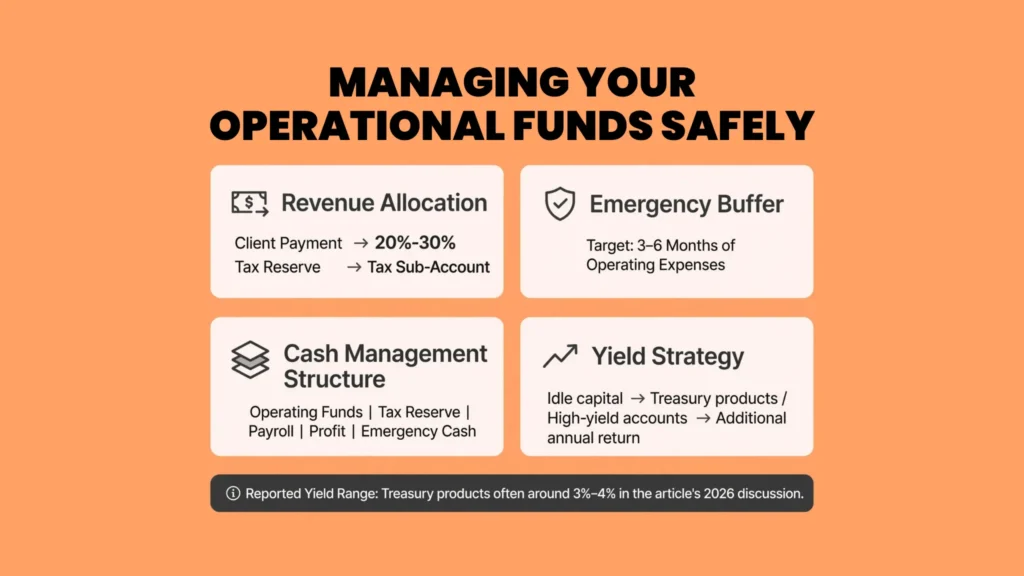
It is also wise to maintain an emergency cash buffer in a high-yield business checking account or dedicated savings bucket. Aiming for 3 to 6 months of operational expenses gives your startup room to navigate unexpected market shifts without stress.
Building a disciplined cash management routine early prevents common financial traps. When revenue flows into a single main balance, it is easy to overspend on software or marketing campaigns because your cash reserves look artificially high. Segmenting your funds into specific operational buckets gives you an immediate, realistic view of what money is actually available to spend on growth.
Our team at reliablestratup.com always recommends auditing your software subscriptions twice a year to cancel unused tools and keep overhead light.
Maximizing Interest and Treasury Yield on Startup Capital
If your startup has raised a seed round or holds substantial cash reserves, leaving those funds sitting in a zero-interest checking account means leaving real money on the table. In 2026, modern financial platforms offer direct access to low-risk treasury funds and high-yield savings accounts that generate significant annual returns.
Treasury management products typically invest your idle working capital into short-term U.S. government backed securities. These instruments offer high liquidity, meaning you can move money back into your main spending account whenever payroll or operational needs arise. Yields on these accounts often hover around 3% to 4%, providing thousands of dollars in extra annual runway for a venture-backed team.
For smaller or early-stage startups that do not hold large cash reserves, high-yield business checking accounts offer a simpler alternative. You earn a solid interest rate directly on your primary working capital without needing to set up complex treasury structures or maintain quarter-million-dollar balances.
Common Mistakes Founders Make When Picking a Bank
Even experienced founders can fall into avoidable traps when setting up their startup banking architecture. Recognizing these missteps keeps your money safe and your operations moving forward smoothly.
Ignoring Hidden Fees: Falling for zero monthly maintenance offers without checking international wire fees, foreign transaction charges, or outbound ACH costs.
Overlooking Software Connections: Choosing a platform that does not sync directly with your current bookkeeping or payroll tools, leading to tedious manual work.
Skipping Sub-Account Structure: Keeping all company funds in a single main checking bucket, which makes tax planning and runway tracking confusing.
Neglecting Security Features: Failing to mandate hardware keys or multi-factor authentication for team members authorized to move corporate funds.
Taking the time to read through account fee schedules and platform terms before applying protects your startup from unexpected charges later. Choosing a partner that grows alongside your business ensures you will not have to switch financial providers midway through a major growth phase.
Final Thoughts on Startup Banking
Choosing the best business bank account comes down to clarity, low fees, and modern digital features. Separating your personal and business cash protects your legal standing while making daily financial management simple. Pick a platform that matches your team’s workflow today so you can stay focused on building a successful business.
Frequently Asked Questions
Which bank account is best for small business startups?
The best business bank account depends on your startup’s needs. Mercury works well for VC-backed teams, while Relay excels at cash management.
Can I open a startup account online?
Yes, most digital platforms let you apply online using your incorporation documents and EIN.
Do I need an EIN to open an account?
In most cases, yes, an EIN is required to open an account for LLCs and corporations.
How much money do I need to open an account?
Many online options allow you to open a business checking account with a zero dollar minimum deposit.