Restaurant Labour Cost Percentage and How to Control It
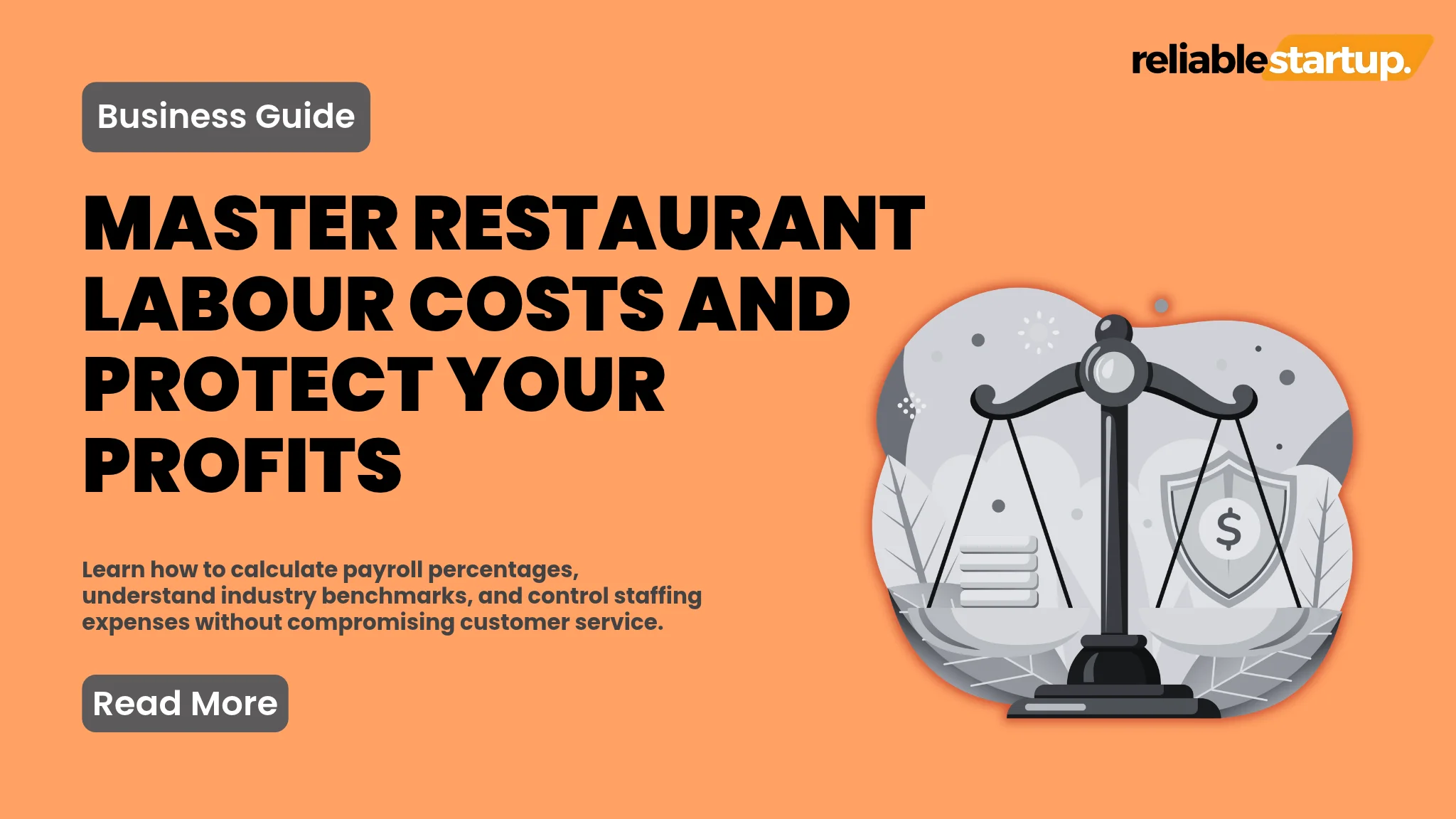
Restaurant labour cost percentage is the total money a restaurant spends on staff wages, taxes, and benefits divided by its total gross sales. For most profitable restaurants, keeping this figure between 25% and 35% of total revenue is vital for survival. In fact, payroll is usually one of the largest expenses you can control.
When staffing costs rise above your target range, even a busy dining room can lose money. Therefore, you must measure your labour cost ratio accurately and match daily schedules to real customer demand. Doing so protects your profit margins without burning out your team or hurting guest service.
What Is Restaurant Labour Cost Percentage?
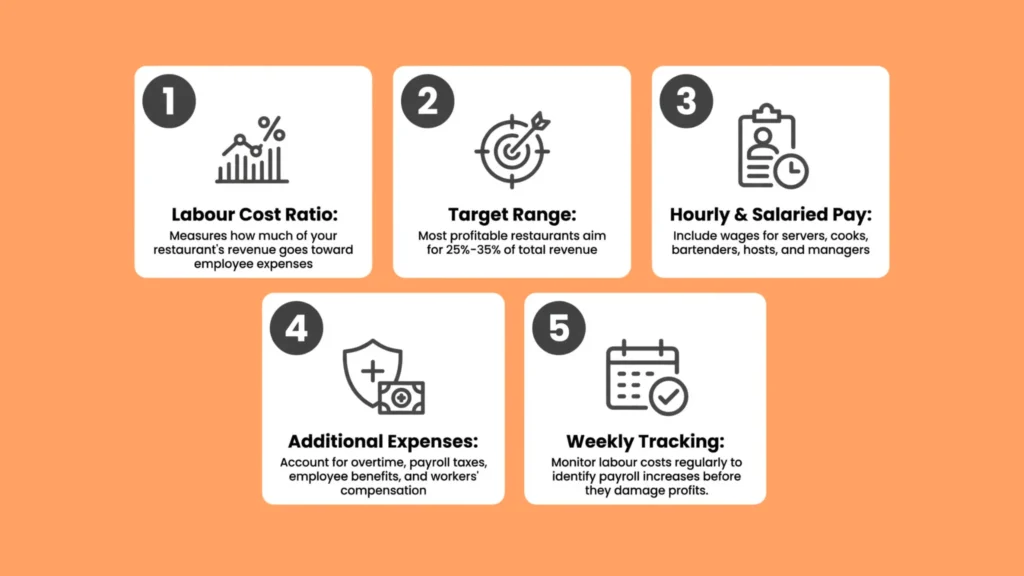
Your labour cost ratio restaurant metric shows how many cents of every sales dollar go toward paying your team. Rather than looking at raw payroll dollars alone, comparing labour to sales puts staffing costs into clear context.
For example, a $12,000 weekly payroll works well for a busy bistro making $45,000 in sales (26.7%). However, that same payroll is too high for a small café bringing in $28,000 (42.9%). As a result, tracking this percentage every week gives you an early warning when shift hours grow faster than guest traffic.
What Counts Toward Total Labour Cost?
To get an accurate figure, you must include every staff-related expense rather than just base hourly wages. Restaurant owners exploring a ghost kitchen business model may also have a different labour cost structure because delivery-focused operations generally require fewer front-of-house employees.
Otherwise, leaving out hidden payroll costs will make your profits look better on paper than they really are.
Hourly wages and salaried pay: Include all regular pay for servers, hosts, bartenders, cooks, dishwashers, and salaried managers.
Overtime pay: Count any extra hours worked that require higher pay rates.
Payroll taxes: Add employer payments toward social security, unemployment insurance, and local payroll taxes.
Employee benefits: Include health insurance, paid time off, retirement plans, and workers’ compensation insurance.
Bonuses and shift meals: Factor in staff bonuses or free employee meals tracked as pay.
How to Calculate Your Restaurant Labour Cost Percentage
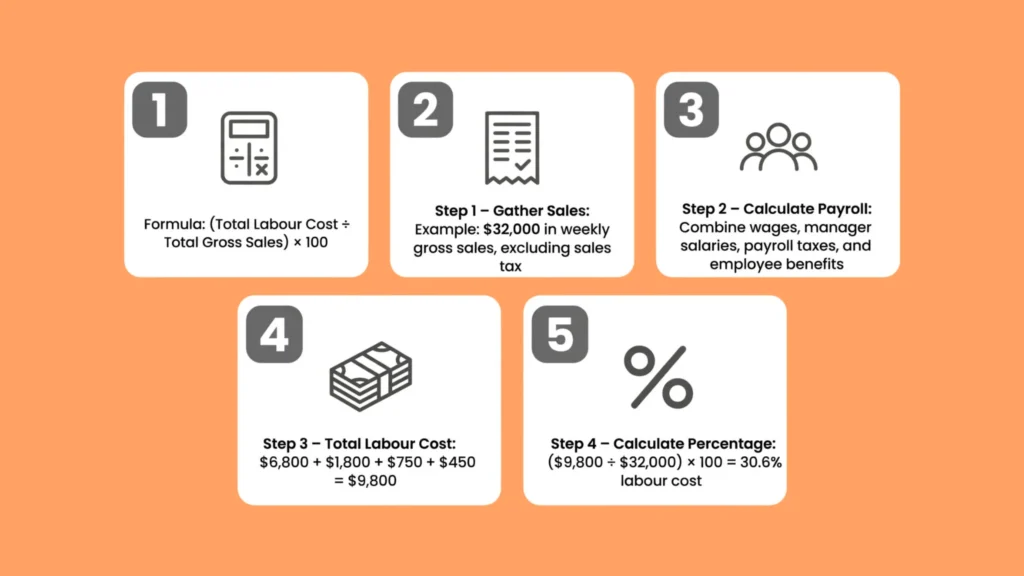
To find your restaurant labour cost percentage, you need two numbers from the same time period. Specifically, you need your Total Labour Cost and your Total Gross Sales.
Step-by-Step Calculation Example
Suppose you want to check your restaurant’s staffing costs for the past week. Follow these four simple steps:
Gather your total sales: First, pull your gross food and drink sales from your point-of-sale (POS) system. Exclude any sales tax collected from guests. Let us say total sales equal $32,000.
Add up all payroll expenses: Next, combine hourly wages ($6,800), manager pay ($1,800), payroll taxes ($750), and benefits ($450). Your total labour cost equals $9,800.
Divide labour by sales: Then, divide $9,800 by $32,000 to get 0.30625.
Convert to a percentage: Finally, multiply 0.30625 by 100 to get 30.6%.
In this example, the restaurant spends about 30.6 cents of every sales dollar on staff. Additionally, you can run this math using net sales, which subtracts free meals and discounts from gross sales. Using net sales gives a slightly higher percentage and shows how discounts affect your labour efficiency. Whatever sales figure you pick, use it the same way every week so your numbers stay reliable.
Industry Benchmarks by Restaurant Type
There is no single target that fits every food business. Instead, service style, menu size, and average bill totals shape how many staff members you need per sales dollar. For example, a food truck business typically requires a different staffing structure and labour budget than a traditional full-service restaurant.
| Restaurant Concept | Typical Labour Cost Target | Key Operational Drivers |
| Quick-Service & Fast-Casual | 25% – 30% | Counter ordering, simple menus, and no table service keep front-of-house hours low. |
| Casual Dining | 28% – 33% | Full table service, hosts, bartenders, and kitchen prep require more staff hours. |
| Fine Dining | 30% – 35% (or higher) | High staff-to-guest ratios, skilled cooks, and detailed table service raise payroll costs. |
| Coffee Shops & Bakeries | 25% – 32% | Busy morning rushes balance out smaller average customer orders. |
| Bars & Pubs | 20% – 28% | High drink profits and simple food prep reduce kitchen staffing needs. |
Understanding Prime Cost: The Bigger Picture
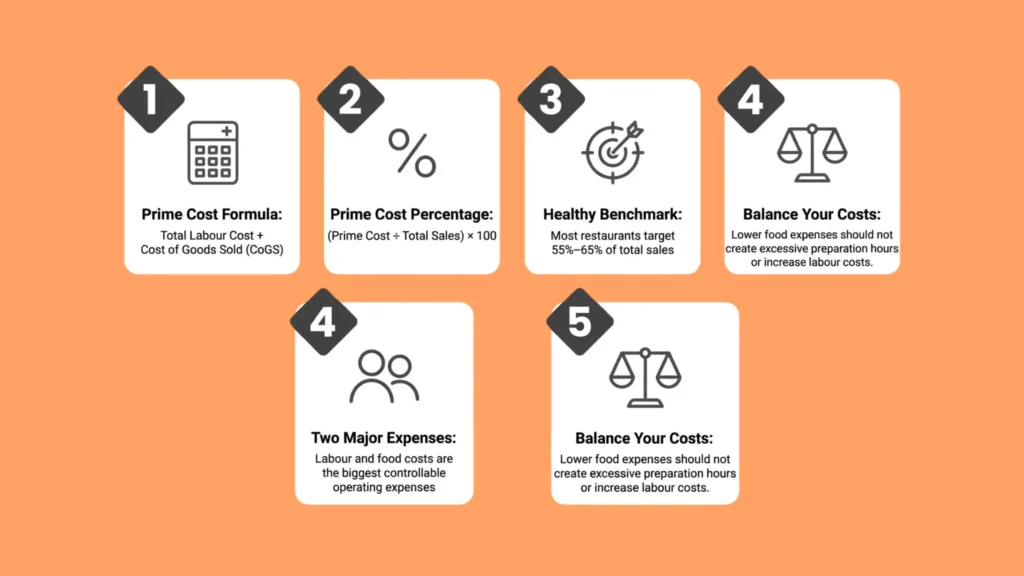
Looking at staff wages alone only tells half the story. Consequently, smart owners also track prime cost, which adds total labour cost to Cost of Goods Sold (CoGS).
CoGS is the direct cost of all food, drinks, and packaging used during that period. Understanding your food cost percentage also helps you identify how ingredient expenses affect your restaurant’s overall profitability.
Prime cost covers your two biggest controllable expenses. For most restaurants, a healthy prime cost sits between 55% and 65% of total sales.
Moreover, tracking prime cost helps you make better daily choices. For instance, buying pre-cut vegetables raises your food cost, yet it saves kitchen prep hours and may lower your overall prime cost. On the other hand, making sauces from scratch lowers food costs while requiring more kitchen hours. Watching both numbers together ensures savings in one area do not raise costs in another.
Actionable Ways to Control Restaurant Labour Costs
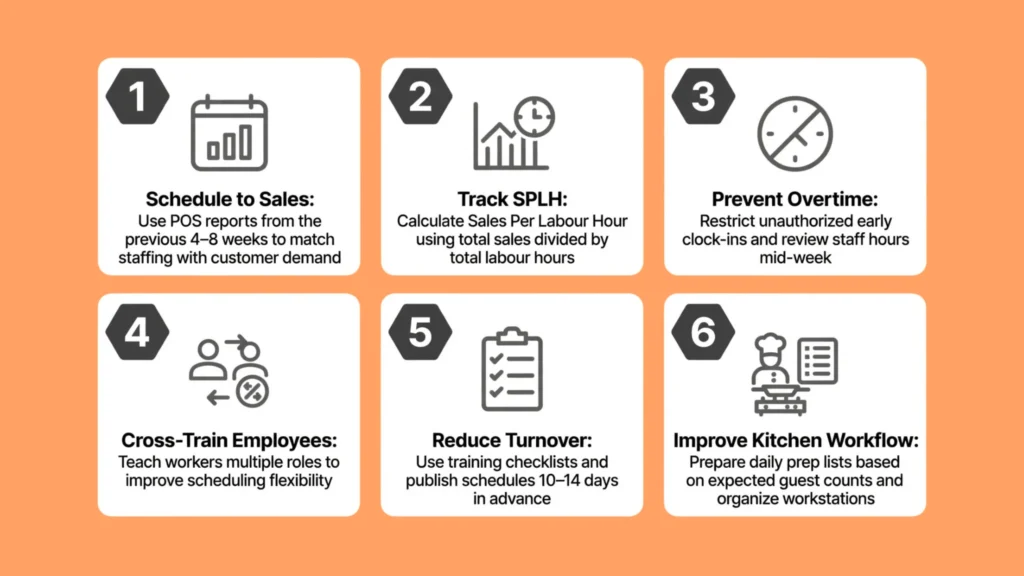
Lowering your labour ratio does not mean leaving shifts short-staffed and letting service suffer. Rather, smart labour control removes wasted hours, stops avoidable overtime, and matches staff levels to real guest demand.
1. Use Scheduling to Sales
Scheduling to sales means building staff rosters from past sales data instead of copying last week’s schedule.
First, check your POS hourly sales reports from the past four to eight weeks. Reliable POS systems for food businesses can help you monitor sales patterns and make more informed staffing decisions.
Look closely at busy days, local events, and seasonal shifts. Next, spot your busiest dining hours and your slowest quiet periods. Instead of bringing the whole dinner crew in at 4:00 PM, stagger start times so staff arrive right before the rush hits. Similarly, send staff home in stages as evening sales slow down.
2. Track Sales Per Labour Hour (SPLH)
Sales Per Labour Hour shows how much money your team brings in for every hour worked on the clock.
For example, suppose your restaurant makes $4,000 during a four-hour dinner rush with 10 staff working (40 total hours). In that case, your SPLH is $100. Checking SPLH for breakfast, lunch, and dinner shows which shifts have too many workers. Whenever SPLH drops too low during slow weekday lunches, combine roles or shorten shift blocks.
3. Stop Unplanned Overtime and Early Clock-Ins
Unplanned overtime quickly eats away at weekly profits. Even a few workers staying 20 minutes late each shift adds many hours of expensive overtime pay by week’s end.
Set clock-in limits: First, set your POS timeclock to block workers from clocking in more than five minutes early without manager approval.
Check hours mid-week: Next, review total hours every Wednesday or Thursday so you can adjust weekend shifts before anyone hits overtime.
Speed up closing tasks: Often, slow closing times happen because side-work lacks structure. Assign closing chores early during slow periods so staff finish right after the last guest leaves.
4. Cross-Train Staff for Multiple Roles
When workers only know one job, managers often schedule extra people just to cover sick calls or sudden rushes. Therefore, cross-training gives your team much more flexibility.
Teach hosts to clear tables and run food, and train servers to pack takeout orders. Likewise, teach line cooks to run the grill, fryers, and cold prep stations. During slow shifts, a cross-trained crew lets you send one or two workers home early while the rest easily handle the floor.
5. Lower Staff Turnover Through Better Training
High staff turnover brings heavy hidden payroll costs. Every time a trained server or cook quits, you spend money on job ads, interviews, and paid training shifts. During training shifts, two people are on the clock doing one person’s job.
To prevent this, use clear training checklists and set simple job rules from day one. In addition, post work schedules at least 10 to 14 days early. Giving reliable schedules boosts team morale, cuts down on missed shifts, and keeps good workers longer.
6. Improve Kitchen Prep Lists and Workflow
Kitchen labour often rises when prep cooks lack clear targets or waste time hunting for tools and ingredients.
Instead, use daily prep sheets based on expected guest counts so cooks only prep what you need for the next day or two. Furthermore, organize coolers, dry storage, and cooking stations neatly to save steps during busy rushes.
Common Mistakes That Inflate Labour Ratios
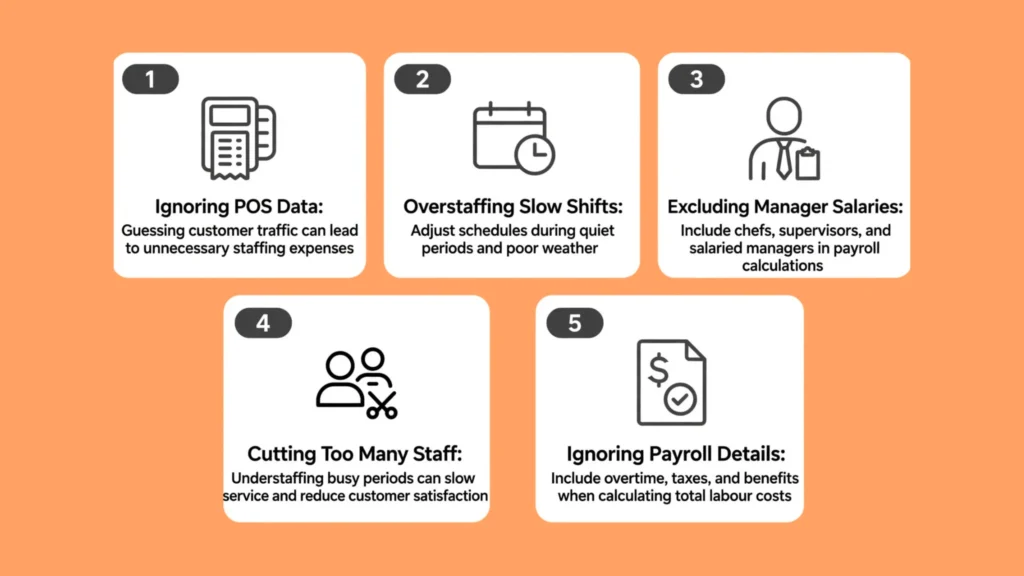
Even careful managers sometimes fall into habits that push payroll costs higher:
Guessing traffic instead of checking POS data: Assuming Friday will be busy without checking weather or past sales often leads to overstaffing.
Keeping full staff during slow weather: Failing to send workers home early on a rainy Tuesday turns a manageable shift into a money loser.
Leaving out salaried managers: Forgetting to include manager salaries makes your labour ratio look falsely low and hides true costs.
Cutting too deep during busy hours: Understaffing Friday dinner to save $80 in wages causes slow food, fewer table turns, and unhappy guests who never return.
Frequently Asked Questions
What is a good labour cost percentage for a restaurant?
For most restaurants, a good restaurant labour cost percentage sits between 25% and 35% of gross sales. Fast-food spots and bars usually aim for 20% to 30%. Meanwhile, casual and fine dining restaurants often run between 28% and 35% because they need more service staff.
Should salaried managers be included in restaurant labour cost?
Yes, you must include salaried managers, chefs, and supervisors in your total labour cost. Simply divide their yearly pay, taxes, and benefits by 52 weeks to get an accurate weekly management cost.
How often should I calculate my restaurant labour cost percentage?
You should check daily labour numbers in your POS system to spot scheduling problems fast. Then, run a full calculation that includes payroll taxes and benefits every week or pay period.
What is the difference between labour cost percentage and prime cost?
Labour cost percentage only tracks staff expenses against sales. By contrast, prime cost adds your total labour cost and your food and drink costs together. Ideally, prime cost should stay between 55% and 65% of total sales.
How can I lower labour costs without hurting customer service?
Focus on scheduling to sales rather than cutting staff during your busiest hours. Stagger shift start times, cross-train workers for slow hours, block early clock-ins, and organize closing duties. As a result, you cut wasted hours while keeping peak rushes fully staffed.
Does restaurant labour cost percentage include tips?
No, customer tips paid directly to workers are not a restaurant expense and stay out of this math. However, if you pay credit card fees on tips or give house-funded bonuses, include those employer costs in your payroll total.
Final Thoughts
Controlling your restaurant labour cost percentage takes smart planning rather than harsh cuts. By counting every payroll expense each week, watching prime cost alongside wages, and using scheduling to sales, you can match every shift to real guest demand. Start today by checking your slowest shifts and stopping early clock-ins. Over time, small weekly changes to your schedule will protect your profits while keeping both your team and your guests happy.
About The Author