Nutrition Labels and Barcodes: What a Packaged Food Needs
Launching a packaged food product into the retail landscape requires far more than mastering a signature recipe or designing an eye-catching logo. Understanding nutrition label requirements, legal compliance, and supply chain compatibility is equally essential for bringing a food product successfully to market.
Whether you are scaling an artisanal salsa, rolling out protein bars, or bottling a specialized beverage, legal compliance and supply chain compatibility are absolute prerequisites. Commercial retailers and regulatory bodies require specific visual declarations on every unit to protect consumers and streamline digital inventory management.
If you plan to scale production, finding the right food co-packer can also help streamline manufacturing, packaging, labeling, and quality control.
Navigating these regulations means understanding two distinct but equally crucial components: regulatory nutrition declarations and retail barcode systems. Meeting official nutrition label requirements alongside distributor expectations ensures your food product remains legally compliant, safe for consumption, and completely retail-ready.
Understanding Food Packaging Panels
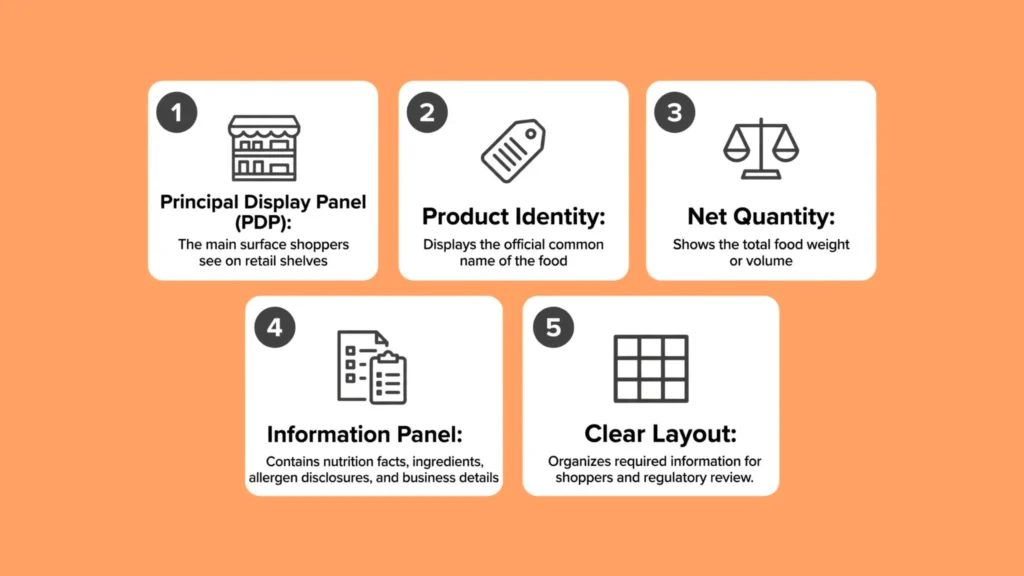
Federal regulators enforce strict framework standards regarding where specific information must be positioned on retail containers. Packaging layout revolves around two primary surface areas that direct consumer attention and store critical safety data.
The Principal Display Panel serves as the primary visual surface visible to shoppers on retail shelves. It holds the core statements identifying the item and its quantity.
Located immediately adjacent to the main display panel is the Information Panel. This designated area consolidates crucial regulatory details, including the Nutrition Facts grid, the complete ingredient sequence, allergen disclosures, and manufacturer contact data. Maintaining proper visual hierarchy across these two sections prevents regulatory delays and ensures shoppers can evaluate products instantly.
Core Components of the Nutrition Facts Panel
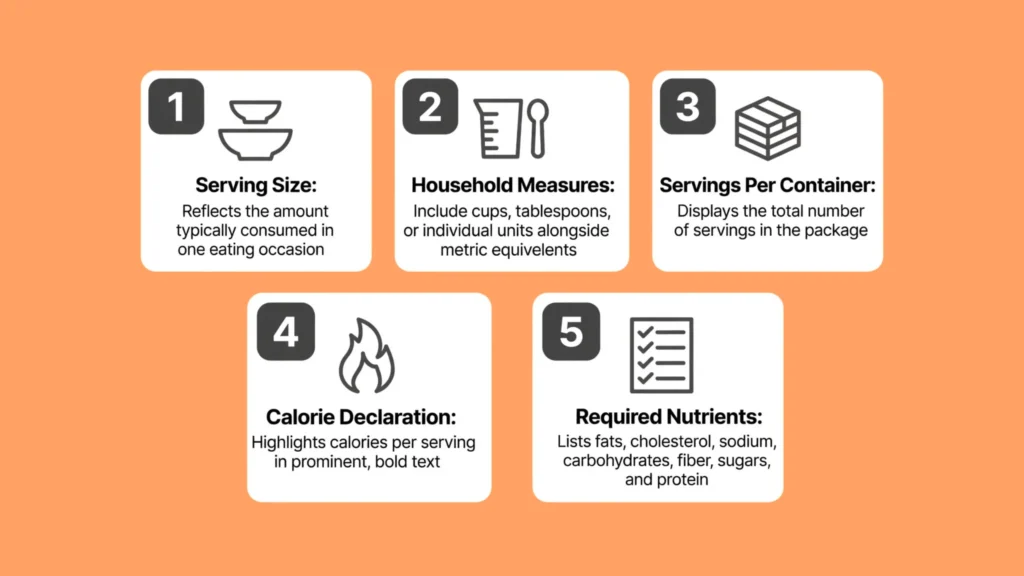
The Nutrition Facts panel offers consumers an accurate overview of a product’s nutrient structure per individual serving. Modern regulatory updates emphasize clear visual sizing for key values, helping consumers make informed diet choices.
Serving Metrics and Caloric Value
Serving sizes must accurately represent portions typically consumed during a single eating occasion rather than idealized dietary goals. Food producers must state these quantities in standard household measures, such as cups, tablespoons, or discrete units, accompanied by metric equivalents in grams or milliliters. Additionally, you must display the total count of servings within the container directly above or beside the serving metric.
The panel displays caloric values per serving in a prominent, bold typeface to maximize readability. Presenting calories clearly allows shoppers to quickly assess energy content without deciphering small text.
Required Nutrient Calculations
Regulatory guidelines mandate declaring exact quantities and Percent Daily Values for key macro and micronutrients. These disclosures include Total Fat, Saturated Fat, Trans Fat, Cholesterol, Sodium, Total Carbohydrate, Dietary Fiber, Total Sugars, Added Sugars, and Protein.
Labeling regulations also mandate reporting actual numeric weights and Daily Value percentages for four specific micronutrients: Vitamin D, Calcium, Iron, and Potassium. Health authorities highlight these nutrients due to their significance in public health guidelines.
Ingredient Declarations and Allergen Guidelines
Accurate ingredient statements establish consumer trust and prevent major regulatory issues. Incorrect ingredient lists or missing allergen notices remain the leading cause of food product recalls in retail operations.
Small food businesses operating from home should also understand cottage food labeling requirements, as local regulations may specify additional ingredient, allergen, and packaging disclosures.
Structuring the Ingredient List
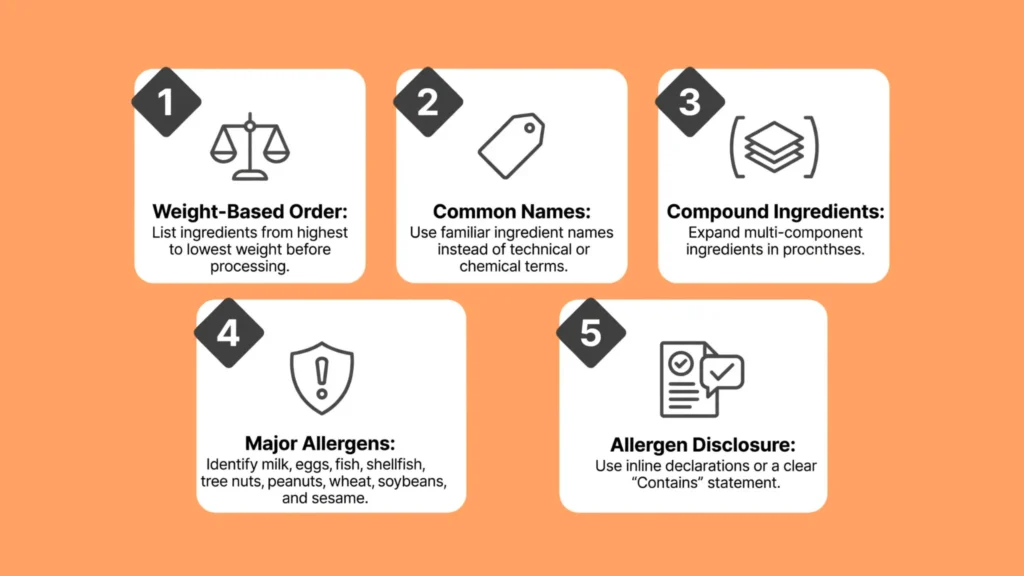
You must arrange ingredients in descending order based on their weight prior to processing. Consequently, the heaviest component in your formulation must appear first, followed sequentially down to the smallest ingredient.
Manufacturers must identify all ingredients by their common or usual terms rather than technical or chemical names. Furthermore, you must expand multi-component ingredients fully within parentheses. For example, using cheese as a component requires listing it clearly, such as Cheddar Cheese (cultured milk, salt, enzymes). Spices and natural flavorings can generally appear as collective terms unless specific regulations require explicit naming.
Identifying Major Food Allergens
Regulations mandate clear labeling for major food allergens, including milk, eggs, fish, crustacean shellfish, tree nuts, peanuts, wheat, soybeans, and sesame.
Brands can fulfill allergen disclosure rules through two standard methods:
Inline Declarations: Placing the common allergen source in parentheses directly after the ingredient, such as Flour (wheat).
Summary Statements: Adding a dedicated statement directly under or beside the ingredient list, such as Contains Wheat, Milk, and Soy.
Mandatory Front-Panel Declarations
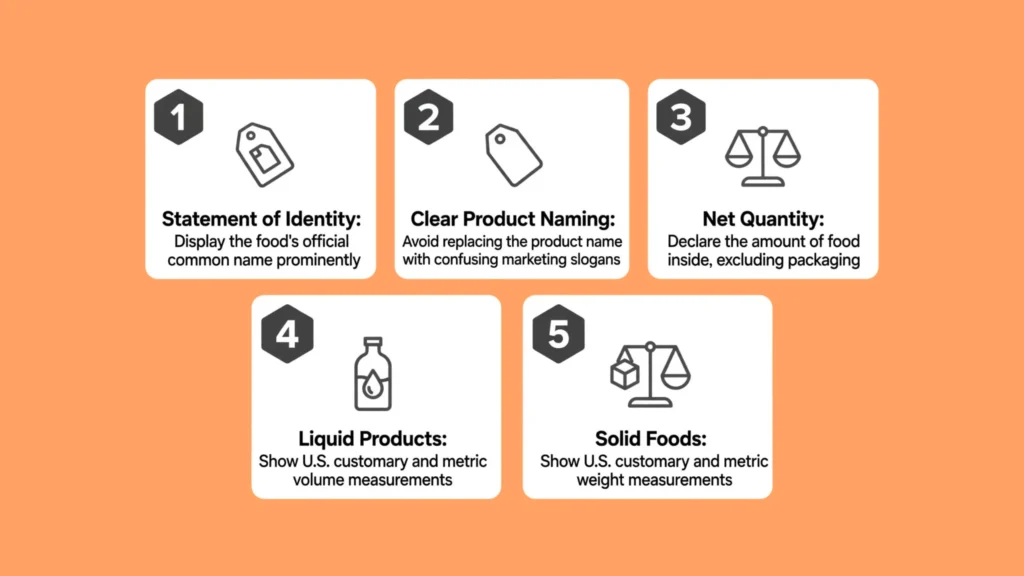
The front display panel creates the primary commercial impression while fulfilling crucial legal mandates regarding product identification and weight metrics. These packaging standards are particularly important when launching a beverage brand, where accurate net quantity declarations, ingredient listings, and nutritional information are essential.
Statement of Identity
The statement of identity is the official, common name of the food item, such as Oat Oatmeal, Apple Cider Vinegar, or Almond Butter. You must position it prominently on the primary display panel, parallel to the base of the container. Therefore, avoid replacing the common product name with creative marketing slogans that confuse buyers about the actual contents.
Net Quantity Declaration
The net quantity statement specifies the total weight or volume of food inside the container, excluding all outer packaging materials.
Liquid Products: You must declare volume using U.S. customary units (such as fluid ounces or quarts) alongside metric units (such as milliliters or liters).
Solid or Semi-Solid Foods: You must declare net weight using standard weight units (ounces or pounds) along with metric weight units (grams or kilograms).
You must position this metric within the lower 30 percent of the display panel, sizing it appropriately according to the total surface area of the package.
Integrating Retail UPC Barcodes
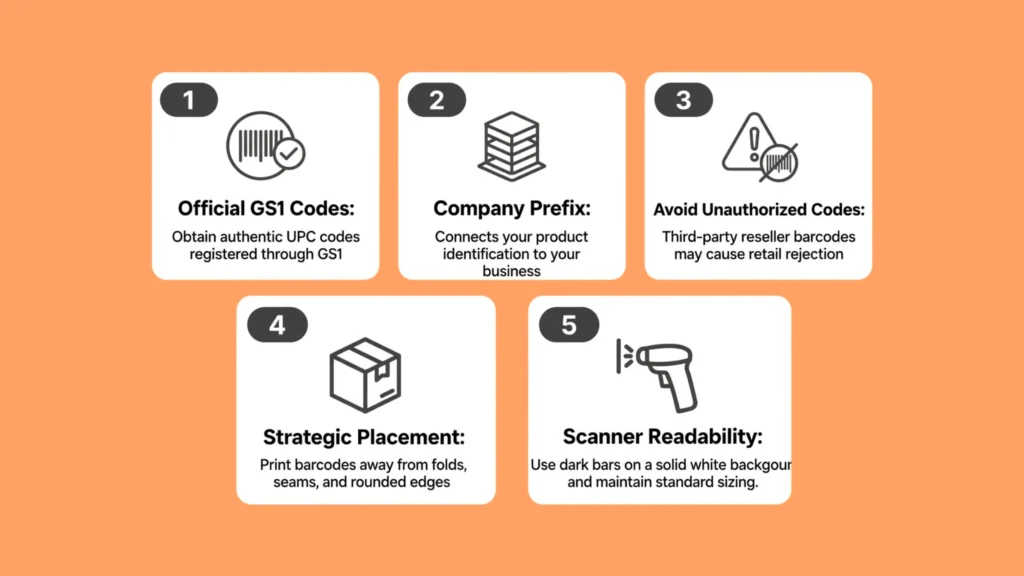
While nutrition labels focus on consumer safety and health, Universal Product Code barcodes manage commercial logistics, store pricing, and automated inventory control across retail channels.
Acquiring Authentic GS1 Barcodes
Major retailers require brands to obtain authentic UPC codes registered through GS1, which is the official international supply chain organization. Obtaining an official GS1 Company Prefix ensures that your product code links directly to your business in global database records.
Purchasing low-cost, third-party barcodes from unauthorized vendors frequently leads to operational roadblocks. As a result, major retail networks regularly verify barcode ownership against official registry systems and reject products linked to third-party prefixes.
Barcode Printing Guidelines
You should print barcodes cleanly on the information panel or back portion of the container, away from folds, rounded edges, or package seams that hinder scanner performance.
High color contrast is essential for consistent scanning. Dark bars printed over a solid white background offer reliable readability. In contrast, avoid using red or metallic inks for barcode patterns, because retail scanners struggle to read these reflective surfaces. Finally, maintain standard barcode sizing to prevent scan errors at checkout terminals.
Food Packaging Readiness Overview
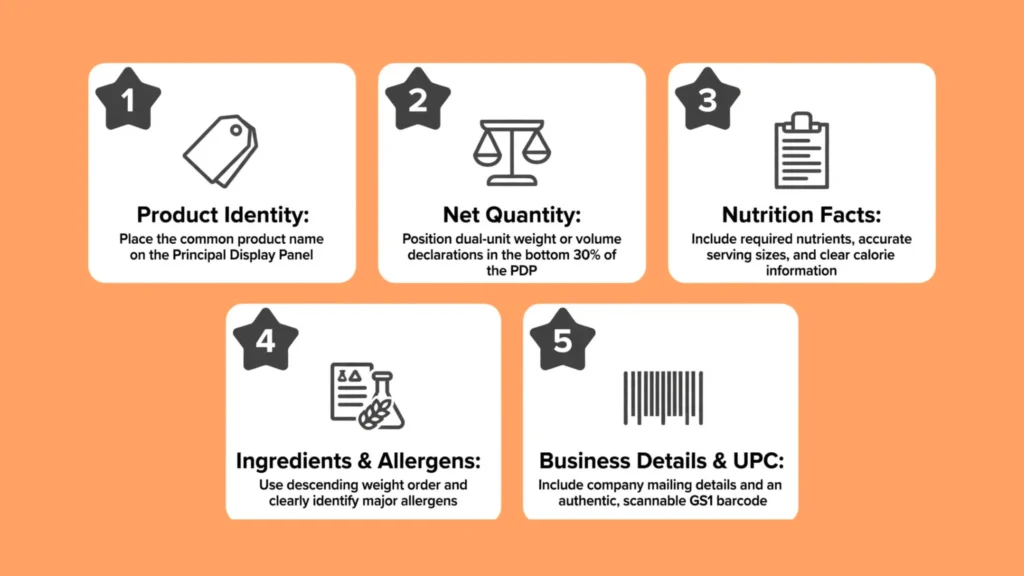
| Packaging Section | Target Location | Regulatory Requirement | Key Error to Avoid |
| Product Identity | Principal Display Panel | Standard common name parallel to package base | Replacing product identity with brand taglines |
| Net Quantity | Bottom 30% of PDP | Dual system displaying U.S. Customary and Metric units | Placing weight declaration too high on the panel |
| Nutrition Facts | Information Panel | Modern font layout with bold calories and required nutrients | Using outdated portion estimates or missing Added Sugars |
| Ingredient List | Information Panel | Descending weight sequence with expanded components | Listing ingredients alphabetically instead of by weight |
| Allergen Notice | Information Panel | Clear summary statement or inline source parenthetical | Omitting sesame or specific tree nut types |
| Business Details | Information Panel | Full company name and physical location | Displaying only a website address without mailing details |
| UPC Barcode | Information Panel or Back | Authentic GS1 GTIN with strong visual contrast | Printing reflective bars or spanning across seams |
Key Mistakes to Avoid in Food Packaging Design
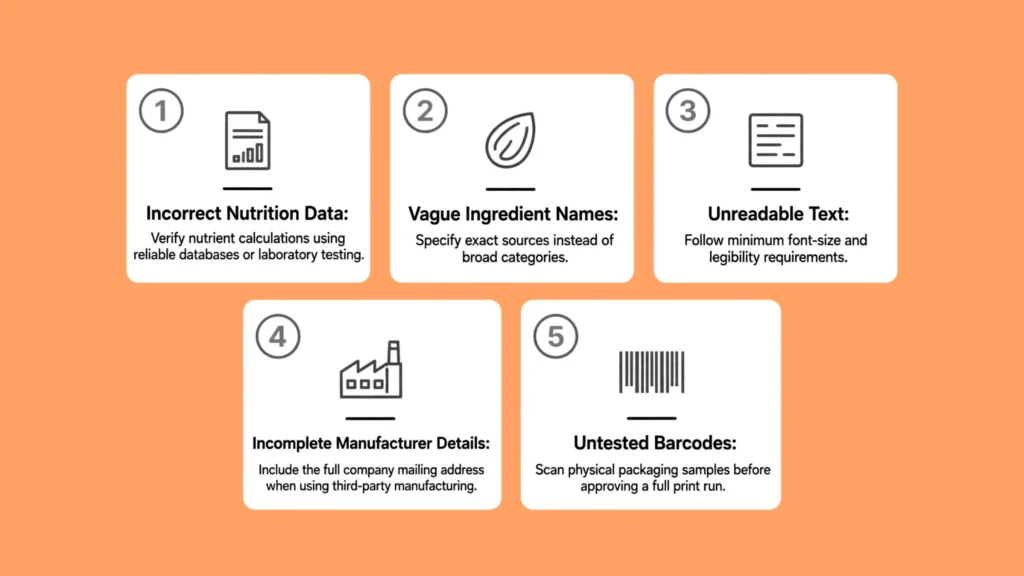
Relying on basic online templates can cause formatting errors or incorrect nutrient counts. Therefore, always verify recipe metrics using accredited database software or laboratory testing. Using broad categories instead of specific names causes compliance failures. For instance, always specify the exact source, such as Walnuts instead of Tree Nuts, or Salmon instead of Fish.
Regulatory codes dictate minimum font heights for net quantity lines and nutrition headings based on total package area. As a result, you must ensure that all text meets legibility standards. If a third party manufactures your product, packaging text must state “Distributed by” or “Manufactured for” followed by the full company mailing address and ZIP code.
Printing full packaging runs without test-scanning physical barcode samples risks costly reprints if scan contrast or sizing proves defective.
Frequently Asked Questions
What qualifies a small business for a nutrition labeling exemption?
Small businesses employing fewer than 100 full-time staff and selling under 100,000 units annually in the U.S. can apply for a small business nutrition labeling exemption. However, making any nutrient or health claims on the product packaging immediately voids this exemption and requires full nutrition labeling.
How do UPC barcodes differ from Nutrition Facts panels?
A Nutrition Facts panel is a legal regulatory requirement managed by public health agencies to provide ingredient, safety, and nutritional data to consumers. In contrast, a UPC barcode is an operational tool required by retail stores to manage inventory, track prices, and process customer purchases at checkout.
Can food brands use third-party reseller barcodes?
While third-party resellers sell lower-cost single barcodes, major retail chains require official verification confirming that the company prefix matches your brand in the GS1 database. Consequently, using third-party reseller codes often leads to retail rejection or costly packaging revisions.
What is the best way to determine nutritional values for a recipe?
You can calculate nutritional values through direct chemical laboratory analysis of finished samples or through recipe software utilizing verified ingredient databases, such as the USDA FoodData Central system. However, laboratory analysis is particularly recommended for products involving deep frying, baking, or fermentation.
Where should the ingredient list be printed on the package?
You should print the ingredient list and allergen disclosures directly below or adjacent to the Nutrition Facts panel on the Information Panel. Grouping these elements together allows shoppers to examine nutritional values and ingredient profiles simultaneously.
How are terms like Organic and Natural managed on food labels?
The USDA National Organic Program strictly governs the term Organic, requiring formal third-party certification prior to printing. Similarly, terms such as Natural follow specific regulatory policies requiring that producers add no artificial colors, synthetic flavors, or synthetic additives to the product.
Final Thoughts
Preparing a compliant food product for retail distribution requires balancing strong visual branding with strict regulatory rules. By presenting clear product identification on the front display, organizing ingredient and allergen disclosures correctly on the information panel, displaying an accurate Nutrition Facts panel, and applying an official GS1 UPC barcode, you establish a solid foundation for your brand.
Taking time to review every packaging detail before full commercial printing prevents expensive packaging revisions, protects against product recalls, and builds long-term confidence among retail partners and consumers.
About The Author