Writing a HACCP Plan for a Small Food Business
Creating a HACCP plan for small business operations can feel overwhelming at first. Small food business owners often find the regulatory requirements daunting.
However, whether you run a bakery, a food truck, or a local catering service, a solid food safety plan is essential. It protects public health and ensures your business complies with local laws.
A HACCP plan is a simple, preventive approach to food safety. It identifies biological, chemical, and physical hazards in your production line. Then, it sets strict safety limits to prevent those hazards. Instead of testing only the final product, this system monitors safety at every stage. You will track safety from receiving raw ingredients all the way to final delivery.
You do not need a large team or a massive budget to build your system. Instead, focus on your specific setup and master the core principles.
With clear documentation, you can easily create a practical plan for your daily workflow, especially when building a compliant operation for new food and beverage startups.
Prerequisites to HACCP (Prerequisite Programs)
Before you write your main HACCP plan, you must establish prerequisite programs. These programs build the basic sanitary environment for safe food handling. In fact, a HACCP plan cannot succeed without these foundation steps.
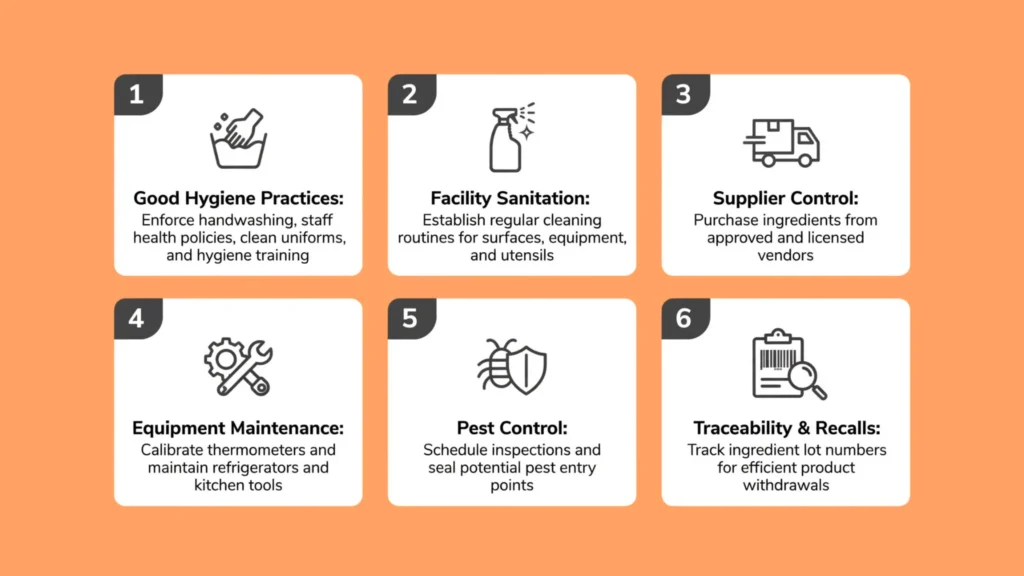
Essential prerequisite programs include:
Good Hygiene Practices: Maintain strict handwashing rules, staff health policies, clean uniforms, and regular hygiene training.
Facility Sanitation: Create standard cleaning routines for food contact surfaces, machinery, and kitchen utensils.
Supplier Control: Buy raw materials only from approved and fully licensed vendors.
Equipment Maintenance: Calibrate thermometers regularly, service refrigerators, and repair damaged tools promptly.
Pest Control: Schedule routine inspections and seal building entry points to keep pests away from food areas.
Traceability and Recalls: Track ingredient lot numbers so you can quickly withdraw products during a recall.
These foundational steps keep your workspace clean. As a result, your primary HACCP plan can focus solely on critical process steps.
The 5 Preliminary Steps Before Writing Your HACCP Plan
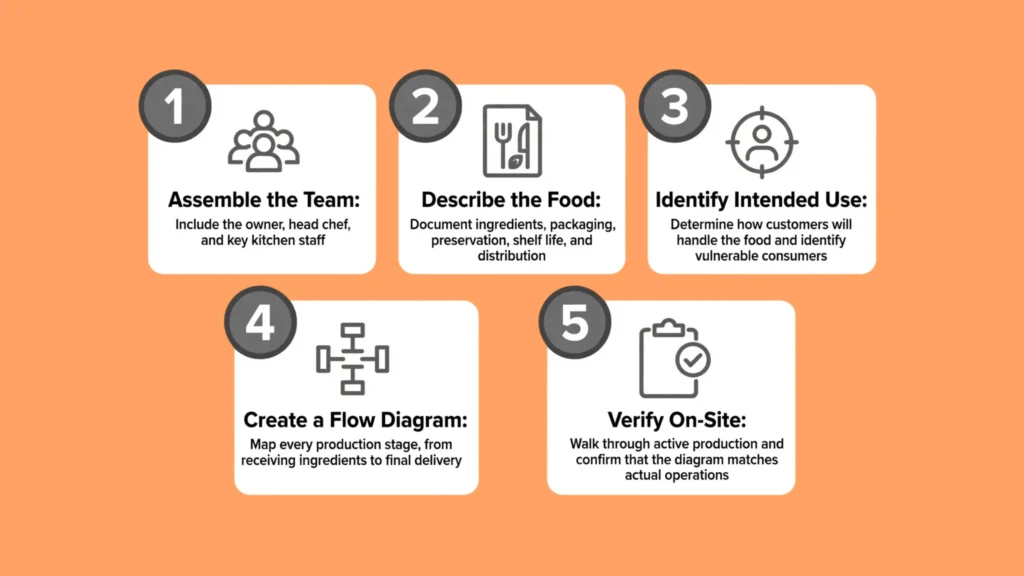
Regulatory agencies recommend five setup steps before you write your official safety plan.
1. Assemble the HACCP Team
Small businesses can keep this team compact. Your team might include the owner, the head chef, and a key kitchen staff member. If you need extra guidance, reach out to local health inspectors or food safety consultants.
If you operate a mobile food business, incorporating food safety procedures into your food truck business plan can help align daily operations with regulatory requirements.
2. Describe the Food and Its Distribution
Write down key product details clearly. Record the product name, ingredients, preservation methods, packaging types, shelf life, and storage requirements. Furthermore, explain how you deliver items to your customers.
For mobile food operators, understanding the operational requirements of starting a food truck business also helps establish appropriate food storage, preparation, and transportation procedures.
3. Identify the Intended Use and Consumers
Specify how customers will handle the food. Note whether the item is ready-to-eat or requires further cooking. Additionally, identify your target market, especially if you serve vulnerable groups like children or the elderly.
4. Construct a Process Flow Diagram
Map every step of your process in order. Start with raw material reception and move through storage, preparation, cooking, and cooling. Finish the map with packaging and final delivery. Keep this diagram clear and true to your kitchen layout.
5. Verify the Flow Diagram On-Site
Walk through your facility during active production while holding your diagram. Check that every physical action matches your written steps. If you spot differences, update the chart immediately.
The 7 Principles of HACCP Applied to a Small Business
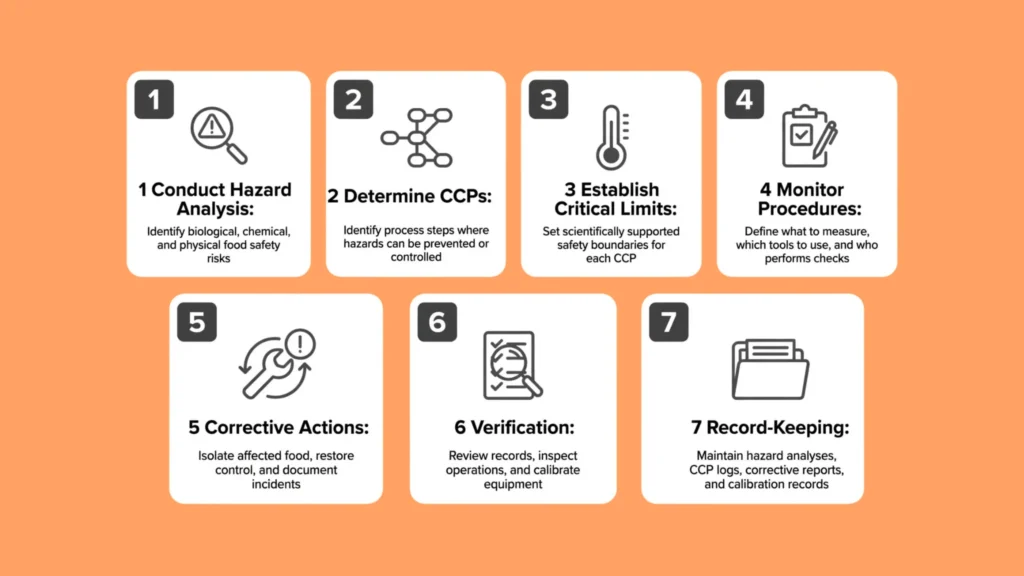
After completing the preliminary steps, apply the seven core HACCP principles in order.
1. Conduct a Hazard Analysis
Review each step on your process diagram and list potential hazards. Divide these risks into three simple categories:
Biological: Bacteria like Salmonella or E. coli, viruses, parasites, and mold.
Chemical: Cleaning solution residues, unmanaged food allergens, and natural toxins.
Physical: Metal splinters, glass fragments, plastic chips, or hair.
Evaluate how severe each hazard is. Consequently, you can decide which hazards require strict controls in your plan.
2. Determine Critical Control Points
A Critical Control Point (CCP) is a specific step where you can prevent or eliminate a safety hazard. Common examples include cooking, rapid cooling, metal detection, and pH adjustments. Not every step is a CCP, so use a standard decision tree to separate basic checks from true critical points.
3. Establish Critical Limits
Set strict minimum and maximum safety boundaries for each CCP. Scientific research or food regulations must support these limits. For example, you must cook chicken to an internal temperature of 165°F (74°C) for 15 seconds. Likewise, keep your cold storage units at or below 41°F (5°C).
4. Establish Monitoring Procedures
Monitoring tracks your process to keep CCPs within safe boundaries. Specify what you are measuring, such as internal meat temperature. Choose your tool, like a digital probe thermometer. Finally, set your testing schedule and assign the task to a specific staff member.
5. Establish Corrective Actions
When a process breaches a critical limit, team members must act immediately. Corrective plans must detail how to restore safety control. Additionally, explain how to isolate and discard the affected food. Always record the incident so you can prevent future mistakes.
6. Establish Verification Procedures
Verification checks confirm that your safety system works effectively. Therefore, review your monitoring logs and corrective reports weekly. Calibrate equipment like thermometers routinely, and inspect production lines regularly.
Businesses producing packaged drinks should also verify their formulation, processing conditions, and stability testing procedures before launching a beverage brand.
7. Establish Record-Keeping Procedures
Good records prove that your business follows its food safety system. Keep clean folders for your hazard analysis, CCP logs, corrective action reports, and calibration records.
Practical Record-Keeping for Small Businesses
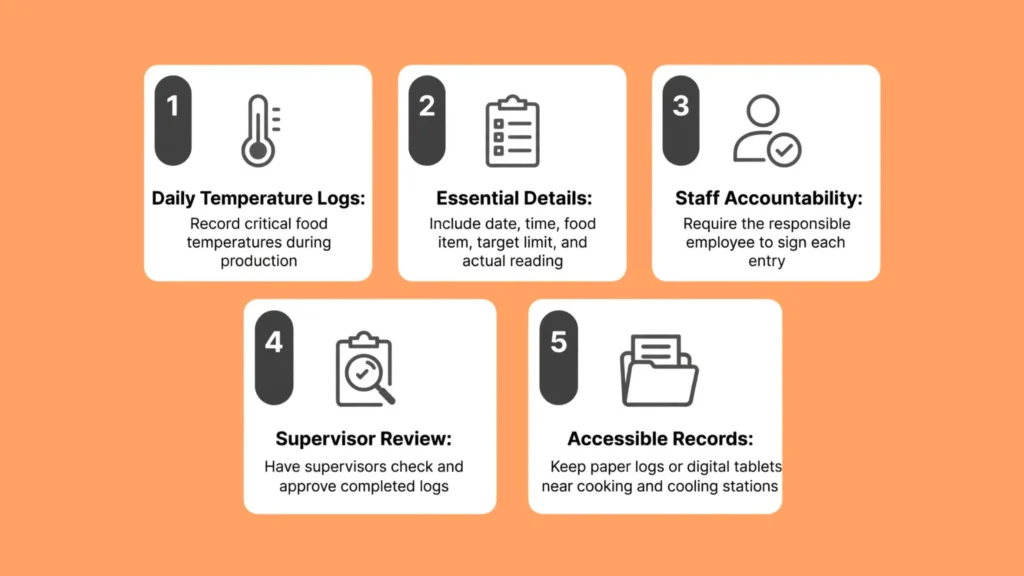
Small businesses should keep record-keeping simple and direct. For instance, a basic daily CCP temperature log works best. Staff should write down the date, time, food item, target limit, actual reading, and their signature. Finally, supervisors must review and sign off on these logs.
Place these paper logs or digital tablets near cooking and cooling stations. Because staff can access them easily, they will record data in real time.
Common Mistakes Small Food Businesses Make
You can build a better safety plan by avoiding these frequent mistakes:
Overcomplicating the System: Labeling too many steps as CCPs causes staff fatigue. Instead, limit CCPs to steps that control major hazards.
Confusing Quality with Safety: Keep food taste and appearance separate from safety risks like bacterial growth.
Skipping Thermometer Calibration: Uncalibrated thermometers give wrong readings, which makes your safety logs useless.
Neglecting Staff Training: A safety binder on a shelf cannot protect your customers. Train your workers so they understand why safety steps matter.
Inconsistent Logging: Missing entries or late logging hurts your regulatory standing during audits.
Frequently Asked Questions
What is the difference between a HACCP plan and a food safety plan?
A classic HACCP plan targets critical processing points to control hazards. In contrast, a modern Food Safety Plan expands on these ideas. It includes extra preventive controls for supply chains, allergens, and general sanitation.
Does a small business need a HACCP plan by law?
Legal requirements depend on your location and food category. Many jurisdictions require formal HACCP plans for meat, seafood, juice, and specialized methods like vacuum packaging. Check with your local health department to learn your local rules.
How long does it take to write a small business HACCP plan?
Drafting a plan for a simple product line takes a few days to a few weeks. This timeline gives you enough space to test, adjust, and verify your procedures in daily operations.
Can I use a generic HACCP template?
Yes, generic templates offer a great starting point. However, you must adapt the template to your specific kitchen layout, recipes, and tools. Unmodified templates rarely pass official health inspections.
How often should I review my HACCP plan?
Review your plan once a year at minimum. Furthermore, update it whenever you change suppliers, buy new machinery, alter a recipe, or encounter a process failure.
What tools do I need to monitor CCPs?
You can start with simple, reliable tools. Buy calibrated digital probe thermometers, surface sensors, pH test strips, and clean logging sheets.
Final Thoughts
Writing a HACCP plan is a smart investment in your business stability. By identifying risks early and keeping simple logs, you make food safety a daily routine. Focus on robust prerequisite programs, keep records tidy, and support your team. As a result, you will build a safe, compliant, and successful food business.
About The Author