How to Launch a Beverage Brand Like the Top Startups Did
Launching a successful consumer drink company requires navigating complex manufacturing supply chains, retail slotting fees, distributor networks, and competitive shelf placement. Breakthrough drink brands do not rely on chance; they build scalable operations, establish clear unit economics, and secure market traction early.
If you are planning to launch a beverage brand, this comprehensive guide provides a step-by-step framework modeled on the playbooks of fast-growing drink startups. Learning how to launch a beverage brand effectively involves controlling early co-packing minimums, complying with strict food safety regulations, and building brand recognition across direct-to-consumer and retail channels. With disciplined execution, a well-positioned drink company can achieve sustainable gross margins while scaling distribution.
Below is a detailed beverage startup launch guide covering setup costs, regulatory requirements, profit expectations, and strategic operational milestones.
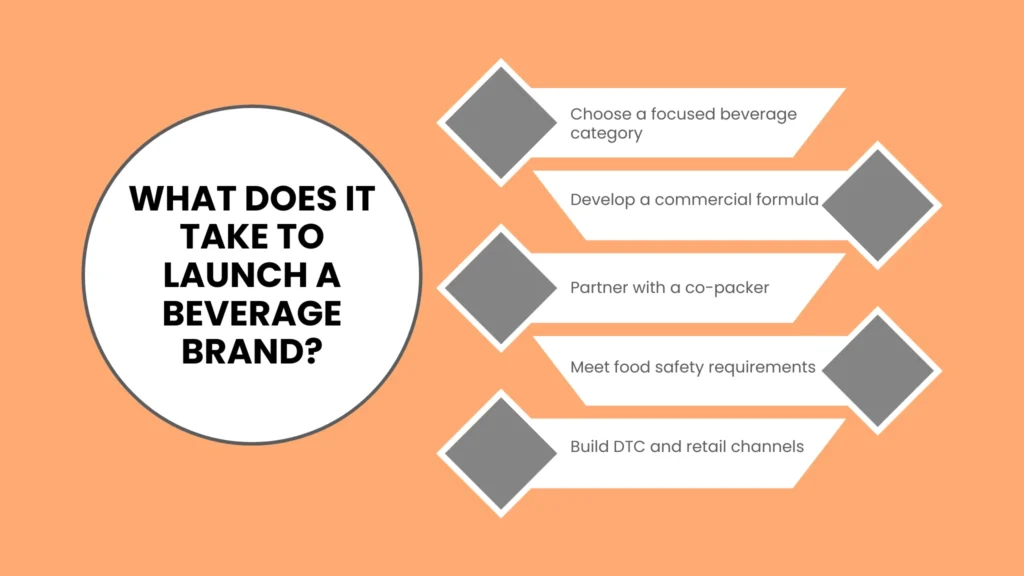
What Does It Take to Launch a Beverage Brand?
To launch a beverage brand, founders must take a liquid formulation from a kitchen or lab prototype through commercialization, mass manufacturing, and retail distribution. Unlike digital software businesses, physical drink companies require tangible inventory management, specialized packaging lines, cold-chain or shelf-stable logistics, and strict regulatory oversight.
Modern drink startups usually fall into several fast-growing market categories:
Functional Beverages: Adaptogen-infused sparkling waters, nootropic drinks, and gut-health sodas.
Ready-To-Drink (RTD) Teas & Coffees: Cold brews, matcha lattes, and nitro-infused canned drinks.
Hydration & Electrolytes: Clean sports drinks, coconut waters, and powdered mix-ins.
Non-Alcoholic (NA) Spirits & Craft Sodas: Zero-proof aperitifs, botanical mixers, and premium craft sodas.
Regardless of your category, success relies on partnering with commercial formulators and contract manufacturers (co-packers) rather than building expensive manufacturing facilities from scratch.
Is Launching a Beverage Brand Profitable?
Before committing significant capital, every founder asks: is launch a beverage brand profitable? The short answer is yes. However, physical drink brands require careful cash flow management to stay profitable during early retail expansion.
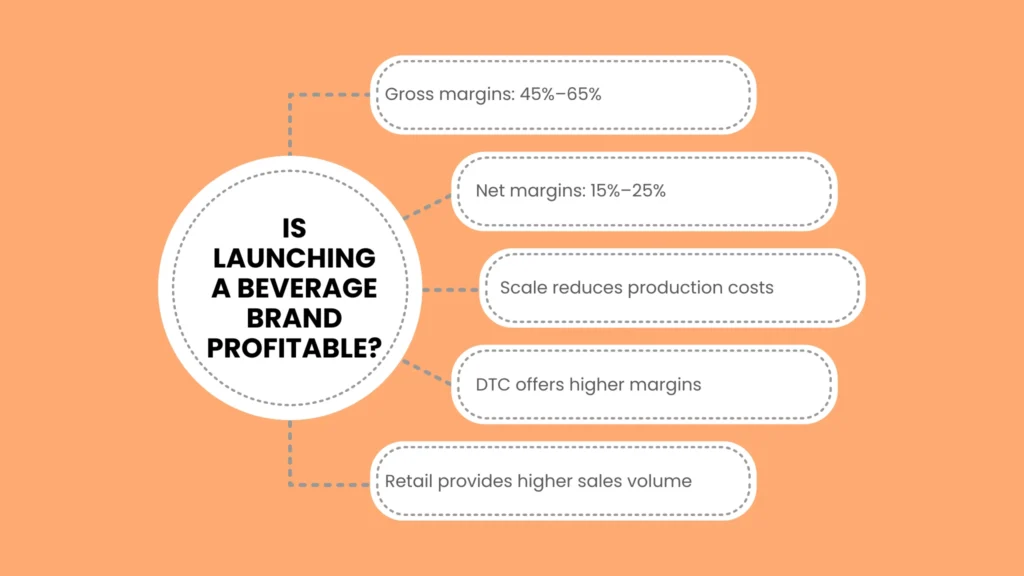
Profitability in the drink sector depends heavily on production scale. Initial small-batch production runs yield lower margins due to high per-unit packaging and ingredient costs. As order volumes grow, purchasing raw materials in bulk and securing lower co-packer fees significantly reduces your Cost of Goods Sold (COGS).
When evaluating overall financial viability, a mature drink business targets an average launch a beverage brand profit margin of 45% to 65% on gross product sales at the brand level. Net profit margins typically land between 15% and 25% after accounting for distributor margins, retail trade spend, marketing, and freight logistics.
Key Revenue Channels
Direct-to-Consumer (DTC): High-margin online sales (single purchases and subscriptions) that build direct relationships with early adopters.
Specialty & Independent Retail: Premium placement in independent grocery stores, cafes, and specialty markets where shelf placement is easier to secure.
Regional & National Grocery: High-volume distribution through major grocery chains, managed via regional brokers and food distributors.
Foodservice & Corporate Offices: Supplying office micro-kitchens, hotel mini-bars, restaurants, and university campuses.
Launch a Beverage Brand Cost Breakdown
Understanding the overall launch a beverage brand cost helps founders raise appropriate seed capital and avoid running out of cash mid-production. Expenses vary depending on your product formulation, liquid processing requirements (such as hot-fill, tunnel pasteurization, or cold-pressed HPP), and packaging types (aluminum cans vs. glass bottles).
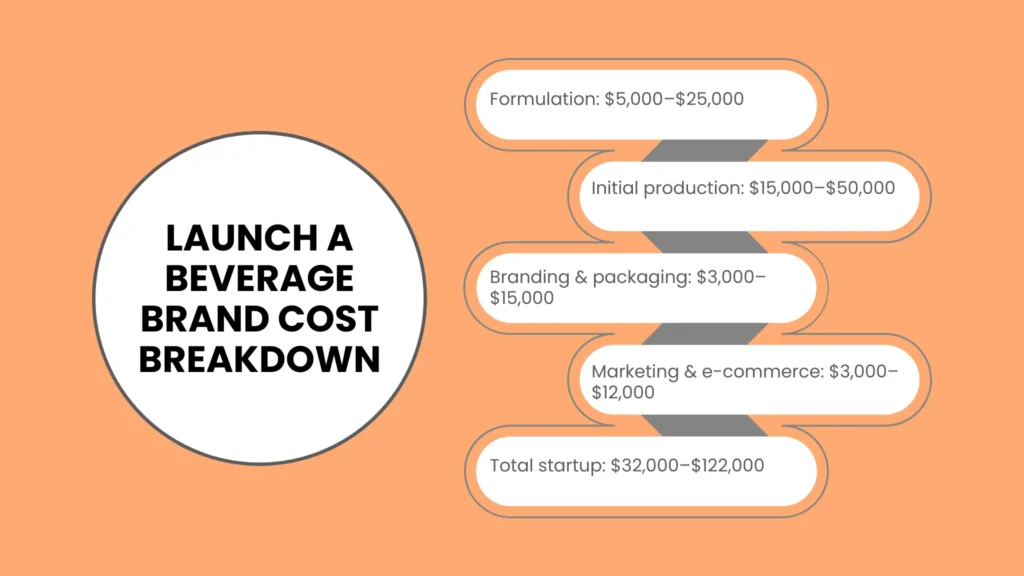
Based on available industry data, launching an initial commercial batch of a beverage brand typically costs between $35,000 for a lean online-first launch up to $150,000+ for a regional retail rollout.
Estimated Startup Capital Breakdown
| Expense Category | Estimated Cost Range | Key Details and Components |
| Formulation & Lab Development | $5,000 – $25,000 | Professional food scientist fees, flavor matching, and stability testing. |
| Branding & Packaging Design | $3,000 – $15,000 | Brand identity, die-line design, and compliant nutrition label formatting. |
| Initial Production Run (Co-Packer) | $15,000 – $50,000 | Minimum Order Quantity (MOQ) run including ingredients, cans/bottles, and labor. |
| Regulatory & Food Safety Lab Tests | $1,500 – $5,000 | Shelf-life validation, micro-testing, and FDA facility filings. |
| Warehouse & Initial Logistics | $2,000 – $8,000 | Pallet storage, temperature-controlled freight, and fulfillment setup. |
| E-Commerce & Digital Marketing | $3,000 – $12,000 | Website development, digital ad launch, photography, and influencer gifting. |
| Legal, Trademarks & Insurance | $2,500 – $7,000 | Corporate entity setup, trademark filings, and general product liability insurance. |
| Total Estimated Initial Investment | ** $32,000 – $122,000** | Total capital required to complete your first commercial production run. |
Crucial Launch a Beverage Brand Requirements
To bring a drink product to market legally and safely, you must meet strict industry regulations. Satisfying these core launch a beverage brand requirements protects your company from regulatory holds, product recalls, and retailer rejections.
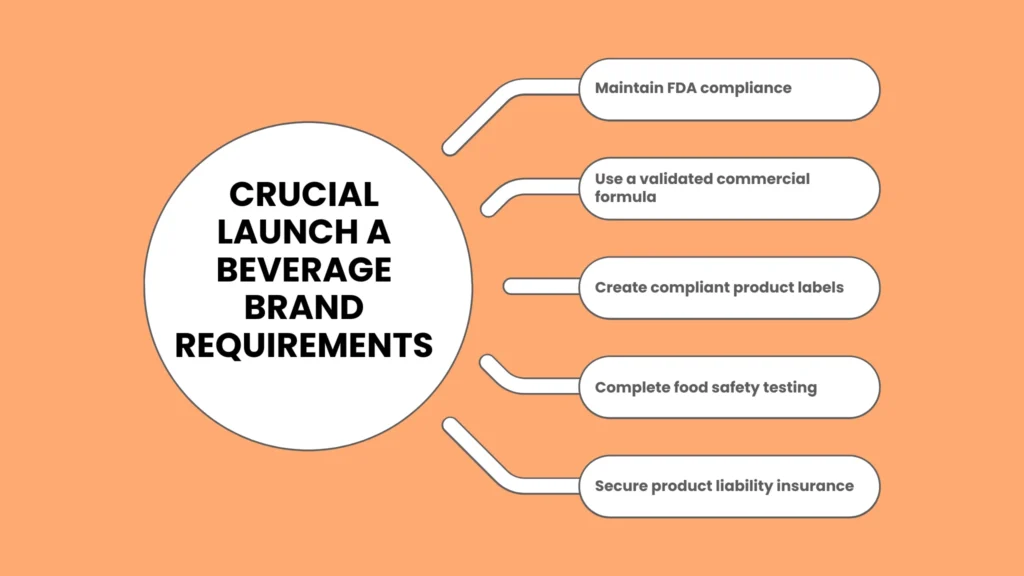
1. FDA Compliance and Facility Registration
In the United States, all food and beverage production facilities must register with the Food and Drug Administration (FDA) under the Food Safety Modernization Act (FSMA). When working with a third-party co-packer, ensure their facility maintains current FDA registrations, Good Manufacturing Practices (GMP) compliance, and active Hazard Analysis Critical Control Point (HACCP) plans.
2. Formally Validated Formulation and Process Authority
Commercializing a beverage requires converting a kitchen recipe into a scalable, lab-tested formula. A certified Process Authority must review low-acid or acidified canned drinks to establish thermal processing parameters (temperature and hold times) that prevent bacterial contamination.
3. Compliant Product Labeling
Beverage packaging must adhere to strict regulatory guidelines:
Standardized Nutrition Facts or Supplement Facts panel.
Clear net quantity declaration on the principal display panel.
Accurate statement of identity (for example, “Sparkling Juice Beverage”).
Complete ingredient listing arranged by weight, alongside major allergen disclosures.
Manufacturer or distributor contact address.
4. Product Liability Insurance
Retailers and distributors will not place your product on store shelves without proof of commercial general liability insurance. Most retail buyers require a minimum of $1,000,000 to $2,000,000 in product liability coverage.
How to Launch Your Beverage Brand Step by Step
Top startup founders follow a disciplined process to move from concept to retail distribution. Follow this step-by-step roadmap to launch your drink brand efficiently.
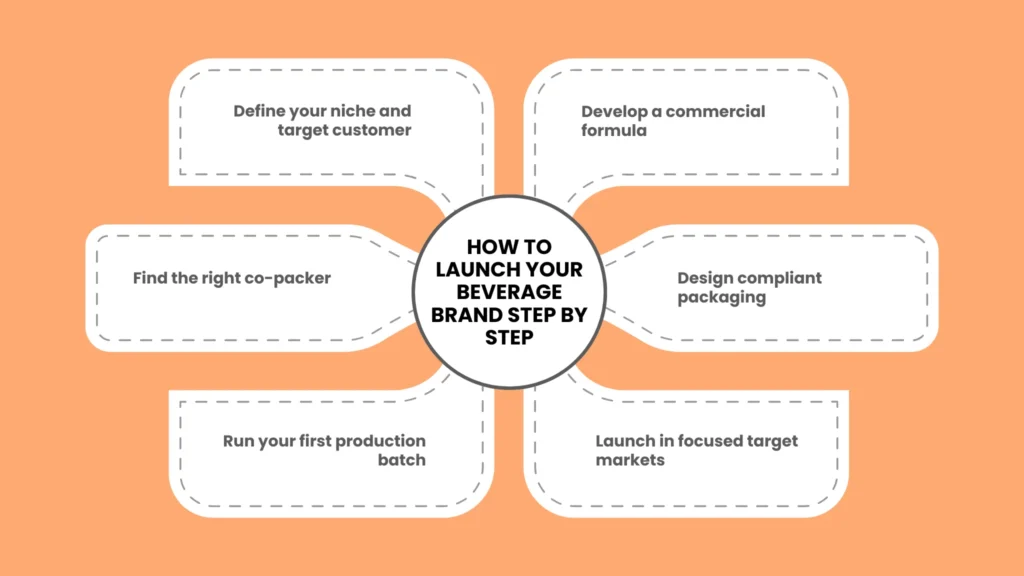
Step 1: Identify Your Market Gap and Position
Define what makes your drink unique. Is it a lower sugar content, a functional benefit (such as focus or relaxation), or a distinct flavor pairing? Study existing category leaders, analyze competitor price points, and identify target retail channels.
Step 2: Develop a Commercial Formula
Work with a specialized beverage formulator or food scientist to develop your recipe. Homemade recipes often use ingredients that spoil quickly or separate over time. A professional formulator balances pH, sweetness, acidity, and preservatives to ensure a shelf-stable product that tastes great.
Step 3: Partner with the Right Co-Packer
A co-packer (contract manufacturer) brews, blends, cans, or bottles your drink using industrial machinery. Search for regional co-packers that handle your specific packaging format (e.g., 12oz sleek cans) and offer Minimum Order Quantities (MOQs) aligned with your starting budget.
Step 4: Source Surcharged Packaging Materials
Order custom-printed cans, labels, glass bottles, caps, and corrugated shipping cartons. Coordinate delivery timelines with your co-packer so that raw ingredients (flavors, juices, sweeteners) and packaging supplies arrive at the facility simultaneously.
Step 5: Execute Your First Commercial Run
Conduct a pilot production run at your co-packer’s facility. This initial run tests line speeds, verifies filling consistency, tests seal integrity, and yields finished inventory for microbiological testing, retailer buyer meetings, and initial customer orders.
Step 6: Drive Sales Velocity in Target Markets
Instead of trying to launch nationally on day one, focus on building sales velocity in a specific city or region.
Direct-to-Consumer: Build an e-commerce website on platforms like Shopify to ship multi-packs directly to consumers nation-wide.
Local Retail Execution: Self-distribute to local independent grocers, coffee shops, and boutique markets. Visit store managers in person to secure prime shelf space at eye level.
Demonstrations and Sampling: Conduct in-store sampling events. In the beverage industry, liquid-to-lips is the single most effective conversion strategy.
Common Operational Hurdles and Solutions
Running a beverage company presents distinct supply chain challenges:
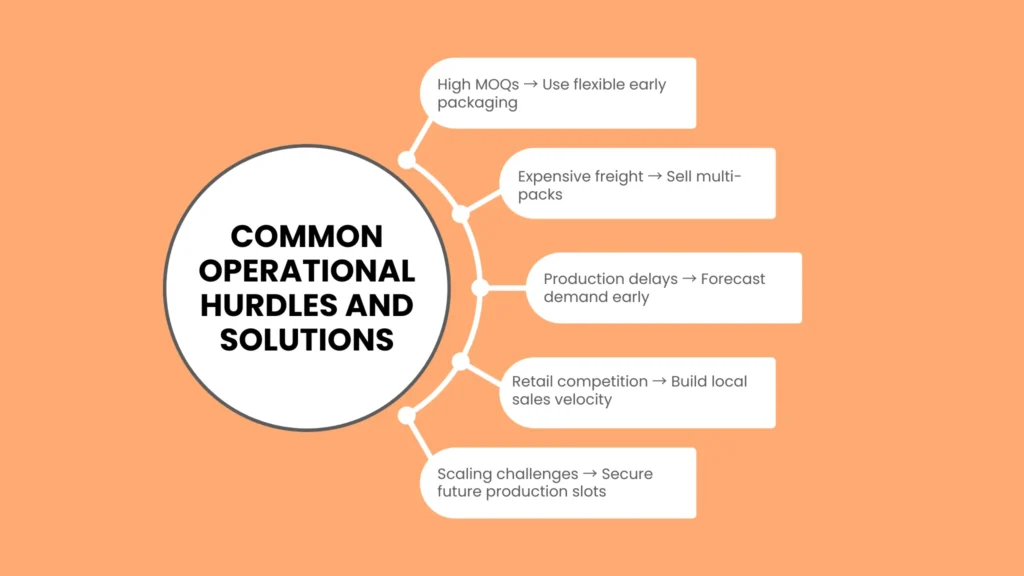
High Minimum Order Quantities (MOQs): Can manufacturers often require minimum orders of 100,000+ custom-printed cans.
Solution: Use pressure-sensitive labels or digitally printed shrink sleeves over blank (bright) cans for your early, small-batch runs.High Freight and Shipping Weights: Liquids are heavy, making direct-to-consumer shipping expensive.
Solution: Charge realistic shipping fees, offer multi-packs (12-packs or 24-packs) to raise your average order value, and transition customers toward retail purchasing.Out-of-Stock Risk and Production Delays: Co-packers often schedule production slots months in advance.
Solution: Maintain a rolling 6-month demand forecast and lock in future manufacturing dates well before running out of inventory.
Final Thoughts: Launching Your Drink Brand
Learning how to launch a beverage brand allows you to build a recognizable consumer company in a high-demand market. By securing a commercial formulation, partnering with an audited co-packer, enforcing strict food safety controls, and driving local sales velocity, you can build a scalable and profitable business.
Focus on creating a great-tasting product, managing your unit economics carefully, and building genuine connections with your early customers. Over time, expanding distribution across regional and national channels will establish your brand as a lasting market presence. For detailed startup frameworks, financial modeling tools, and operational growth guides, explore additional resources at reliablestartup.com.
Frequently Asked Questions
How much capital do I need to start a beverage brand?
While lean entrepreneurs can test small-batch runs using specialized local co-packers for around $30,000 to $50,000, launching a competitive retail beverage brand with full custom packaging generally requires between $70,000 and $150,000+.
What is a co-packer and why do I need one?
A co-packer is a contract manufacturing facility that blends, processes, and packages your drink using industrial equipment. Working with a co-packer allows you to produce thousands of finished units per hour without spending millions of dollars building your own factory.
How do I get my drink onto major grocery store shelves?
Start by building strong local sales velocity in independent stores. Once you can prove that your product sells quickly off the shelf, submit product applications to regional buyers, hire specialized food brokers, and present your brand at trade shows like Expo West or Summer Fancy Food Show.
How long does it take to develop and launch a beverage?
Developing a beverage formula, completing stability testing, designing packaging, securing a co-packer, and completing your first commercial production run typically takes between 6 and 12 months.