Passive Income Rental Business: 7 Models Ranked by Effort and Capital
A passive income rental business earns money by renting out an asset, like a property, a room, equipment, or shares of a property fund, with limited daily work. The seven main models include long-term rentals, short-term rentals, rental arbitrage, room rentals, REITs, equipment rentals, and built-for-rent properties. Capital ranges from under $100 for REITs to $50,000+ for vacation rentals. The most automated rental business options use property managers, smart tech, and software for true hands-off income.
Most passive income advice skips the one model that actually works at scale. A passive income rental business pays you for owning or controlling something other people need. And right now, more than 35% of U.S. households rent their homes. That demand is not slowing down.
At reliablestartup, we match people to recurring income ideas that fit their wallet and their schedule. So this guide breaks down seven rental models, ranked by how much money you need and how truly hands-off each one is. Basically, you’ll know exactly which model fits you before you finish reading.
What Is a Passive Income Rental Business?
A passive income rental business earns you money by renting out an asset. That asset can be a house, a room, a parking spot, a piece of equipment, or even shares of a property fund. You collect rent. The asset does the work.
Now, no rental business is fully hands-off. Tenants call. Pipes break. Bookings get cancelled. So the smart move is picking a model that matches your time, not just your money. Compared to other recurring income ideas like dividend stocks or digital products, rentals give you something physical, something that usually grows in value while it pays you each month.
How Passive Is Your Passive Income Rental Business, Really?
Here’s something most blogs won’t say out loud. A vacation rental you manage yourself is basically a part-time job. Meanwhile, a REIT in your brokerage account is genuinely passive.
So we use a simple Passivity Scale from 1 to 5:
- Level 5: Fully hands-off (REITs, fractional shares)
- Level 4: Light oversight (built-for-rent, equipment rentals)
- Level 3: Monthly check-ins (long-term rentals, room rentals)
- Level 2: Weekly work (short-term rentals, arbitrage)
- Level 1: Almost a full-time gig (self-managed Airbnbs)
Pick your level first. Then pick your model.
7 Rental Side Hustle Models Ranked by Effort & Capital
Each option below works as a rental side hustle. Some need cash. Some need hustle. A few need both.
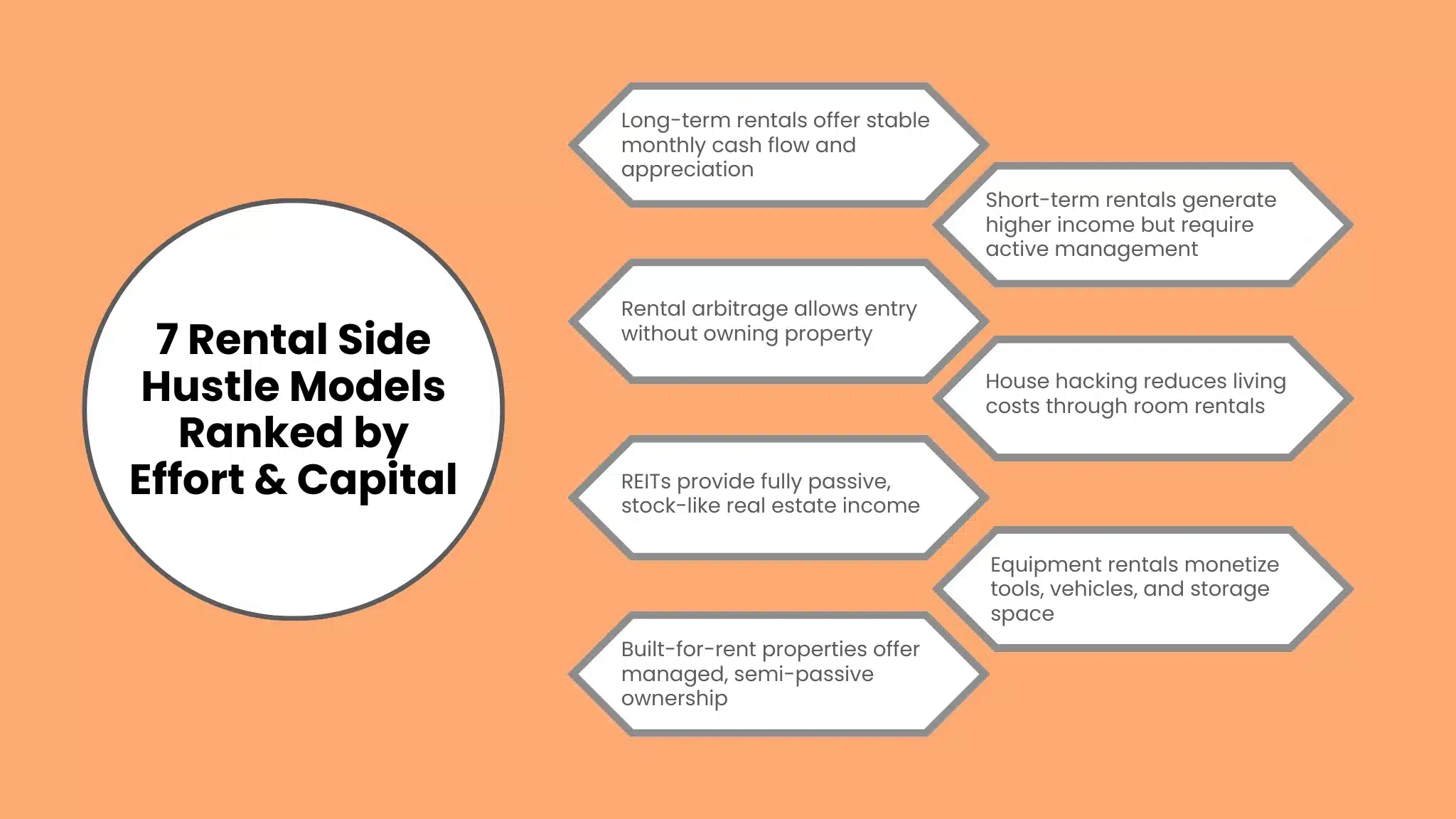
1. Long-Term Rental Property — The Classic Passive Income Rental Business
Capital: $30,000+ down payment | Passivity: 3/5 | Best for: Capital-rich beginners
You buy a single-family home or duplex. Then you sign a one-year lease with a tenant. They pay rent every month. So the cash flow is predictable, vacancies stay low, and the property usually appreciates.
Average net cash flow per door in 2026 sits between $200 and $600 a month after the mortgage, taxes, and repairs.
2. Short-Term Vacation Rental (Airbnb / VRBO)
Capital: $50,000+ | Passivity: 2/5 | Best for: Tourist-heavy markets
Short-term rentals charge nightly rates that beat long-term rents by two or three times. Meanwhile, you deal with cleaning crews, guest messages, and city regulations. Profitable, but not lazy money.
3. Rental Arbitrage: A Zero-Property Rental Side Hustle
Capital: $5,000–$15,000 | Passivity: 2/5 | Best for: Low-capital starters
You lease a unit from a landlord. Then you furnish it and re-list it on Airbnb at a higher nightly rate. Basically, you keep the spread. So you don’t need to own anything. Just get the landlord’s written permission first.
4. Rent-by-the-Room / House Hacking
Capital: $0–$10,000 | Passivity: 3/5 | Best for: Current homeowners
Rent out a spare room, basement, or ADU. Whether it’s one tenant or three, the rent often covers your whole mortgage. Consequently, this is the cheapest way to start.
5. REITs: The Most Hands-Off Passive Income Rental Business
Capital: $100+ | Passivity: 5/5 | Best for: Total beginners
A Real Estate Investment Trust owns and manages rental properties on your behalf. You buy shares like a stock. So they pay you dividends from rent collected across hundreds of buildings. No tenants. No toilets.
6. Equipment & Storage Rentals
Capital: $5,000–$20,000 | Passivity: 4/5 | Best for: People with garage or land
Rent out cars on Turo, tools on Sparetoolz, or storage space on Neighbor. Whether it’s a trailer, a camera kit, or empty driveway space, niche rentals fly under the radar of most “real estate” advice.
7. Built-for-Rent or Turnkey Properties
Capital: $40,000+ | Passivity: 4/5 | Best for: Investors who want a managed asset
A company builds the property, places the tenant, and runs the management for you. So you wire the down payment and start collecting rent within weeks.
Capital Required: Recurring Income Ideas for Every Budget
Not every recurring income idea needs deep pockets. Here’s what fits each tier:
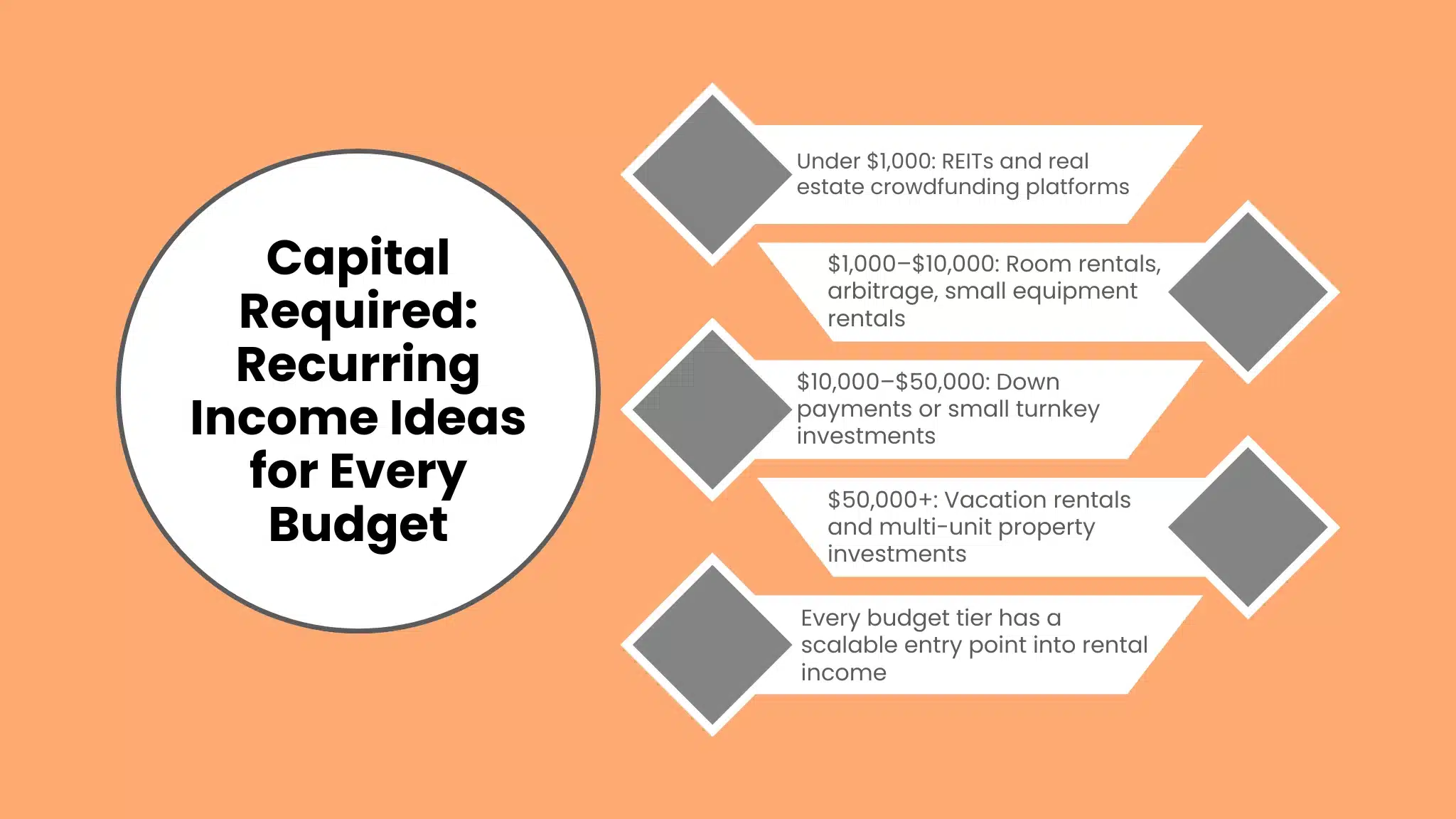
- Under $1,000: REITs, real estate crowdfunding (Fundrise, Arrived)
- $1,000–$10,000: Rental arbitrage, equipment rentals, room rental
- $10,000–$50,000: Down payment on a long-term rental, small turnkey property
- $50,000+: Vacation rentals, multi-unit buildings, built-for-rent homes
Whether you have a hundred bucks or fifty grand, there’s a model that fits. So don’t wait until you have enough. Start at your tier.
How to Build an Automated Rental Business
The difference between a stressful landlord life and a real automated rental business comes down to systems. Set them up early. Thank yourself later.
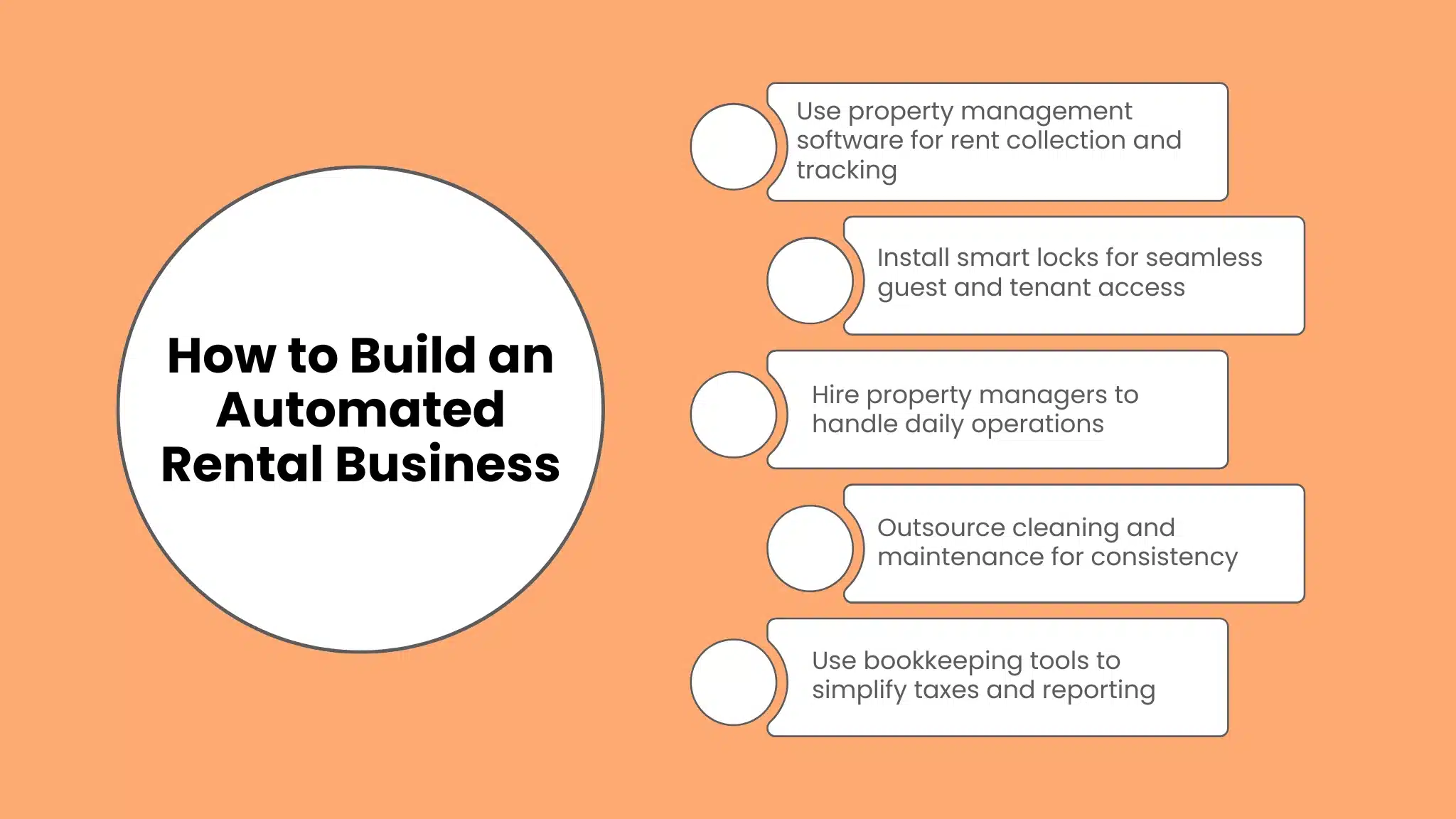
- Use property management software like Stessa or Hemlane for rent collection and screening
- Install smart locks for self check-in (key for short-term rentals)
- Hire a property manager for 8% to 12% of monthly rent
- Outsource cleaning and maintenance to vetted vendors on a recurring schedule
- Track everything with bookkeeping software so taxes take an hour, not a weekend
Basically, your goal is to remove yourself from the daily flow. So when something breaks, the system handles it. You just see the deposit hit your account.
Common Mistakes That Kill Rental Cash Flow
Most failed rentals fail for the same reasons:
- Underestimating vacancy. Always budget 8% to 10% of the year as empty
- Skipping tenant screening because the unit “needs to be filled”
- Buying based on the listing price instead of the rental yield
- Ignoring local short-term rental laws (some cities ban them outright)
- Running with no cash reserve, so a $4,000 HVAC repair wipes you out
Avoid these five and you’re already ahead of half the market.
Quick Tax Snapshot for Your Passive Income Rental Business
The IRS treats most rental income as passive under Publication 925. So your earnings get taxed at your normal income rate, but you also get deductions for mortgage interest, repairs, depreciation, and management fees. Real estate professionals (750+ hours per year in real estate) can treat rental income as active and unlock bigger loss deductions. Talk to a CPA before filing. Tax rules shift, and your situation is unique.
Final Thoughts
There’s a passive income rental business model for every capital level and every schedule. Whether you start with $100 in a REIT or $50,000 in a vacation home, the right systems turn it into a real automated rental business that pays you while you sleep.
So pick your tier. Pick your model. Then build the systems first and scale second. For more startup blueprints, capital-matched recurring income ideas, and step-by-step rental guides, head over to ReliableStartup. We’ll help you find the model that actually fits your goals, not just the one that sounds good on Instagram.
Frequently Asked Questions
Is a rental business really passive income?
Mostly, yes, but only after setup. Long-term rentals and REITs come closest to truly hands-off. Short-term rentals feel more like a part-time job.
What’s the cheapest rental side hustle to start?
Rental arbitrage and rent-by-the-room. Both can launch under $5,000 if you already have access to a lease or spare space.
How much can I earn from a passive income rental business?
A single long-term rental in the U.S. averages $200 to $600 in monthly net cash flow. Short-term rentals can earn two to three times more, but they take more work.
Do I need to own property to run an automated rental business?
No. Rental arbitrage, REITs, and equipment rentals all work without owning any property at all.
Which rental model has the highest ROI?
Short-term rentals in tourist-heavy cities top the list, but long-term rentals give the best risk-adjusted returns for first-timers.