B2B SaaS Startup Pricing Models Explained With Examples
Pricing is the ultimate growth lever that software founders consistently overlook. While companies obsess over customer acquisition pipelines and feature rollouts, research shows that a minor 1% optimization in your pricing structure can yield a staggering 11% to 12% surge in bottom-line profits.
Choosing the right b2b saas pricing models is not just about slapping a dollar figure on your landing page. Getting your pricing right also directly impacts how efficiently your B2B SaaS lead generation funnel converts, since prospects evaluate cost against perceived value from the very first touchpoint. It is about aligning the financial cost of your software directly with the value your customers extract from it. In this guide, we will break down the dominant B2B software monetization structures, look at real-world saas pricing strategy examples, and evaluate what it takes to build a highly optimized, high-margin revenue engine.
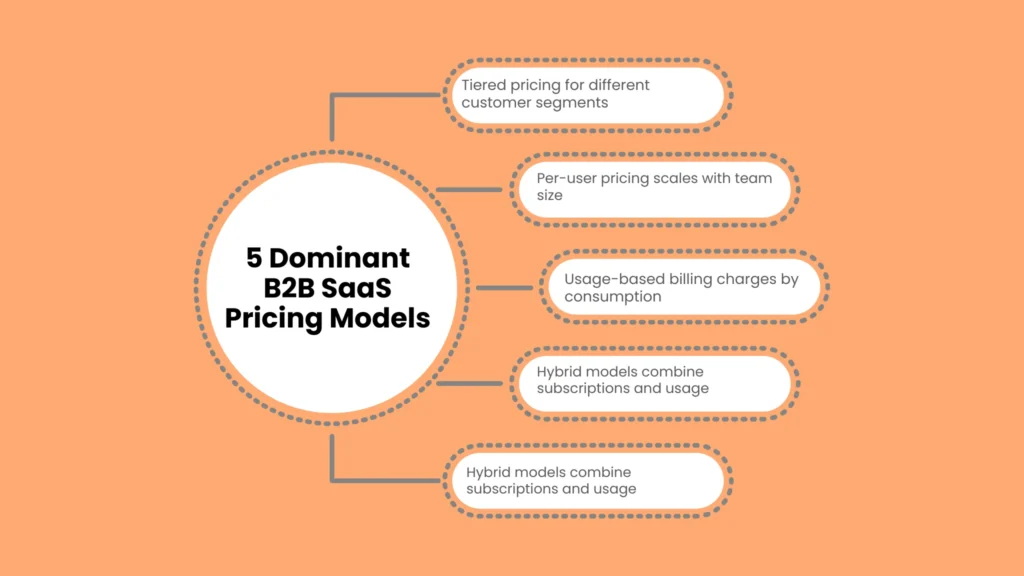
5 Dominant B2B SaaS Pricing Models
A pricing model serves as the structural framework for how you charge businesses—whether you bill by individual headcount, volume of data processed, or specific feature access. Modern enterprise software typically relies on five core frameworks:
1. Tiered Pricing (The “Good, Better, Best” Standard)
Tiered pricing segments your software into multiple distinct packages at varying price points, usually separated by feature sets, usage thresholds, or company size.
How it works: You design specific packages tailored to different customer segments—such as a “Starter” tier for small teams, a “Pro” tier for mid-market scale, and an “Enterprise” tier for large corporations.
Saas pricing strategy examples: HubSpot and Zendesk utilize this framework heavily, locking advanced reporting, automation, and dedicated account management behind higher-tier paywalls.
Key data point: Conversion metrics show that maintaining exactly three tiers converts best; pages displaying four or more choices see a significant drop in purchase likelihood due to decision paralysis.
2. Per-User / Seat-Based Pricing
This traditional framework charges the customer a predictable, flat recurring fee for every individual employee who logs into the platform.
How it works: If your software costs $30 per seat per month and an organization has 10 active team members, their monthly bill is exactly $300.
Saas pricing strategy examples: Salesforce, Slack, and Asana popularized this model. It aligns beautifully with organizational headcount growth—as your customer hires more staff, your expansion revenue increases naturally.
3. Usage-Based / Consumption Billing
Popularized by data infrastructure and developer-focused tools, usage-based models charge clients purely based on how much they actually consume the product.
How it works: Customers pay for measurable units like API calls, gigabytes of storage, or server compute hours.
Saas pricing strategy examples: Twilio charges per SMS sent or voice minute used, Snowflake scales fees based on data compute processing, and AWS charges for raw cloud consumption.
4. Value-Based & Outcome-Based Models
Instead of billing based on input metrics (like seats or data size), value-based frameworks price the software relative to the concrete return on investment (ROI) or specific business outcomes delivered.
How it works: You charge based on quantifiable financial wins or completed tasks.
Saas pricing strategy examples: Intercom utilizes this for its Fin AI Agent, charging a flat $0.99 for every single customer support ticket the AI successfully resolves without human intervention.
5. Hybrid Pricing Models
To balance revenue predictability with growth upside, the vast majority of successful B2B software enterprises combine multiple frameworks into a cohesive hybrid structure.
How it works: A platform might charge a fixed base subscription fee (e.g., $200/month) that includes 5 user seats, while adding a usage-based meter for any extra seats or excessive data consumption beyond that threshold.
Market Shift: Driven heavily by the rise of automated AI agents that don’t fit into traditional human headcount seats, over 61% of B2B SaaS companies now utilize hybrid billing models.
Technical and Operational B2B SaaS Pricing Requirements
Migrating from a simple flat-rate subscription to a high-yielding, multi-layered B2B structure requires robust back-end alignment.
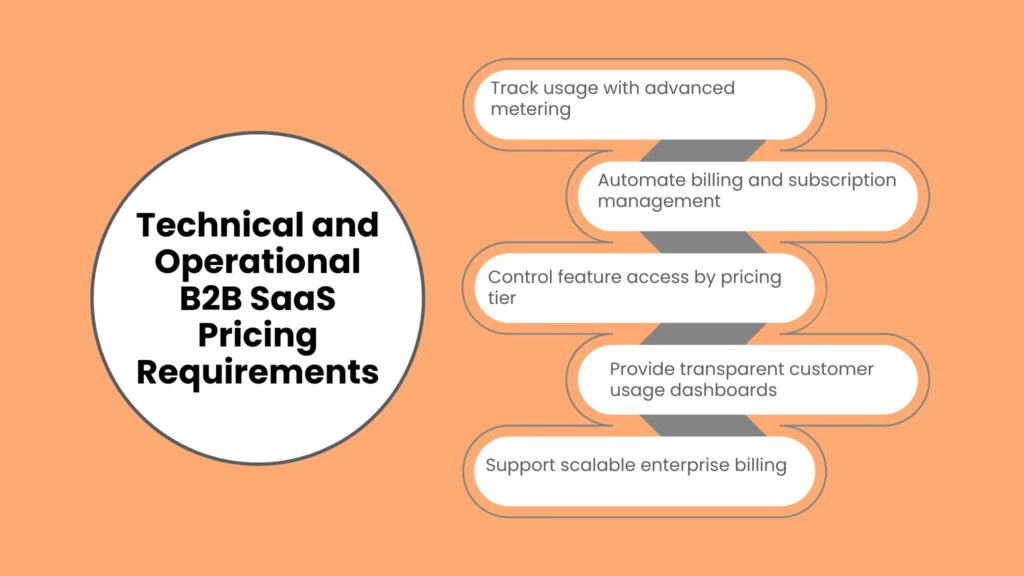
Ensure your technical architecture meets these crucial b2b saas pricing models requirements:
Advanced Metering Infrastructure: If you introduce usage or hybrid elements, your architecture must accurately log every single API call, data point, or action in real time without causing system lag.
Dynamic CPQ & Billing Tools: You need enterprise-grade billing logic engines (like Stripe Billing, Chargebee, or Togai) capable of handling complex pro-rated seat changes, localized currencies, and automated usage tiers.
Granular Gating Logic: Your application codebase must feature tight permission gates that instantly lock or unlock specific modules, limits, or security tools based on the customer’s current paid tier.
Transparent Usage Dashboards: B2B buyers hate surprise bills. You must build accessible customer dashboards showing exact current consumption metrics to prevent end-of-month billing disputes.
Financial Benchmarks: Costs, Margins, and Long-Term Viability
Structuring your monetization correctly directly determines your startup’s enterprise valuation and cash efficiency. Let’s look at the financial realities behind these frameworks.
The True B2B SaaS Pricing Models Cost
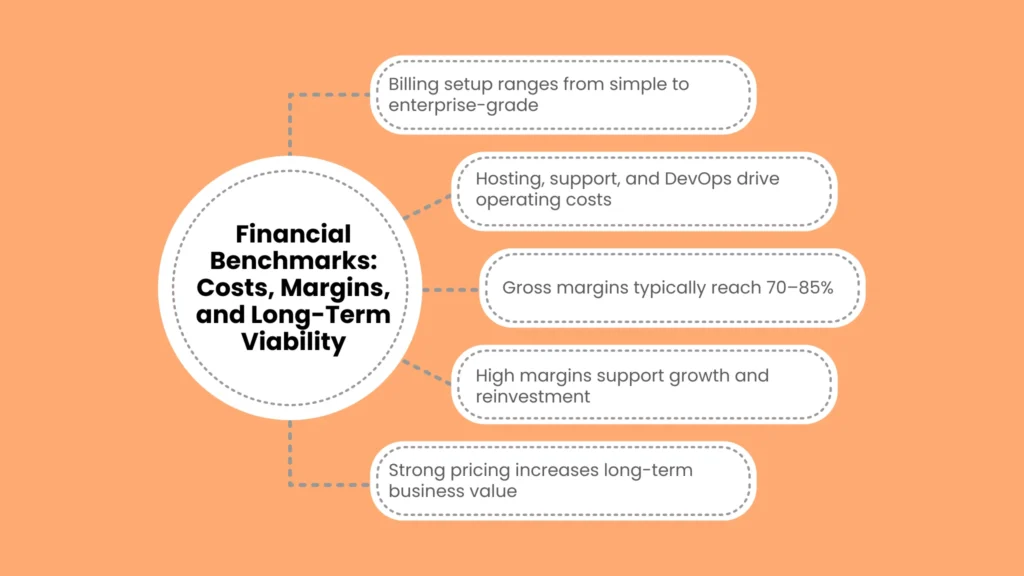
The literal cost of setting up your billing system can range from a few hundred dollars using standard subscription plug-ins to thousands for custom enterprise meters. However, the real “cost” to consider is your Cost of Goods Sold (COGS)—the direct expenses required to deliver the software to the customer.
According to private B2B SaaS benchmarks, hosting infrastructure typically consumes roughly 5% of Annual Recurring Revenue (ARR), customer support and success absorb 9%, and ongoing DevOps processes take around 4%. Understanding these fixed costs ensures you don’t accidentally underprice your usage metrics. Mapping these figures into a proper financial model for your startup makes it far easier to stress-test pricing scenarios before you commit to a structure.
Analyzing the B2B SaaS Pricing Models Profit Margin
Because software code can be distributed globally with negligible manufacturing costs, the standard b2b saas pricing models profit margin (gross margin) sits at a stellar 70% to 85%. Best-in-class, optimized B2B companies regularly hit or exceed an 80% gross margin. This incredible cash efficiency provides founders with ample financial runway to reinvest heavily back into aggressive sales, marketing, and R&D pipelines.
Is B2B SaaS Pricing Models Profitable?
Yes, structuring your product with a value-aligned B2B pricing model is exceptionally profitable. Unlike consumer products, enterprise software enjoys massive contract values and sticky retention rates. While bootstrapped startups often prioritize immediate profitability (with 83% operating at or near break-even), This discipline is especially common among bootstrapped startups, who often prioritize sustainable pricing over aggressive discounting to fund growth without outside capital. venture-backed SaaS platforms frequently leverage their high margins to run at an intentional net loss early on, trading short-term profits for rapid market expansion.
Core Monetization Models Compared
| Pricing Framework | Predictability Level | Upside Expansion Potential | Best Suited For |
| Tiered (Good/Better/Best) | High — Fixed recurring monthly/annual contracts. | Moderate — Relies on organic feature upgrades or plan scaling. | Workflow tools, project management apps, and CRM software. |
| Usage / Consumption | Low — Varies based on customer activity cyclicality. | Massive — Revenue expands infinitely alongside customer growth. | Developer toolkits, unified APIs, database infrastructure, and AI systems. |
| Hybrid Subscription | High — Baseline subscription sets a solid financial floor. | High — Usage metrics capture additional active workloads. | Generative AI platforms, marketing automation, and compliance suites. |
3 Critical Anti-Patterns to Avoid When Pricing Your SaaS
When finalizing your pricing strategy, steer clear of these common pitfalls that can quietly drain early-stage startup revenue:
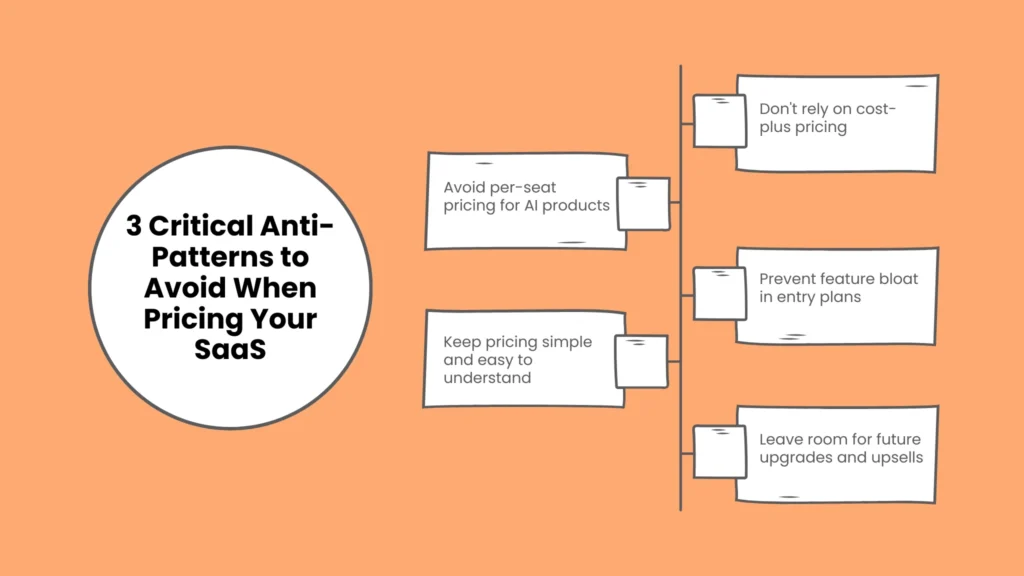
Avoid Rigid Cost-Plus Pricing Strategies
Never calculate your software pricing by taking your internal server costs and simply adding a 30% markup. B2B software buyers pay for business value, not your infrastructure overhead. If your workflow platform saves a corporate logistics team $100,000 in labor every year, charging them a modest $50/month because your hosting costs are low means you are leaving thousands of dollars of hard-earned value completely on the table.
Beware of the “Per-Seat Paradox” in the AI Era
If your software uses advanced artificial intelligence to automate manual work, do not price purely per user seat. If your tool allows a single employee to do the work of a five-person team via AI agents, a per-seat model penalizes your business by only letting you collect one subscription fee while delivering massive enterprise efficiency. In these scenarios, utilize hybrid or outcome-based triggers instead.
Resist the Temptation of Continuous Feature Bloat
When launching your basic package, do not cram 40 different features into a single starter plan. This creates decision paralysis for buyers and limits your ability to upsell later. Keep your introductory tiers simple, focus on your core value proposition, and save specialized tools for premium upgrades.
Conclusion
Finding the ideal monetization model requires an ongoing balance between product utility, financial tracking, and close customer observation. By aligning your software tiers with true business outcomes, monitoring your COGS, and embracing flexible hybrid models, you can maximize your expansion revenue and drive long-term business health. If you are ready to explore step-by-step product playbooks, interactive financial frameworks, and deep startup scaling resources, visit our main platform at reliablestartup to build and grow your software venture today.
Frequently Asked Questions
What is the difference between a pricing model and a pricing strategy?
Your pricing model is the mechanical framework of how you charge (e.g., charging $20 per seat per month). Your pricing strategy is the foundational psychology and market positioning behind your numbers (e.g., choosing to underprice a competitor to win market share, or charging a premium price to signal elite product quality).
Should our startup publish enterprise pricing transparently on our website?
For standard self-serve or mid-market tiers, transparent public pricing builds immediate buyer confidence and slashes friction. However, for large corporate accounts requiring custom security integrations, dedicated SLA metrics, or legal reviews, it is best to use a clear “Contact Sales” call-to-action to maximize your negotiation leverage.
How frequently should a B2B startup update its pricing?
You should conduct a thorough internal review of your value delivery and packaging frameworks quarterly. While you don’t want to actually change your sticker prices for users that frequently, your pricing should steadily adapt and increase as you ship major new features and improve your platform’s core ROI.