How to Find Your First 10 B2B SaaS Customers
Acquiring your very first cohort of paying users is the most demanding phase of the software startup lifecycle. Unlike later growth stages that rely on automated marketing funnels, programmatic advertising, or mature search engine optimization (SEO) pipelines, the initial phase of enterprise customer acquisition requires the exact opposite approach. To succeed, you must embrace unscalable, highly manual, and deeply personal tactics.
Understanding how to find first b2b saas customers effectively prevents you from burning through your pre-seed capital on expensive, broad-spectrum ad campaigns that rarely convert for an unproven brand. In this guide, we will break down the structural mechanics of early customer acquisition saas frameworks, detail the true setup costs, analyze realistic initial margins, and detail the foundational execution requirements needed to turn your early software prototype into a validated, revenue-generating asset.
The Core Philosophy: Do Things That Do Not Scale
When you are hunting for your first ten clients, you are not engaging in traditional marketing; you are engaging in founder-led discovery and direct, relationship-driven sales. The primary objective here is not immediate macroeconomic scaling, but rather uncovering intense qualitative feedback, refining your core product positioning, and securing definitive proof of market demand.
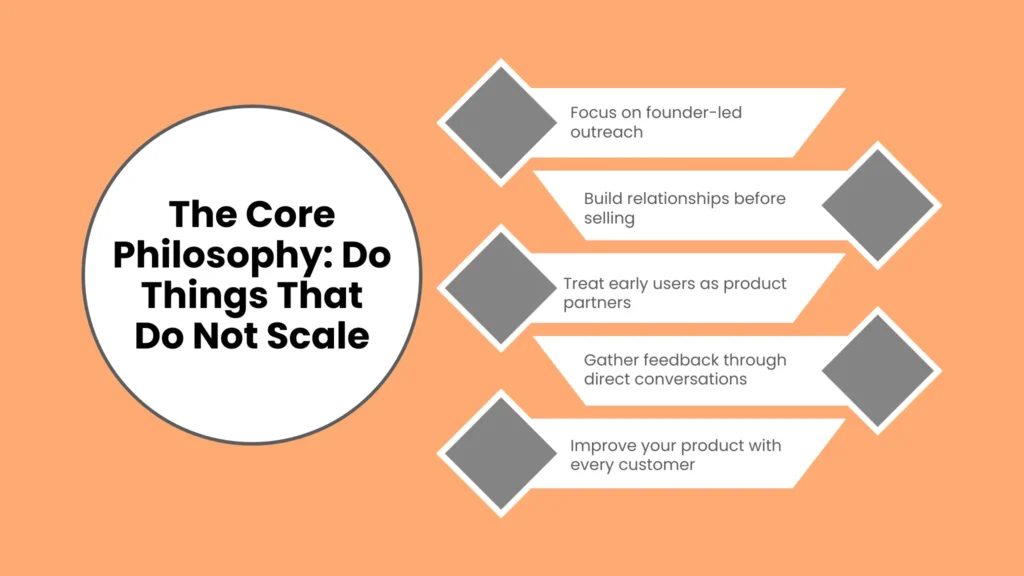
First, you must bypass automated marketing sequences entirely. B2B buyers in the modern era are inundated with generic, AI-generated email blasts, causing response rates for cold, unsegmented outreach to plummet. Instead, leverage your personal professional network, request warm introductions from industry colleagues, and personally embed yourself in hyper-niche digital communities where your target personas actively debate their daily operational frustrations. This manual-first phase eventually feeds directly into a scalable B2B SaaS lead generation engine once you’ve proven your outreach playbook works.
Second, treat your initial users as collaborative design partners rather than mere software transactions. When an early-stage founder demonstrates that they are willing to manually adapt workflows, provide instantaneous customer support, and customize elements to solve a client’s burning operational pain point, it creates a deep trust bond that large, established software competitors simply cannot replicate.
Foundational Technical and Operational Requirements
Before launching direct outreach sprints, your startup must establish a lean, professional technical baseline to capture intent and build immediate B2B credibility.
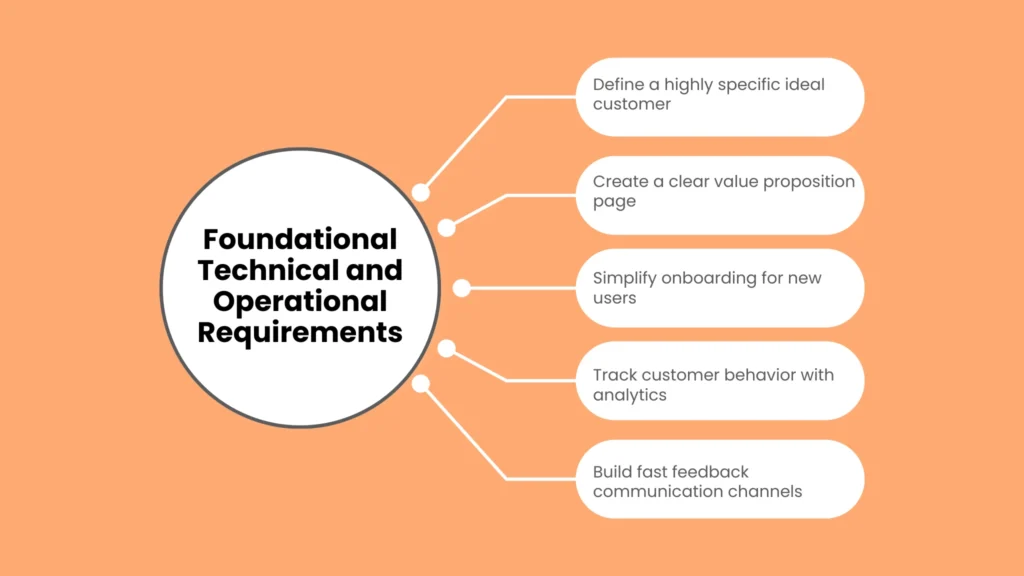
Ensure your operational framework aligns with these critical find first b2b saas customers requirements:
A Hyper-Focused Ideal Customer Profile (ICP): Define an incredibly narrow target segment (e.g., not just “HR managers,” but “payroll compliance directors at mid-sized logistics firms with 50–200 employees”) to keep your messaging razor-sharp.
A High-Clarity Value Proposition Landing Page: Build a clean, professional web page that explicitly articulates the exact business problem you solve, displays crisp product interface screenshots, and features an effortless call-to-action.
Frictionless Product Onboarding Infrastructure: Ensure your technical setup allows you to provision new accounts, adjust feature permissions, and log user data instantly during live onboarding sessions.
Direct Behavioral Analytics Tracking: Embed lightweight product analytics tools to observe precisely where early users encounter friction or abandon your application workflow.
An Agile Feedback Loop Mechanism: Establish direct communication channels—such as shared Slack channels or direct founder messaging access—to capture feature bugs and user critiques in real time.
Financial Benchmarks: Acquisition Costs vs. Software Margins
Launching your early sales sprints requires a careful understanding of initial capital outlays, customer payback timelines, and early software unit economics.
The True Find First B2B SaaS Customers Cost
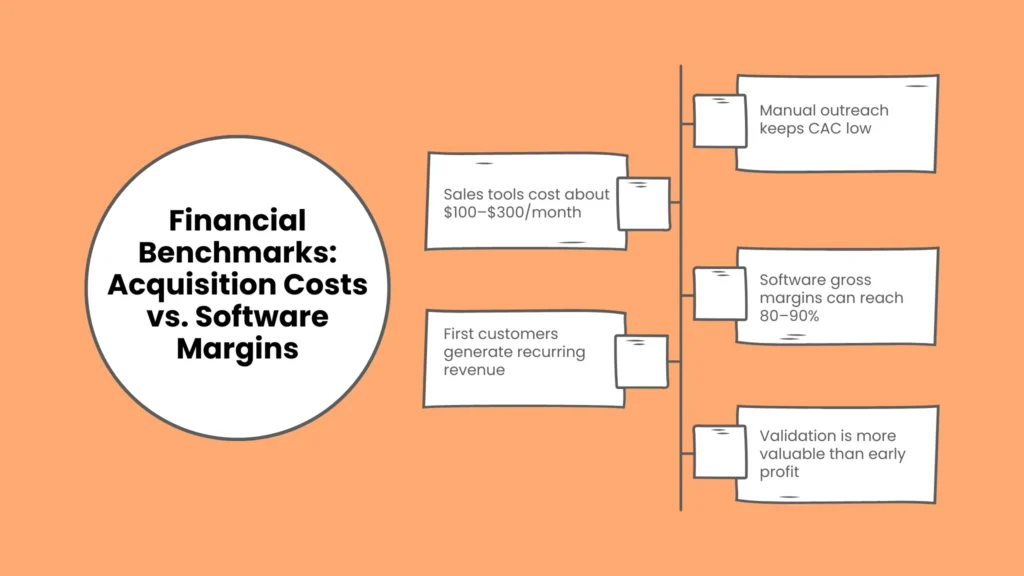
In the early days of a software startup, the literal find first b2b saas customers cost—frequently measured as Customer Acquisition Cost (CAC)—should be kept remarkably low because you are substituting expensive paid media with your own personal time and sweat equity. While average industry-wide B2B CAC can easily soar past $700 to $1,200 for mature companies running paid LinkedIn or Google ad campaigns, your initial manual outreach should cost next to nothing. Your out-of-pocket expenses are restricted to basic operations: roughly $100 to $300 per month for premium B2B data prospecting tools (like LinkedIn Sales Navigator) and specialized CRM software to track your early validation conversations.
Analyzing the Early Phase Profit Margin
Because your initial sales motion relies heavily on manual founder labor rather than massive marketing expenditures, your immediate find first b2b saas customers profit margin (gross margin) can comfortably exceed 80% to 90%. Software code requires near-zero marginal costs to serve to an extra user, meaning almost every dollar collected from your first ten customers flows directly into your core development runway, provided you keep cloud server hosting expenses minimal. Mapping these early numbers into a proper financial model for your startup helps you project when manual acquisition needs to give way to paid channels.
Is Finding Your First 10 Customers Profitable?
Yes, executing a lean, manual search for your first ten accounts is incredibly profitable over the long term, though perhaps not in the form of immediate net cash flow. Is find first b2b saas customers profitable right out of the gate? From a pure cash-flow perspective, ten early customers paying $100 per month yields a modest $1,000 in Monthly Recurring Revenue (MRR), which rarely covers a founder’s full cost of living. However, the true “profitability” of this stage lies in asset validation. Securing ten real companies willing to pay for your unproven product gives you the case studies, testimonials, and verified usage data required to raise outside capital, command higher price points, and systematically scale your future marketing engine. These same case studies and usage metrics become the backbone of a compelling startup business pitch when you’re ready to approach investors.
Core Early Acquisition Channels Compared
| Acquisition Channel | Upfront Capital Required | Execution Speed | Long-Term Strategic Value |
| Warm Professional Networks | Near Zero | Very Fast (Days) | Excellent for rapid UI testing, initial feedback, and glowing early testimonials. |
| Hyper-Personalized Cold Outreach | Very Low ($100-$300/mo) | Moderate (Weeks) | Validates whether your cold market value proposition can cut through industry noise. |
| Niche Industry Communities | Zero (Requires heavy time) | Slow (1-2 Months) | Builds authentic brand authority, deep organic trust, and long-term referrals. |
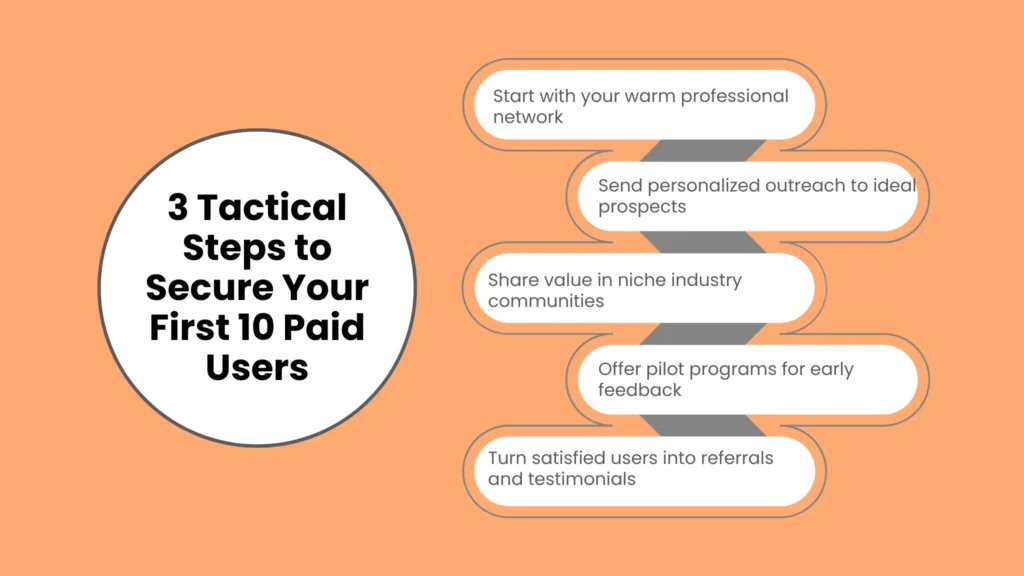
3 Tactical Steps to Secure Your First 10 Paid Users
To methodically transition from zero users to your first ten active accounts, execute this high-impact, founder-led outbound playbook:
1. Map and Segment Your Warm Network
Compile a comprehensive list of the top 100 professionals you know personally or can easily reach via a mutual introduction. Segment them strictly by who matches your defined ICP. When you reach out, do not execute a aggressive sales pitch. Instead, position the conversation entirely around expert product discovery. Ask deep questions about their daily operational roadblocks, show a brief interactive preview of how your software solves those specific friction points, and ask if they would be open to running a highly discounted pilot program in exchange for direct feedback.
2. Execute Hyper Personalized Outbound Sprints
For prospects outside your immediate social circle, deploy highly customized outreach campaigns rather than generic bulk messaging templates. Identify 30 high-value ideal targets on LinkedIn. Research their specific business profile, identify a visible inefficiency in their public workflow, and record a brief, 60-second personalized video walk-through demonstrating exactly how your B2B platform solves that single problem. This deep level of personal attention signals true professional dedication and achieves dramatically higher conversion rates than any standard automated email tool.
3. Embed and Provide Value in Niche Ecosystems
Locate the specialized digital spaces where your ideal buyers congregate—whether that is a dedicated professional Subreddit, a private Discord server, an industry Slack community, or a local trade association meetup. Spend your initial weeks completely answering user technical questions, sharing actionable advice, and contributing genuine intellectual value without linking to your business. Once the community recognizes you as a helpful, knowledgeable expert, you can organically introduce your software as an automated solution to the precise problems members are actively complaining about.
Conclusion
Securing your initial cohort of business clients requires an ongoing balance of disciplined founder-led prospecting, highly personalized value delivery, and active listening. By keeping your upfront marketing costs low, focusing intensely on an hyper-focused target audience, and turning early user feedback into raw product improvements, you lay a rock-solid operational foundation for exponential startup growth. If you are searching for step-by-step customer acquisition blueprints, interactive financial models, and founder scaling toolkits, visit our primary platform at reliablestartup to build and expand your software venture today.
Frequently Asked Questions
Should I offer my software completely for free to secure my first 10 users?
Avoid giving your product away completely without any conditions. Free users do not validate market demand because they risk nothing to use your tool. Instead, offer deeply discounted introductory pricing, a specialized money-back guarantee, or an extended free trial that explicitly requires a credit card upfront to verify genuine buying intent.
How do I handle early feature requests from my first few clients?
Listen intently, but filter every request through your core product vision. If an early customer asks for a specialized feature that only benefits their unique business layout, resist the urge to build it. Focus your engineering resources exclusively on building upgrades that solve broad, painful problems shared by your entire target industry market.
When is the right time to transition from manual outreach to paid advertising?
You should only transition to scalable channels like paid ads or heavy content marketing after you have successfully achieved consistent usage and retention with your first 10 to 20 manual clients. Manual sales teach you the exact language, emotional hooks, and feature highlights that resonate with buyers, giving you the insights needed to launch profitable paid marketing campaigns later.