How to Start a Tire Recycling Business in Texas: 2026 Startup Guide
To launch a successful tire recycling business Texas entrepreneurs can scale, you must prioritize compliance with the TCEQ tire recycling standards before investing in heavy machinery. Texas generates millions of scrap tires annually, yet a significant portion remains unmanaged in illegal stockpiles. This supply-demand gap creates a massive opening for professional recyclers who can bridge the distance between waste generators and industrial buyers.
At Reliable Startup, we translate complex environmental regulations into actionable business models. This guide outlines the essential permits, capital requirements, and recycling business Texas grant opportunities necessary to transition from a startup to a high-volume processor.
Why a Tire Recycling Business in Texas Is Worth Starting in 2026
The Texas market is uniquely positioned for growth due to high vehicle density and tightening environmental mandates. With the United States producing approximately 290 million scrap tires annually, existing facilities are operating at peak capacity.
The money side works in two directions, and that is what makes it attractive:
- You charge a gate fee when generators drop off tires.
- You earn again when you sell the processed material.
That processed material is not waste. It turns into crumb rubber, tire-derived fuel, rubber mulch, and rubberized asphalt. Builders, playground makers, and road crews all buy it. So a single tire pays you twice, and that is the core reason a tire recycling business Texas founders launch today can stay profitable for years.
Understanding the Texas Scrap Tire Program
Regulatory compliance is the backbone of this industry. Every operator must strictly adhere to the Texas scrap tire program, which is governed by the Texas Commission on Environmental Quality (TCEQ). The program’s primary goal is to mitigate fire hazards and public health risks (such as mosquito-borne illnesses) associated with unmanaged tire piles.
The core requirement of TCEQ tire recycling compliance is the manifest system. Every tire entering or leaving your facility must be documented. Failure to maintain these records can result in heavy fines or the revocation of your operating authority.
TCEQ Tire Recycling Rules Your Tire Recycling Business in Texas Must Follow
The tceq tire recycling rules split your options into two clear paths, and the path you pick changes what you must register for.
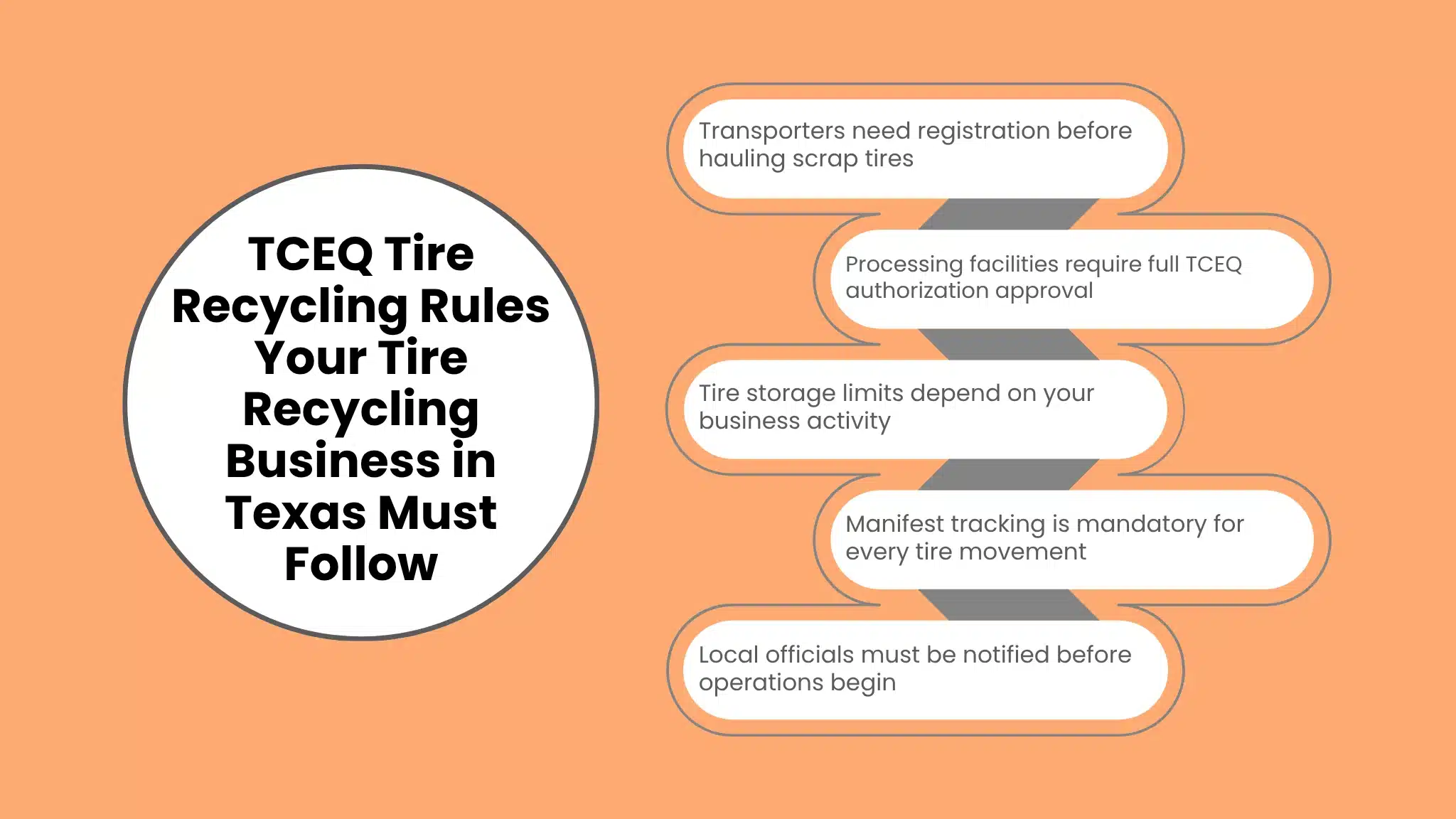
- A scrap tire transporter only needs a registration. You collect and haul, nothing more.
- A processing facility needs full authorization. You cut, shred, grind, or bale, so the rules are stricter.
Storage limits matter too. A processing-only site may keep 500 tires on the ground or 2,000 tires in trailers. But if you recycle on-site or recover energy, you may only hold an approved 30-day supply.
You also have to notify local officials before you open, and that list includes the county judge, the fire authority, and the mayor if you sit inside city limits. So a tire recycling business Texas owner who plans the paperwork early avoids painful delays later.
Permits and Steps to Launch a Tire Recycling Business in Texas
Getting set up follows a clear sequence. Rush it, and you waste money. Follow it, and you save months.
- Confirm demand and line up buyers before you spend a dollar.
- Choose your model: transporter, processor, or both.
- Apply for TCEQ registration or authorization, and wait for approval before you operate.
- Secure a compliant site, then notify your local authorities.
- Set up your manifest tracking system from day one.
Here is how the three main registration types compare, so you can see exactly which one fits your plan.
| Registration type | What it lets you do | Storage limit | Who needs it |
|---|---|---|---|
| Scrap Tire Transporter | Collect and haul scrap tires | Transport only | Collection-only operators |
| Scrap Tire Processing Facility | Cut, shred, grind, or bale tires | 500 on ground / 2,000 in trailers | Shredding and baling businesses |
| Recycling / Energy Recovery | Recycle on-site or make TDF | Approved 30-day supply | Crumb rubber and TDF producers |
Permit timelines run anywhere from 60 days to six months, so build that wait into your launch plan.
Startup Costs and Equipment for a Tire Recycling Business in Texas
Now for the part most guides skip. Real numbers. A tire recycling business Texas startup is capital-heavy, and pretending otherwise sets you up to fail.
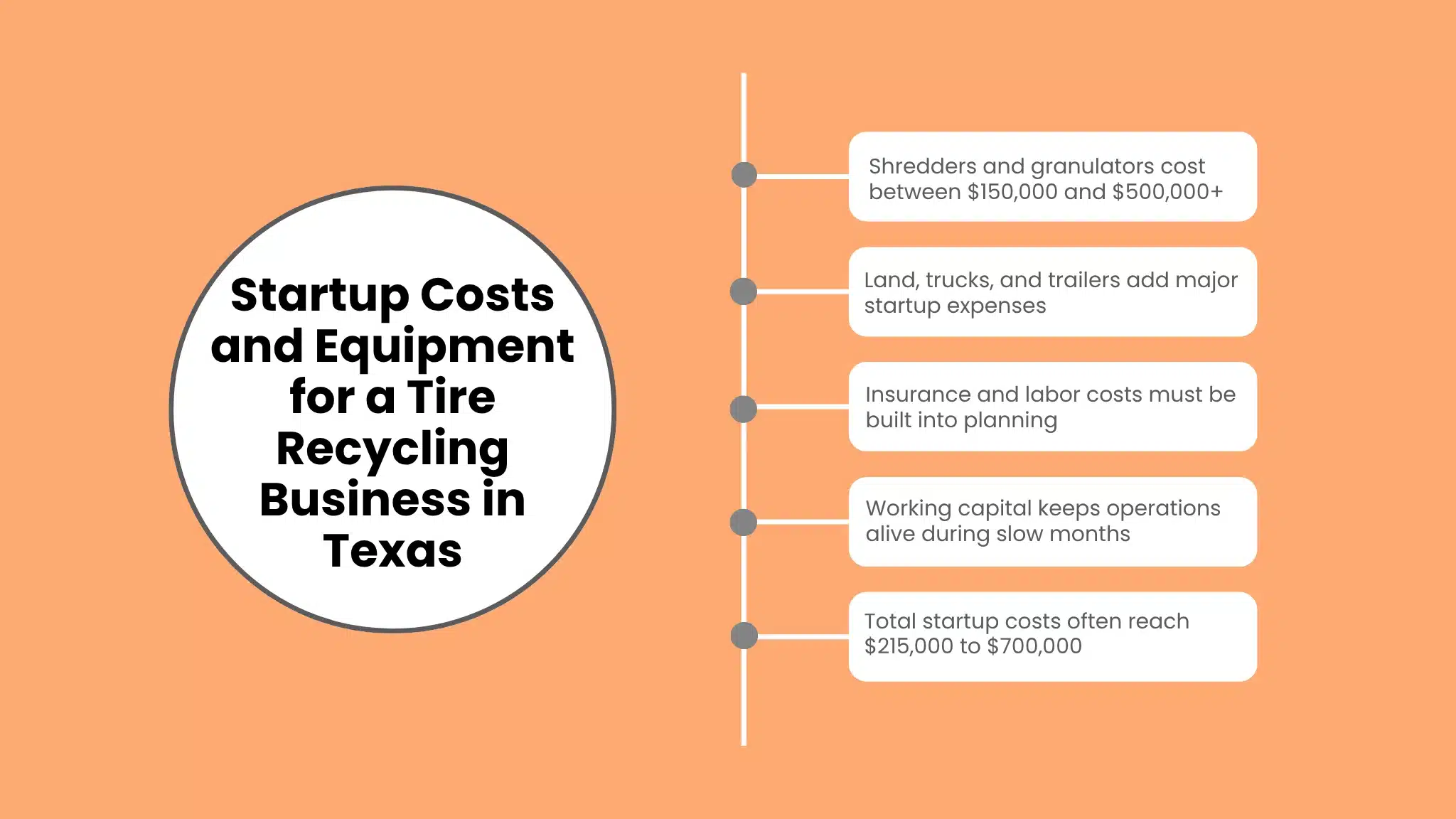
Your equipment alone is the biggest line. Shredders and granulators run from $150,000 to over $500,000, and that range depends on speed and output. Once you add everything else, total startup costs land between $215,000 and $700,000.
Plan for these core expenses:
- Shredders and granulators
- Land or a leased facility with room for storage
- Collection trucks and trailers
- Insurance and TCEQ registration fees
- Labor for operators, drivers, and sorters
- Working capital for the first slow months
That last point trips up new owners the most. Many spend everything on machines, then run dry on cash before the first big payment lands. So keep a buffer, and treat working capital as a real cost and not an afterthought.
Recycling Business Texas Grant and Funding Options
You do not have to bootstrap the entire operation. Several state and federal programs exist to support the circular economy. A recycling business Texas grant or a specialized SBA 504 loan (designed for heavy equipment) can significantly lower your entry barrier.
Start with the obvious route. An SBA small business loan is the most common way founders cover heavy equipment costs.
How to Fund a Tire Recycling Business in Texas Without Draining Savings
Texas and federal programs reward people who clean up scrap tires, and that works in your favor.
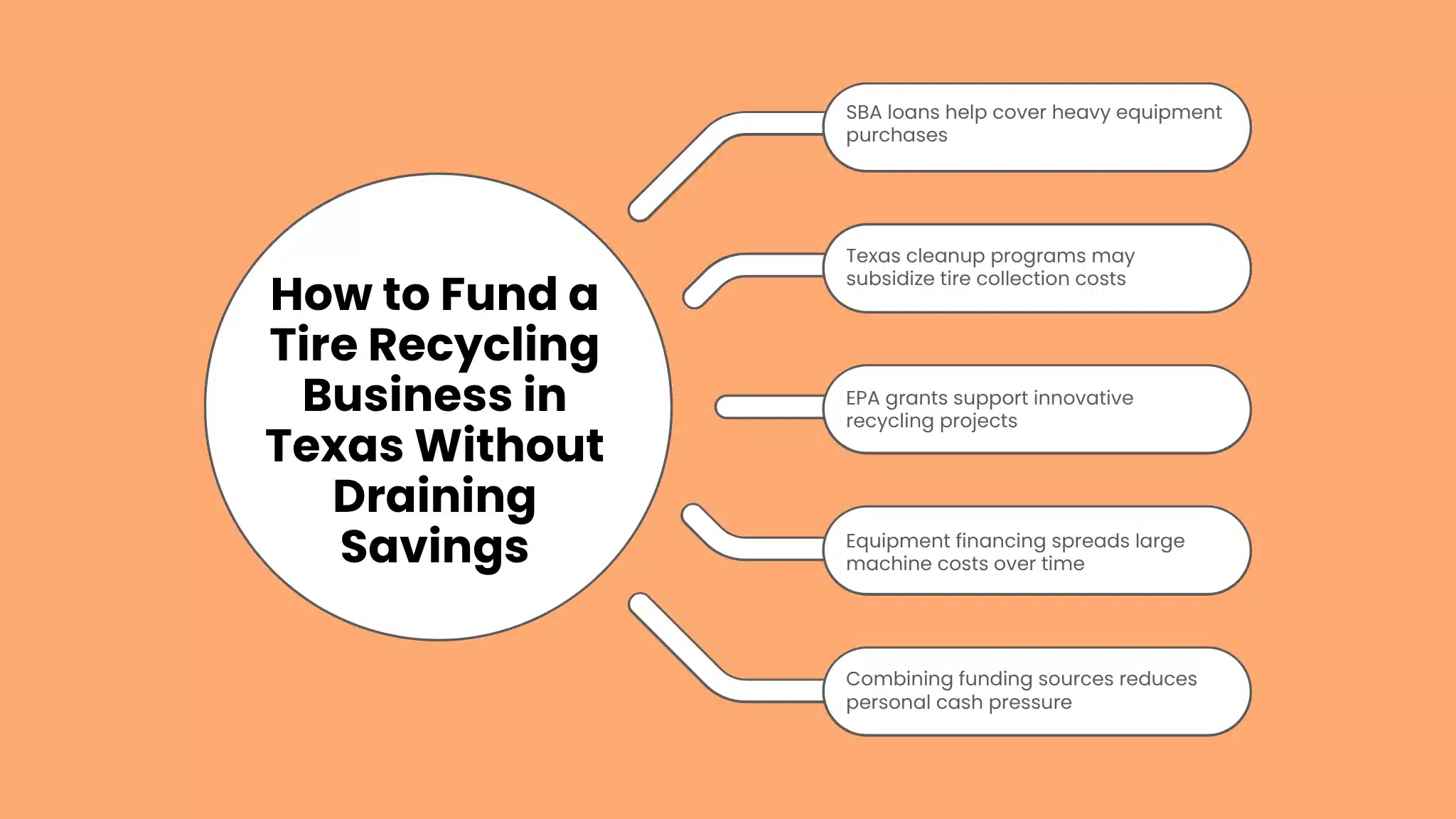
- Texas cleanup and tire amnesty programs sometimes subsidize the cost of collecting tires.
- The EPA offers grants, but mostly for innovative research, so read the fine print.
- Equipment financing and leasing let you spread big machine costs over years instead of paying upfront.
Stack two or three of these, and your out-of-pocket cost drops a lot. So a tire recycling business Texas founder with smart funding can launch faster and breathe easier.
Tyre Recycling Houston Dallas: The Best Texas Markets to Target
For those targeting tyre recycling Houston Dallas markets, the growth potential is exceptional. These metropolitan areas provide the highest density of tire supply and a concentrated pool of industrial buyers (asphalt plants and civil engineering firms).
A successful North Texas operation recently scaled from a single collection vehicle to processing over 6 million tires annually. By establishing your facility near tyre recycling Houston Dallas hubs, you minimize logistics costs—the single biggest drain on recycling margins.
Once you collect, you still need buyers, and Texas has plenty:
- Asphalt companies that mix in rubberized material
- Civil engineering firms
- Playground and athletic surface makers
- Rubber mulch suppliers
So pick a metro with high tire volume, then build steady buyer relationships nearby. That combination keeps both sides of your revenue flowing.
Conclusion
A tire recycling business Texas founders launch in 2026 is both a civic service and a high-yield enterprise. By securing your TCEQ authorization first and locking in off-take agreements with buyers second, you mitigate the risks that typically sink new operators.
At Reliable Startup, we specialize in helping founders navigate the Texas scrap tire program with precision. When you are ready to map out your tyre recycling Houston dallas launch step-by-step, we provide the technical roadmap to ensure your facility remains profitable and compliant.
Frequently Asked Questions
How much does it cost to start a tire recycling business in Texas?
Most operations cost between $215,000 and $700,000 to launch. Equipment is the biggest expense, with shredders and granulators alone running from $150,000 to over $500,000.
Do you need a license for tire recycling in Texas?
Yes. You must register with the TCEQ. A transporter needs a registration, and a processing facility needs full authorization before it can operate.
How many scrap tires can you store in Texas without extra limits?
A processing-only site may store 500 tires on the ground or 2,000 in trailers. If you recycle on-site, you may only keep an approved 30-day supply.
Is a tire recycling business profitable in Texas?
It can be. You earn gate fees when tires arrive and sales revenue when you sell crumb rubber or tire-derived fuel, so the dual income model supports strong margins at the right scale.
What is the Texas scrap tire program?
It is the TCEQ system that controls how scrap tires are collected, stored, transported, and recycled across Texas. It uses manifests and storage limits to keep tires out of illegal dumps.