Portable Toilet Rental Business: How to Land Your First Contracts
Starting a new equipment hire business is highly lucrative, but you cannot make money with your inventory sitting idle in a warehouse. Consequently, if you want to build a sustainable, recurring stream of income, you need to learn how to secure portable toilet rental business contracts right from the start.
Many new business owners mistakenly think that buying inventory is the hardest part of the process. In reality, the real work begins when you attempt to secure consistent clients. Whether you want to focus on dusty commercial construction zones or elegant outdoor weddings, learning how to get portable toilet rental clients is what will keep your business solvent and expanding.
To help you get started, we have put together this comprehensive, fluff-free guide on landing your first commercial accounts, understanding your operational costs, and securing consistent revenue in today’s competitive market.
Why Secure Long-Term Contracts?
The classic business model for portable sanitation relies heavily on recurring, predictable work. One-off backyard birthday party rentals are great for quick cash, but they are incredibly labor-intensive to market, deliver, and coordinate relative to their return.
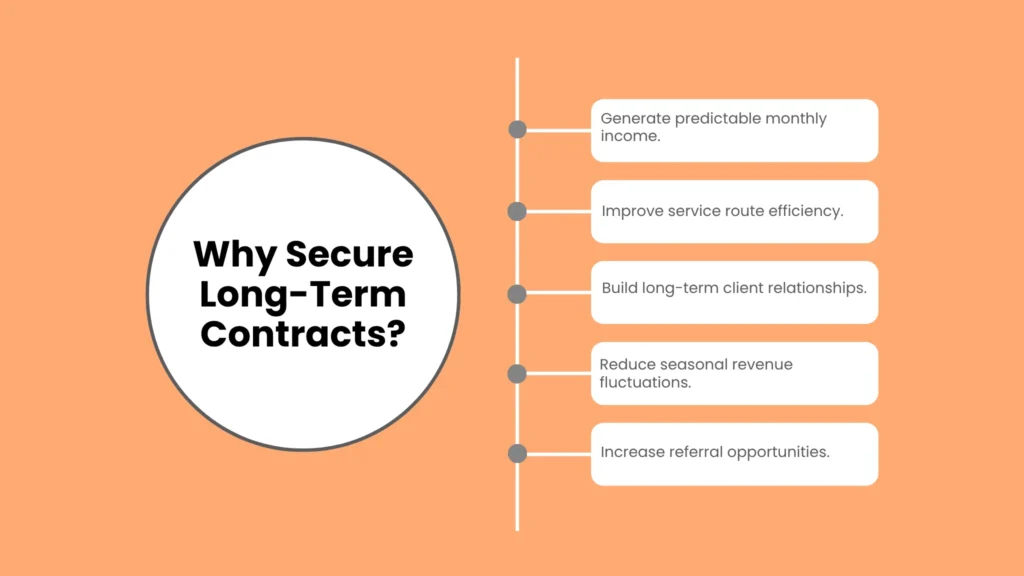
On the flip side, long-term portable toilet rental business contracts act as an anchor for your company. When you secure a multi-month commercial contract, you receive a guaranteed stream of income each month, and your logistics become highly predictable. Therefore, you know exactly where your trucks need to go, how much fuel they will use, and how many service technicians you need on payroll.
Furthermore, long-term contracts allow you to establish strong relationships with local developers and government entities. These relationships often lead to automatic renewals and direct referrals for future projects. Over time, a solid foundation of recurring contracts reduces your dependency on seasonal event peaks, keeping your revenue stable even during the slower winter months a strategy we also cover in our portable toilet rental business startup guide for balancing commercial and event work.
Is the Portable Toilet Business Profitable?
Before investing your hard-earned capital, it is natural to ask: is portable toilet rental business contracts profitable?
Based on current industry data, the answer is a resounding yes. Well-managed portable sanitation companies routinely achieve an impressive portable toilet rental business contracts profit margin of 20% to 50% depending on route density and operational efficiency.
A standard plastic portable restroom unit costs roughly $1,500 to $3,000 to purchase brand new. However, you can rent that single unit out for $150 to $300 per month on long-term commercial sites, or even more for weekend events. Once your asset is paid off, the ongoing costs of chemical refills, water, and fuel are relatively minimal, leaving you with exceptionally healthy margins.
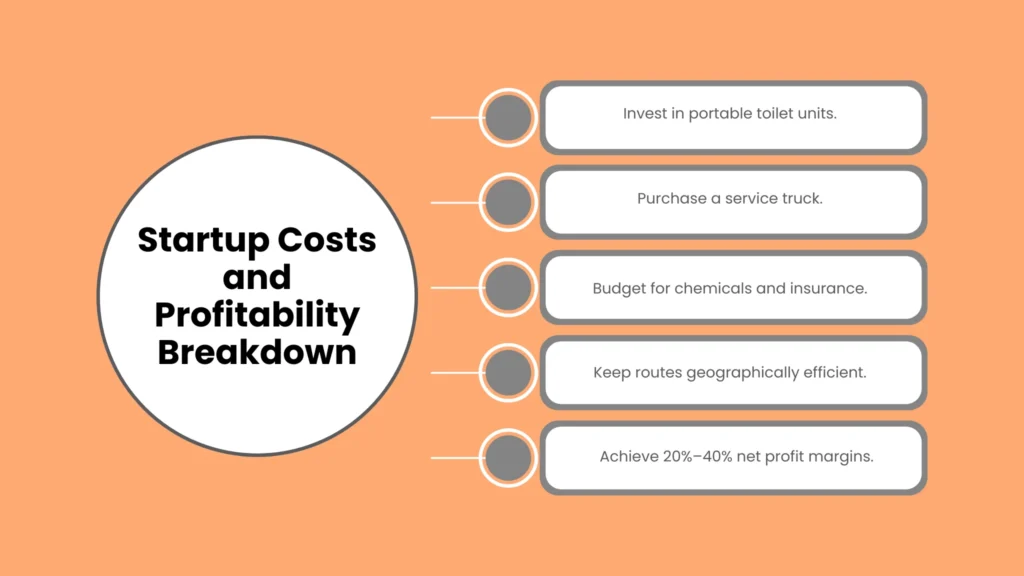
To maximize this profitability, you must carefully calculate your service route density. If your service truck is driving 30 miles between stops, fuel and labor costs will eat into your earnings. By clustering your contracts within a tight geographical area, you drastically reduce your overhead and keep your profit margins on the higher end of the spectrum.
Startup Costs and Profitability Breakdown
To give you a realistic picture of what to expect, we have outlined the estimated financial projections for a new operator launching with a fleet of 20 standard units and a single service truck.
Fleet Financial Estimates
For a broader comparison across different rental models, our rental business profit margins guide breaks down how these numbers stack up against other equipment rental niches
| Financial Metric | Estimated Value | Details and Description |
| Initial Inventory Capital | $50,000 to $80,000 | Purchasing 20 standard units, a small service pump truck, and chemicals |
| Monthly Rental Rate | $150 to $250 per unit | Standard long-term rate including weekly sanitation service |
| Estimated Monthly Revenue | $3,000 to $5,000 | Based on keeping 20 units consistently rented out |
| Monthly Operating Expenses | $1,200 to $2,000 | Covers disposal fees, fuel, cleaning chemicals, and insurance |
| Average Profit Margin | 20% to 40% (Net) | Typical net profit margin after fuel, labor, and overhead |
Portable Toilet Rental Business Contracts Requirements
Before you can legally sign a commercial agreement with a major construction company or a local government municipality, you must meet several regulatory and operational criteria. Commercial clients will not hire an unlicensed or uninsured operator because it exposes them to massive liabilities.
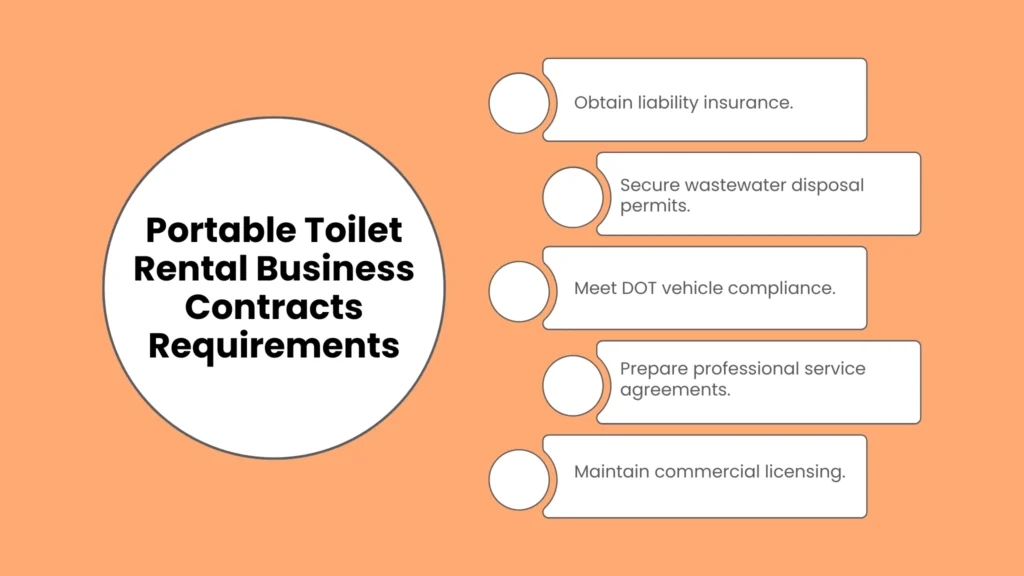
To ensure you are fully prepared, make sure you meet these essential portable toilet rental business contracts requirements:
Commercial General Liability Insurance
You will need a robust commercial general liability policy. Most commercial builders and municipal event planners require a minimum of $1 million to $2 million in coverage to protect against on-site accidents, property damage, or environmental issues.
Wastewater Disposal Permits
You cannot dump septic waste just anywhere. You must establish a formal legal agreement with a local municipal wastewater treatment facility or a licensed waste processing plant, and pay their designated disposal fees.
DOT and Vehicle Compliance
If you are operating a commercial service truck with a vacuum tank to pump out waste, you may need a Commercial Driver License (CDL) depending on the weight of your vehicle. You must also register your commercial vehicle with your state Department of Transportation (DOT) a requirement we also detail in our dumpster rental business license permits 2026 guide, since both businesses share similar vehicle compliance rules.
Standard Service Agreements
You need a professionally drafted contract template. This agreement must clearly outline the rental period, the scheduled service frequency, additional fees for emergency pump-outs, and liability policies for damaged or vandalized units on site.
Overcoming the “Catch-22” of Your First Contract
When you are pitching major commercial accounts, many developers will ask for references or proof of past performance. If you are a brand new startup, this can feel like an impossible obstacle.
To overcome this hurdle, lean heavily on your professionalism, agility, and modern equipment.
Highlight the fact that because you are a growing local business, you can provide highly personalized, flexible service. Unlike giant national sanitation corporations, you can offer direct-line access to the owner, faster emergency response times, and highly customized billing schedules. Many local contractors would much rather support a local family-owned startup than deal with the automated phone tree of a massive national supplier.
Pro Tip: When pitching your first few contracts, always lead with your sanitation and service standards rather than trying to be the absolute cheapest option. Contractors care far more about a clean, well-serviced unit that keeps their workers happy and compliant than saving an extra $10 a month on a poorly maintained box.
Understanding Your Operational Costs
To stay profitable, you must have a clear understanding of the portable toilet rental business contracts cost structure. Many owners fail because they underprice their services, failing to account for hidden overhead costs. Consequently, you should carefully define your rates to keep your business running smoothly.
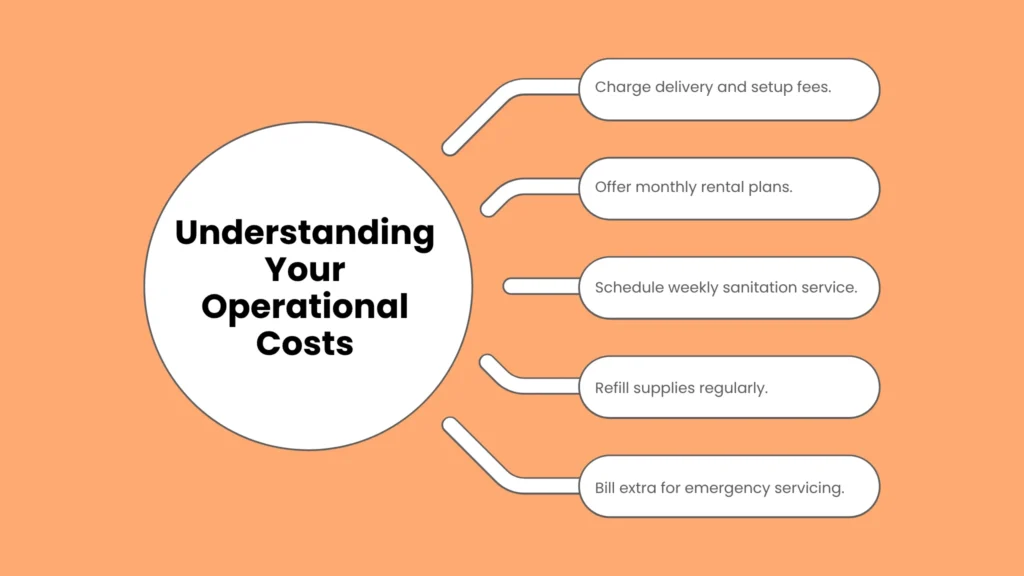
Your pricing model should always be split into two distinct categories:
1. Delivery and Setup Fees
This is a one-time fee charged at the beginning of the contract to cover the labor, fuel, and vehicle wear-and-tear associated with delivering the units to the site.
2. Monthly Rental and Service Fees
This flat monthly rate covers the physical rental of the unit and the weekly sanitation service. Your weekly service must include:
Pumping out the waste holding tank
Thoroughly washing and sanitizing all interior surfaces
Refilling the blue chemical deodorizer liquid
Restocking toilet paper, hand sanitizer, and paper towels
Always make sure your contracts specify that any additional servicing beyond the agreed-upon weekly schedule will incur extra charges.
Navigating OSHA Regulations for Commercial Contracts
When dealing with commercial construction, safety and compliance are paramount. The Occupational Safety and Health Administration (OSHA) enforces strict rules regarding sanitation on job sites. Under OSHA Standard 1926.51, employers must provide an adequate number of toilet facilities for their employees.
Specifically, OSHA’s official sanitation standard 1926.51 states that employers must provide at least one toilet for 20 or fewer employees, two toilets for 20 to 199 employees, and one additional toilet for every 40 employees over 200. Understanding these exact numbers allows you to consult directly with project managers.
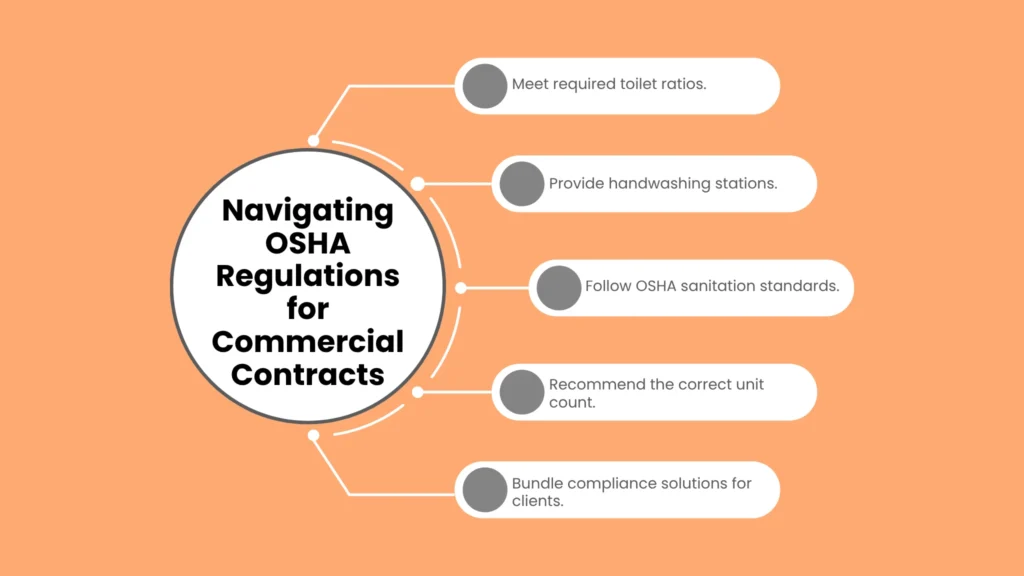
By calculating their labor force and recommending the exact number of units they legally need, you position yourself as a trusted industry expert rather than just another vendor. This level of consultative selling builds immediate trust and can help you secure larger, multi-unit contracts.
Meeting Additional Site Needs Under OSHA Standards
In addition to basic toilet numbers, you should educate your clients on handwashing station requirements. OSHA also mandates that employers provide proper handwashing facilities with clean water, soap, and single-use towels. Consequently, if you can bundle handwashing stations with your restroom rentals, you can easily increase your overall transaction value.
By offering these bundles, you save the project manager the hassle of dealing with multiple vendors. Furthermore, this comprehensive approach ensures that the entire job site remains fully compliant with federal workplace safety standards. As a result, you build long-term trust and establish your business as a highly reliable partner.
Building a Scalable Business Model
Landing your first few contracts is the hardest part of building your rental company. Once you secure your first five accounts, you will establish a consistent routine, streamline your routes, and start seeing predictable monthly revenue flow into your business bank account.
Always treat your early clients like gold. Show up on time, keep your units exceptionally clean, and maintain open communication. As your local reputation grows, you will find that securing new accounts becomes much easier.
If you are looking for more step-by-step business blueprints, marketing frameworks, and proven startup guides, visit us over at reliablestartup.com to help scale your business.
Frequently Asked Questions
What is the typical portable toilet rental business contracts cost to get started?
The initial cost to get up and running typically ranges from $50,000 to $150,000 based on industry estimates. This primary investment covers your first batch of standard units, a dependable used pickup truck equipped with a waste vacuum pump system, cleaning chemicals, safety gear, and initial marketing and insurance costs.
How often do portable toilets need to be serviced under a standard contract?
Under almost all standard commercial and construction contracts, units must be fully serviced, pumped out, cleaned, and restocked at least once a week. However, high-traffic job sites or busy public events may require servicing multiple times a week. You can bill these additional service visits as extra fees on top of your base rental rate.
Can I run a portable toilet rental business by myself?
Yes, it is highly feasible to run a small-scale route by yourself when you are first starting out. A single owner-operator can comfortably manage, deliver, and service a fleet of 20 to 40 standard units. Once you scale past 50 units, you will likely need to hire your first route driver so you can focus entirely on sales and business development.
What is the best way to handle non-paying clients on long-term contracts?
To protect your cash flow, always include a clear clause in your contract that requires a credit card on file or a security deposit for new accounts. State clearly that if a monthly payment is more than 15 days late, you reserve the complete right to pause servicing the units or lock them until the outstanding balance is paid in full.
How do seasonal fluctuations affect contract availability?
While construction contracts tend to remain relatively steady throughout the year, outdoor event and wedding contracts peak significantly between late spring and early autumn. Savvy business owners balance their fleets by using the winter months to pitch commercial developers, and then transitioning a portion of their units to high-margin weekend events during the warmer seasons.