Bounce House Rental Business Liability: How to Protect Yourself
The party supply and event entertainment industry is expanding fast, similar to the growth seen in the party rental business sector, as more entrepreneurs tap into backyard birthday parties, school festivals, and corporate events. If you are wondering is bounce house rental liability profitable when factoring in the unique risks of inflatable equipment, the data points to a clear yes. Operating an inflatable party business is highly lucrative, frequently yielding an excellent average bounce house rental liability profit margin of 35% to 50%.
However, because you are renting out heavy, wind-sensitive equipment designed for active children, managing your legal risks is the absolute foundation of your success. If a single bad accident occurs without proper protection, it can quickly bankrupt an unprotected business.
This comprehensive guide breaks down the true bounce house rental liability cost structure, necessary insurance coverages, legal safety waivers, and local municipal regulations to ensure your company stays safe and profitable.
The Initial Bounce House Rental Liability Cost and Asset Setup
Launching a commercial party inventory business involves balancing upfront hardware purchases with mandatory risk management expenses. Buying cheap residential inflatables from a retail store will not work. Specifically, commercial rental units must be constructed from heavy-duty, puncture-resistant vinyl and double-stitched for safety.
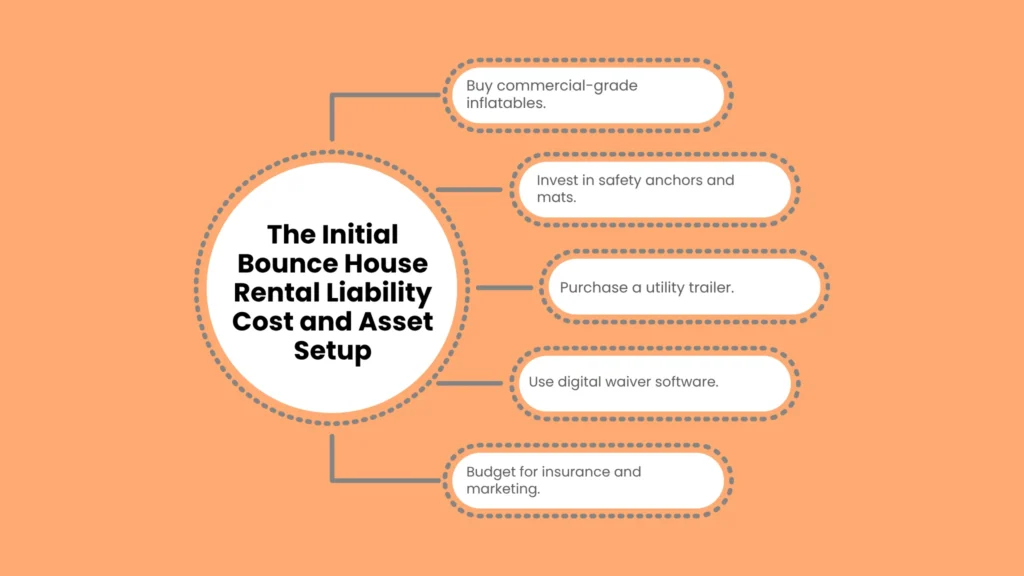
For an independent operator launching a localized startup with a fleet of 5 commercial inflatables, your estimated initial investment ranges from $15,000 to $35,000.
Core Fleet and Delivery Tools
First, commercial bounce houses, water slides, and obstacle courses cost between $1,500 and $4,500 per unit. Along with the physical inflatables, you must invest in heavy-duty commercial air blowers, industrial-grade steel anchoring stakes, heavy sandbags for pavement setups, and safety impact mats. Furthermore, a sturdy utility trailer and specialized heavy-duty hand trucks are required to transport these massive 300-pound commercial vinyl units safely.
Risk Management and Protection Tools
Second, a major part of your launch capital must cover your legal armor. This setup includes professional legal drafting for your rental liability waivers, similar to the rental agreement risk-management practices used across other equipment rental businesses.
Detailed Startup Fleet Capital Estimates
The table below outlines the realistic capital requirements for a basic 5-inflatables commercial starter fleet based on current industry averages:
| Expense Category | Low-End Estimate | High-End Estimate | Budget Details & Safety Notes |
| Commercial Inflatable Fleet (5 Units) | $8,000 | $18,000 | Heavy-duty vinyl bounce houses and obstacle courses. |
| Safety Anchors, Straps, & Mats | $500 | $1,500 | 18-inch steel stakes, 50-lb sandbags, and foam mats. |
| Heavy-Duty Utility Trailer | $2,000 | $5,000 | Enclosed or open trailer with secure tie-down points. |
| Commercial Air Blowers & Extension Cords | $600 | $1,200 | UL-certified waterproof blowers and 10-gauge cords. |
| Waiver Software & Digital POS | $300 | $1,000 | E-signature platform and mobile payment processing. |
| Insurance Down Payment & Legal Fees | $1,500 | $3,500 | Initial premium deposit and corporate waiver review. |
| Initial Local Marketing Runway | $800 | $2,500 | Local search engine optimization, yard signs, and flyers. |
| Operational Contingency Cash | $2,000 | $5,000 | Financial cushion for emergency equipment repairs. |
| Total Estimated Startup Capital | $15,700 | $37,700 | Average initial deployment centers around $24,000 |
Managing Your Ongoing Bounce House Rental Insurance and Overhead
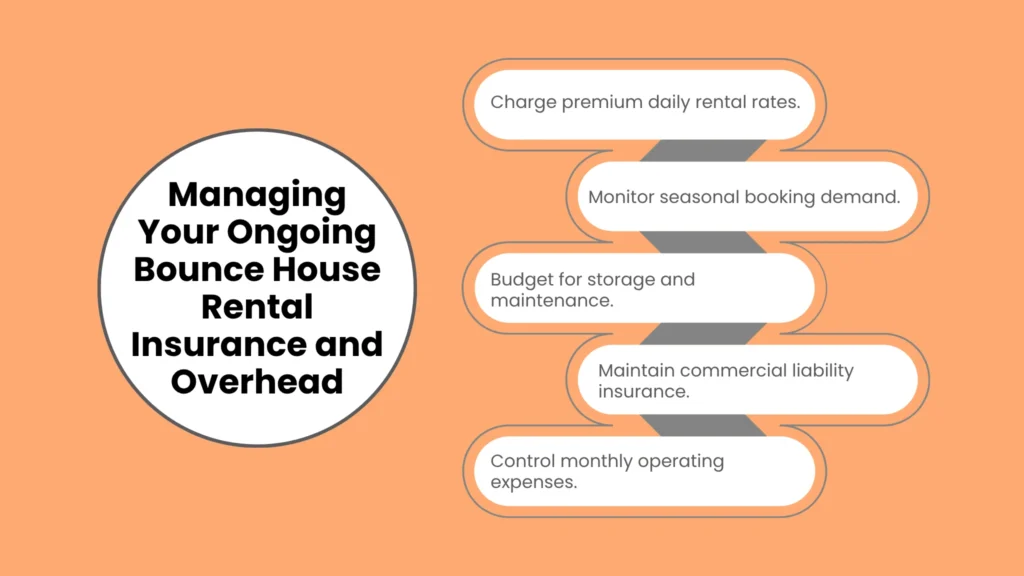
Once your initial equipment is secured, your ongoing profitability hinges on maintaining your safety assets and managing fixed monthly costs. Fortunately, the recurring variable cost per individual rental is low. Therefore, your business can generate substantial cash flows during peak weekend rental windows.
Rental Pricing Frameworks
Inflatable rental operations command premium daily rates based on unit sizes and delivery complexities:
Standard Backyard Bounce House: $150 to $250 per day.
Large Inflatable Obstacle Course: $350 to $600 per day.
Premium Commercial Water Slide: $400 to $750 per day.
Practical Revenue Example
Let us evaluate a realistic scenario for a small business. Suppose you operate a modest fleet of 5 commercial inflatables. During a 30-week warm-weather event season, your team maintains a steady weekend utilization rate, booking out each unit for an average of 1.5 days per weekend.
If your blended rental rate averages $300 per day across your mixed inventory, a single inflatable generates $450 per weekend. Consequently, across your entire 5-unit fleet, your business brings in $2,250 in gross revenue per week, totaling $67,500 over the course of the season.
Ongoing Monthly Operating Costs
To isolate your true net earnings, you must subtract your recurring monthly operational and protection costs from your gross intake:
Bounce House Rental Insurance: $250 to $600 per month for general liability insurance covering active participant injuries.
Equipment Storage Unit: $150 to $400 per month for a clean, dry garage or climate-controlled space to prevent vinyl mold.
Delivery Vehicle Fuel & Maintenance: $200 to $500 per month for truck and trailer upkeep.
Digital Software Subscriptions: $100 to $300 per month for booking engines and automated waiver tracking.
Cleaning and Sanitization Supplies: $50 to $150 per month for commercial-grade, eco-friendly vinyl disinfectants.
If your total fixed operating overhead averages roughly $1,500 per month during the active season, your business can remain highly profitable. Subtracting these operational numbers from your seasonal gross revenue leaves you with a substantial net return, verifying that the model handles its overhead costs with ease.
Legal and Regulatory Bounce House Rental Liability Requirements
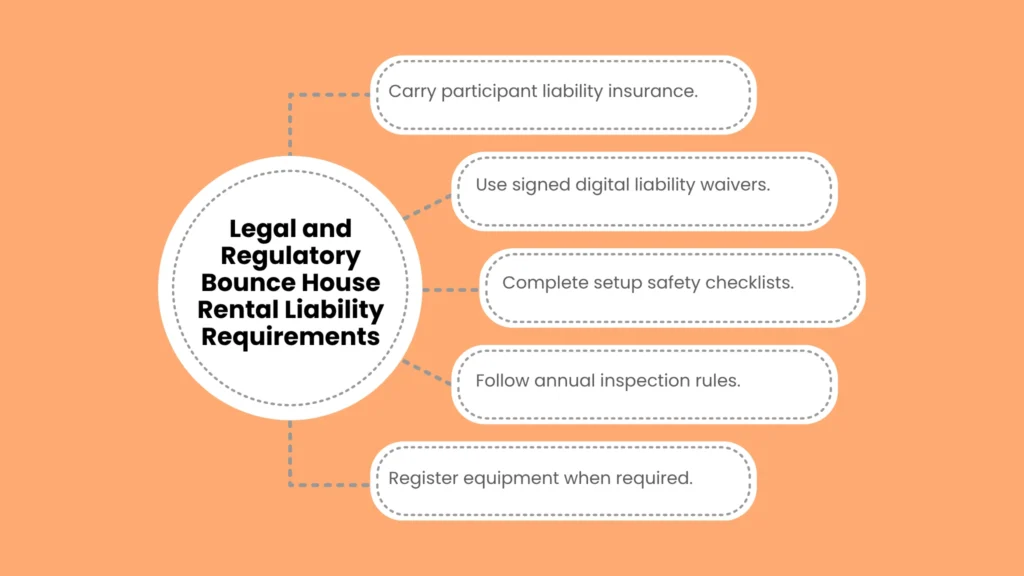
Operating an entertainment business requires careful compliance with municipal, state, and federal guidelines. Fulfilling these critical bounce house rental liability requirements is completely mandatory if you want to avoid costly lawsuits, government fines, or complete operational closure.
1. Securing Specialized General Liability Insurance
Standard commercial business policies do not cover amusement rides or active bounce house rentals. Therefore, you must purchase a specialized policy, just as other rental businesses require dedicated insurance policies that explicitly cover third-party equipment use.” Your policy must carry a minimum of $1 million per occurrence. Furthermore, if you plan to rent equipment to public schools, churches, or municipal parks, they will require you to add them to your policy as an “Additionally Insured” entity before you can drop off any equipment.
2. Mandatory Liability Waivers and Checklists
You must never rent out a piece of equipment without a signed, legally sound rental agreement and liability waiver. This document must clearly state that the client assumes all risks for unapproved use, such as exceeding weight capacities or mixing older children with toddlers. Additionally, your delivery team must fill out a physical or digital site-inspection checklist upon setup. This document proves that the unit was anchored properly and inspected before your staff left the property.
3. State-Level Annual Inspections and Permits
Many states categorize commercial inflatables as amusement rides, and consequently local laws may require your business to register every single unit with the U.S. Consumer Product Safety Commission guidelines for amusement ride safety compliance. These local regulations often mandate annual structural integrity inspections by a certified engineer. They may also require you to pay small annual permit fees per unit to ensure your gear meets up-to-date safety rules.
Critical Safety Practices to Protect Your Fleet and Profits
To protect your investments from equipment failures and to keep your local search visibility high, implement these essential field management practices:
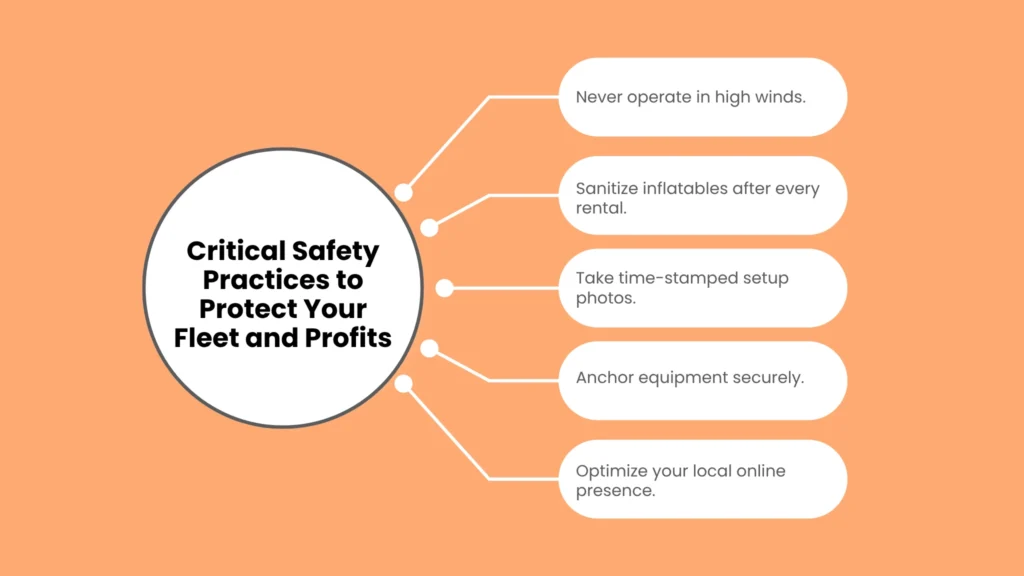
Enforce Strict Wind Limits: Wind is the single greatest threat to an inflatable rental company. Always include a strict weather clause in your contract stating that your team will immediately cancel or pack up an outdoor rental if sustained winds exceed 15 to 20 mph, as high winds can rip anchors right out of the soil.
Sanitize Units in Front of the Client: Hygiene is a massive selling point that builds instant trust. After setting up a unit at a birthday party, spray down the interior jump zones with a child-safe disinfectant cleaner in full view of the parent, which establishes your brand as a premium, professional service.
Take Time-Stamped Setup Photos: Every time your delivery crew finishes anchoring a bounce house, require them to take high-resolution, time-stamped photos of all anchor points, stakes, and blowers. These photos serve as ironclad proof that the equipment was set up safely if a client moves the unit later and causes an accident.
Optimize for Local Search Terms: Most parents and event planners look for rentals by searching on their mobile devices for terms like “party rentals near me.” Claim your Google Business listing immediately, list your specific safety certifications, and gather positive reviews from corporate accounts to dominate your local mappack.
Conclusion
Learning how to navigate bounce house rental liability challenges is the most important step in building a long-lasting party rental company. While your initial bounce house rental insurance setup and commercial gear requirements require an upfront capital investment, the market demand provides an incredibly strong return. By selecting top-tier vinyl equipment, using strict digital waivers, and following rigid safety protocols on every delivery, you can scale a highly secure and profitable entertainment business.
For more real-world operational blueprints, financial planning tools, and tested marketing guides designed to launch your next venture with complete confidence, check out our latest resources over at reliablestartup.
Frequently Asked Questions
Will a signed waiver completely protect my business from a lawsuit?
No, a liability waiver is not a magical shield. While a well-drafted waiver protects your business from ordinary risks and customer carelessness, it will not protect you from gross negligence. For example, if your team fails to anchor a bounce house properly or rents out a visibly torn unit, you can still be held legally responsible despite a signed waiver.
Can I run a profitable inflatable rental business from my residential home?
Yes, absolutely. Many independent operators run highly profitable startups directly out of their residential garages or backyard storage sheds to keep overhead extremely low. However, you must verify that your local residential HOA rules or zoning laws allow you to park a commercial utility trailer on your property.
What is the average lifespan of a commercial bounce house?
With proper care, a high-quality commercial inflatable will last between 3 and 5 years of regular weekend use. To reach this lifespan, you must never pack away a unit while it is wet, as trapping moisture inside rolled vinyl causes rapid mold growth and rots the structural seams.