Tyre Recycling vs Tyre Retreading: Which Business Is Better in 2026?
Tyre recycling chops up scrap tires into raw stuff like crumb rubber, steel scrap, and fuel. Retreading puts a fresh layer of rubber on a worn casing so it can run again. Recycling costs more to start, roughly $250K to over a million. Retreading is cheaper, maybe $50K to $200K, and you break even faster.
Tyre recycling vs retreading is one of those debates that sounds boring until you see the money behind it. The US tosses out around 275 million tires a year. Some end up in landfills. Some catch fire and burn for weeks. And some get turned into real businesses pulling in serious cash. At Reliable Startup, we keep getting the same question from new founders: which one should I actually start?
Short answer? Both can make you money. Long answer takes a bit more digging. Let’s break it down properly. Startup costs, profit margins, customer types, and where each one fits.
What Is Tyre Recycling vs Retreading?
Both keep old tires out of the trash. The way they get there is totally different though.
Recycling is destruction with a purpose. You shred the tire and grind it down. You pull the steel out with magnets. What you sell is the raw material left behind. Crumb rubber goes into playgrounds and asphalt. Steel goes to scrap metal buyers. Tire-derived fuel goes to cement kilns hungry for cheap heat.
Retreading is repair work. You take a worn tire that still has a strong body underneath. You buff off the dead tread. And you bond on a new layer of rubber using heat and pressure. The tire goes back on the road, usually for another 150,000 to 220,000 kilometers.
Here’s something almost every other article on recycled vs retreaded tyres gets wrong. They treat these like enemies. They are not. A tire gets retreaded first, sometimes two or three times. Once it can’t be retreaded anymore, then it gets recycled. As a founder, you can plug into either step, or run both.
Tyre Recycling vs Retreading Business
| Factor | Tyre Recycling Business | Retread Tyre Business |
|---|---|---|
| Startup Cost (US) | $250K – $1.2M | $50K – $200K |
| Equipment Needed | Shredders, granulators, magnetic separators | Buffing machines, vulcanization chambers, inspection tools |
| Break-Even Timeline | 24 – 36 months | 12 – 18 months |
| Average Profit Margin | 18 – 30% | 25 – 40% |
| Primary Customers | Construction, paving, civil engineering, fuel buyers | Trucking fleets, bus operators, aviation |
| Output Sold As | Crumb rubber, steel, TDF, mulch | Finished retread tires |
| Skill Barrier | Medium | High |
| Regulatory Load | High (EPA, state waste permits) | Medium (DOT, safety standards) |
| Market Demand 2026 | Growing | Stable to growing |
Retreading Business Profit Margins and US Market Opportunity
Now let’s get into why so many people quietly make a fortune retreading tires.
The American retread market moves about 15 million commercial retreads every year. Almost half of all commercial truck tires running on US highways right now are retreads. That’s not a niche. That’s a giant ongoing market hiding in plain sight.
Fleets love them because the math is simple. A new commercial tire runs $400 to $600. A retread runs $150 to $300. When you operate 50 trucks with 18 tires each, you’re talking real money. Trucking margins are paper thin. Retreads keep them alive.
If you are eyeing a retread tyre business USA play, follow the freight. Some of the strongest markets sit in:
- Texas and the Gulf freight corridors
- Ohio and the Midwest distribution hubstire recycling business comparison
- Georgia, especially around Atlanta logistics zones
- California’s port traffic
- Tennessee’s central trucking belt
The retreading business profit picture works because three things line up: low raw material cost, repeat fleet customers, and long-term contracts. A retread uses only 25% of the rubber a new tire needs. That’s a brutal cost advantage when you scale.
How Much Profit Does a Retread Tyre Business Make?
A single retread tire usually nets you somewhere between $40 and $80 after labor and materials. A small shop pushing out 30 tires a day pulls in $36,000 to $72,000 a month in gross revenue. Once you land a couple of fleet contracts, that number jumps. Solid mid-size operations clear $500K to $1.5M in annual net profit. The two things that can crush you? Casing supply and skilled labor. Both run tight in 2026.
Tire Recycling Business Comparison: Costs, Output, and Returns
Recycling plays a different game. The door is heavier to push open. But once you’re inside, the room is much bigger.
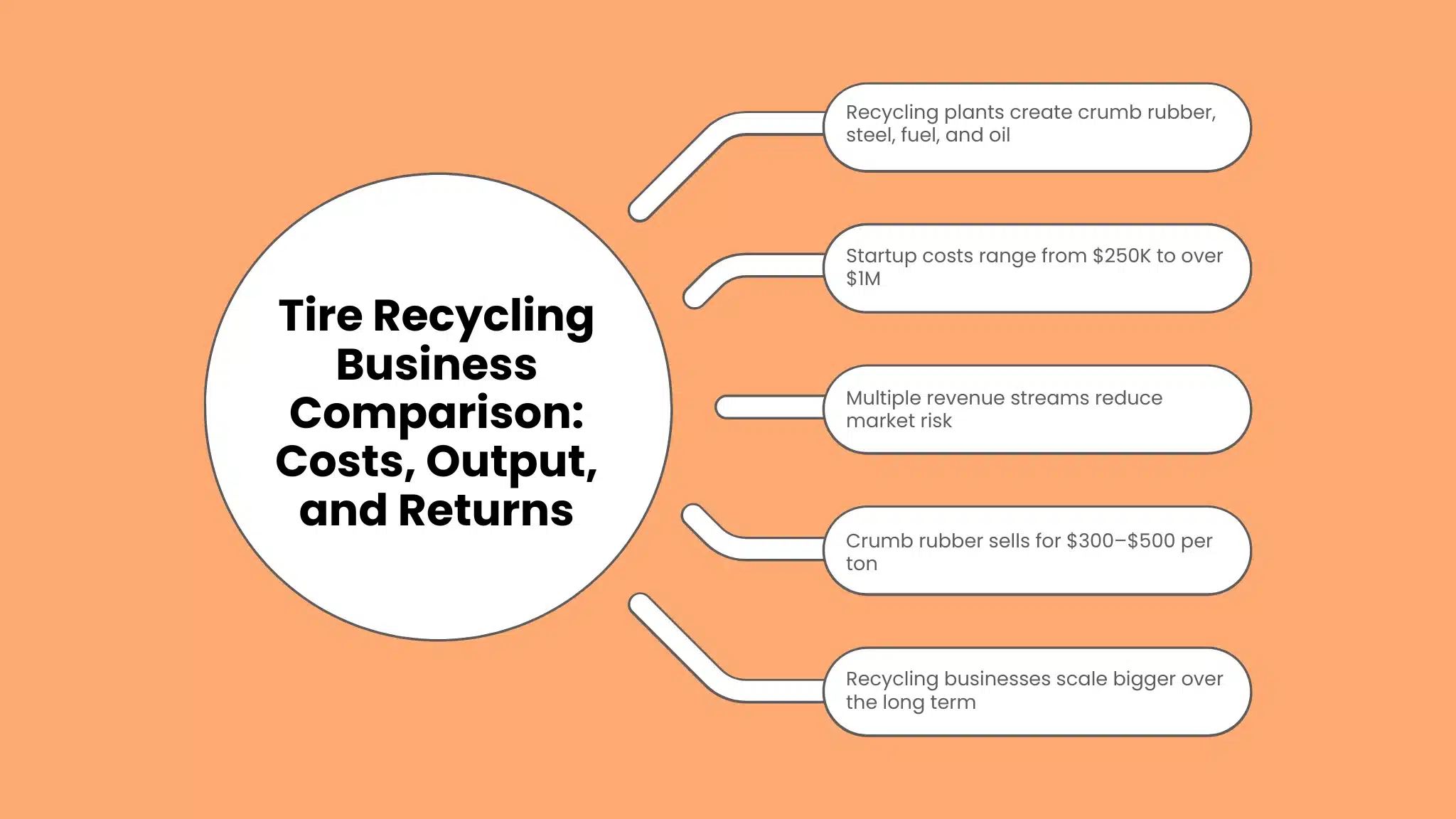
A recycling plant doesn’t sell one product. It sells four or five at the same time. Crumb rubber goes for $300 to $500 a ton. Steel scrap goes to metal recyclers. Tire-derived fuel pulls $30 to $80 a ton from cement kilns. Some plants also produce pyrolysis oil and recovered carbon black.
Right now in the US, scrap tire flow looks like this:
- 43% becomes tire-derived fuel
- 25% becomes ground rubber
- 8% goes into civil engineering projects
- The rest splits across export, reuse, and disposal
Growth areas to watch are rubber-modified asphalt, sports turf, playground surfaces, and building materials. State infrastructure budgets keep pushing more recycled rubber into public projects.
A real tire recycling business comparison with retreading lands like this: recycling wins on scale and revenue diversity, retreading wins on speed and lower cost to enter. Recycling protects you against any single market crashing because you sell so many outputs. Retreading rises and falls mostly with fleet demand.
Which Tyre Recycling vs Retreading Model Has Lower Entry Barriers?
Retreading. Not even close.
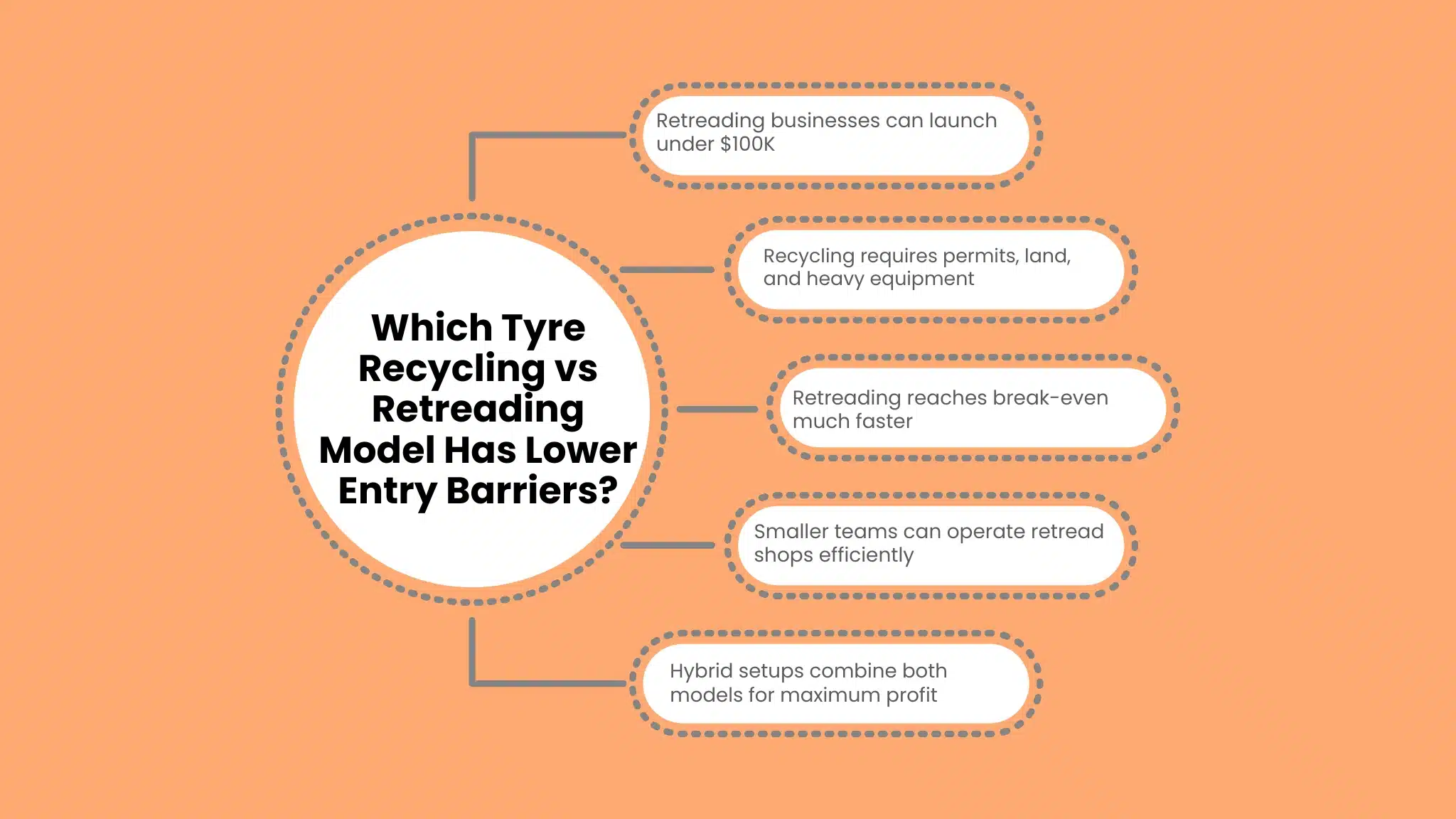
A small retread shop with two trained workers and basic vulcanization gear can open under $100K. A recycling plant needs land, permits, heavy machinery, environmental approvals, and serious working capital. So if you’re a first-time founder with limited cash, start with retreading. Once cash flow stabilizes, add a small recycling line for the casings that fail your inspection. That hybrid setup is one of the smartest moves nobody talks about.
Environmental Impact and Government Incentives
Here’s a piece most founders miss until it’s too late. Both businesses sit in the government’s good books, and that means money on the table.
Nearly every state charges a tire disposal tax, usually $1 to $5 per tire. That money doesn’t disappear. It goes back into grants, cleanup funds, and green business loans. California, Texas, and Florida run the biggest programs. Smaller states like Iowa, Oklahoma, and Tennessee see far less competition for the same grant dollars.
Retreading saves around 15 gallons of oil per tire compared to making a brand new one. Across the country, that adds up to roughly 360 million gallons of oil saved every year. Recycling keeps about 4 million tons of rubber out of American landfills annually.
Both qualify for EPA grants, SBA-backed green loans, and state circular economy incentives. The least crowded zones right now sit in the Midwest and Mountain West. Collection infrastructure in those regions is thin, which means less competition and easier permits.
Recycled vs Retreaded Tyres: Which Customer Base Is Bigger?
Your customer type changes how you sell, how often you sell, and how stable your cash flow looks.
Recycled output goes to bigger institutional buyers. Construction firms, asphalt plants, cement kilns, playground manufacturers, and city governments. Contracts often tie to public infrastructure spending. Big orders. Slower sales cycles. Strong long-term anchors.
Retreaded tires go to a different crowd. Trucking fleets, school districts, military bases, airlines, government vehicle programs, and off-road operators. The federal government actually requires its fleets to use retreads where possible. That’s a guaranteed buyer pool most new founders never even realize exists.
Location matters too. Retread shops thrive near highway freight corridors. Recycling plants thrive near industrial zones with active construction nearby. Pick your spot before you sign any lease.
Conclusion
The tyre recycling vs retreading decision really comes down to three honest questions. How much cash do you have to start? How fast do you need it to come back? And how much risk can you actually stomach? Retreading hands you a lower entry cost, faster break-even, and a steady B2B customer base. Recycling asks for more capital and patience, but pays you back with bigger scale and several revenue streams stacked on top of each other.
A smart play for most new founders? Start small with retreading. Build your cash flow. Lock in a few fleet contracts. Then add a recycling line once you have the volume and working capital to support it. That way you own both ends of the tire’s life cycle.
Frequently Asked Questions
Is retreading more profitable than tyre recycling?
Per unit, yes. Retread margins run 25 to 40%, and you start earning faster. Recycling pays more in total revenue once you scale because you sell several outputs at once. Solo founders usually pick retreading. Investor-backed teams usually pick recycling.
How much does it cost to start a tyre recycling business in the USA?
Most setups cost $250K to $1.2M. A basic crumb rubber operation sits at the lower end. Full pyrolysis or steel recovery plants push past a million. Permits and land are often the hidden cost killers.
Are retreaded tyres legal and safe in the United States?
Yes. The DOT holds retreads to the same safety standards as new tires. School buses, ambulances, military trucks, commercial airlines, and federal fleets run on retreads every single day.
What is the difference between recycled vs retreaded tyres?
Recycled tires get destroyed and turned into raw materials like rubber crumb, steel, and fuel. Retreaded tires get repaired and resold as working tires that go back on the road.