Inflatable Rental Business Profit: What Owners Really Earn in 2026
A typical inflatable rental business profit margin averages 30% to 40% net. For a part-time owner with one or two units, this translates to roughly $7,000 to $11,000 in annual take-home pay. However, as you scale to a small fleet of three to five units, you can clear $18,000 to $28,000. Established operators managing eight or more commercial-grade units often see profits ranging from $40,000 to $65,000.
Ultimately, your booking frequency and unit inventory mix are the primary drivers of your total bounce house rental income.
Most earning guides are published by manufacturers focused on equipment sales, leading to inflated projections. At Reliable Startup, we provide a data-backed analysis of the industry landscape, accounting for the true cost of acquisition, maintenance, and year-over-year growth models.
How Much Inflatable Rental Business Profit Can You Actually Make?
Net profit margins in this industry typically stabilize between 30% and 40%, though elite operators utilizing optimized routing and tiered pricing can push margins toward 43%.
In terms of gross revenue, a first-year owner can expect between $25,000 and $35,000. By year three—through inventory expansion and customer retention—a focused operator can surpass the $100,000 revenue milestone. Your total income is highly dependent on weekend utilization rates; a full calendar is the difference between a side hustle and a scalable enterprise.
Your bounce house rental income drives all of it. Each weekend booking matters, and the math adds up fast when your calendar fills.
Average Inflatable Rental Business Profit Margins by Operator Size
Profit changes a lot based on how big you run. A solo weekend hustle looks nothing like a full operation with a box truck and staff. So here is a clear side-by-side view.
| Operation Size | Fleet | Inflatable Business Startup Cost | Annual Revenue | Net Profit Margin | Owner Take-Home |
|---|---|---|---|---|---|
| Part-time / solo | 1-2 units | $10,000-$18,000 | $25,000-$35,000 | 28-32% | $7,000-$11,000 |
| Small fleet | 3-5 units | $25,000-$45,000 | $50,000-$75,000 | 32-38% | $18,000-$28,000 |
| Established | 8-12 units | $50,000-$90,000 | $100,000-$150,000 | 38-43% | $40,000-$65,000 |
Notice the margin climbs as you grow. That happens because your fixed costs spread across more bookings. Your truck, your insurance, and your storage cost the same whether you run four jobs or fourteen.
The Real Inflatable Business Startup Cost Nobody Itemizes
Here is where most guides cheat you. They say start for $10,000 to $50,000 and stop there. But your inflatable business startup cost hides a lot of pieces, and the equipment is only about a third of it.
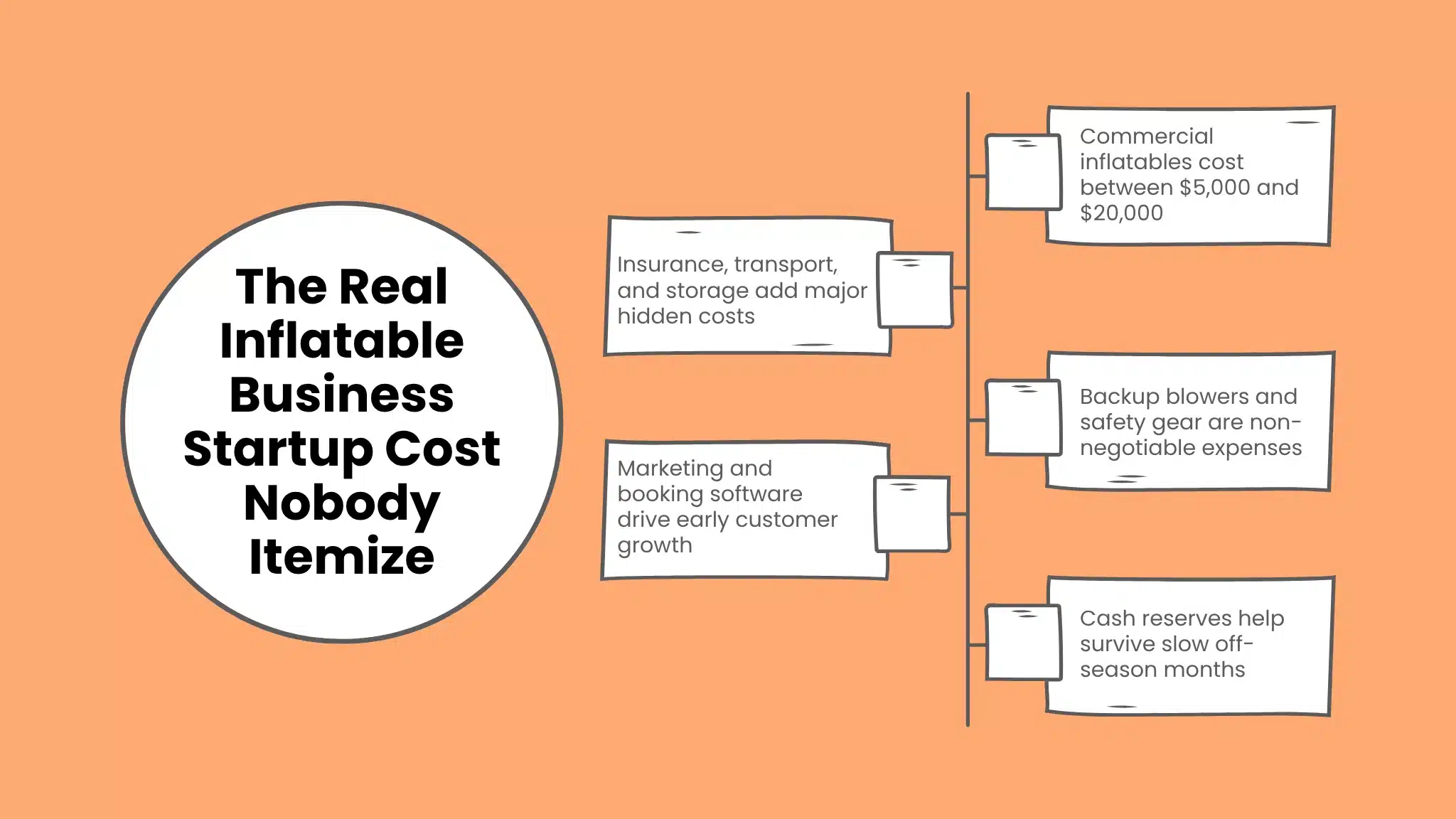
A real budget includes:
- Inflatables: $5,000 to $20,000 for commercial-grade units
- Blowers and spares: $300 to $800 (you need a backup on every job)
- Insurance: $500 to $1,500 a year for liability coverage
- Transport: a trailer or van, plus fuel
- Storage: a dry space so mold does not ruin your gear
- Safety gear: stakes, sandbags, and impact mats to meet ASTM standards
- Marketing: $1,000 to $3,000 for a website, ads, and booking software
- Cash reserve: money to survive slow months
Add it up and the “extras” often run $25,000 to $35,000 more than new owners expect. So plan for the full picture, not just the fun part.
One-Time vs Recurring Costs That Cut Into Bounce House Rental Income
Some costs hit once. Others come back every month and quietly shrink your take-home. Knowing the difference protects your bounce house rental income.
Recurring costs to watch:
- Fuel for delivery and pickup
- Blower replacement and repair
- Insurance renewals
- Cleaning supplies and patch kits
- Ad spend to keep bookings flowing
A small tear can cost $100 to fix. A worn blower costs more. So set aside a slice of every booking for upkeep, and your margins stay healthy.
A Realistic Year 1-5 Inflatable Rental Business Profit Model
Single-year promises mislead people. The real money shows up when you stack a few years and reinvest. So here is a grounded ramp.
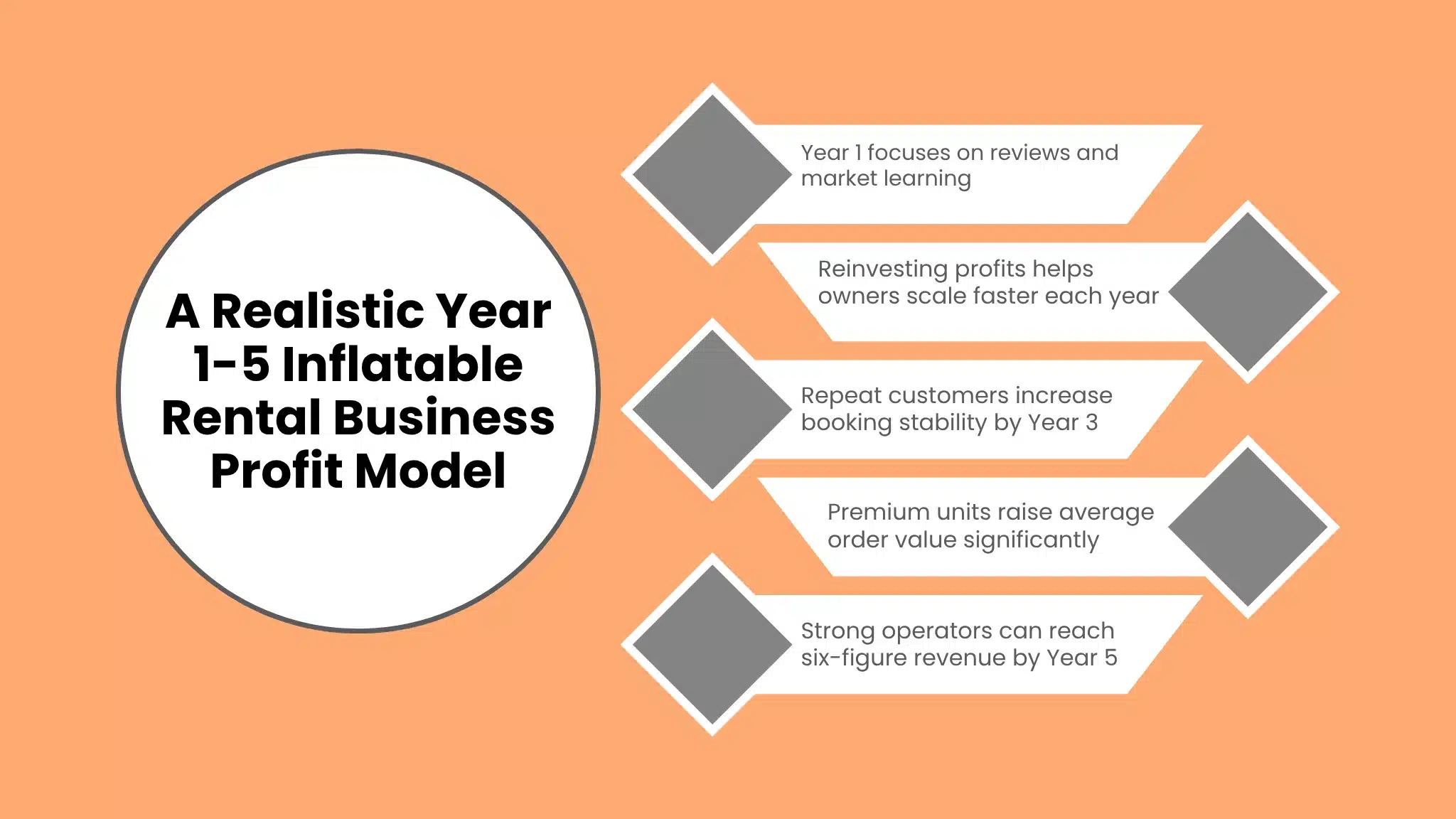
- Year 1: $25,000 to $35,000 revenue. Net profit near $7,000 to $11,000. You learn the market and build reviews.
- Year 2: $50,000 to $65,000 revenue. Net profit around $15,000 to $23,000. You add units and raise rates.
- Year 3: $75,000 to $100,000 revenue. Net profit near $30,000 to $40,000. Repeat clients carry you.
- Year 4: $100,000 to $130,000 revenue. Net profit climbs as your fixed costs spread out.
- Year 5: $130,000 to $175,000 revenue for strong operators who reinvested well.
Take one real pattern. An owner started with $12,500, two bounce houses, and one combo unit. Year one brought roughly $28,000. Then they put half their profit back into premium water slides. By year three, they hit about $92,000, and their average order value grew from $240 to $340. That is the power of reinvesting instead of cashing out early.
Which Inflatables Drive the Highest Party Inflatable Rental USA Profit?
Not all units earn the same. Your equipment mix shapes your whole party inflatable rental usa income. So choose with profit in mind, not just looks.
Daily rate ranges look like this:
- Standard bounce houses: $100 to $250
- Water slides: $300 to $600
- Obstacle courses: $300 to $600
- Combo units (slide plus bounce): premium weekend rates of $250 to over $600
Premium units cost more upfront, but they pay back fast. A strong combo can earn over $700 profit on a single booking. A plain bounce house often nets under $200 on the same day. So a smart fleet leans on the big earners.
A balanced mix works well: about 60 percent standard bounce houses, 25 percent water slides, and 15 percent specialty units. That blend keeps everyday demand covered and still lands the high-ticket jobs.
Kids Inflatable Rental Demand and Seasonal Profit Swings
The kids inflatable rental market is your bread and butter. Birthday parties book all year, and happy parents call you again next time. That repeat business is gold.
But the calendar is not flat. Around 60 percent of revenue lands in June, July, and August. Roughly 70 to 80 percent of bookings hit on weekends. So summer fills your pockets, and winter tests your savings.
Smart owners plan for this. They push indoor venues in cold months, offer holiday packages, and bank summer cash to cover the slow stretch. So the off-season stings less.
Hidden Risks That Quietly Kill Inflatable Rental Business Profit
Now the part suppliers skip. This business carries real risk, and ignoring it costs people their savings.
Watch these traps:
- Weather: A rained-out weekend means zero income that day. Build a refund or reschedule policy.
- Underpricing: Competing on price alone can drop your margin from 77 percent to 57 percent. Hold your rates.
- Free delivery: Absorbing a $50 to $200 delivery cost surrenders a big chunk of profit. Charge for it.
- Insurance gaps: One injury claim without coverage can end your business.
- Storage damage: Damp storage breeds mold, and a ruined unit is dead money.
None of these has to sink you. Still, you have to respect them and plan ahead.
Regional Pricing: Where Party Inflatable Rental USA Rates Run Highest
Location changes your ceiling. In busy Sun Belt metros, premium combos rent for $400 to over $600 a weekend. In rural areas, the same unit might pull $250. So your zip code shapes your pricing power.
Warm states also enjoy longer seasons, which means more bookings each year. Cold-climate owners earn more per job sometimes, yet they fight a shorter window. So study your local market before you buy a single unit.
Is the Inflatable Rental Business Profit Worth It?
So, is it worth it? For the right person, yes. This business rewards owners who show up on weekends, market hard, and reinvest their early profit. It suits hands-on people who do not mind heavy lifting and early mornings.
It is a poor fit for anyone chasing passive income. You handle setup, teardown, cleaning, and customer calls. The single biggest lever is simple: book more jobs and stock more premium units. Do that, and the inflatable rental business profit follows.
Final Thoughts
The honest takeaway is this. An inflatable rental business can earn solid money, with 30 to 40 percent margins and six-figure potential by year three. But the real number depends on your bookings, your unit mix, and your discipline with costs.
At Reliable Startup, we always tell new owners to model their own numbers first, then buy gear second. Run the math on your market, plan for the slow season, and treat the risks with respect. Do that, and your inflatable rental business profit can grow into a business you are proud of.
Frequently Asked Questions
How profitable is an inflatable rental business?
Most owners earn a 30 to 40 percent net profit margin. Part-time operators take home $7,000 to $11,000 a year, and established owners can clear $40,000 to $65,000 once their fleet and bookings grow.
How much does it cost to start an inflatable rental business?
A realistic inflatable business startup cost runs $10,000 to $50,000. Equipment is only about a third of that. The rest covers insurance, transport, storage, marketing, and a cash reserve for slow months.
How much can you make renting bounce houses?
A single bounce house rents for $100 to $250 a day. Run four bookings a weekend and your bounce house rental income adds up quickly, often reaching $24,000 or more a year from one busy unit.
Is a kids inflatable rental business worth it in 2026?
Yes, for hands-on owners. The kids inflatable rental market stays strong all year thanks to birthday parties and repeat clients. Just plan for summer peaks and a slower winter.
What is the average profit margin on party inflatable rental in the USA?
The average party inflatable rental usa margin sits at 30 to 40 percent net. Premium combo units and water slides push margins higher, sometimes past 70 percent on a single booking.