Lease or Loan: How to Finance Your First Rental Fleet
Launching an equipment rental business requires capital, but purchasing a fleet outright with cash can severely drain your working reserves. To scale safely, equipment business owners face a pivotal decision: securing an equipment loan or signing a lease agreement. Choosing the right lease vs loan rental equipment strategy can help businesses preserve working capital, manage financing costs, and build a profitable rental fleet.
Both pathways provide access to revenue-generating machinery, yet they impact your cash flow, tax liabilities, and ownership structure in fundamentally different ways.
Choosing between a lease vs loan for rental equipment depends on your immediate capital, tax strategy, expected equipment utilization, and long-term ownership goals. While loans build equity and offer complete ownership from day one, leases preserve working capital and simplify equipment rotation. Understanding how these financial structures align with your operational model ensures your fleet generates profit rather than balance sheet strain.
Understanding Equipment Financing for a Rental Business
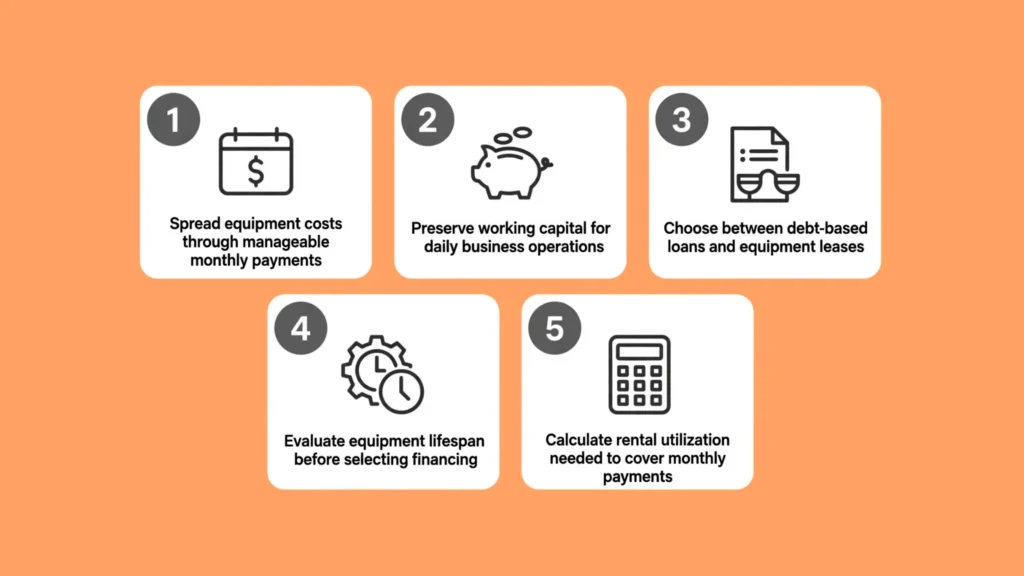
When launching or expanding an equipment rental business, equipment financing allows you to acquire heavy machinery, tools, or vehicles by spreading costs over time. Instead of tying up liquidity in capital expenditures, monthly payments are offset by rental income generated by the assets.
Equipment financing generally falls into two primary categories: debt-based financing (loans) and asset-based usage contracts (leases). Selecting the right model requires matching the financing term to the revenue lifecycle of the equipment.
Core Metrics to Evaluate Before Financing
Asset Lifecycle: How quickly will the machinery experience wear, tear, or technological obsolescence?
Utilization Rate: How many days per month must the asset be rented out to cover its monthly obligation?
Tax Considerations: Does your business benefit more from immediate depreciation deductions or monthly lease expense write-offs?
Equipment Loans: Building Fleet Equity
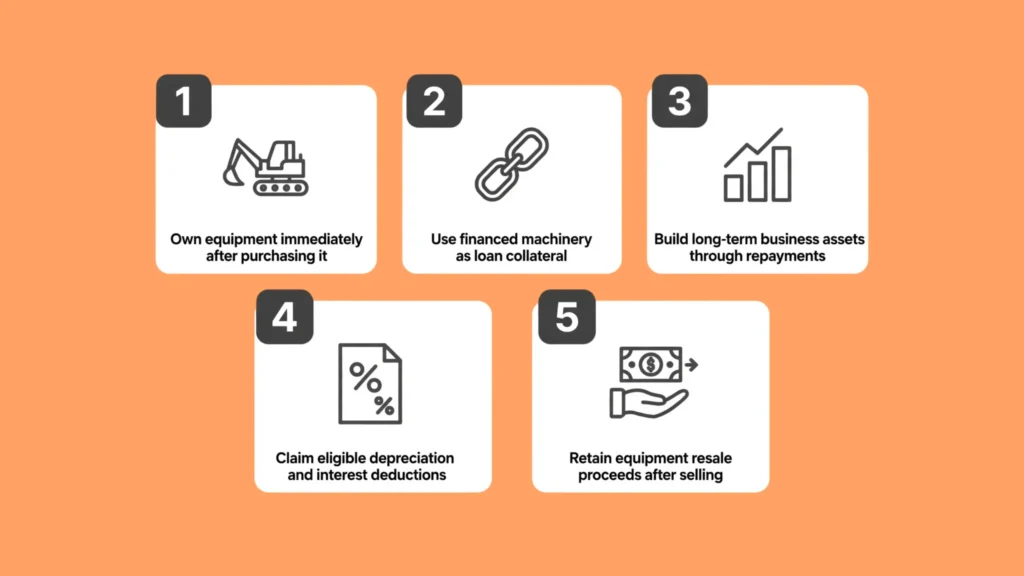
An equipment loan operates like a traditional term loan and is one of several options for rental business funding. A lender provides funds to purchase the equipment, and your business repays the principal plus interest over a fixed period. The equipment itself serves as collateral for the loan.
In an equipment loan arrangement, the lender sends funds directly to the dealer or seller to complete the purchase. Your business receives the title and assumes ownership right away, while making monthly principal and interest payments to the lender until the balance is cleared.
Key Features of Equipment Loans
Ownership and Title: Your company owns the equipment immediately upon purchase, while the lender holds a lien until the debt is fully paid.
Balance Sheet Impact: Both the asset value and the liability (debt) appear on your balance sheet.
Tax Advantages: Under mechanisms like Section 179 (or equivalent local tax provisions), businesses can often deduct the full purchase price of qualifying equipment in the year acquired, alongside interest expense deductions.
Advantages of Loans for Rental Fleets
Long-Term Asset Value: Once repaid, the asset belongs entirely to your business, allowing you to generate full margin on rentals (minus ongoing maintenance).
No Usage Restrictions: You maintain unrestricted authority over equipment modifications, maintenance schedules, and sub-leasing rules.
Resale Realization: When retiring the machine, all proceeds from the secondary market return directly to your business.
Disadvantages of Loans
Higher Upfront Cash Outlay: Lenders typically require a down payment ranging from 10% to 20%.
Obsolescence Risk: If market demand shifts or newer technology makes the machine obsolete, your business absorbs the loss in market value.
Equipment Leases: Preserving Capital and Flexibility
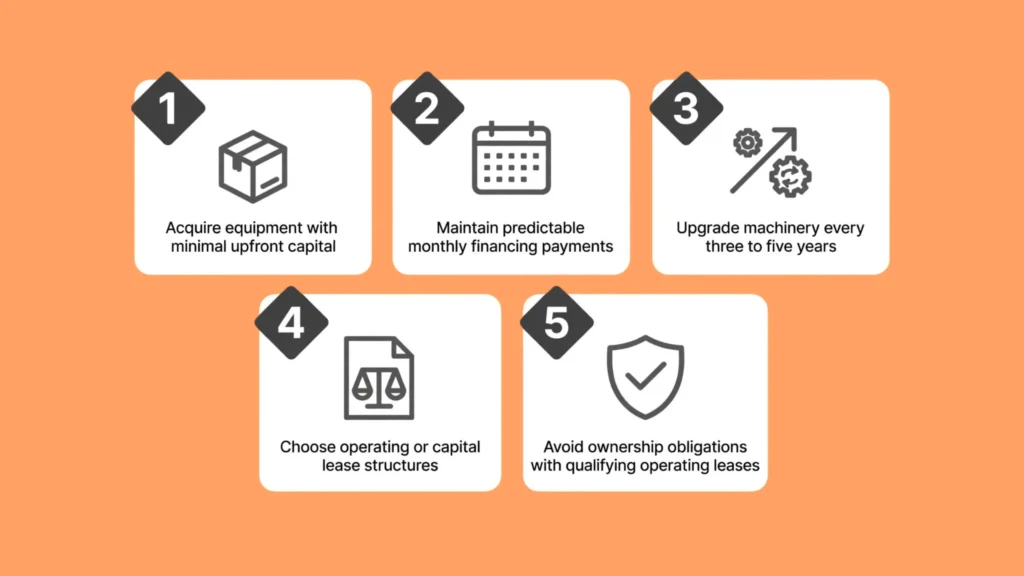
An equipment lease is a contractual agreement where a lessor (leasing company) grants a lessee (your rental business) the right to use equipment for a set period in exchange for regular lease payments.Leases fall primarily into two structures: Operating Leases and Capital Leases.
Operating Lease vs. Capital Lease Comparison
When comparing primary goals, an operating lease focuses on temporary asset use without taking ownership, whereas a capital lease serves as a direct path toward owning the asset.
Regarding ownership transfer, operating leases leave the title with the lessor at the end of the term. In contrast, capital leases transfer ownership to the lessee at the conclusion of the contract or through a nominal buyout option.
From an accounting perspective, operating leases are treated as an operating expense or a right-of-use asset on financial statements. Capital leases require recording both an asset and a corresponding liability on your balance sheet.
Tax treatment also varies between the two options. Operating lease payments can generally be deducted as standard operating expenses. Capital leases allow businesses to deduct asset depreciation and interest expenses instead.
Finally, end-of-term options differ significantly. An operating lease allows you to return the equipment, renew the agreement, or upgrade to newer models. A capital lease typically concludes with an asset buyout (such as a $1 buyout clause) or a full transfer of title.
Advantages of Leases for Rental Fleets
Minimal Upfront Capital: Leases rarely require significant down payments, allowing start-up rental companies to preserve cash for operations and marketing.
Predictable Fleet Rotation: Modernizing your fleet every 3 to 5 years is straightforward—return older machinery and lease newer units.
Flexible Monthly Payments: Payments are frequently lower than loan installments because you pay for the asset’s depreciation during the lease term rather than its total value.
Disadvantages of Leases
Higher Cumulative Cost: Over long periods, leasing can prove more expensive than buying due to built-in lessor fees and financing rates.
Lack of Equity: Operating leases yield zero equity at contract expiration unless a buyout clause is exercised.
Comparing Fleet Finance Options: Lease vs. Loan
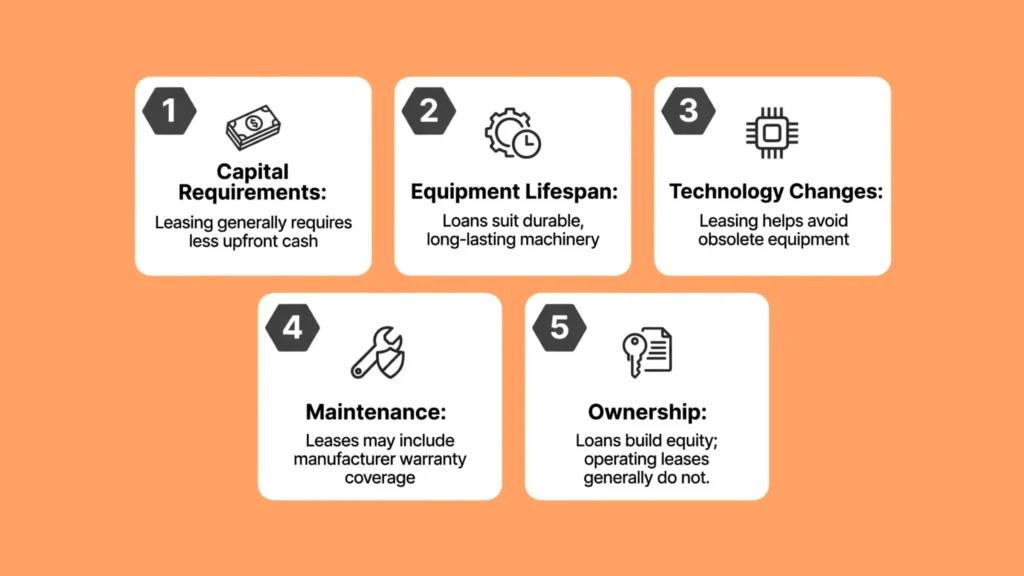
Evaluating lease vs loan rental equipment strategies requires balancing short-term liquidity against long-term asset value and understanding equipment rental business profitability.
If your fleet relies on high-tech machinery subject to fast obsolescence, or if your business has low initial capital reserves, leasing the fleet is often the most prudent strategy.
If your business utilizes heavy equipment with high long-term durability and you possess strong cash reserves, choosing an equipment loan or purchase plan offers superior value.
1. Capital Requirements
If your business needs to deploy five machines immediately but only possesses cash reserves for one down payment, leasing allows you to distribute available capital across multiple assets. Conversely, if you have healthy capital reserves, an equipment loan reduces long-term financing costs.
2. Equipment Type and Useful Life
Heavy, Durable Machinery (Excavators, Telehandlers, Generators): High-durability equipment retains value for a long time. An equipment loan or capital lease makes financial sense because the machine remains operational long after the debt is cleared.
High-Tech or Rapidly Evolving Gear (AV Equipment, Specialized IT Rentals, Precision Tools): Rapid technological shifts make short-term operating leases ideal to avoid holding outdated inventory.
3. Maintenance and Fleet Upkeep
Leased equipment often comes with manufacturer warranty coverage throughout the lease window, limiting unexpected repair expenses. With loans, out-of-warranty repair costs rest entirely on your balance sheet once the initial warranty expires.
Practical Tips for Financing Your First Fleet
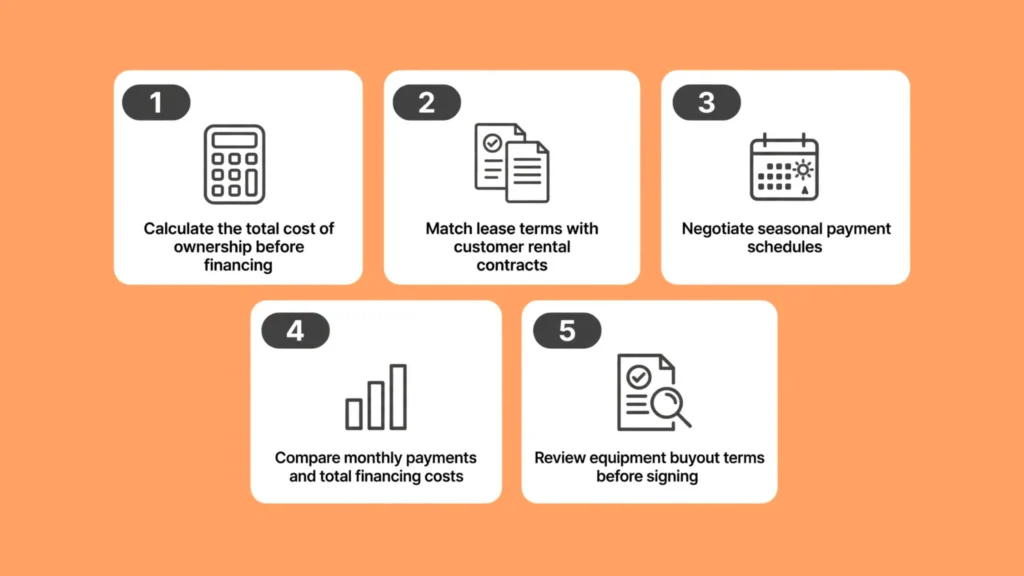
Before committing to financing, calculate your rental business startup costs and total cost of ownership (TCO). Compare total loan payments (principal, interest, and down payment) against total lease payments (monthly rates, turn-in fees, and buyout costs).
Match Lease Terms to Rental Contracts: If you secure a 2-year commercial rental contract with a corporate client, align your equipment lease term to match that specific contract window.
Negotiate Seasonal Payment Structures: Rental demand fluctuates with weather and economic cycles. Request skip-payment or seasonal payment structures from financing partners to lower monthly obligations during slow months.
Inspect Buyout Terms: If choosing a capital lease, ensure the end-of-lease buyout price ($1 vs. Fair Market Value) is explicitly defined in writing.
Common Financing Mistakes to Avoid
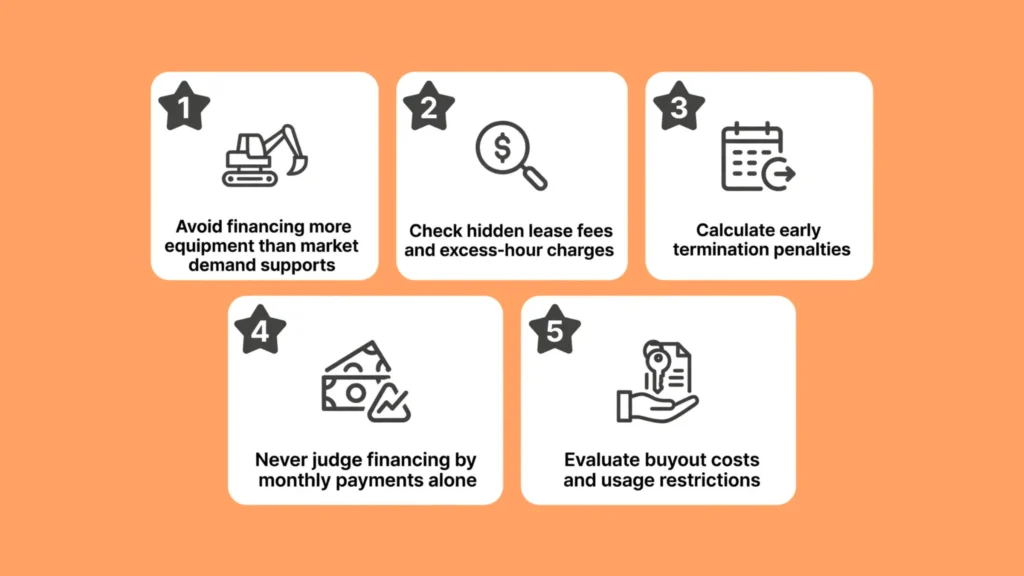
Over-Leveraging Early On: Financing a large fleet before validating market demand leads to idle equipment and unmanageable monthly debt service.
Ignoring Hidden Lease Fees: Factor in potential charges for excess engine hours, wear-and-tear penalties, and early termination fees.
Focusing Solely on Monthly Payment Size: A lower monthly lease payment may look attractive, but high buyout costs or restrictive usage conditions can erode profit margins over time.
Frequently Asked Questions
Is it better to lease or loan equipment for a startup rental business?
For startups with limited capital, leasing preserves cash flow and requires lower down payments. However, if your startup has strong funding and intends to keep machinery for many years, an equipment loan provides long-term value by building equity.
What is a capital lease in equipment financing?
A capital lease (also known as a finance lease) is a lease contract that shares characteristics of asset ownership. The lessee records the equipment as an asset on the balance sheet and usually has an option to purchase the machinery at a nominal price when the lease ends.
Can I purchase equipment at the end of a lease?
Yes. Most lease contracts offer options to return the equipment, extend the lease, or purchase the asset either at Fair Market Value (FMV) or for a predetermined amount (such as a $1 buyout option).
How does equipment financing affect my taxes?
Equipment loans and capital leases often allow you to claim asset depreciation and deduct interest payments. Operating lease payments are typically deductible as standard operating expenses. Consult a CPA to determine the best tax strategy for your jurisdiction.
What credit score is required for fleet financing?
Lenders generally look for a commercial or personal credit score of 650 or higher for competitive rates. Newer businesses without an established credit history may need to provide a larger down payment or personal guarantee.
Can I lease used rental equipment?
Yes. Many financial institutions and equipment dealers offer leasing and loan options for certified pre-owned or used equipment, provided the asset has a verified service history and remaining useful life.
Final Thoughts
Deciding between a lease or a loan to build your rental fleet comes down to balancing your working capital against your long-term equity goals. Leasing provides flexibility, protects cash flow, and simplifies fleet upgrades, making it an excellent choice for fast-growing startups or short-lifecycle assets. Equipment loans require more capital upfront but yield full ownership, complete control, and residual asset value for durable, long-term machinery.
Assess your cash flow projections, analyze equipment wear rates, and consult with a financial advisor before committing. Selecting the right financing structure ensures your fleet remains a profitable revenue engine rather than a financial bottleneck.
About The Author