Storage Unit Rental Business Profit: What to Expect in 2026
Storage unit rental business profit averages around $184,500 annually for a standard 50,000-square-foot facility. With net operating margins typically ranging between 40% and 60%, this sector remains a powerhouse in real estate. Most owners reach a break-even point at 60-70% occupancy, while significant wealth is generated once occupancy scales beyond 80%. While startup costs fluctuate between $1.5M and $2.4M, the path to consistent cash flow usually stabilizes within two to five years.
Reality in 2026 is more nuanced than previous years. Many outdated guides still rely on 2021 data when rental rates were at an artificial peak. At ReliableStartup, we have analyzed current market shifts, rising operational costs, and the specific metrics that modern investors need to track to hit “top 1” rankings in their local markets.
A typical facility owner clears around $184,500 a year, though a small site earns a sliver of that and a big one earns far more.
Profit margins run 40% to 60%, which is hard to beat in real estate.
You cover your costs near 60-70% occupancy, and the real money starts above 80%.
Returns land around 8-15% cash-on-cash, with cap rates close to 6.5%.
Building a facility costs $1.5 million to $2.4 million, and most owners wait two to five years for steady profit.
Understanding Average Annual Revenue
The storage unit rental business profitin the U.S. is heavily dependent on the facility’s scale. A 50,000 sq. ft. benchmark, priced at approximately $9 per square foot annually with a 41% margin, yields about $450,000 in revenue. However, high-demand urban areas with climate-controlled units can effectively double these projections. It is vital to adjust these averages based on your specific zip code and facility tier.
Storage unit profit by facility size
Facility size
Annual revenue
Profit margin
Estimated annual profit
Small (10,000 sq ft)
~$90,000
40%
~$36,000
Mid (25,000 sq ft)
~$225,000
41%
~$92,000
Average (50,000 sq ft)
~$450,000
41%
~$184,500
Large (80,000 sq ft)
~$720,000
50%
~$360,000
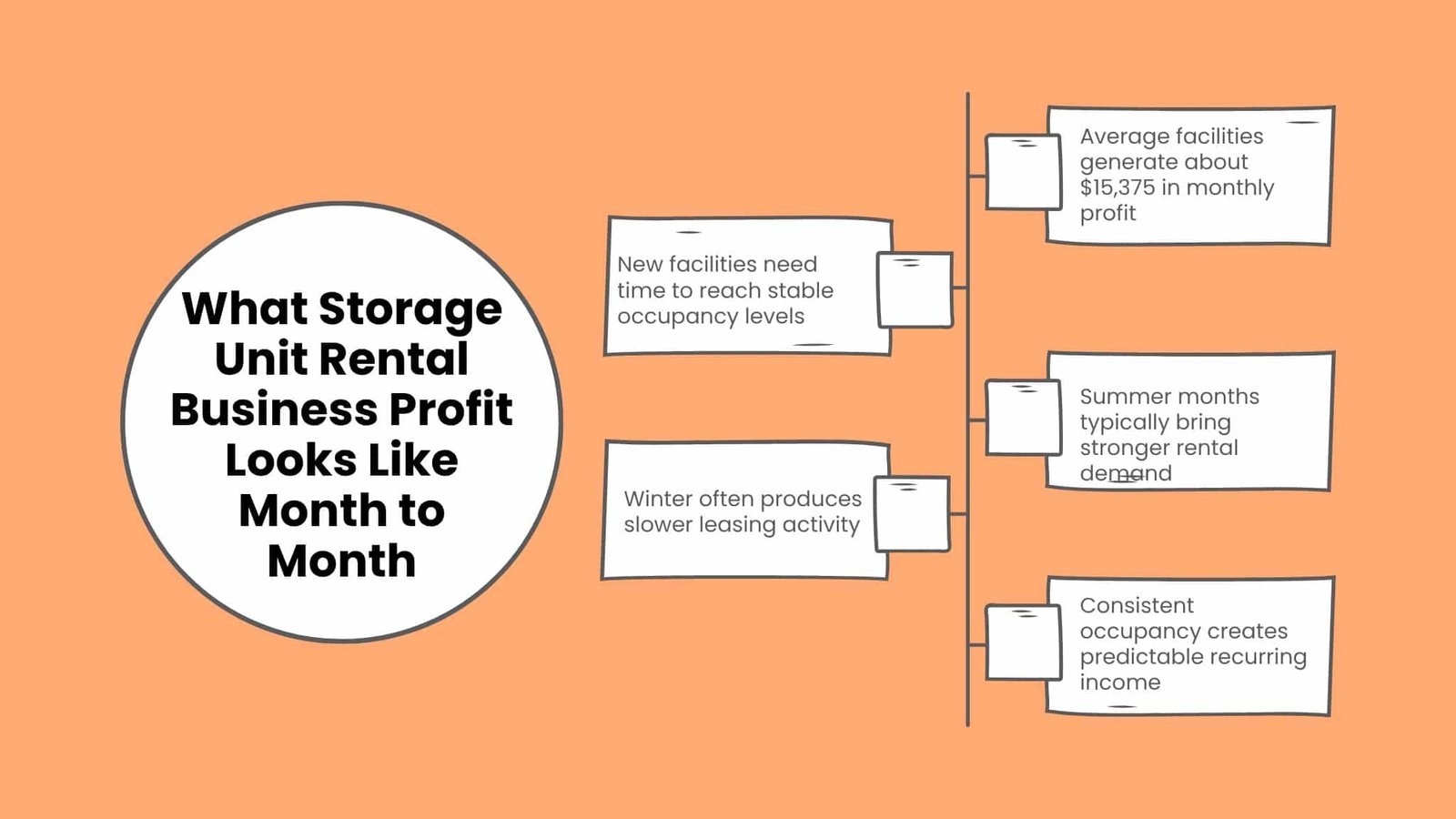
What Storage Unit Rental Business Profit Looks Like Month to Month
Break that yearly average down and you are looking at roughly $15,375 a month at the midpoint. The cash does not land in neat equal piles, though. A brand new facility loses money while it fills, and your profit only appears once units actually rent. Summer tends to bring movers and a bump in demand. Winter cools things off. So your first year, especially, is going to feel lumpy, and that is normal.
What Drives Self Storage Business Income
Location remains the primary lever for increasing your self storage business income. Facilities situated near high-density apartments, universities, or military bases often command higher premiums and maintain faster “lease-up” periods. Beyond just physical location, your income is driven by your “unit mix”—balancing small lockers with large vehicle bays—and implementing dynamic rental rates that adjust based on real-time local demand.
These are the factors that matter most:
Location: foot traffic and visibility bring renters to the door.
Occupancy rate: the biggest single driver of what you take home.
Unit mix: small units and climate units earn more per square foot.
Rental rates: set to your local market, not some national average.
Add-on services: insurance, retail, and assorted fees.
Operations: the right software keeps vacancy and payroll down.
Self storage income drivers and their impact
Factor
Why it matters
Income impact
Location
Drives demand and pricing
High
Occupancy
Profit lives above break-even
High
Unit mix
Small/climate units earn more per sq ft
Medium-High
Rental rates
Market vs target pricing
Medium
Add-on services
Insurance, retail, fees
Medium
Operations
Software trims cost and vacancy
Medium
Curious how this stacks up against other rental models? Our walkthrough on how to start a P2P rental businessruns on the same occupancy math in a totally different niche.
Self Storage Profit Margin 2026: Gross vs Net Explained
When analyzing the self storage profit margin 2026, it is crucial to distinguish between Gross and Net. Operating costs—including property taxes (10%), management (12%), and marketing (2%)—typically consume about 35% of total revenue. As of March 2026, annual rents have stabilized at approximately $16 per square foot. While the era of “runaway rate hikes” has slowed, the underlying margins remain superior to retail or office spaces.
Operating cost breakdown (% of revenue)
Cost line
Share of revenue
Real estate taxes
~10%
On/off-site management
~12%
Repairs & maintenance
~3%
Utilities
~2%
Insurance
~1%
Advertising
~2%
Admin & misc
~5%
Total operating cost
~35%
Net operating margin
~40-60%
A word on 2026 pricing, because it has shifted. Rates have cooled off. Yardi Matrix clocked the average annual rent near $16 per square foot in March 2026, down about 2% year over year, and SpareFoot put the typical monthly unit around $89. Margins are still healthy. You just cannot bank on the runaway rate hikes that owners enjoyed a few years back.
Storage Unit ROI, Cap Rate, and Payback Period
Investors prioritize storage unit ROI through three specific lenses: Cash-on-cash returns (8-15%), Cap Rates (averaging 6.5%), and the Internal Rate of Return (IRR). Unlike other asset classes, storage is uniquely “recession-resistant.” Even in slower markets, you can improve your ROI by integrating lean management software and high-margin add-ons like tenant insurance and retail packaging supplies.
Cash-on-cash ROI shows your yearly return on the actual cash you put in, and it usually runs 8-15%.
Cap rate ignores financing and reveals the property’s raw return. Self storage hovers near 6.5%, ahead of the 5% you often find on retail or office buildings.
Payback period is how long before you earn your investment back, and that tends to stretch across 5 to 10 years.
Storage unit ROI benchmarks
Metric
Typical range
What it tells you
Cash-on-cash ROI
8-15%
Annual return on cash invested
Cap rate
~6.5%
Return without financing
Historical IRR
~16.9%
Long-run investor return
Payback period
5-10 yrs
Time to earn your money back
How to Improve Storage Unit ROI in a Slower Market
With rates soft this year, you raise your storage unit roi by leaning on the things you can actually control. Drive occupancy up with sharp local marketing. Add climate-controlled units, since renters pay a premium for them. And run lean operations with good software so empty units and staffing do not bleed you dry. Each gain is small on its own, but they stack into something real.
Revenue Streams That Boost Storage Unit Rental Business Profit
Rent is the engine, but it is not the whole car. The owners pulling in the fattest storage unit rental business profit layer extra income on top of the monthly rent. Most of these cost almost nothing to set up, and they often carry better margins than the units themselves.
Monthly rent: the steady base that pays the bills.
Tenant insurance: you offer a policy and collect a referral fee each month.
Retail sales: boxes, tape, locks, and bubble wrap, right when people need them.
Vehicle and RV storage: turn unused land into fenced, paved parking spots.
Fees: late charges, admin fees, and gate access quietly pile up.
Combine two or three of these and total revenue can climb 10% or more, and you have not rented one additional unit to get there.
The 2026 Occupancy Reality Nobody Explains
Nearly every article you will read still parrots a flat 92% occupancy. That figure is slippery, and getting it straight actually matters for your projections. Two separate numbers float around out there, and they are measuring different things entirely.
Mature facilities run by the big REITs really did sit in the low 90s heading into 2026. But stabilized sites across the broader market averaged about 77% in late 2025. The difference comes down to lease-up. New facilities need time to fill, so they pull the wider average down while the seasoned REIT properties stay packed.
Demand itself is in good shape, for the record. With home sales stuck, people are staying put and holding onto their units longer, and the average renter now keeps one for roughly 18.5 months. Business tenants are growing fastest of all, with online sellers grabbing urban units to shorten delivery routes. So the pool of customers keeps getting wider, even while fresh supply keeps a lid on rates.
Mini Storage Business Plan: Startup Cost vs Profit Timeline
You cannot talk profit honestly until you talk about the build. A real mini storage business plan opens with the startup math, and that math is not cheap. Construction runs $25 to $70 per square foot for a single-story site, and pushes past $100 once you go multi-story or climate-controlled. Land, permits, security, and insurance all pile on after that.
Mini storage startup cost breakdown
Cost category
Typical range
Land (2.5-5 acres)
$112K-$350K+
Construction (per sq ft)
$25-$70 (up to $130 multi-story)
Security & technology
$8,500-$35,000
Permits & zoning
$5,000-$50,000+
Insurance (annual)
$2,500-$12,000
Total (50K sq ft build)
~$1.5M-$2.4M
Then there is the waiting. A new facility takes two to four years to reach stabilized occupancy, so strong cash flow on opening day is not happening. Most owners land on consistent profit somewhere between years two and five.
Buying a facility that is already full shortens the wait, but you pay up for the privilege. Either path asks for patience. If you want to see which rental models pay back quicker, compare our wedding rental business profit and inflatable rental business profit breakdowns.
Risks That Can Shrink Storage Unit Rental Business Profit
The model is steady, but it is not foolproof. A handful of risks can carve into your storage unit rental business profit, so it pays to know them before you sign anything.
Oversupply: a new competitor opening nearby can drag your rates down quickly.
Slow lease-up: an empty new building eats cash for months on end.
Security and management: these are costs you simply cannot cut corners on.
None of this sinks the business. It just favors the owners who plan ahead and hold firm on their pricing instead of panicking.
Final Thoughts
So, is it worth the trouble? For a patient owner who lands the right location, the answer is a clear yes. The storage unit rental business profit is real, the margins outrun most other rental plays, and the income holds together even when the wider economy gets shaky. Just go in respecting the timeline and the size of the check you write up front.
At reliablestartup, we sit down with new founders and run these exact numbers before they commit a dime so dig through more rental business ideas until you find the one that matches your budget.
Frequently Asked Questions
Is a storage unit rental business profitable in 2026?
Yes. Margins still sit between 40% and 60%, and demand is steady as people hang onto units longer. Rates have eased a little, but the model is still one of the steadier real estate bets around.
How much profit do storage unit owners make per month?
The average facility brings in about $15,375 a month, based on that $184,500 yearly midpoint. Small sites earn well under it, and large ones earn well over it.
What is a good self storage profit margin 2026?
A solid net operating margin runs 40% to 60%. If you are coming in lower, look hard at your occupancy and your operating costs.
What storage unit ROI should investors expect?
Count on 8-15% cash-on-cash, with a cap rate near 6.5%. Earning your money back usually takes 5 to 10 years.
How long until a mini storage business becomes profitable?
Most facilities reach steady profit in years two through five. A brand new build needs two to four years just to fill up.
What occupancy do you need to break even?
Most sites cover their costs around 60-70% occupancy. The real profit shows up once you climb past 80%.
Ayesha Mansha
Ayesha Mansha writes about small business development, entrepreneurship, and practical ways to turn ideas into business opportunities. She focuses on accessible guides, business planning, and actionable insights to help readers navigate the early stages of building a business.