How Tyre Recycling Companies Make Money: 8 Revenue Streams

The global scrap tyre market has transitioned from a waste management challenge into a high-value feedstock industry. While most see a disposal headache, seasoned operators recognize a multi-layered manufacturing opportunity. To understand how tyre recycling companies make money in 2026, you have to look beyond simple shredding and analyze the entire value chain—from collection logistics to polymer engineering.
In the U.S. alone, over 300 million tyres are discarded annually. The difference between a struggling yard and a high-growth enterprise lies in the strategic diversification of tyre recycling revenue streams.
How Do Tyre Recycling Companies Make Money?
Short version? They get paid coming and going.
A recycler charges a fee to take your old tyres. Then they rip those tyres apart and sell the pieces, the rubber, the steel, the fiber. The clever ones go one step further and turn that rubber into something you would actually buy off a shelf. One tyre, paid for two or three separate times before it ever leaves the lot. Stack those payments and you have a business.
The 8 Tyre Recycling Revenue Streams That Drive Profit
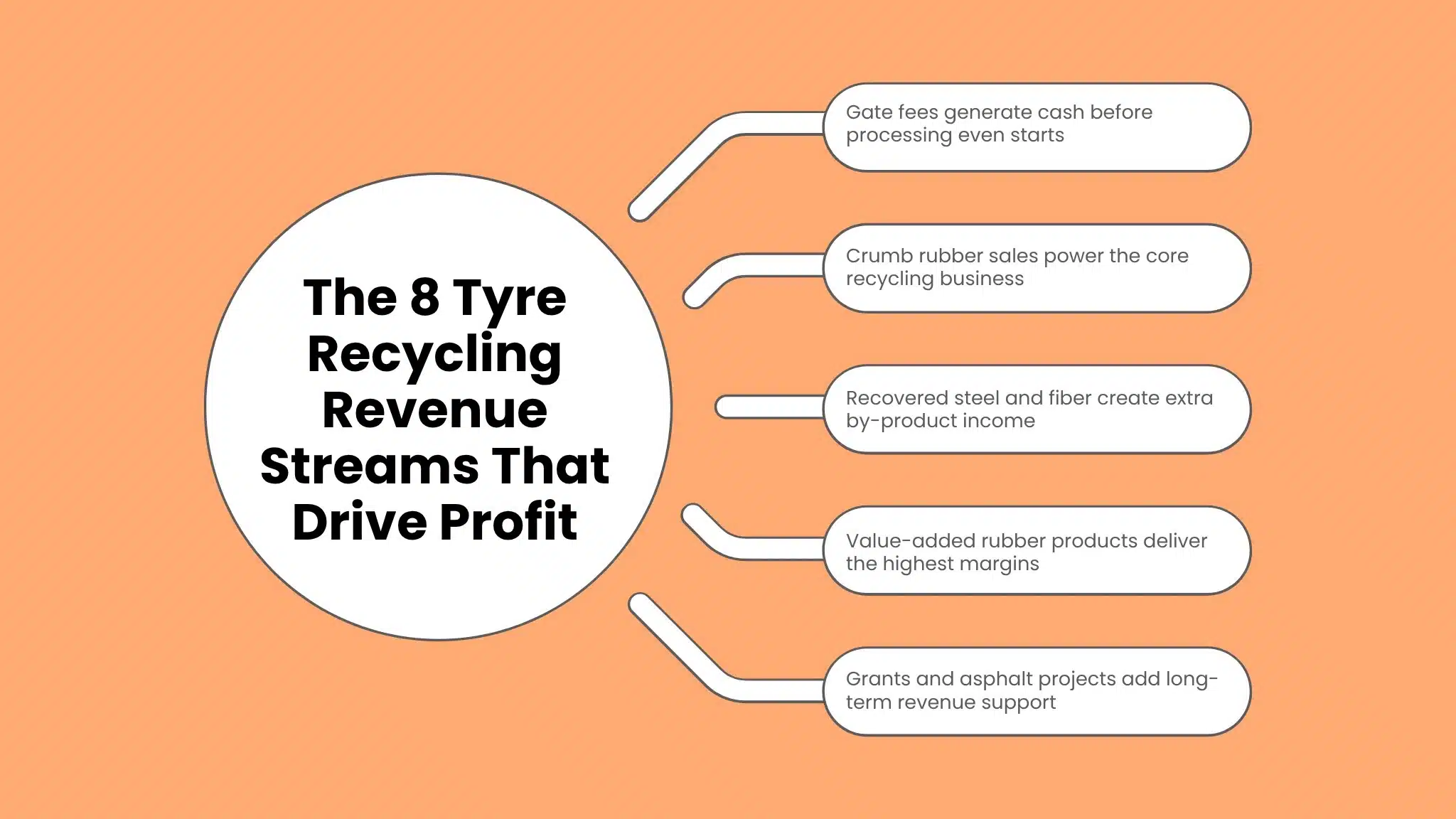
A robust tyre recycler business model operates on a “Circular Revenue” principle: Getting paid to acquire raw material and getting paid again to sell the processed output. By stacking your tire recycling income sources, you ensure that even if the rubber market fluctuates, steel recovery or collection fees maintain a positive cash flow.
| Revenue Stream | How It Earns | US Price / Range | Margin Profile | Volatility |
|---|---|---|---|---|
| Tipping / gate fees | Charge per tyre accepted | $2 to $25 per tyre | High | Low |
| Crumb rubber sales | Sell graded rubber | $200 to $500+ per ton | Medium | Medium-high |
| Steel scrap recovery | Sell recovered wire | Tracks scrap market | By-product | High |
| Tyre-derived fuel (TDF) | Sell or offset as fuel | Low per ton | Low | Low |
| Civil engineering fill | Sell shredded aggregate | Project-based | Medium | Medium |
| Rubber-modified asphalt | Supply road projects | Growing demand | Medium | Low |
| Value-added products | Sell mats, turf, molds | Highest per unit | Highest | Medium |
| Grants & incentives | State programs | Varies by state | Bonus | Low |
Tire Recycling Income Sources Explained One by One
Let’s go through these one at a time so you can see where your money would really land. I have lined up these tire recycling income sources roughly from steadiest to most lucrative.
How Gate Fees Help Tyre Recycling Companies Make Money
Gate fees (or tipping fees) are the most immediate tire recycling income sources. You provide a regulated disposal service for auto shops, trucking fleets, and municipalities.
Passenger Tyres: Average $2 to $6 per unit.
OTR (Off-the-Road) Tyres: Mining and earthmover tyres can fetch $100+ per unit due to specialized processing requirements.
Crumb Rubber: The Core Tyre Recycling Revenue Stream
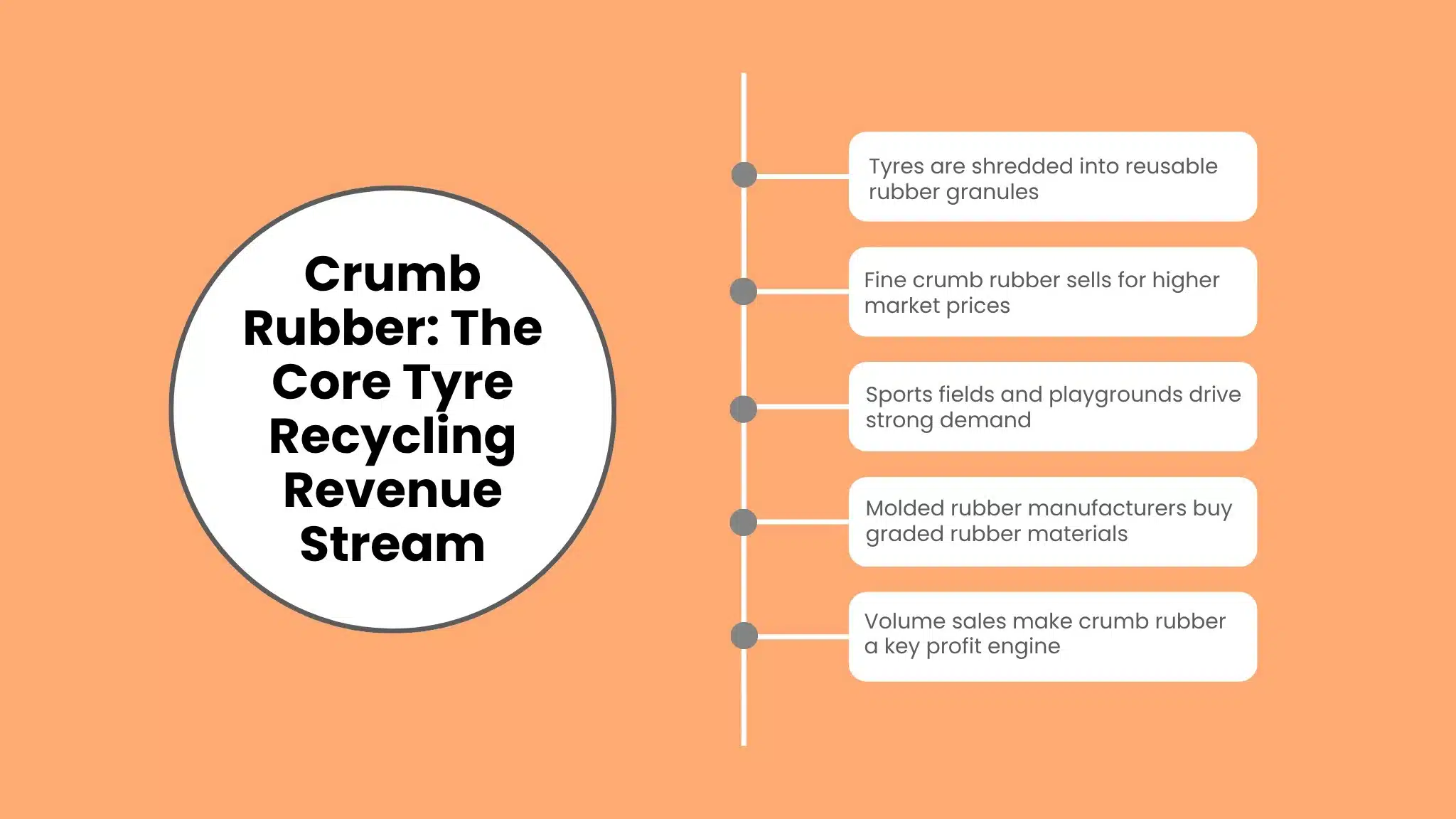
Producing clean, wire-free crumb rubber is the primary way how tyre recycling companies make money. The market value is driven by “Mesh Size”—finer grinds (30-40 mesh) fetch premium prices for use in injection molding and high-end rubberized surfaces.
Steel and Fiber Recovery as Tire Recycling Income Sources
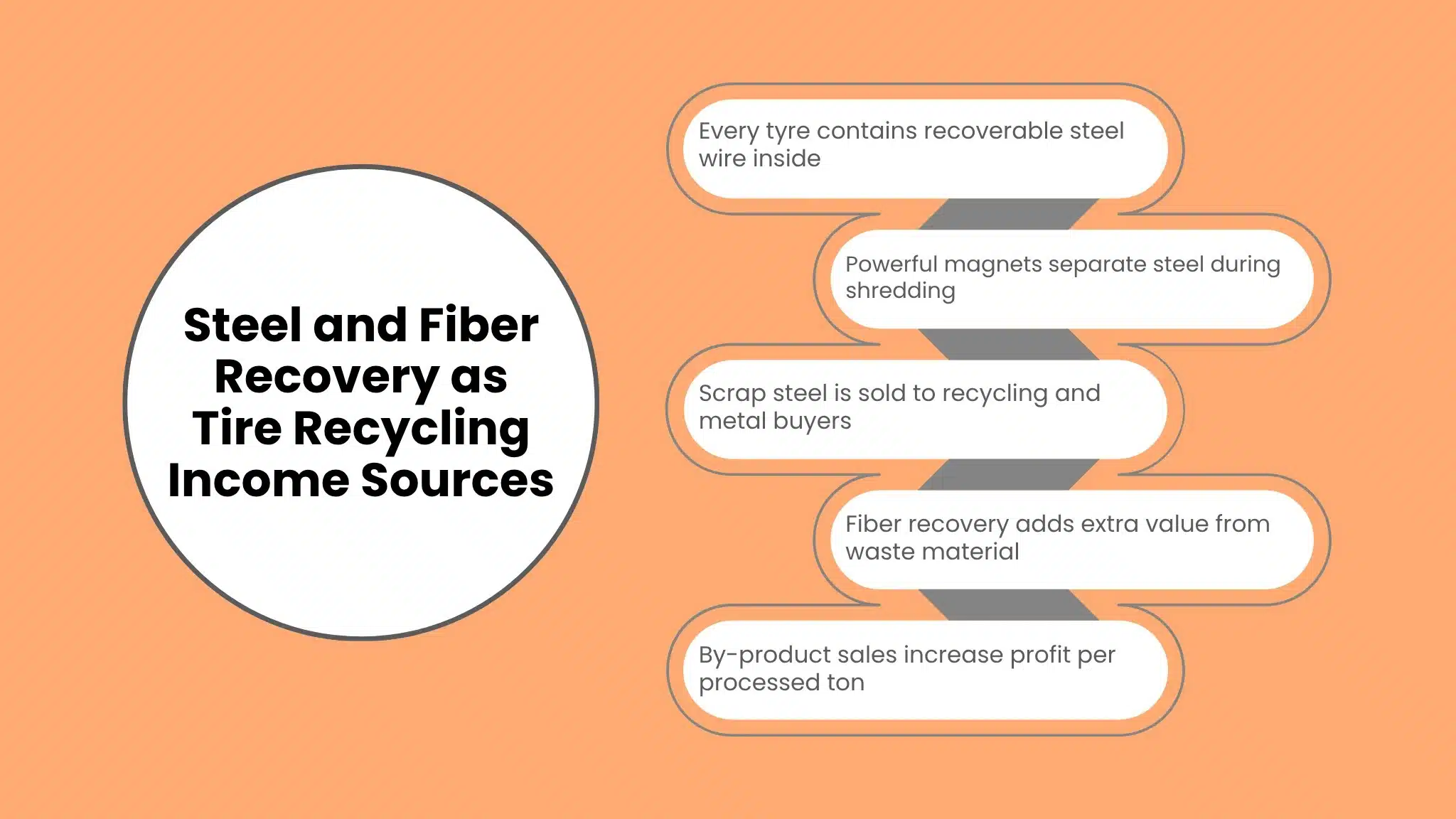
Radial tyres contain roughly 15-20% high-grade steel. Using magnetic separation during shredding allows you to extract this material. This scrap tire monetization route is highly efficient because the raw material is essentially “free,” and the extracted steel sells directly to mills at scrap market rates.
Fiber comes loose too, and some plants move that as well. Look, neither one is your headline product. But this is material already sitting in your yard, so selling it is close to free money. Quietly, these by-products nudge your revenue per ton up without you lifting much of a finger.
Tyre-Derived Fuel and Civil Engineering Routes
Not all rubber finds a buyer as crumb. Rather than pay to dump the leftovers, recyclers send them off as tyre-derived fuel. Cement kilns and power plants burn it for energy. Truth is, TDF usually works more like a cost cutter than a real earner, since it clears out stuff you couldn’t sell anyway.
Civil engineering is the other handy outlet. Shredded tyre chips make excellent lightweight fill, and contractors use them in:
- Road base and embankments
- Drainage and septic beds
- Retaining wall backfill
These are local, project-by-project deals. So knowing the right contractors in your area matters more than almost anything else with this one.
Value-Added Products: The Highest-Margin Scrap Tire Monetization Route
Now for the bit most guides breeze right past, and it is the real key to serious scrap tire monetization. The fat margins aren’t in selling raw rubber. They’re in turning that rubber into a finished thing somebody pays a premium for.
A ton of plain crumb sells for one price. Press that same rubber into gym flooring and the math changes completely. The owners who get rich do this on purpose. They stop thinking like tyre shredders and start thinking like manufacturers who just happen to use recycled rubber. Common money-makers include:
- Rubber gym and stable mats
- Playground and patio tiles
- Artificial turf infill
- Molded industrial parts
- Rubber-modified asphalt for roads
That single shift in mindset, from I shred tyres to I make products, is what separates a scrappy little yard from a business that actually prints money.
The Tyre Recycler Business Model: Costs vs. Revenue
Revenue is only half the picture, though. To really get the tyre recycler business model, you have to stare at the costs too, and some of them sting.
Startup money swings wildly. A small baling rig is cheap to get going. A full shredding and granulation line, on the other hand, can cost millions and tie you up for months in permits and installation before you earn a dime. Then the running costs pile on: labor, power, wear parts, insurance, permits, plus disposal for whatever you can not sell.
One cost towers over the rest, though. Downtime. When the line dies, your crew still gets paid while nothing comes in. So the plants that win are obsessed with uptime, usually keeping it between 90 and 95 percent. Cheap equipment that breaks constantly? That’s how good operators go broke.
Is Tyre Recycling Actually Profitable? Real Margins and Owner Income
Yes. Just not for eYes. With increasing ESG pressures and infrastructure demands, the market for recycled rubber is outstripping supply. By securing long-term “Off-take Agreements” with industrial buyers, you can stabilize your tyre recycling revenue streams and build a scalable, bankable business.
- Winners run several income streams, not one.
- Winners keep their machines humming.
- Winners route every tyre to its highest-paying outlet.
Losers, meanwhile, bet everything on a single product, get caught when that market dips, and burn through their cash. So the honest answer is this. Tyre recycling pays well when you run it like a real business and falls apart when you treat it like a weekend gig.
How to Maximize Scrap Tire Monetization
Just starting out? Relax, you don not need a million-dollar plant on day one. Smart scrap tire monetization is about moving in the right order.
First, lock down a steady tyre supply. Auto shops and local fleets are always desperate to get rid of them. After that, kick things off with low-cost baling or basic shredding so money starts moving fast. Pour those early profits back into better gear and higher-value products. And do not skip your state’s grant programs, because plenty of them hand out real cash to back tyre recycling.
Want the full launch plan for this exact business? Dig into our tyre recycling business guides and check out more proven business ideas on Reliable Startup to figure out your first move.
Conclusion
So that is how tyre recycling companies make money, and it is never one clever trick. It is eight income sources pulling together: gate fees, crumb rubber, steel and fiber, tyre-derived fuel, civil engineering fill, rubber-modified asphalt, value-added goods, and grants. The owners who stack these and keep their lines moving are the ones still standing in five years.
A diversified tyre recycler business model beats a one-product gamble every single time. Ready to flip scrap tyres into real income? Reliable Startup will walk you from your very first tyre to your first profit.
Frequently Asked Questions
How much money can a tyre recycling business make?
A scaled tyre recycling business can earn its owner $300,000 a year or more, with net margins around 10 to 25 percent. Smaller setups make less, sure, but they still turn a healthy profit once supply is steady and a few income streams are running together.
What is the most profitable part of tyre recycling?
Value-added products win, hands down. Turning crumb rubber into mats, turf, or rubber-modified asphalt pays way more per ton than selling raw granules. Gate fees come in close behind because that cash arrives before you process anything.
How much does it cost to start a tyre recycling business?
It depends a lot. A small baling setup can start in the low thousands. A full shredding and granulation plant can climb into the millions, and you’re looking at several months of permitting and install before the first dollar comes in.
Do tyre recycling companies get paid to take tyres?
Yep. They charge gate fees, sometimes called tipping fees, just to accept old tyres. That runs from roughly $2 per car tyre up to $25 for a big truck tyre, so collection by itself is a genuine income source.
Is tyre recycling a good business in 2026?
It is a solid bet in 2026. Supply is massive, dumping laws keep tightening, and demand for recycled rubber keeps climbing. Owners who spread their income across streams and keep their equipment running are set up to do really well.