Rental Business Profit Margins 2026: Top Niches, and ROI Benchmarks
The US rental industry crossed $60 billion in 2026 and is still growing close to 10% per year. So the real question is no longer whether rental businesses make money. The question is which ones make the most. Rental business profit margins vary wildly between niches. A party rental setup can clear 30% net while a heavy equipment yard fights to hold 15%.
Most articles online give you a vague range and call it a day. This guide breaks margins down by niche with real ROI numbers, 2026 market data, and the hidden costs that drag profits down. At Reliable Startup, we help new founders pick rental niches based on actual numbers, not hype. Here is what you need to know before you put a single dollar into rental inventory.
What Are Rental Business Profit Margins?
A rental business profit margin shows how much money you keep from every dollar of rental revenue after costs. There are three layers worth knowing.
Gross margin is what’s left after the direct costs of running a rental, like maintenance, cleaning, and fuel. Operating margin subtracts overhead like rent, salaries, and marketing. Net margin is the final number after taxes and interest. Most operators quote net margin when they say “we run at 20%.”
Rental businesses behave differently from retail. You’re not selling inventory once. You’re renting the same asset hundreds of times. That’s why depreciation, utilization rate, and asset payback period matter more here than in almost any other business model.
Average Rental Business Profit Margins by Niche
Here’s the cleanest snapshot of rental business profit margins across the most popular niches in the US right now.
| Rental Niche | Gross Margin | Net Margin | Startup Cost (USD) | Break-Even Window |
|---|---|---|---|---|
| Party & Event Rentals | 50-70% | 20-35% | $13,000-$50,000 | 12-18 months |
| Small Tool Rental | 60-70% | 25-40% | $20,000-$80,000 | 9-15 months |
| Heavy Equipment Rental | 40-50% | 15-20% | $250,000+ | 24-36 months |
| Car Rental (Independent) | 30-55% | 8-15% | $210,000-$560,000 | 18-30 months |
| Luxury Car Rental | 60-70% | 18-25% | $400,000+ | 24-36 months |
| Short-Term Property (Airbnb) | — | 25-50% | $20,000-$80,000 setup | 12-24 months |
| Long-Term Rental Property | — | 10-30% | Mortgage-based | 5-10 years |
| Kayak / Watercraft Rental | 55-70% | 25-40% | $15,000-$60,000 | 1-3 seasons |
| Bike Rental | 50-65% | 20-35% | $10,000-$40,000 | 1-2 seasons |
| Vacation Rental Property Mgmt | — | 11% avg, 32% top | $5,000-$30,000 | 12-18 months |
Read this table as a starting benchmark, not a guarantee. First-year operators typically land at the low end. Once utilization climbs and pricing tightens, margins shift toward the upper range within 18 to 24 months.
The Most Profitable Rental Niche in 2026
Look at the table and a clear pattern shows up. The most profitable rental niche in 2026 is small tool rental, with short-term property rentals close behind. Both pull 25% to 40% net margins when run well. Why these two? Tool rentals stay cheap to maintain, units rent out fast, and the same drill or pressure washer earns its cost back inside 12 months. Short-term properties win on premium nightly rates and direct booking margins.
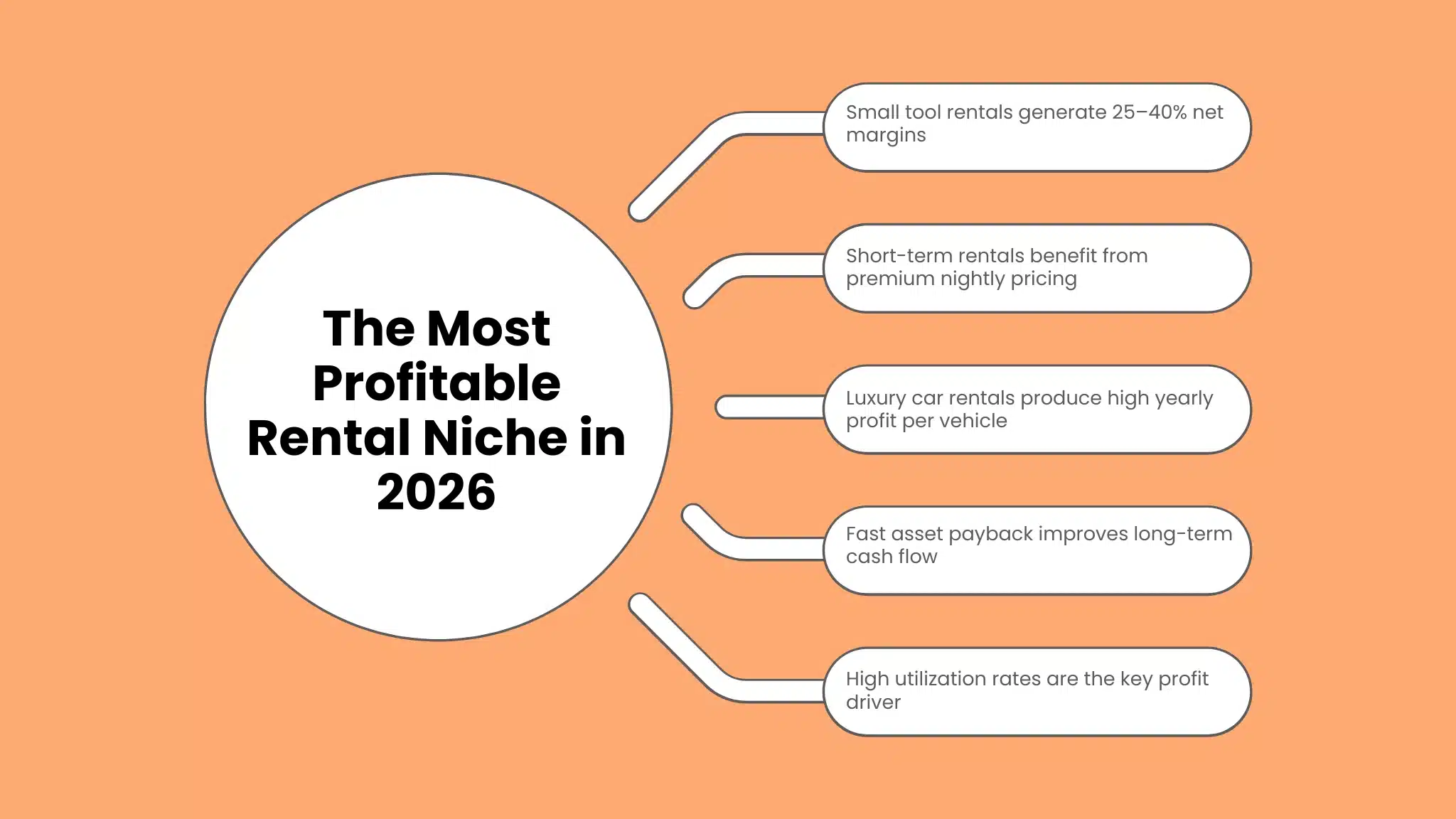
Luxury car rentals deserve a separate mention. The net margin sits lower at 18% to 25%, but the dollars per unit are massive. A single high-end vehicle can clear $48,000 to $72,000 a year in profit. So if you have the capital, luxury rentals are worth a serious look. For lower-budget founders, our guide on 25 Unique Rental Business Ideas walks through smaller-ticket niches that still deliver 30%+ margins.
How to Calculate Rental Business ROI: Formula + Example
Margin tells you profitability per sale. Rental business ROI tells you how fast your money comes back. Here’s the simple formula.
Rental Business ROI = (Annual Net Profit ÷ Total Investment) × 100
Let’s run real numbers. Say you invest $40,000 to launch a party rental setup. Year one revenue lands at $65,000, and after all costs, your net profit is $14,000. Your ROI is 35%. That’s strong, and it puts your full payback at under three years.
Now compare a short-term Airbnb setup. You spend $60,000 on furniture, deposits, and renovation. Year one nets $18,000. Your ROI is 30%, but property appreciation can lift the real return well above that. So when you compare rental niches, always check both ROI and unit economics. One niche may pay back faster, while another stacks long-term wealth.
Highest Margin Rentals Ranked by Profit Per Unit
Not every high-margin rental fits every operator. Some need garage space. Others need waterfront access. Here are the highest margin rentals ranked by profit per unit per year in 2026.
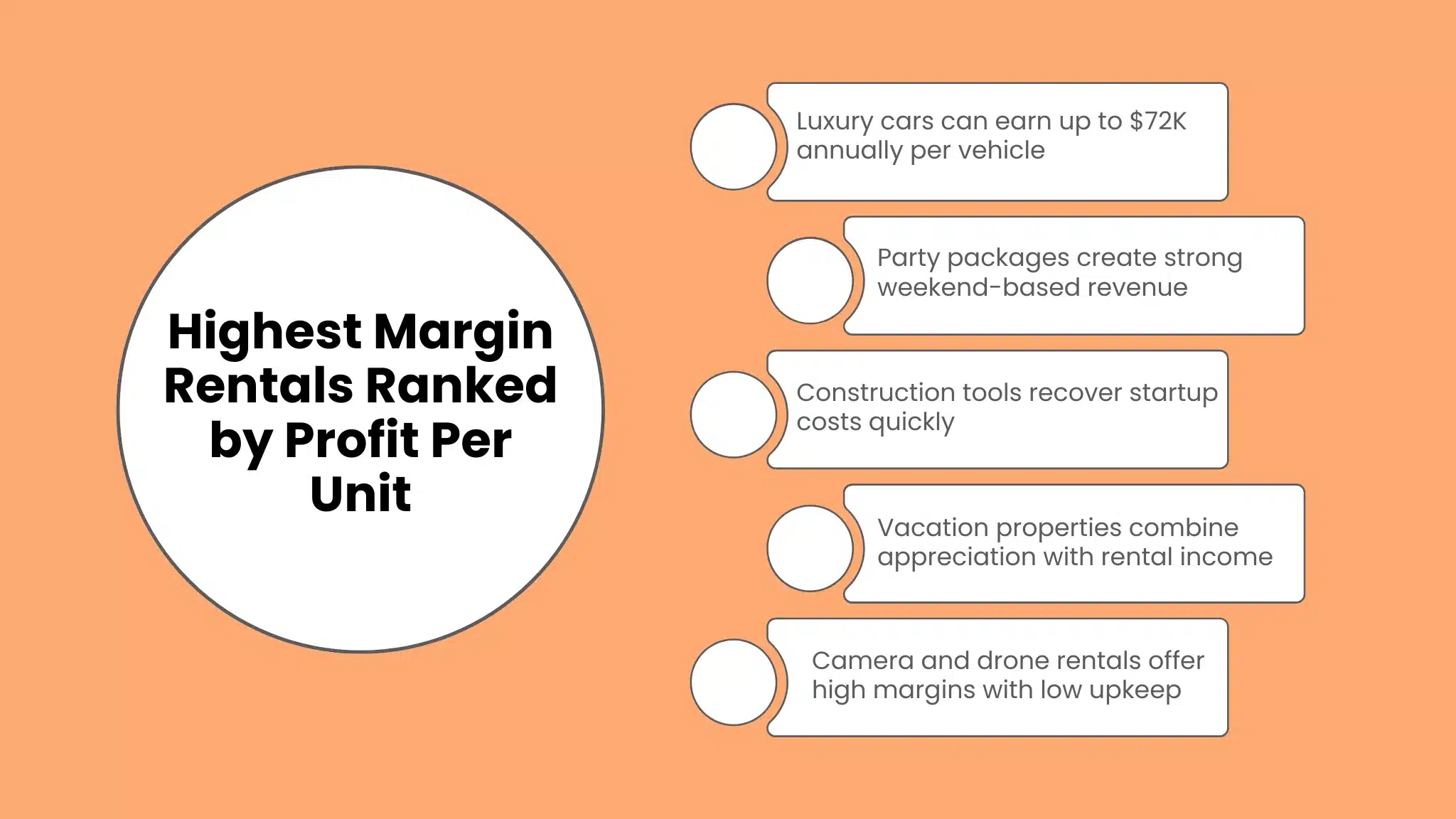
- Luxury cars earn $48,000 to $72,000 per vehicle annually with 60% to 70% gross margins.
- Party and event packages generate $300 to $1,500 per booking at 60% margins, with weekend-heavy demand.
- Small construction tools hold 70% gross margins and pay back inside 12 months.
- Short-term vacation properties deliver 25% to 50% net margins in tourist-heavy markets.
- Specialty equipment like camera gear, audio-visual setups, and drone rentals run 50% to 65% margins with low maintenance.
What Drives High Rental Business Profit Margins?
Four levers shape every rental business profit margin number. Utilization rate matters most. An asset rented 25 days a month earns nearly double what one rented 15 days makes. Pricing power comes second, and luxury rentals win here.
Maintenance discipline keeps repair costs under control, while asset payback period shows whether your inventory is actually working for you. Rental management software is now adding 5 to 8 percentage points to margins through better booking flow and dynamic pricing.
Rental Industry Profit Data 2026: Market Trends
Industry profit data 2026 shows the sector in a healthy growth phase. The US equipment rental market alone sits above $60 billion, expanding 7% to 10% annually. Demand keeps climbing as Gen Z and millennial buyers shift away from ownership. They rent tools, cars, party gear, and even clothes instead of buying them.
Tech adoption is the bigger story. Operators using rental management platforms are reporting 5 to 8 point margin lifts compared to manual operations. Insurance costs, on the other hand, are rising 10% to 15% year over year. So new operators in 2026 need to budget more for coverage than they would have in 2023.
Peer-to-peer rental marketplaces are also reshaping the entry point. Platforms like Turo and Fat Llama let new operators test rental demand without buying full inventory upfront. Our Peer to Peer Rental Business guide covers this trend in depth, and it’s a smart starting point for first-time founders.
5 Hidden Costs That Shrink Rental Business Profit Margins
Most articles skip this part, but it’s where new operators lose the most money. Here are the five costs that quietly cut into your bottom line.
- Idle inventory cost. Every asset sitting unrented still depreciates. Aim to keep utilization above 60% or rotate underperforming items out fast.
- Damage and replacement reserves. Most beginners budget 1% for damage. Reality runs closer to 3% to 5%, and one bad weekend can wipe out a month of profit.
- Insurance creep. Rates jumped 10% to 15% in 2026 alone. Build annual increases into your forecast.
- Payment processing fees. Card processors take 2% to 4% per transaction. On a $50,000 revenue year, that’s up to $2,000 vanishing silently.
- Customer acquisition cost. Google Ads, Facebook Ads, and SEO costs keep rising. Smart operators are shifting toward organic content and referral programs to keep CAC low.
How to Improve Your Rental Business Profit Margins
Margins move in small steps, but those steps compound fast. The first lever is utilization. Push it past 60% and your numbers transform overnight. Add high-margin extras next. Insurance waivers, delivery fees, and accessories typically run 80% to 90% margins and lift your average ticket without adding inventory.
Dynamic pricing is the third lever. Charge more during peak weekends, holidays, and tourist seasons. Rental software handles this automatically. After that, audit your inventory every quarter. Items renting less than 40% of the time should be sold or replaced.
Repeat customers cost almost nothing to win back, so build a simple loyalty program. Even a 10% returning-customer rate adds real margin. Lastly, switch to rental management software if you’re still tracking bookings on spreadsheets. The 5 to 8 point margin lift is real and it pays for the software many times over.
Conclusion
Knowing your rental business profit margins is step one, but picking the right niche based on your capital, location, and time horizon is what actually wins. Small tool rentals and short-term properties lead net margins. Luxury cars deliver the biggest dollar per unit. Heavy equipment needs deeper pockets but pays steady once it scales.
At Reliable Startup, we help founders match their budget to the right rental niche, run real ROI projections, and launch with a plan that holds up past year one. If you’re ready to move from research to action, visit Reliable Startup and we’ll help you choose the rental business that actually fits your numbers.
Frequently Asked Questions
What is a good profit margin for a rental business?
A good net profit margin for most rental businesses runs 15% to 30%. Equipment rentals typically hit 10% to 25%, while short-term property rentals can reach 25% to 50%. Anything below 10% net signals operational issues or overpriced inventory.
Which is the most profitable rental niche in 2026?
Small tool rentals, luxury car rentals, and short-term vacation properties lead the most profitable rental niche rankings in 2026. Each delivers 25% to 50% net margins when utilization stays above 60%.
How long does it take a rental business to become profitable?
Most rental businesses break even within 12 to 24 months. Party and tool rentals can break even in under a year. Heavy equipment and car rental businesses take 24 to 36 months due to higher startup costs.
What is the average rental business ROI in the US?
The average rental business ROI in the US runs 8% to 35% annually, depending on niche and management quality. Top-quartile operators in highest margin rentals reach 30%+ ROI consistently.
Are rental businesses still profitable in 2026?
Yes, rental businesses remain highly profitable in 2026, with the US market growing 7% to 10% annually. Demand for renting over buying keeps rising, especially in tools, vehicles, and short-term properties.