How to Start a Data Analytics Startup With No Funding
The global data analytics market is projected to skyrocket from $107 billion in 2026 to over $738 billion by 2033. This explosive growth has left many technical professionals wondering how to start a data analytics startup before the market becomes oversaturated. The good news is that you do not need venture capital backing to claim your share of this massive industry.
You can build a highly profitable, self-sustaining enterprise completely from scratch without giving away company equity. By focusing on specialized consulting, niche automated dashboards, or specific micro-SaaS indicators, founders can bypass high infrastructure costs entirely.
This modern guide will outline exactly how to launch a bootstrapped data analytics business. We will unpack the exact data analytics startup requirements, real operational costs, and the steps needed to scale your profit margins safely.
The Economics of a Bootstrapped Analytics Agency
Many founders assume that entering the modern business intelligence market requires buying expensive enterprise software or data warehousing pipelines up front. In reality, the modern tech ecosystem allows small, agile teams to process huge amounts of information using open-source utilities and variable cloud compute frameworks.
| Service Tier | Estimated Data Analytics Startup Cost | Targeted Data Analytics Startup Profit Margin | Key Tech Stack Components |
| Niche E-commerce Audit | $200 to $500 | 85% to 95% | Python, PostgreSQL, Looker Studio |
| Fractional Analytics Engineering | $400 to $1,000 | 80% to 90% | dbt Core, DuckDB, BigQuery (Free Tier) |
| Automated KPI Dashboarding | $500 to $1,500 | 75% to 85% | Supabase, Metabase, Airbyte Open Source |
| Predictive Retargeting Micro-SaaS | $1,000 to $2,500 | 65% to 80% | FastAPI, Scikit-learn, AWS Lambda |
When determining is data analytics startup profitable, look closely at the cost structures above. Because a lean consulting or micro-SaaS framework has low infrastructure overhead, your operational margins remain incredibly insulated compared to capital-heavy software firms. Your operational margins remain incredibly insulated compared to capital-heavy software firms. This lean-first approach is similar to how founders approach data analytics startups more broadly, where minimal infrastructure translates directly into stronger early profitability.
4 Paths to Start a Data Analytics Startup Without Outside Capital
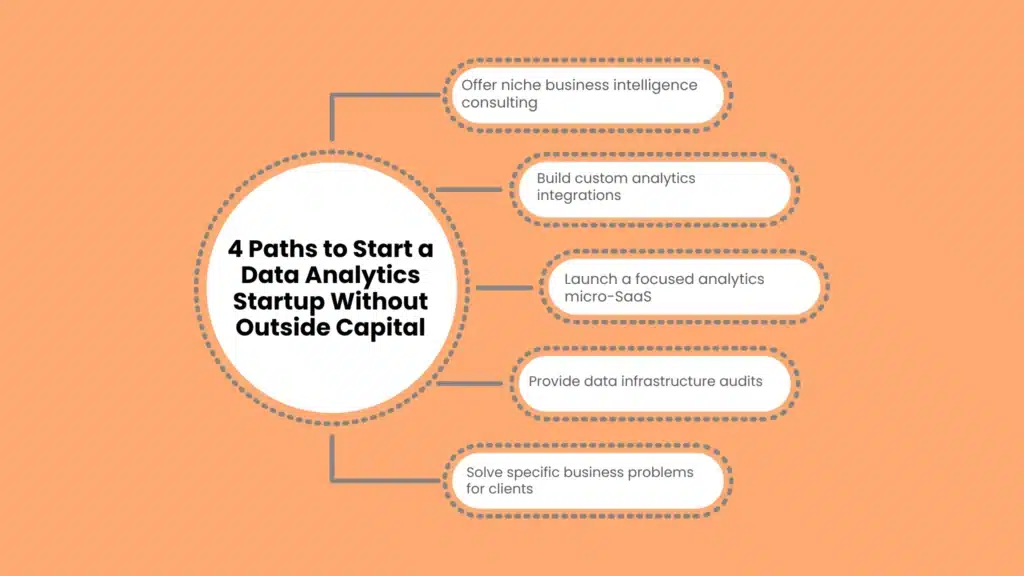
1. High-Ticket Niche Business Intelligence Consulting
The fastest way to generate immediate revenue with zero upfront funding is by selling your data analysis skills as a premium service. Instead of offering general data analysis to everyone, pick a highly specific sector like operational logistics for regional medical suppliers or localized Shopify store optimization.
The Execution Strategy: Identify businesses stuck processing records manually inside messy spreadsheets. Build custom pipelines that ingest their operational files, clean the records, and output interactive visual progress boards.
The Technical Framework: Utilize free open-source visualization platforms like Google Looker Studio or Metabase connected to a free-tier cloud database instance. Your primary cost will be your time spent refining the customer data models.
2. Tailored Analytics Framework Integration
Modern companies use dozens of internal software tools, but their internal engineering departments rarely have time to connect them seamlessly. Your agency can step in to build reliable, structured data extraction pipelines that centralize disparate records.
The Execution Strategy: Focus entirely on connecting distinct software sets, such as linking regional CRM platforms to localized finance ledgers. You build the automated pipeline that extracts, normalizes, and packages the data into a single dashboard.
The Technical Framework: Leverage open-source variations of tools like Airbyte or Meltano to manage the information transfer pipelines. Run your data transformation workloads on lightweight frameworks like dbt Core to keep processing costs near zero.
3. Hyper-Focused Analytical Micro-SaaS Platforms
If you prefer building a product over managing consulting clients, focus on a micro-SaaS business model. Look for very specific questions that major business intelligence platforms ignore.
The Execution Strategy: Build a simple software wrapper that monitors one specific business driver, such as calculating product return probabilities for boutique clothing brands or tracking local fleet fuel efficiencies.
The Technical Framework: Build your platform using lean backend technologies like Python FastAPI. Instead of paying for massive standalone data systems, use serverless tools like Supabase or specialized serverless computing instances where you only pay when a customer triggers an actual request.
Use serverless tools like Supabase or specialized serverless computing instances where you only pay when a customer triggers an actual request. If a full product model appeals to you more than consulting, these micro SaaS ideas explore similarly lean, usage-based business builds.
4. Fragmented Data Infrastructure Auditing
Many scaling businesses waste thousands of dollars per month on bloated, unoptimized cloud databases. Your startup can offer optimization audits that discover structural pipeline inefficiencies, duplicate data models, and runaway query costs.
The Execution Strategy: Review a client’s active cloud warehouse configurations, identify slow-running processing jobs, and restructure their system to cut their software bills in half.
The Technical Framework: Use standard data profiling packages alongside system monitoring scripts to pinpoint structural errors. You can charge a flat project fee or ask for a direct percentage of the total infrastructure cost reduction you achieve for the business.
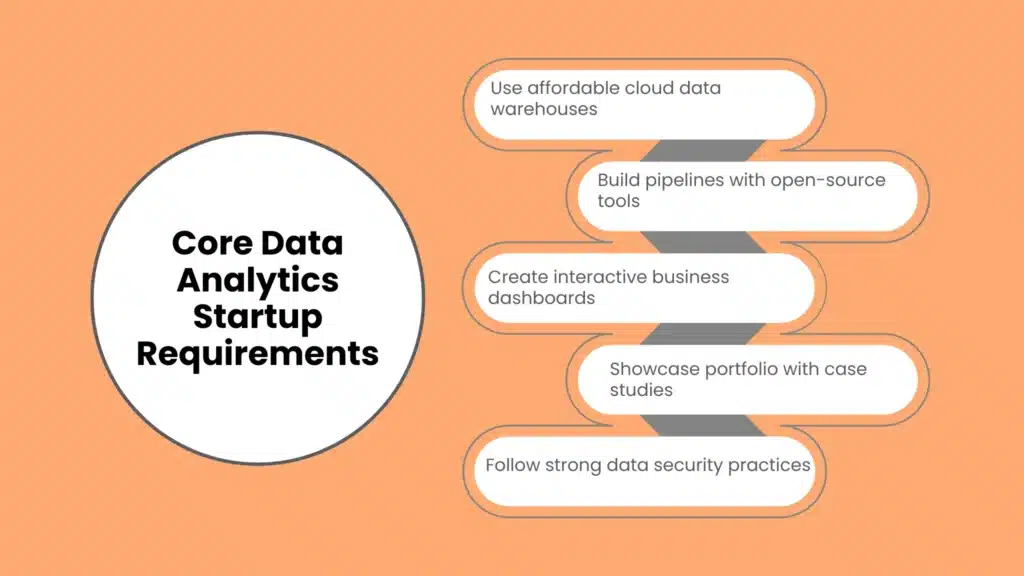
Core Data Analytics Startup Requirements
Launching a lean data venture successfully requires balancing practical technical skills with a focused, low-cost marketing strategy.
The Essential Minimalist Tech Stack
To keep your initial data analytics startup cost as close to zero as possible, choose highly modular technologies that scale only as your client volume increases:
Storage & Warehousing: Use Google BigQuery’s generous free tier or embedded relational structures like DuckDB for small to mid-sized analytical projects.
Transformation Engines: Rely on dbt Core to build and document clean data logic models without incurring licensing fees.
Visual Presentation Layer: Build clear customer facing reports using free versions of tools like Metabase or Apache Superset.
Build clear customer facing reports using free versions of tools like Metabase or Apache Superset. Founders assembling a broader software stack from scratch may also find this guide on all-in-one business software for startups useful for keeping operations centralized.
Non-Technical Requirements for Growth
Technical skills alone will not sustain a bootstrapped data analytics business. You must actively build operational credibility within your chosen market niche:
Definitive Proof of Performance: Create mock analytical case studies using public datasets from platforms like Kaggle. Publish these clear data models online to visually demonstrate your technical precision to prospects.
Ironclad Data Security Compliance: Draft a transparent, legally sound data privacy agreement before handling any client infrastructure. Clearly define how consumer data is safely managed, stored, and isolated during your projects.
Strategy for Sustaining Premium Profit Margins
Achieving a stellar data analytics startup profit margin requires avoiding the temptation to compete on price with generic overseas agencies. When you sell general data analysis, you turn your skills into a basic commodity. When you sell specific corporate answers, you can command premium fees.
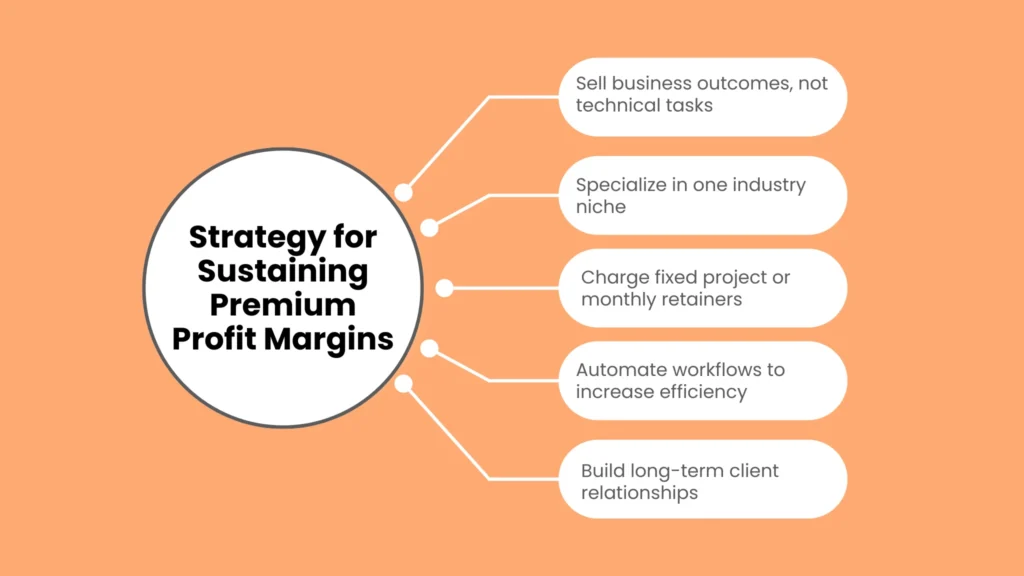
Always structure your client agreements around specific business results rather than hours worked. Charging a predictable monthly retainer or a fixed project fee allows you to grow your financial returns exponentially as your internal automation tools become faster and more efficient.
Build Your Analytics Foundation
You do not need massive venture capital reserves to launch a highly successful technology firm. By mastering open-source tools, focusing on a specific industry vertical, and prioritizing immediate cash flow over expensive custom builds, you can build a stable enterprise entirely on your own terms.
Begin by building a simple prototype or offering high-value consulting services to local businesses. Listen closely to the exact data obstacles your early clients face, refine your workflows based on that real-world feedback, and use those successes to steadily win larger contracts.
If you want more practical business strategies, low-cost growth playbooks, and structural step-by-step guides for independent founders, visit our resource platform at reliablestartup to accelerate your entrepreneurial growth.
Frequently Asked Questions
Is data analytics startup profitable without upfront funding?
Yes, it is highly profitable. Because the primary asset of a data analytics startup is your technical specialized expertise, your early operational expenses are remarkably low. This allows bootstrapped businesses to quickly reinvest their early consulting revenues directly into product expansion.
What is the true data analytics startup cost for a solo founder?
A solo founder can launch a data analytics business for under $500. Your primary initial investments include domain registration, secure professional email hosting, and small web app server instances. You can leverage the robust free tiers of major cloud processing platforms to handle your early client workloads.
How do I acquire my very first data analytics client?
Avoid generic cold emailing. Instead, find businesses in your target niche that have clear operational problems. Audit their public data infrastructure or run a helpful sample analysis using open industry records, then present those clear insights directly to their leadership team as an actionable blueprint.
Do I need complex infrastructure to serve mid-sized businesses?
No. Most mid-sized companies do not require massive lakehouse environments. They need clean, well-modeled relational databases and reliable dashboards that update automatically. You can easily build these systems using lightweight open-source software packages.