How to Get Edtech Venture Capital Funding as a First-Time Founder
The venture capital environment for education technology has transitioned into a highly selective landscape. Previously, investors frequently backed speculative platforms based purely on user traction or aesthetic interface design. However, in 2026, the sector is experiencing a strict emphasis on pedagogical proof and capital efficiency. Consequently, understanding how to raise edtech funding as a first-time founder requires moving past traditional pitch decks. Because institutional capital is heavily concentrated in scalable, high-outcome products, understanding the precise edtech venture capital funding requirements is vital to secure early backing and build a defensible business.
Importantly, catching a venture capitalist’s attention requires addressing specific structural changes in software procurement. Educational institutions and enterprise buyers are no longer buying experimental tools; instead, they demand clear returns on investment, rigid compliance metrics, and verifiable skills growth. Therefore, matching your solution to modern market parameters can position your startup to capture crucial initial seed investment.
This comprehensive playbook outlines the fundamental mechanics of securing edtech venture capital funding as an early founder. We will evaluate realistic creation budgets, break down standard business margins, and lay out an actionable strategy to make your venture highly attractive to institutional investors.
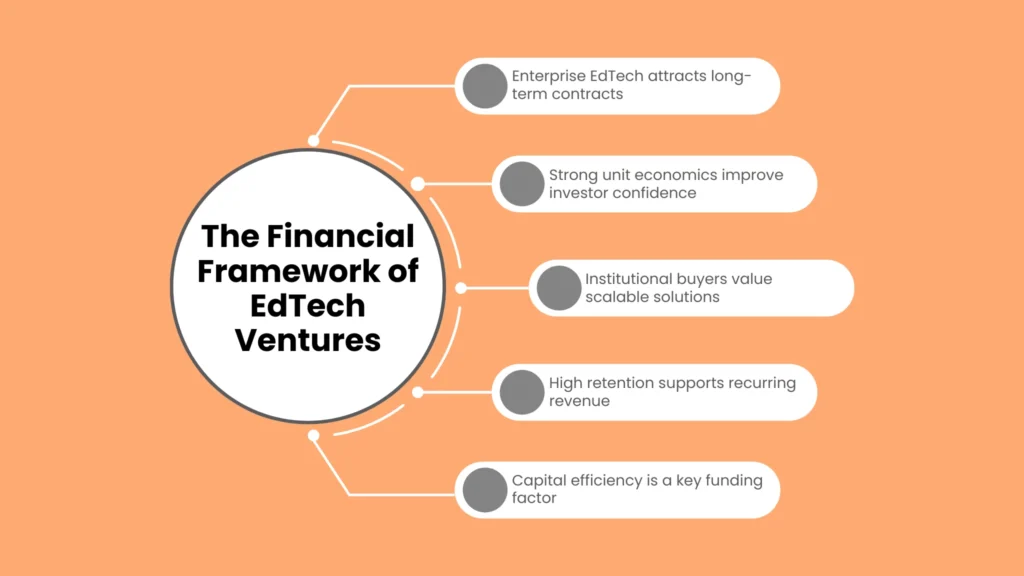
The Financial Framework of EdTech Ventures
Before initiating your fundraising process, you must accurately map out your corporate financial indicators. Venture funds analyze unit economics deeply during initial due diligence rounds. By presenting clear cost boundaries, you protect your early cap table from unnecessary dilution.
| EdTech Venture Sector Focus | Estimated EdTech Venture Capital Funding Cost | Expected EdTech Venture Capital Funding Profit Margin | Baseline Legal & Product Requirements |
| K-12 Platform & Administration | $75,000 to $165,000 (Audits & Base Build) | 70% to 84% | COPPA 2.0 Compliance, ADA Title II, LTI 1.3 Standards |
| Higher Ed Infrastructure & AI Nodes | $90,000 to $210,000 (API Stacks & Safety Logs) | 75% to 88% | FERPA Data Security, SOC2 Type II, LMS Interoperability |
| Workforce Skilling & Upskilling Software | $60,000 to $145,000 (Content & Engine) | 80% to 92% | Enterprise SSO, SCORM/xAPI, Custom Admin Dashboards |
When tackling the macro question of is edtech venture capital funding profitable for early founders, current sector performance highlights a clear distinction between consumer apps and institutional platforms. Enterprise tools achieve stable profitability rapidly because corporate and university buyers gladly commit to large annual contracts. Consequently, this stable baseline ensures your edtech venture capital funding profit margin remains insulated from consumer churn patterns. As a result, your team can focus capital directly on product refinement rather than constant digital advertising.
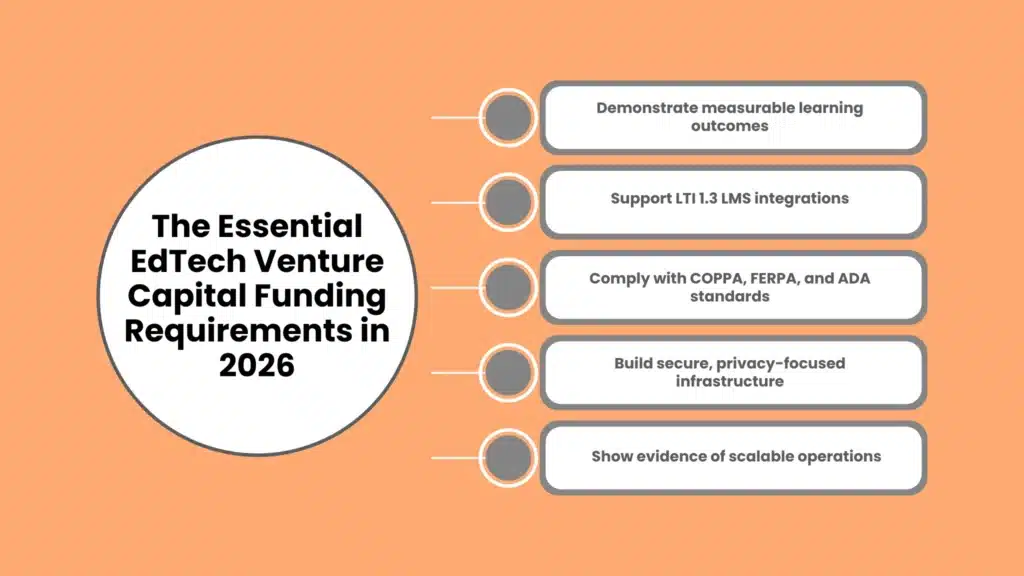
The Essential EdTech Venture Capital Funding Requirements in 2026
To satisfy institutional venture capital requirements, first-time founders must move beyond basic code prototypes. VCs require clear operational evidence that your application can safely scale within strict institutional rules.
1. The Efficacy Framework and Logic Models
Venture capital funds now actively avoid platforms that act as simple digital worksheets. Your platform must offer measurable educational value:
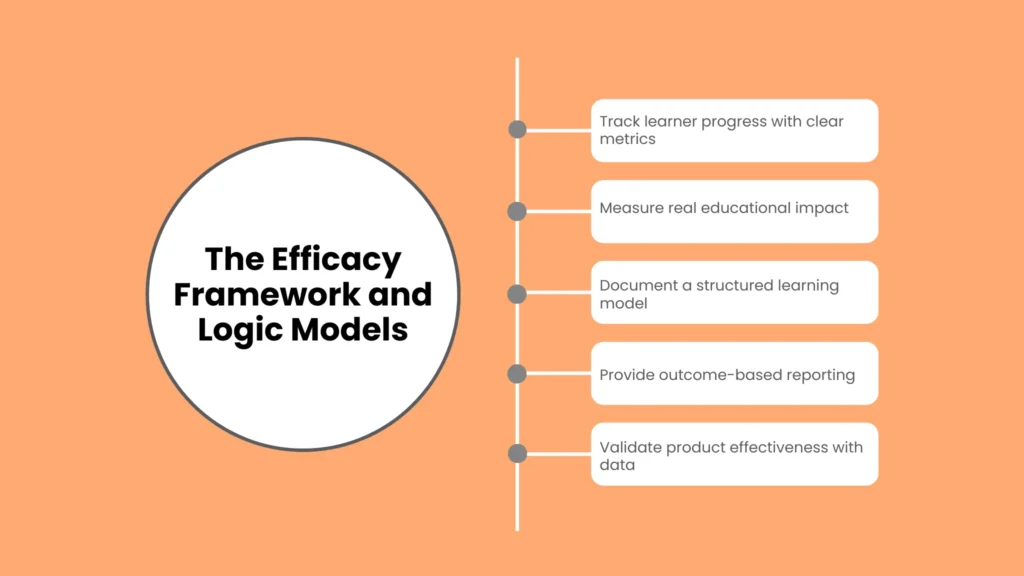
Verifiable Learning Progress: Build automated dashboards that display explicit skill improvements or time-saving milestones for educators.
Logic Model Documentation: Provide a structured framework explaining how your software directly improves student outcomes. Having a clear model gives institutional buyers the concrete proof they need to justify their spending.
2. Comprehensive Security and Interoperability
Modern education ecosystems use tightly integrated software networks. Your application must plug into existing setups easily:
Strict Procurement Standards: Build your code to support LTI 1.3 (Learning Tools Interoperability) protocols. This makes it easy to connect with massive Learning Management Systems like Canvas and Blackboard.
Absolute Data Privacy: Implement clear data tracking rules that match current COPPA 2.0 and FERPA privacy regulations. Investors will thoroughly inspect your data collection loops during due diligence to ensure you are well-protected against security risks.
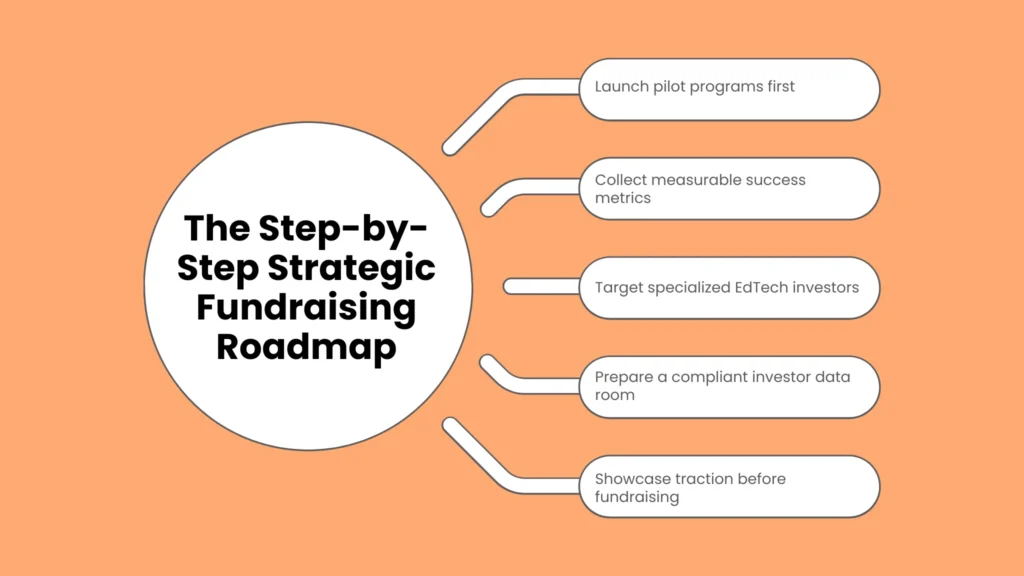
The Step-by-Step Strategic Fundraising Roadmap
First-time founders frequently waste valuable time pitching generalist venture firms who lack a deep understanding of education procurement cycles. Instead, target your capital search toward specialized syndicates by following an incremental, milestone-driven outreach plan.
Step 1: Secure Unregulated Pilot Proof
Before reaching out to institutional funds, launch focused pilots with independent school groups, regional training centers, or specialized corporate departments. Use these initial testing grounds to collect real-world usage statistics, system engagement trends, and direct user feedback. This gives you a strong foundation of practical validation before starting formal investor conversations.
Step 2: Pitch Specialized Sector Investors
Do not spend early energy on massive consumer-focused venture networks. Target specialized funds that focus specifically on workforce development and educational software. Because these micro-VC firms deeply understand regional procurement cycles, they can evaluate early-stage software opportunities quickly without requiring millions in immediate revenue.
Step 3: Package a Compliant Sandbox Data Room
When your initial investor meetings progress to deep due diligence, ensure your digital data room is thoroughly organized. Include your SOC2 timeline, explicit data privacy policies, and documented evidence of your system’s accessibility features. Presenting these regulatory elements upfront proves your team possesses the structural maturity required to close institutional contracts.
Launch Your Educational Enterprise Successfully
Building a lasting, venture-backed education platform does not require decades of institutional experience. By focusing on resolving the clear administrative bottlenecks, integration hurdles, and compliance demands that legacy providers regularly overlook, you can create immense value for buyers.
Begin your fundraising journey by speaking directly with classroom teachers, university registrars, and corporate training directors. Pinpoint their most time-consuming manual processes, build a secure minimum viable product to automate those specific tasks, and use those cost-saving metrics to confidently secure venture backing.
If you are looking for actionable development blueprints, compliance checklists, and proven growth playbooks for modern technical builders, explore our complete startup resource center at reliablestartup.com to accelerate your corporate path.
Frequently Asked Questions
Is edtech venture capital funding profitable for lean, first-time founder teams?
Yes, it is highly profitable if you target software solutions tailored to enterprise workflows, workforce skilling, or institutional infrastructure. By avoiding consumer-facing marketing costs, business-to-business models can route capital directly into product improvement, allowing small technical teams to quickly hit positive cash flow metrics.
What is the major cost driver within the initial edtech venture capital funding cost?
The largest upfront costs involve securing mandatory security badges, integrating complex software ecosystems, and implementing data protection frameworks. Minimizing high office rents and non-essential marketing expenses early on ensures you can dedicate your seed funding entirely to maintaining institutional compliance.
Why are modern VCs emphasizing efficacy proof over basic user acquisition?
School districts and large corporations are now highly accountable for every software dollar they spend. Because buyers are actively cutting tools that fail to show clear utility, venture capital firms prioritize platforms that feature built-in tracking tools. This focus protects their investments from sudden cancellations during budget cycles.
Can a first-time founder raise seed capital without having an active sales pipeline?
Yes, but you must offset the lack of revenue with strong proof of user engagement, unique software capabilities, or successful pilot programs. Showing high user retention rates during early testing validates your core product value, proving to investors that schools will naturally want to adopt your tool at scale.
How does ADA Title II impact software requirements for new edtech platforms?
Recent legal adjustments mandate that all digital learning tools utilized by public entities must meet strict accessibility criteria. Consequently, your engineering team must build the product with comprehensive screen-reader support, keyboard-only navigation options, and flexible display choices right from the very first build.