How to Start a Poke Bowl Business on a Food Truck Budget
To start a poke bowl business on a mobile food truck budget, you need a reliable food truck or trailer setup, commercial-grade refrigeration, health department permits, and an ethical seafood sourcing network. A poke food truck eliminates the heavy lease costs and expensive build-out expenses of a traditional brick-and-mortar restaurant. By serving fresh, customizable raw fish bowls in high-foot-traffic urban areas, business parks, and events, an entrepreneur can launch a high-margin culinary brand for a fraction of standard restaurant costs.
The global demand for healthy, fast-casual meals makes poke one of the most attractive food concepts on the market today. Because poke relies on cold prep work rather than heavy deep fryers or commercial ventilation hoods, mobile equipment needs remain significantly lower than traditional food trucks. Whether you plan to operate as a hands-on owner-operator or scale into a fleet of mobile units, this guide provides a clear blueprint to launch your brand efficiently.
Why Choose a Food Truck for Your Poke Bowl Concept?
Launching a mobile food vehicle gives food entrepreneurs a distinct operational advantage over traditional stationary eateries. Poke bowls originated as a traditional Hawaiian dish made of cubed raw fish, savory soy seasonings, rice, and fresh toppings. Today, the concept fits perfectly into the fast-casual lifestyle.
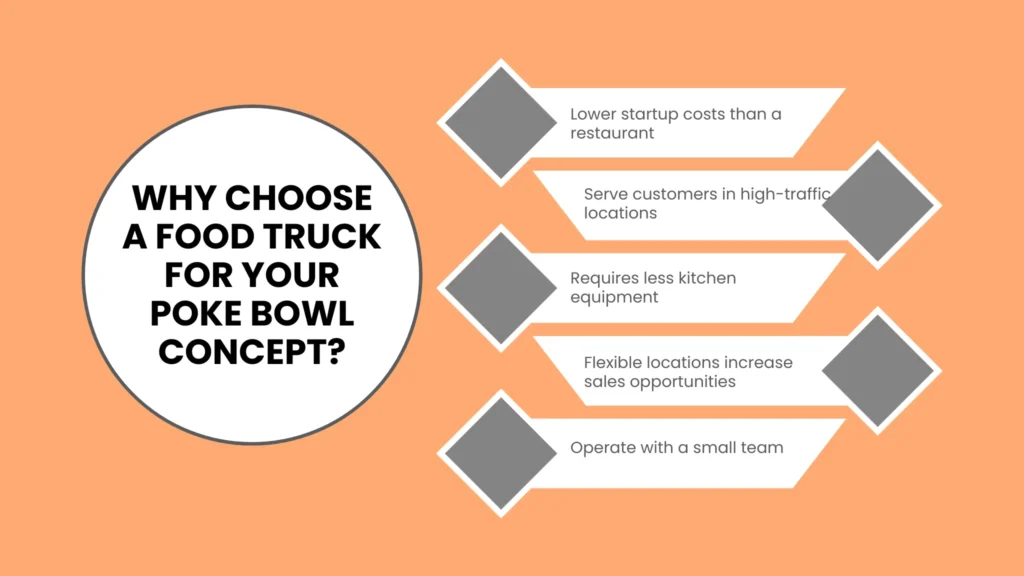
Operating from a food truck offers several key advantages:
Significantly Lower Capital Requirements: Brick-and-mortar storefronts can cost upwards of $200,000 to $400,000 to lease and build out. A mobile truck allows you to open for a fraction of that investment.
Flexible Location Strategy: If sales are slow in a specific business park, you can simply drive to a college campus, festival, or beach area.
Reduced Kitchen Equipment Needs: Poke requires rice cookers, refrigerated prep rails, and cold storage, eliminating the need for grease traps, commercial gas lines, or expensive fire suppression hoods.
Lower Labor Overhead: A compact mobile setup requires only two to three team members to handle order taking, assembly, and customer service.
Essential Poke Bowl Business Requirements
Before serving your first customer, you must comply with strict municipal and health regulations. Handling raw sushi-grade fish requires meticulous temperature control, food safety training, and proper business registration.
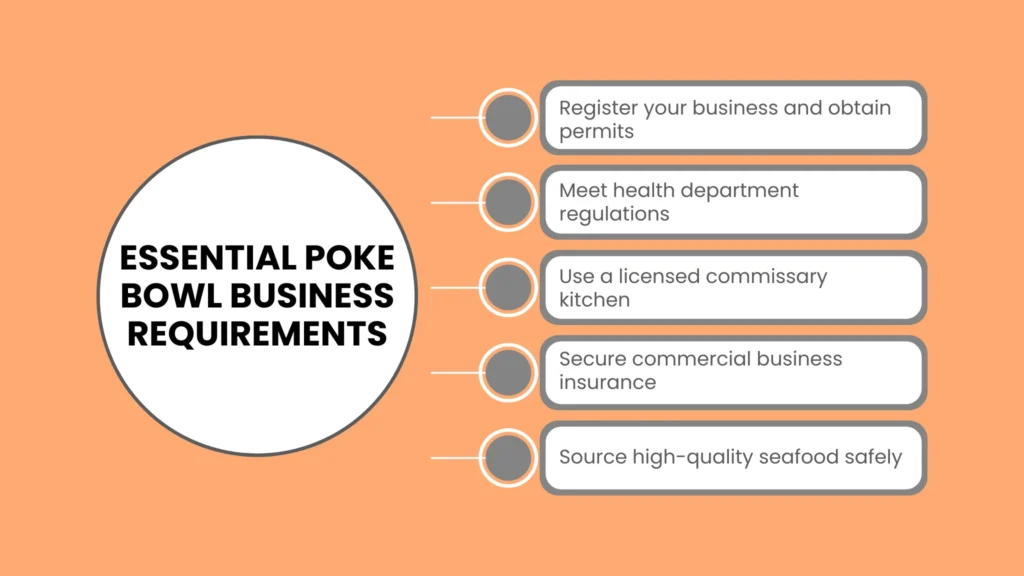
Meeting these essential poke bowl business requirements is mandatory for long-term operational success:
1. Business Structure and Licensing
Register your business as a Limited Liability Company (LLC) or corporation. An LLC isolates your personal assets from business liabilities. You must also obtain an Employer Identification Number (EIN) from the IRS, a local business license, and a seller permit for state sales tax collection.
2. Health Department Permits and Food Safety
Because poke involves raw seafood, local health departments enforce strict food safety rules. You will need a Mobile Food Facility Permit, a Hazard Analysis Critical Control Point (HACCP) plan for raw fish handling, and a Food Safety Manager Certification for at least one full-time team member.
3. Commercial Commissary Kitchen Agreement
Most municipalities prohibit food trucks from prepping raw ingredients or storing food inside residential kitchens. You are usually required to rent space at a licensed commercial commissary kitchen to park your truck overnight, dump gray water, refill clean water, and prep bulk ingredients.
4. Commercial Insurance Protection
Operating a mobile food business requires specialized commercial insurance policies:
Commercial Auto Insurance: Covers your truck while driving between locations.
General Liability Insurance: Protects against slip-and-fall injuries near your truck or customer claims.
Product Liability Insurance: Essential coverage for businesses serving raw seafood products.
Detailed Poke Bowl Food Truck Startup Cost Breakdown
Understanding your setup expenses is vital when budgeting for your new venture. Your total poke bowl food truck startup cost depends on whether you buy a new custom vehicle, purchase a used truck, or retrofit a specialized trailer.
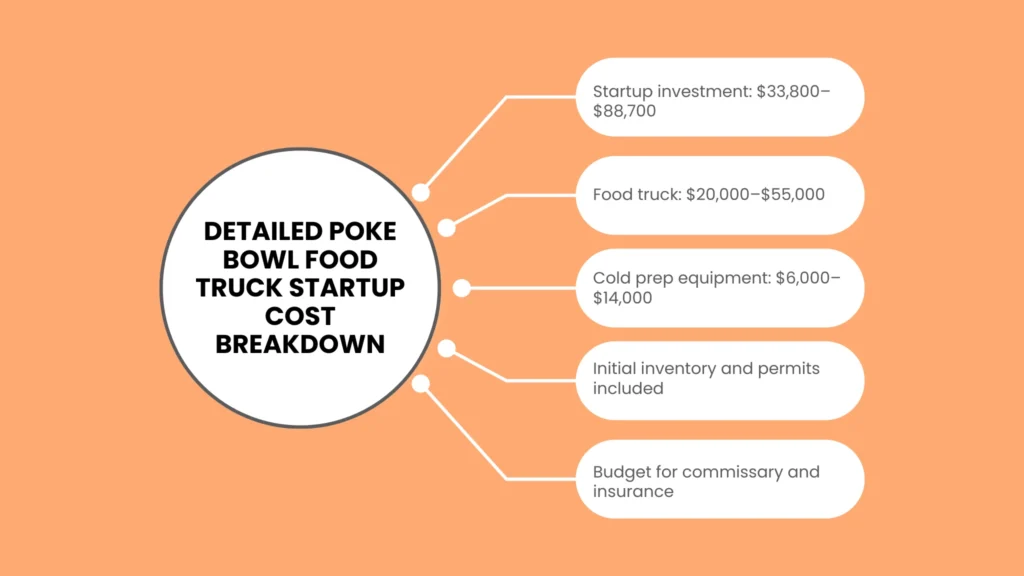
Based on available market data, the average total poke bowl business cost for a mobile setup ranges from $35,000 to $95,000. This is substantially cheaper than opening a traditional storefront location.
The table below outlines the estimated startup and ongoing monthly expenses for a mobile poke shop:
| Expense Category | Startup Cost Range (Estimated) | Monthly Cost Range (Estimated) | Key Details & Description |
| Used Food Truck or Trailer | $20,000 – $55,000 | $400 – $900 | Vehicle purchase or financing payment |
| Refrigeration & Prep Equipment | $6,000 – $14,000 | $150 – $300 | Sandwich prep rails, reach-in coolers, rice cookers |
| Vehicle Exterior Wrap & Branding | $2,000 – $4,500 | $0 | Eye-catching vinyl wrap and menu board signage |
| Permits, Licenses & HACCP Plan | $1,200 – $3,500 | $50 – $150 | Health permits, city vendor licenses, food certifications |
| Initial Food Inventory & Packaging | $2,500 – $5,000 | $2,500 – $6,000 | Ahi tuna, salmon, rice, sauces, eco-friendly bowls |
| Commissary Kitchen & Parking | $500 – $1,500 | $400 – $1,200 | Monthly kitchen rent, overnight parking, water supply |
| Insurance Policies | $1,200 – $3,000 | $150 – $350 | Commercial auto, general, and product liability |
| POS System & Digital Tech | $400 – $1,200 | $60 – $150 | Mobile register, card reader, online ordering apps |
| Estimated Total Investment | $33,800 – $88,700 | $3,710 – $9,050 | Varies by vehicle condition, region, and menu scale |
Starting with a clean, well-maintained used trailer or truck allows new operators to retain cash reserves for marketing and working capital.
Profitability Analysis: Is a Poke Bowl Food Truck Profitable?
Aspiring food entrepreneurs frequently ask: is poke bowl business profitable when operated on wheels?
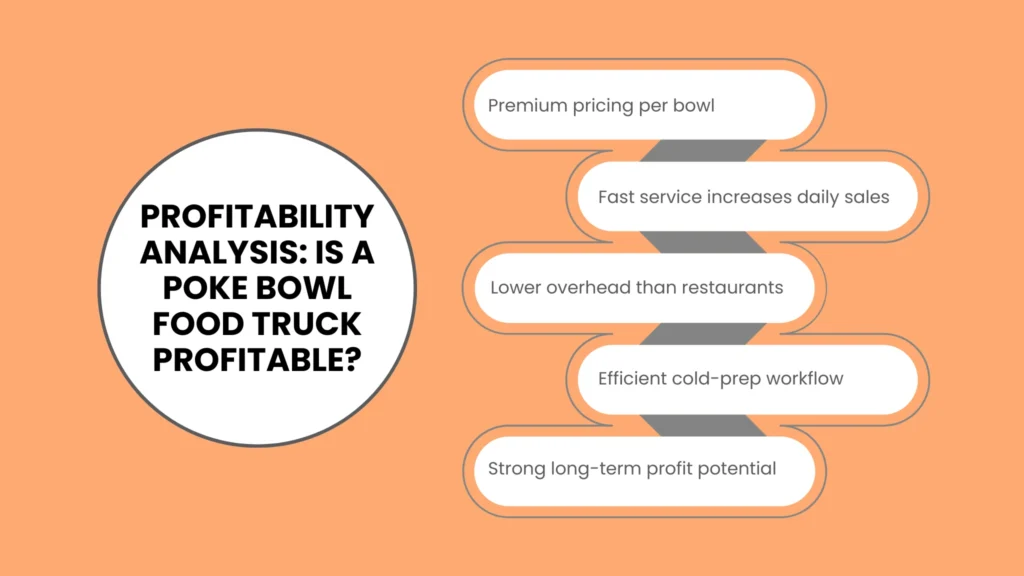
Yes, operating a mobile poke business can be very profitable. Poke bowls command premium menu prices, with average meal tickets ranging between $14 and $19 per bowl. Because raw fish requires no cooking equipment on the truck, energy bills stay low, and ticket times remain exceptionally fast. Fast service means you can handle high customer volume during busy lunch rushes.
Evaluating the Poke Bowl Business Profit Margin
A well-run mobile poke truck can achieve an estimated net poke bowl business profit margin between 15% and 25%, which is notably higher than traditional sit-down restaurants.
To understand how profits are generated, examine this estimated monthly operating scenario:
Daily Bowl Sales: 80 bowls per day at an average ticket of $16
Operating Days: 22 days per month
Gross Monthly Revenue: $28,160
Cost of Goods Sold (Ingredients, Fish, Bowls): $8,448 (30% target)
Labor Expenses (Owner plus one assistant): $5,632 (20% target)
Truck Expenses (Fuel, Commissary, Maintenance, Insurance): $3,800
Marketing and Merchant Processing: $1,100
Estimated Net Monthly Profit: $9,180 (Net Margin ~32.6% before income taxes)
Maintaining strict control over fish portion sizes and reducing daily food waste are the two most critical factors in preserving strong profit margins.
Step-by-Step Launch Plan for Your Poke Business
Launching a successful mobile food concept requires organized planning. Follow these structured steps to move smoothly from concept design to grand opening:
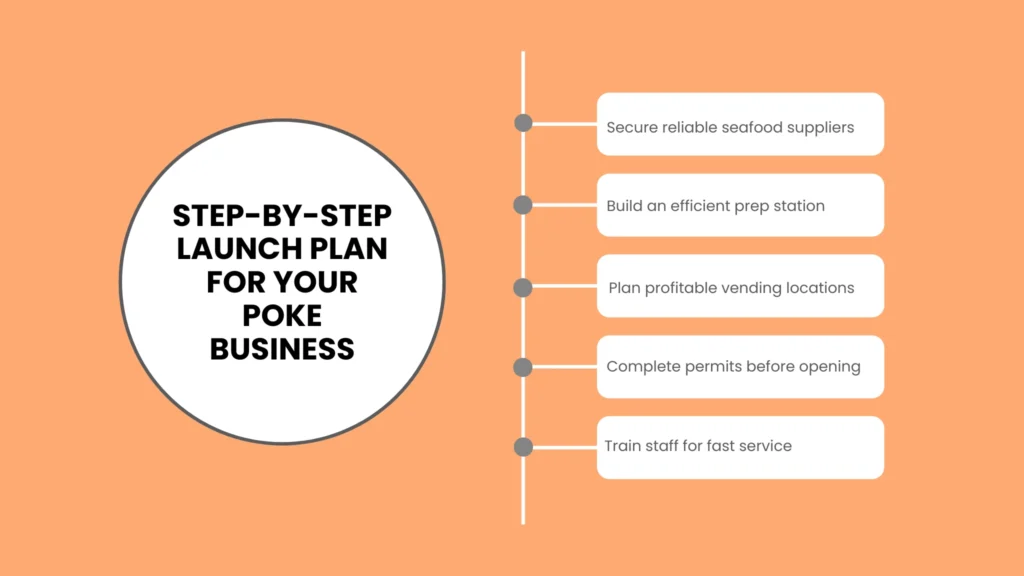
Step 1: Secure Reliable Wholesale Seafood Suppliers
The success of your poke truck hinges on ingredient freshness. Partner with certified wholesale seafood distributors that supply high-grade yellowfin tuna, Atlantic salmon, cooked shrimp, and octopus. Ensure suppliers provide temperature-controlled deliveries and clear catch-origin documentation.
Step 2: Build a Streamlined Prep System
Design your assembly line inside the truck for maximum speed. Place your cold prep rail right next to your point-of-sale window. A typical assembly order flows logically from base (sushi rice, brown rice, or mixed greens), to protein (tuna, salmon, tofu), to mix-ins (cucumbers, edamame, sweet onions), sauces (spicy mayo, ponzu, sesame soy), and crunchy toppings (crispy onions, furikake, tobiko).
Step 3: Map Out High-Density Vending Routes
Research local vending permits and parking laws. Secure recurring weekly parking spots in high-density areas such as medical centers, corporate office parks, brewery yards, and farmers markets.
Marketing Strategies to Build a Loyal Customer Base
To keep lines long at your service window, combine digital local search strategies with direct community outreach.
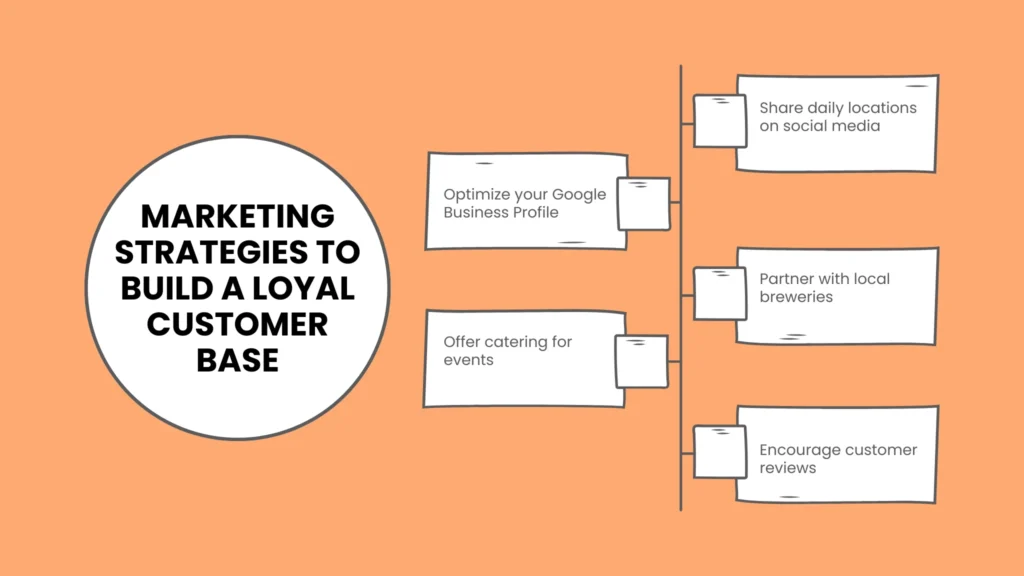
Maintain an Updated Schedule on Social Media: Post weekly location schedules on Instagram, TikTok, and Facebook so fans know exactly where to find your truck each day.
Optimize Your Google Business Profile: Claim your digital business profile and upload bright photos of colorful signature bowls. Encourage happy customers to leave online reviews highlighting your fresh fish.
Partner with Local Craft Breweries: Many popular taprooms do not serve food and actively invite food trucks to park outside for evening crowds.
Offer Catering Services for Corporate Events: Market pre-assembled poke bowl packages or live-action poke bars for office lunches, weddings, and private parties to secure guaranteed revenue.
Conclusion
Learning how to start a poke bowl business on a food truck budget allows culinary entrepreneurs to build a popular, high-margin restaurant brand without taking on excessive debt. By securing reliable wholesale seafood, meeting health department requirements, and maintaining tight inventory control, you can establish a lucrative mobile food business.
As you launch your culinary brand, having an attractive, user-friendly digital presence is essential for sharing your daily locations and driving online catering orders. For expert website design, branding strategies, and digital marketing tailored to growing food and service companies, visit reliablestartup to launch your online platform with confidence.
Frequently Asked Questions
How much inventory should a poke food truck start with each day?
Most new poke trucks start with enough fresh inventory to make 70 to 100 bowls per day. Because raw fish has a short shelf life, it is better to sell out early during your first few weeks than to over-purchase and throw away expensive inventory.
What equipment is mandatory for a poke bowl truck?
Essential equipment includes a commercial refrigerated prep rail, reach-in commercial refrigerators, commercial rice cookers, a hand-washing sink, a three-compartment ware-washing sink, a digital POS register, and an external generator.
How do poke trucks handle raw fish safety on the road?
Poke operators keep raw fish stored strictly at or below 38 degrees Fahrenheit using commercial-grade refrigeration units connected to heavy-duty truck generators or battery systems. Digital probe thermometers are used to log temperatures hourly in compliance with health department standards.
Is it better to buy or lease a food truck?
Buying a clean used truck or trailer is usually better for long-term profit margins because you avoid ongoing lease payments. However, leasing or renting a vehicle for six months allows new operators to test their concept with less upfront capital.