Buying an Existing Franchise Resale Instead of a New Unit

Buying an existing franchise resale allows you to acquire an established, operating business with existing customers, trained staff, and historical financial records, rather than building a new territory from the ground up.
For many prospective business owners, choosing a resale significantly reduces startup risk and accelerates the timeline to positive cash flow, though it often requires a higher upfront purchase price and thorough due diligence into why the current owner is selling.
Deciding between a turnkey resale and a brand-new franchise unit is one of the most consequential choices you will make as a franchisee. While a new unit offers untouched territory, modern build-outs, and the excitement of a grand opening, it also carries the uncertainty of unproven local demand and months of pre-opening expenses.
Understanding how franchise resales work from calculating a fair resale valuation to navigating the franchise transfer fee will help you determine which path aligns best with your capital, risk tolerance, and operational goals.
What Is a Franchise Resale?
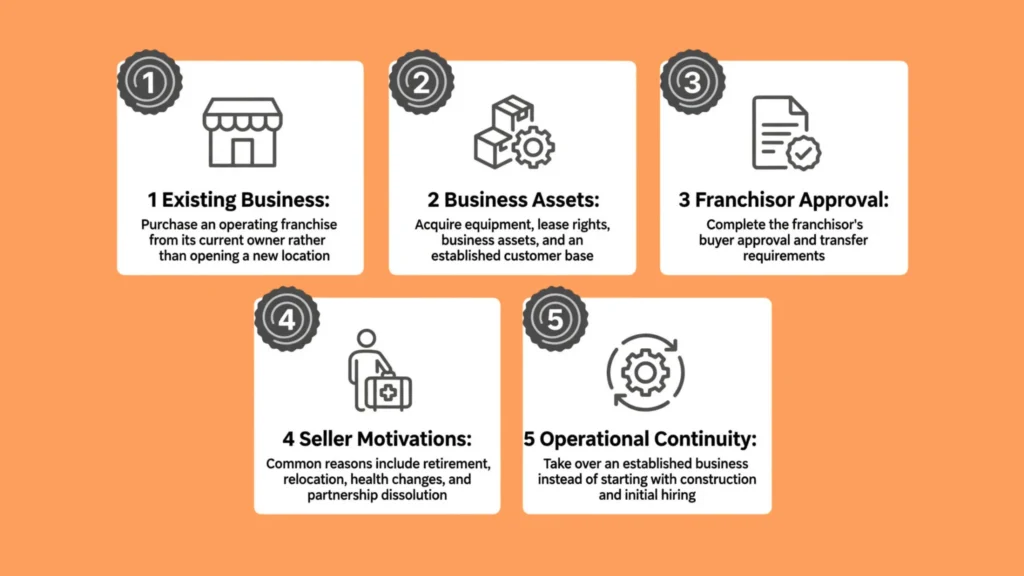
A franchise resale occurs when a current franchisee sells their existing, operating franchise unit or a multi-unit territory to a new buyer. Unlike purchasing a brand-new franchise directly from the franchisor, a resale involves buying the business assets, lease rights, equipment, and local customer base from the outgoing owner, subject to the franchisor’s approval.
Franchisees sell their units for many reasons that have nothing to do with business failure. Common motivations include retirement, relocation, health changes, partnership dissolutions, or a desire to cash out equity and pursue new ventures. Because the business is already open and operating, you step into a functioning enterprise rather than a construction project.
Key Advantages of Buying an Existing Franchise

Acquiring an operational franchise unit eliminates many of the hurdles that make early-stage business ownership stressful and unpredictable.
Immediate Cash Flow and Revenue
When you open a new franchise unit, you typically spend months paying for lease build-outs, equipment installation, permitting, and initial marketing before a single customer walks through the door.
With a franchise resale, revenue begins on day one of ownership. Instead of burning through working capital while waiting to reach your break-even point, you inherit an active revenue stream that can immediately cover operating expenses and debt service. Proper financial planning for business owners helps you assess cash flow, manage ongoing costs, and prepare for financial obligations.
Proven Location and Market Demand
One of the biggest risks of a new unit is discovering whether the local market will actually support the brand. An existing unit provides hard historical data. You can review years of profit-and-loss statements, tax returns, point-of-sale reports, and seasonal sales fluctuations to verify that the location works and that local demand is real.
Established Staff and Customer Base
Recruiting, hiring, and training an initial team from scratch requires substantial time and money. Buying an existing franchise usually means retaining experienced managers, technicians, or frontline staff who already know the franchisor’s operating systems and local customer preferences. You also inherit regular customers, active service contracts, and established local brand awareness.
Easier Access to Financing
Lenders generally view existing businesses with verifiable cash flow as lower-risk investments than startups relying on financial projections. While a financial model for a startup helps estimate future performance, an established franchise unit has tax returns and bank statements demonstrating its ability to service debt, making an SBA loan or conventional commercial financing often faster and more straightforward.
Potential Drawbacks and Risks to Consider
While a franchise resale removes startup guesswork, it introduces a different set of challenges that require careful evaluation.
Higher Upfront Purchase Price: Because you are paying for goodwill, existing cash flow, and an established customer base, a profitable resale often costs more upfront than the initial investment required to build a new unit.
Inherited Operational Problems: If the previous owner neglected customer service, underinvested in local marketing, or created a toxic workplace culture, you will inherit that reputation and must work hard to rebuild trust.
Aging Equipment and Remodel Requirements: Existing units come with used equipment and older interior designs. Many franchisors require buyers to complete a mandatory store remodel or upgrade technology systems as a condition of approving the transfer.
Unfavorable Lease Terms: You will typically assume the seller’s existing commercial lease. If the lease is nearing expiration without renewal options, or if rent escalations are steep, your future profitability could be squeezed.
Franchise Resale vs. New Unit: Side-by-Side Comparison
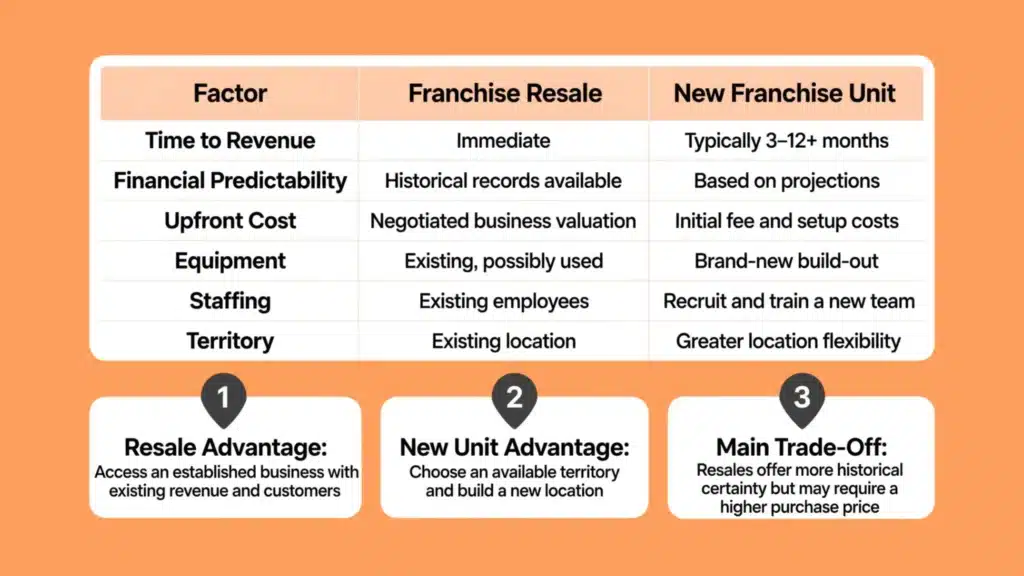
Comparing both options across core financial and operational factors clarifies the trade-offs between stability and fresh-start control.
| Factor | Franchise Resale | New Franchise Unit |
| Time to Revenue | Immediate (day one of closing) | Delayed (typically 3 to 12+ months for build-out) |
| Financial Predictability | High; based on historical tax returns and P&Ls | Lower; relies on industry averages and projections |
| Upfront Cost | Based on business valuation; often higher for profitable units | Fixed initial franchise fee plus build-out and equipment costs |
| Franchisor Fee | Franchise transfer fee (paid by seller, buyer, or split) | Initial franchise fee |
| Equipment & Facility | Used; may require immediate upgrades or franchisor remodel | Brand-new build-out, fixtures, and technology |
| Staffing & Operations | Existing team and established daily workflows | Must recruit, hire, and train a new team from scratch |
| Territory Selection | Fixed to the existing location and boundaries | Greater flexibility to choose prime, untapped locations |
Understanding Franchise Resale Valuation
Determining a fair price is critical when buying an existing franchise. Unlike a new unit where costs are itemized in the Franchise Disclosure Document (FDD), a resale price is negotiated between you and the seller.
Seller’s Discretionary Earnings (SDE) and EBITDA
Most smaller, owner-operated franchise resales are valued using a multiple of Seller’s Discretionary Earnings (SDE). SDE represents the total financial benefit a single full-time owner-operator derives from the business annually, calculated by taking net pre-tax profit and adding back the owner’s salary, personal expenses run through the business, interest, taxes, depreciation, and one-time non-recurring costs.
Larger, multi-unit resales with absentee or semi-absentee management are typically valued using a multiple of EBITDA (Earnings Before Interest, Taxes, Depreciation, and Amortization).
Valuation Multiples and Tangible Assets
Once SDE or EBITDA is established, an industry valuation multiple commonly ranging from 2x to 4x SDE for single-unit service or retail franchises, depending on brand strength, growth trajectory, and lease stability is applied to determine the enterprise value.
Keep in mind that inventory, working capital, and upcoming capital expenditures (such as required equipment replacements) are negotiated separately or factored into the final price adjustments.
Navigating the Franchise Transfer Fee and Approval Process

You cannot simply pay the seller and take over the keys; the franchisor holds contractual approval rights over every resale.
How the Franchise Transfer Fee Works
Instead of paying a full initial franchise fee, a resale transaction involves a franchise transfer fee. This fee covers the franchisor’s administrative costs for vetting the new buyer, drafting a new franchise agreement, and providing mandatory initial training.
Transfer fees vary widely by brand some charge a flat fee (such as $5,000 to $15,000), while others charge a percentage of the current initial franchise fee. Who pays the transfer fee is negotiable in the purchase agreement; sometimes the seller covers it, sometimes the buyer pays, and often both parties split the cost.
Franchisor Vetting and Training Requirements
Even when buying from an independent owner, you must apply to the franchisor, meet their net worth and liquidity requirements, pass background checks, and complete their corporate training program.
Additionally, the franchisor typically holds a Right of First Refusal (ROFR), meaning they have a set window usually 15 to 30 days to match your offer and buy the unit themselves before you can close.
Essential Due Diligence Steps Before Buying
Before signing a binding asset purchase agreement, conduct a thorough investigation into the business’s financial, legal, and operational health:
Verify Financial Records: Cross-check the seller’s profit-and-loss statements against federal tax returns, bank statements, and the franchisor’s royalty reports to ensure reported sales are 100% accurate.
Review the Franchise Disclosure Document (FDD): Examine Item 20 of the current FDD to see how many units in the system have closed, transferred, or terminated over the past three years. High turnover is a red flag.
Talk to Current Franchisees: Reach out to other owners in the network—listed in the FDD—to ask about franchisor support, unit economics, and the reputation of the specific territory you are considering.
Inspect the Lease and Facility: Have a commercial real estate attorney review the lease assignment terms, and hire an inspector to assess the condition of all equipment, HVAC systems, and vehicles.
Check for Liens and Pending Liabilities: Conduct a UCC lien search and verify that all payroll taxes, sales taxes, and vendor accounts are current so you do not inherit unexpected legal claims.
Common Mistakes to Avoid in a Franchise Resale

Skipping Independent Professional Advisors: Never rely solely on the seller’s broker or the franchisor’s guidance. Hire a franchise attorney and a CPA experienced in franchise acquisitions to review the numbers and contracts.
Ignoring Mandatory Remodel Costs: Failing to factor a $50,000 or $100,000 franchisor-mandated renovation into your total acquisition budget can quickly erode your expected return on investment.
Overlooking Why the Owner Is Selling: Accept the seller’s explanation at face value only after verifying local market conditions, new competitors, road construction, or demographic shifts that might threaten future sales.
Underestimating Working Capital Needs: Even profitable businesses experience cash flow dips during ownership transitions. Maintain a healthy cash reserve beyond the purchase price to cover payroll, inventory, and marketing during your first six months.
Frequently Asked Questions
Is it better to buy an existing franchise or start a new one?
Buying an existing franchise is generally better if you want immediate cash flow, verifiable financial history, and lower startup risk. Starting a new unit is often better if you want lower initial entry costs, brand-new equipment, and the ability to choose an untapped location.
How much does a franchise transfer fee usually cost?
A franchise transfer fee typically ranges from $2,500 to $15,000, or roughly 25% to 50% of the brand’s current initial franchise fee. The exact amount is disclosed in Item 6 of the franchisor’s Franchise Disclosure Document (FDD).
Can you negotiate the price of a franchise resale?
Yes. Unlike new franchise fees set by corporate headquarters, the purchase price of a franchise resale is negotiated directly between you and the current owner based on financial performance, asset condition, lease terms, and market demand.
Do I get a new franchise agreement when buying a resale?
In most cases, yes. Franchisors usually require the buyer to sign their current standard franchise agreement for a fresh 5- to 10-year term, though some allow you to assume the remainder of the seller’s existing agreement.
How long does it take to close on a franchise resale?
Closing on a franchise resale typically takes 60 to 120 days. The timeline depends on financial due diligence, SBA or bank loan underwriting, landlord lease assignment approval, and the franchisor’s vetting and training schedule.
Why would someone sell a profitable franchise?
Owners sell profitable franchises for many non-operational reasons, including retirement, health issues, relocation, family changes, burnout, or wanting to liquidate their equity to invest in larger multi-unit or unrelated business opportunities.
Final Thoughts
Buying an existing franchise resale offers a compelling middle ground between independent entrepreneurship and starting a franchise from scratch. By acquiring a unit with an established customer base, trained employees, and real financial history, you bypass the vulnerable startup phase and step directly into an operating business.
However, success depends on disciplined due diligence verifying true cash flow, accounting for transfer fees and potential remodel costs, and ensuring the territory has strong room for growth under your leadership.
About The Author