Franchise Royalty Fees: Royalties, Marketing Funds and the Fees Nobody Mentions
Buying a franchise rarely fails because a prospective owner miscalculates the upfront franchise fee. Most buyers scrutinize the initial investment range and liquid capital requirements before anything else.
Where financial projections actually break down is after opening day, when franchise royalty fees, mandatory marketing assessments, and a long tail of recurring operational charges begin deducting directly from top-line revenue.
Understanding how these ongoing franchise fees work, and how they interact with your franchise cost of sales, is the difference between owning a profitable business and running a high-revenue operation that barely breaks even.
What Are Franchise Royalty Fees?

Franchise royalty fees are recurring payments a franchisee makes to the franchisor for the ongoing right to use the brand’s trademarks, operating systems, proprietary software, and support infrastructure. Unlike a one-time licensing purchase, royalties continue for the entire duration of the franchise agreement, typically five to twenty years.
In most franchise systems, royalties are calculated as a percentage of gross sales rather than net profit. This distinction is critical: the franchisor collects its percentage off the top of every dollar that enters the register, regardless of whether your location turned a profit that month after paying rent, payroll, and suppliers.
Common Franchise Royalty Fee Structures
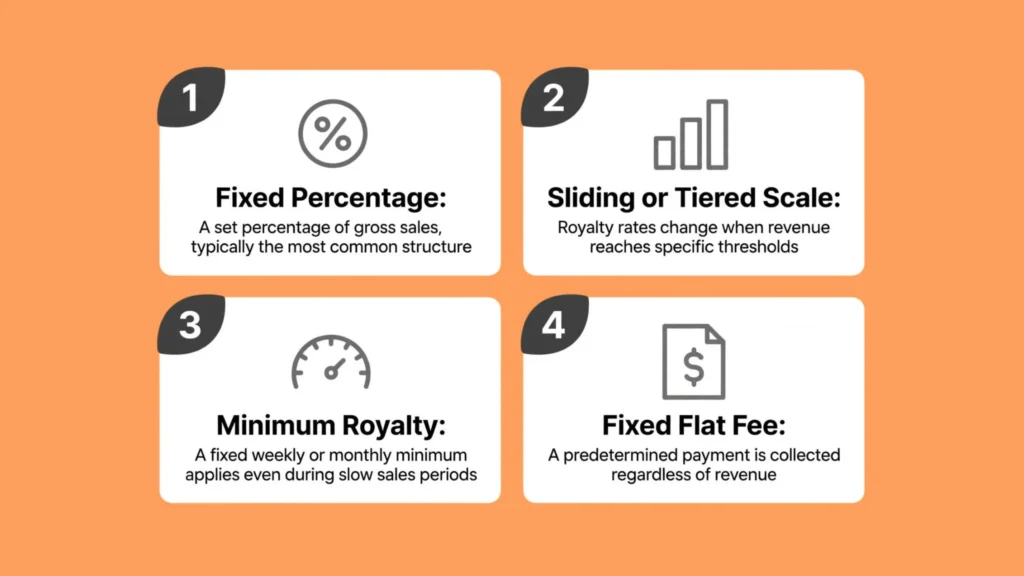
While percentage-of-gross-sales is the industry standard, franchisors use several variations depending on the business model and margin profile:
Fixed Percentage of Gross Sales: The most common structure. Rates vary widely by industry often ranging from 4% to 6% in high-volume food service or retail, and climbing to 8% to 12% or higher in low-overhead, service-based franchises.
Sliding or Tiered Scale: The royalty percentage increases or decreases as revenue crosses specific thresholds. Some systems lower the rate to reward high-performing locations, while others increase it as a franchisee matures.
Minimum Weekly or Monthly Royalty: Many agreements enforce a floor payment. Even if your store experiences a slow season or temporary disruption, you must pay either the percentage of gross sales or the fixed minimum whichever is greater.
Fixed Flat Fee: Common in certain home-based, real estate, or business-to-business franchises, where the owner pays a set weekly or monthly dollar amount regardless of sales volume.
Understanding the Marketing Fund Contribution
Alongside royalties, almost every established franchise requires a marketing fund contribution (often listed in disclosure documents as a Brand Fund, National Advertising Fund, or Ad Royalty).
Typically ranging from 1% to 4% of gross sales, this fee pools money from across the entire network to pay for brand-wide advertising, digital campaigns, public relations, and creative asset development.
Brand Fund vs. Local Advertising Requirements

A common misconception among first-time buyers is that paying into the national marketing fund covers all their local customer acquisition needs. In practice, most franchise agreements separate marketing obligations into two distinct buckets:
System-Wide Brand Fund: Controlled at the franchisor’s discretion to build broad brand awareness, maintain the corporate website, and run national or regional media campaigns.
Local Store Marketing (LSM) Spend: A separate contractual requirement mandating that you spend an additional percentage of gross sales (often 1% to 3%) directly on local outreach such as neighborhood sponsorships, local digital ads, or direct mail and submit proof of spend to corporate.
Regional Advertising Cooperatives: If multiple franchisees operate in the same metropolitan area, the franchisor may require you to join and fund a local co-op that votes on regional media buys.
The Ongoing Franchise Fees Nobody Mentions

When reviewing a Franchise Disclosure Document (FDD), Item 5 covers initial fees, while Item 6 (“Other Fees”) lists recurring and situational charges. Item 6 often spans multiple pages and contains dozens of line items that rarely come up during early discovery calls.
Technology, POS, and Software Stack Fees
Modern franchises rely heavily on centralized cloud platforms for point-of-sale (POS), customer relationship management (CRM), inventory tracking, and scheduling.
Franchisors routinely charge monthly technology fees per terminal or per location. Even when software is provided by a third-party vendor, the franchisor may mandate a specific system and add an administrative markup.
Required Supply Chain and Vendor Markups
In many systems, franchisees must buy ingredients, packaging, equipment, or retail inventory exclusively from the franchisor or approved suppliers.
While bulk purchasing can lower costs, some franchisors generate significant revenue through supply chain markups or vendor rebates. These embedded costs quietly inflate your franchise cost of sales without appearing as a standalone royalty line item.
Call Center, Booking, and Lead Generation Fees
Service-based and appointment-driven franchises frequently operate centralized call centers or national booking portals. Franchisees may be billed a flat monthly fee, a per-minute call charge, or a per-lead fee for every inquiry routed to their territory even if the lead does not convert into a paying customer.
Payment Processing and Gift Card Fees
Franchisors often mandate specific merchant service providers so they can monitor real-time sales data and execute automated ACH royalty drafts. In addition to standard credit card processing rates, franchisees may face fees for administering network-wide gift cards, loyalty apps, and third-party delivery integrations.
Audit, Transfer, Renewal, and Non-Compliance Penalties
Item 6 also includes situational fees that trigger at specific milestones or compliance events:
Renewal Fees: Paid at the end of a 5- or 10-year term just to keep operating the business you already built, often equal to a percentage of the current initial franchise fee.
Transfer Fees: Charged when you sell your franchise to a new owner, sometimes reaching thousands of dollars or a percentage of the sale price.
Audit and Late Fees: If a corporate audit reveals you underreported gross sales beyond a minor margin (often 2% to 3%), you must pay the unpaid royalties, accrued interest, and the full cost of the franchisor’s auditors.
Liquidated Damages: If you close your doors early or breach the agreement, many contracts obligate you to pay years of future projected royalties as a lump-sum penalty.
How Ongoing Franchise Fees Impact Franchise Cost of Sales and Margins

To evaluate whether a franchise is financially viable, you cannot look at franchise royalty fees in isolation. You must combine every top-line percentage deduction into an effective fee rate and weigh it against your unit-level gross margins.
Consider a simplified example of a retail or food-service unit generating $80,000 in monthly gross sales:
| Expense Category | Percentage of Gross Sales | Monthly Dollar Amount |
| Base Franchise Royalty Fee | 6.0% | $4,800 |
| Marketing Fund Contribution | 2.0% | $1,600 |
| Required Local Marketing Spend | 1.5% | $1,200 |
| Technology & POS Fees (est. $400/mo) | 0.5% | $400 |
| Total Effective Brand & System Fees | 10.0% | $8,000 |
In this scenario, 10% of gross revenue leaves the business before you pay for a single dollar of inventory, labor, rent, insurance, or debt service. If your franchise cost of sales (cost of goods sold) is 30% ($24,000) and labor is 28% ($22,400), 68% of your revenue is already spoken for before occupancy and overhead expenses.
This math explains why high-margin service businesses can comfortably absorb an 8% to 10% royalty, whereas low-margin businesses can struggle under a 6% royalty combined with heavy supply chain markups.
How to Audit Franchise Fees Before Signing
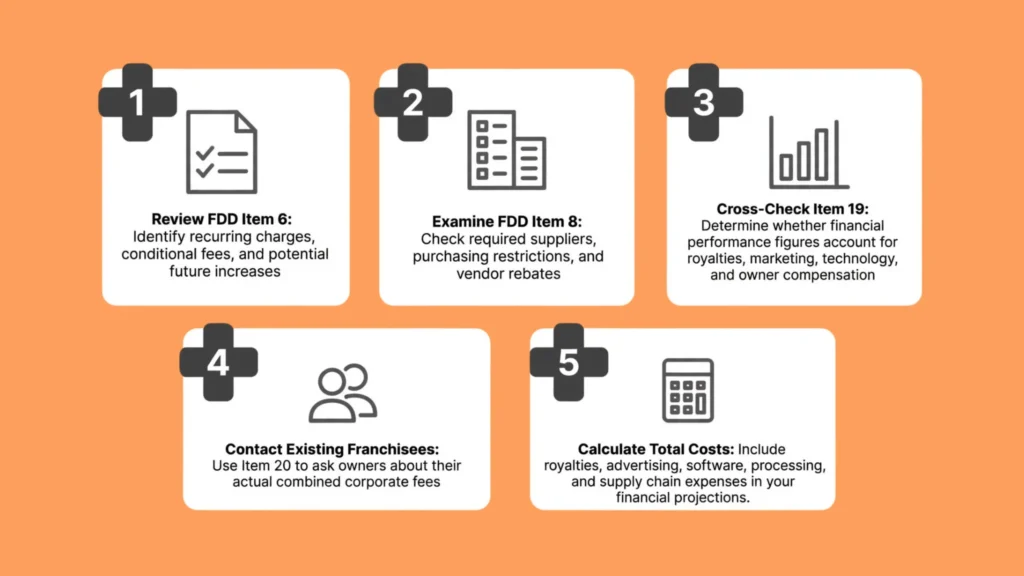
Before committing capital, treat the FDD as a financial blueprint rather than standard legal boilerplate. Focus your due diligence on three concrete steps:
Read Every Line of Item 6 and Item 8: Item 6 details every recurring and conditional fee, including whether the franchisor has the right to raise technology or marketing fees in the future. Item 8 (“Restrictions on Sources of Products and Services”) reveals whether the franchisor profits from required inventory purchases and vendor rebates.
Cross-Reference with Item 19: If the franchisor provides a Financial Performance Representation in Item 19, check whether the disclosed net profit figures already deduct royalties, marketing funds, technology fees, and owner compensation or if they only show gross revenue.
Verify Real-World Numbers with Existing Franchisees: Use the contact list in Item 20 to call current operators. Ask them specifically what percentage of gross sales goes toward all corporate fees combined, and ask which Item 6 expenses surprised them most in their first year.
Frequently Asked Questions
Are franchise royalty fees tax-deductible?
Yes. In most jurisdictions, ongoing franchise royalty fees, marketing fund contributions, and operational software fees are deductible as ordinary and necessary business expenses in the year they are incurred. Consult a qualified CPA to confirm how upfront versus ongoing fees are treated under your local tax laws.
Can you negotiate franchise royalty fees?
In established franchise systems, base royalty percentages and marketing fund contributions are almost never negotiable, as franchisors are legally and operationally incentivized to maintain uniform terms across their network.
Occasionally, an emerging franchisor may offer temporary royalty ramp-ups (such as reduced rates for the first six months) or multi-unit development discounts.
Do franchisees pay royalties if the business loses money?
Yes. Because almost all franchise royalties are calculated on gross sales rather than net profit, you owe the royalty percentage on every sale even if your operating expenses exceed your revenue for the month.
What is the average franchise royalty fee?
Across all franchise industries, royalty fees commonly fall between 4% and 12% of gross sales, with a broad cross-industry average hovering around 5% to 7%. Product-based franchises with higher cost of goods sold generally charge lower percentages, while service franchises with low material costs charge higher percentages.
What happens if a franchisee stops paying royalty fees?
Failing to pay royalties or marketing fund contributions constitutes a material breach of the franchise agreement. After a short cure period (often 10 to 30 days), the franchisor can charge late fees, suspend access to proprietary software and supply channels, terminate your franchise agreement, and sue for unpaid balances plus future liquidated damages.
How is gross sales defined in a franchise agreement?
“Gross sales” typically includes all revenue generated by the franchised business from every source whether cash, credit, digital, or gift card redemptions minus only collected sales taxes and documented customer refunds. Discounts, coupons, or bad debts are frequently not deductible from the gross sales calculation unless explicitly stated in the contract.
Final Thoughts
A strong franchise system earns its fees by providing a proven playbook, brand recognition, and operational leverage that you could not easily build on your own. However, evaluating an opportunity requires looking far beyond the headline royalty rate.
By accounting for the marketing fund contribution, required local advertising, mandatory software stacks, and supply chain markups inside your franchise cost of sales, you can build an accurate financial model and enter a franchise agreement with clear eyes.
About The Author