How Franchise Financing Works and Who Lends
Franchise financing works by combining a borrower’s upfront cash injection typically 10% to 30% of the total project cost, with external debt or equity capital from banks, government-backed lenders, franchisors, or specialized funding providers.
Because established franchise systems operate on proven business models with documented financial performance, lenders often view franchise financing options as lower risk than independent startups, making larger loan amounts and longer repayment terms accessible to qualified buyers.
Understanding how capital moves through a franchise transaction helps prospective owners avoid funding delays, structure manageable monthly payments, and protect personal assets.
Whether you are launching a new territory from scratch or acquiring an existing multi-unit operation, matching your capital stack to the right lender is one of the most consequential decisions in the buying process.
What Franchise Financing Covers
Unlike a standard working capital loan, financing a franchise purchase involves covering a specific sequence of upfront and ongoing expenses outlined in the brand’s Franchise Disclosure Document (FDD). Lenders evaluate the total project cost rather than a single purchase price, ensuring the business has enough liquidity to survive its ramp-up phase.
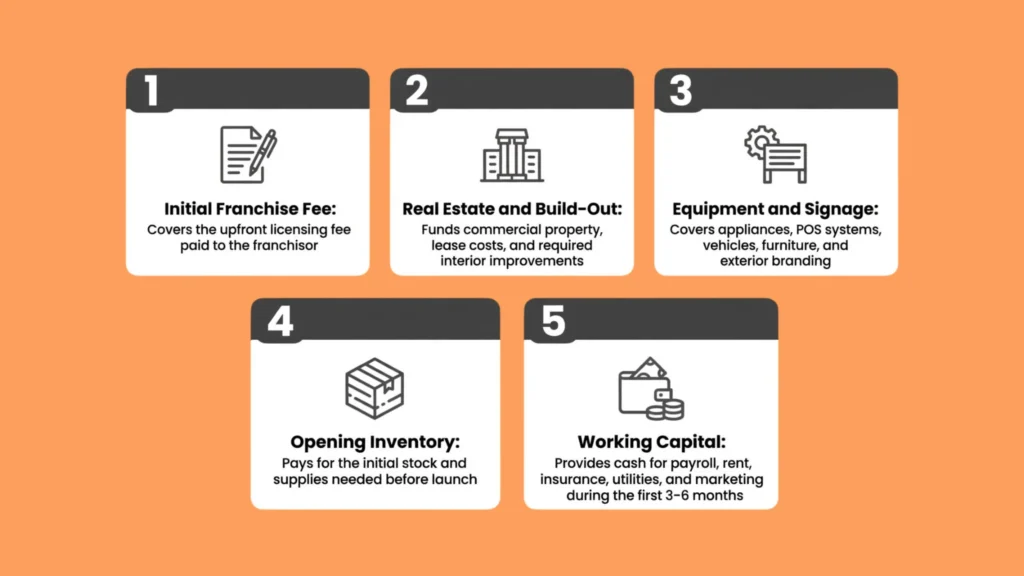
Most franchise loan packages are structured to cover:
Initial Franchise Fee: The upfront licensing fee paid directly to the franchisor upon signing the franchise agreement.
Real Estate and Leasehold Improvements: Costs associated with purchasing commercial property, signing a commercial lease, and completing brand-mandated interior build-outs.
Equipment, Fixtures, and Signage: Commercial kitchen appliances, point-of-sale (POS) systems, vehicles, furniture, and exterior branding.
Opening Inventory and Supplies: Initial stock required before opening day.
Working Capital: Cash reserves set aside to cover payroll, rent, insurance, utilities, and marketing during the first three to six months of operations.
Primary Franchise Financing Options
No single loan product fits every franchise model. A home-based service franchise requiring $85,000 in startup capital has vastly different borrowing needs than a quick-service restaurant requiring $1.5 million for real estate and construction.
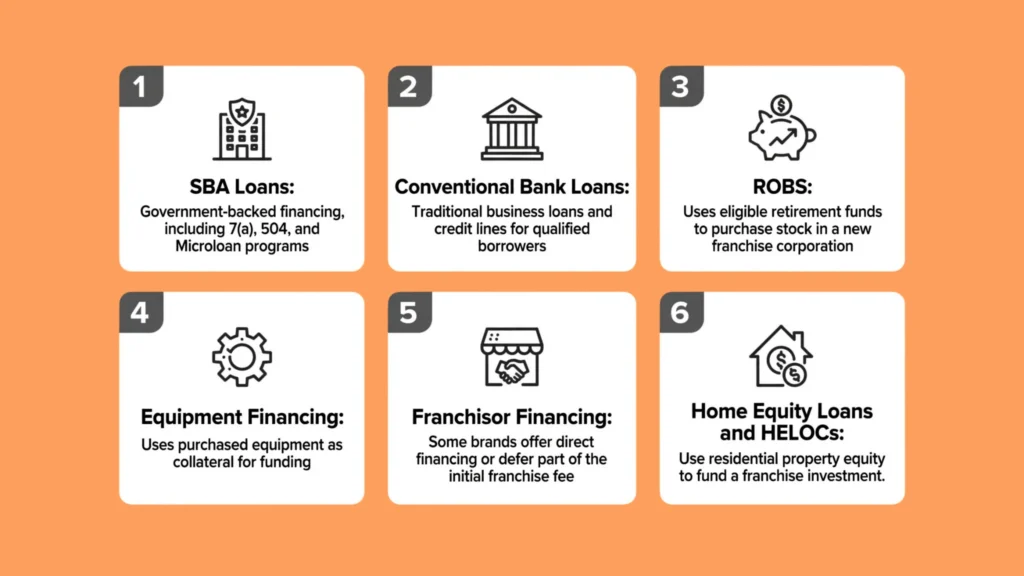
1. SBA Franchise Loans
The U.S. Small Business Administration (SBA) does not lend money directly to business owners; instead, it guarantees a portion of loans issued by approved banks and non-bank lenders. This federal guarantee reduces lender risk, resulting in lower down payments and extended repayment schedules.
SBA 7(a) Loans: The most popular SBA franchise loan program offers up to $5 million for startups, franchise acquisitions, working capital, equipment, and real estate. Repayment terms extend up to 10 years for working capital and equipment, and up to 25 years when commercial real estate is included. Down payments typically start around 10% to 20%.
SBA 504 Loans: Designed strictly for major fixed assets like commercial real estate and heavy machinery, the 504 program pairs a conventional bank loan with a Certified Development Company (CDC) loan. It provides long-term, fixed-rate financing up to $5 million (or $5.5 million for eligible manufacturing and energy projects) with as little as 10% borrower equity, though funds cannot be used for franchise fees or working capital.
SBA Microloans: Administered through nonprofit intermediary lenders, these loans provide up to $50,000 for smaller, low-overhead franchise concepts.
2. Conventional Bank Loans and Lines of Credit
Traditional commercial term loans and business lines of credit offer competitive interest rates and lack the federal guarantee fees attached to SBA loans. For startups that may not qualify for conventional financing, exploring unsecured business funding options can provide additional ways to access capital without pledging business assets as collateral.
However, conventional banks enforce strict underwriting standards. They generally require strong personal credit, substantial collateral, and an established operating history making them far easier to secure for experienced multi-unit franchisees or existing location acquisitions than for first-time startup owners.
3. Rollovers as Business Startups (ROBS)
A ROBS arrangement allows prospective franchisees to invest funds from an eligible retirement account such as a 401(k) or traditional IRA into their new business without incurring early withdrawal penalties or immediate income taxes.
Under IRS rules, the buyer forms a C-Corporation, establishes a new retirement plan for that corporation, rolls existing retirement funds into the new plan, and directs the plan to purchase stock in the franchise corporation.
Because ROBS is an equity investment rather than a loan, it creates zero monthly debt service and is frequently used to fund the cash down payment required for an SBA loan. However, improper administration can trigger severe IRS penalties, so buyers must work with specialized ROBS providers.
4. Equipment Financing and Leasing
For franchises heavily reliant on specialized machinery, medical devices, fitness equipment, or commercial vehicles, equipment financing uses the purchased assets themselves as collateral.
Approval times are fast often within days and down payments can be minimal. The trade-off is that repayment terms are shorter (typically three to seven years) and interest rates may be higher than SBA-backed financing.
5. Franchisor In-House Financing
Some franchisors offer direct financing or defer a portion of the initial franchise fee for qualified candidates, particularly military veterans, first responders, or existing franchisees expanding into new territories. While convenient, in-house financing rarely covers the entire startup cost and usually supplements a primary bank or SBA loan.
6. Home Equity Loans and HELOCs
Buyers with substantial residential equity sometimes use a Home Equity Line of Credit (HELOC) or a fixed-rate home equity loan to cover lower-cost franchises or fund their cash injection. While residential rates are often favorable, using home equity places personal property directly on the line if the business underperforms.
Comparison of Franchise Financing Options
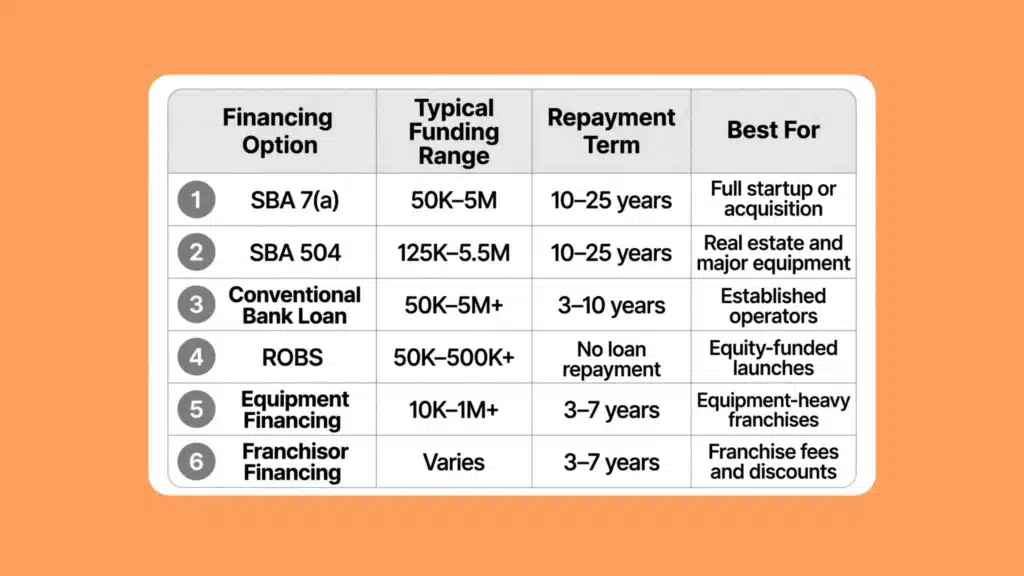
| Financing Option | Typical Funding Range | Repayment Term | Down Payment / Equity | Best For |
| SBA 7(a) Loan | $50,000 – $5,000,000 | 10 – 25 years | 10% – 20% | Full-package startup or acquisition funding |
| SBA 504 Loan | $125,000 – $5,500,000 | 10 – 25 years | 10% – 15% | Purchasing commercial real estate or heavy equipment |
| Conventional Bank Loan | $50,000 – $5,000,000+ | 3 – 10 years (up to 20 with real estate) | 20% – 30% | Established operators with strong cash flow and collateral |
| ROBS (401k Rollover) | $50,000 – $500,000+ | None (Equity) | 100% of rolled funds | Debt-free launches or funding SBA down payments |
| Equipment Financing | $10,000 – $1,000,000+ | 3 – 7 years | 0% – 20% | High-equipment concepts needing rapid approval |
| Franchisor Financing | Varies (often $10,000 – $100,000) | 3 – 7 years | Varies by brand | Covering franchise fees or veteran discounts |
Who Lends to Franchisees: Categories of Franchise Lenders
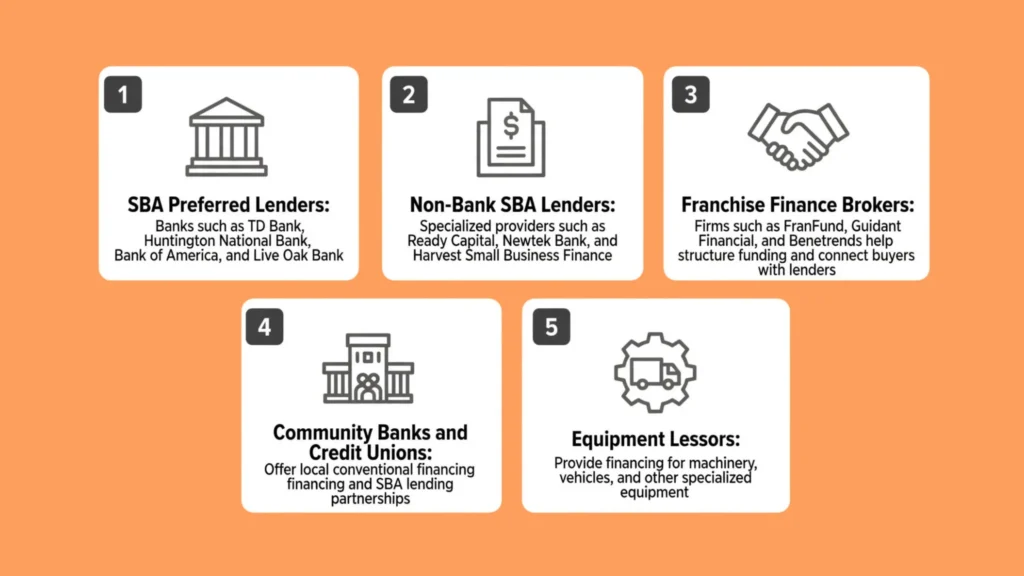
When researching a franchise lender list, prospective owners should understand that lenders fall into distinct operational tiers. Choosing a lender familiar with franchise underwriting prevents unnecessary delays during document review.
SBA Preferred Lenders (PLP): National and regional banks such as TD Bank, Huntington National Bank, Bank of America, and Live Oak Bank hold Preferred Lender Program status with the SBA. Because the SBA delegates final credit decision authority to these institutions, PLP lenders can approve an SBA franchise loan weeks faster than standard SBA lenders.
Non-Bank SBA Lenders: Specialized commercial finance companies like Ready Capital, Newtek Bank, and Harvest Small Business Finance focus heavily on SBA 7(a) lending. They frequently work with borrowers who have lower collateral coverage or unique credit profiles that traditional brick-and-mortar banks might decline.
Franchise Finance Brokers and Multi-Lender Marketplaces: Advisory firms such as FranFund, Guidant Financial, and Benetrends specialize exclusively in franchise capital stacks. Rather than lending their own balance sheet capital, they structure ROBS plans, package SBA loan applications, and match borrowers with vetted banks from an internal franchise lender list.
Community Banks and Credit Unions: Local institutions often offer competitive conventional loans or SBA 504 partnerships, particularly when the franchisee lives in the community and plans to purchase local commercial real estate.
Captive and Independent Equipment Lessors: Direct equipment finance companies partner with franchisors to pre-approve equipment packages, streamlining procurement before a store opens.
What Lenders Require Before Approving a Franchise Loan
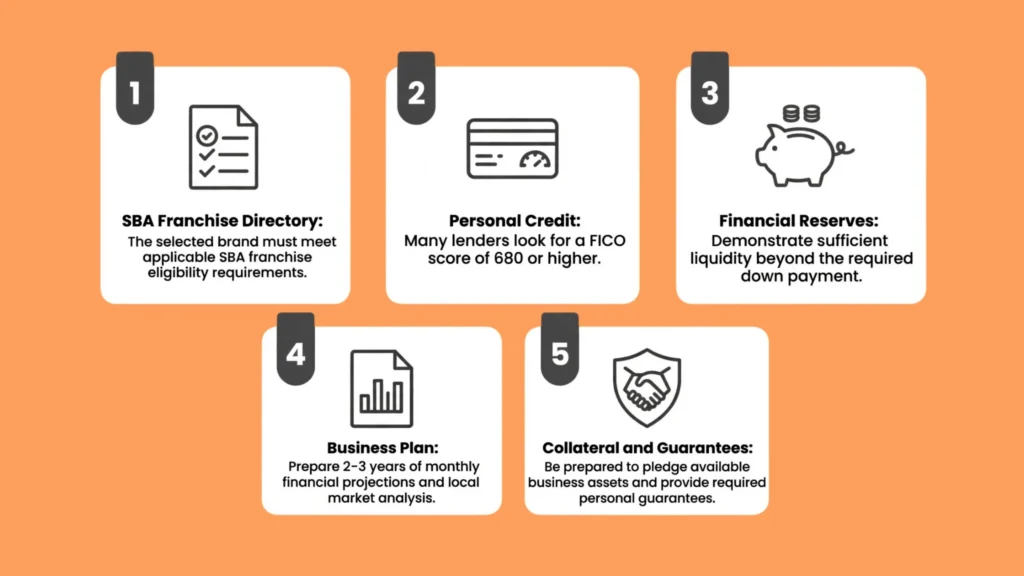
Regardless of which lender you approach, underwriting focuses on four core pillars:
SBA Franchise Directory Eligibility: If you apply for an SBA loan, your chosen brand must appear on the SBA Franchise Directory, which verifies that the franchise agreement meets SBA affiliation and independence standards. If a newer brand is not yet listed, the franchisor must submit its FDD and agreements for SBA review before your loan can be approved.
Personal Credit and Financial Strength: Most franchise lenders look for a personal FICO score of 680 or higher, clean credit history without recent bankruptcies or tax liens, and liquid cash reserves beyond the required down payment.
Business Plan and Financial Projections: Lenders require a formal business plan containing two to three years of monthly financial projections, local market analysis, and assumptions grounded in Item 19 (Financial Performance Representations) of the brand’s FDD.
Collateral and Personal Guarantees: SBA loans exceeding $50,000 require lenders to take available collateral often including a lien on commercial assets or personal residential real estate and require an unconditional personal guarantee from anyone owning 20% or more of the business.
Step-by-Step Process for Financing a Franchise Purchase
Determine Your Liquid Capital and Net Worth: Calculate your available cash, brokerage accounts, and retirement balances to establish a realistic budget before speaking with franchisors.
Review Item 7 of the FDD: Examine the estimated initial investment table in the Franchise Disclosure Document to understand low-to-high startup cost ranges and required working capital.
Get Pre-Qualified Early: Speak with an SBA Preferred Lender or franchise finance specialist while conducting franchise discovery. Pre-qualification confirms your borrowing capacity before you pay a non-refundable franchise fee.
Assemble Your Loan Package: Gather three years of personal and business tax returns, personal financial statements, resumes showing transferable management experience, the signed franchise agreement, and your business plan.
Underwriting, Commitment, and Closing: Once submitted, underwriting typically takes four to eight weeks for SBA loans. After issuing a commitment letter, the lender verifies leasehold agreements, insurance policies, and equity injection receipts before releasing funds.
Common Franchise Financing Mistakes to Avoid
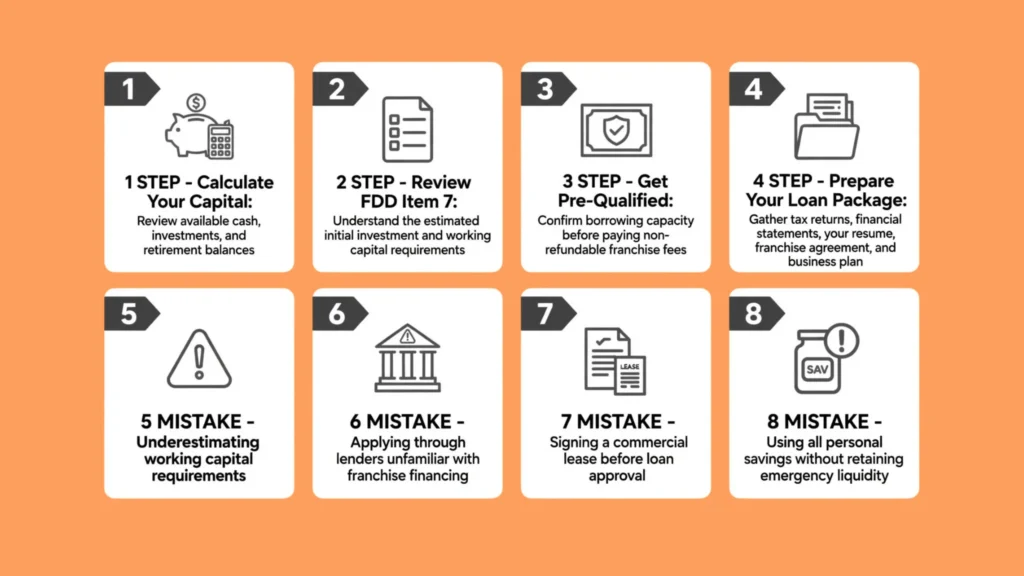
Underestimating Working Capital Needs: Borrowing just enough to open the doors leaves zero margin if customer acquisition takes longer than projected. Always build three to six months of operating expenses into your loan request.
Applying with Generalist Loan Officers: A local bank branch manager who rarely processes franchise loans may misinterpret royalty structures or FDD requirements, stalling your timeline by months.
Signing a Commercial Lease Before Loan Approval: Committing to a binding lease before securing a formal loan commitment letter exposes you to personal liability if financing falls through. Always include a financing contingency clause in your lease.
Draining All Personal Liquidity: Even if you have enough cash to buy a low-cost franchise outright, spending every dollar leaves you vulnerable to unexpected repairs or seasonal slowdowns.
Frequently Asked Questions
How much down payment do you need to finance a franchise?
Most franchise lenders require a cash down payment (equity injection) of 10% to 30% of the total project cost. SBA 7(a) and 504 loans commonly allow 10% to 20% down for qualified borrowers, while conventional bank loans generally require 20% to 30%.
Can you get a franchise loan with no money down?
True zero-down franchise loans are rare because lenders require borrowers to have personal financial skin in the game. However, buyers can avoid out-of-pocket cash payments by combining an SBA loan with a Rollover as Business Startups (ROBS) retirement plan or seller financing on an existing resale.
What credit score is needed for an SBA franchise loan?
While the SBA does not enforce a strict minimum score, most SBA Preferred Lenders look for a personal FICO score of 680 or higher. Borrowers with scores between 640 and 679 may still qualify if they bring strong industry experience, extra cash reserves, or substantial collateral.
How long does it take to get approved for franchise financing?
An SBA franchise loan typically takes 45 to 90 days from application to closing, though working with an SBA Preferred Lender can shorten that timeline. Equipment financing and ROBS funding generally close faster, often within two to four weeks.
Does the franchisor help you get a loan?
Most franchisors do not lend money directly, though some offer fee deferrals or veteran discounts. Instead, established brands maintain relationships with third-party franchise lenders and brokers who already understand the brand’s unit economics and FDD.
Can you finance a franchise resale instead of a new location?
Yes, and lenders often prefer franchise resales because the location has historical tax returns, proven cash flow, and an existing customer base. Financing an existing franchise usually follows the same SBA 7(a) or conventional loan process, with an added business valuation requirement.
Final Thoughts
Securing the right franchise financing options comes down to aligning your personal financial profile with a lender experienced in franchise underwriting.
While SBA 7(a) loans remain the backbone of startup and resale funding due to their low down payments and long repayment windows, blending debt with ROBS equity, equipment leasing, or conventional credit can optimize cash flow.
Getting pre-qualified early, verifying your brand’s SBA Franchise Directory status, and budgeting generously for working capital will put you in the strongest position to close smoothly and launch on schedule.
About The Author