Bakery Equipment List and What It Actually Costs
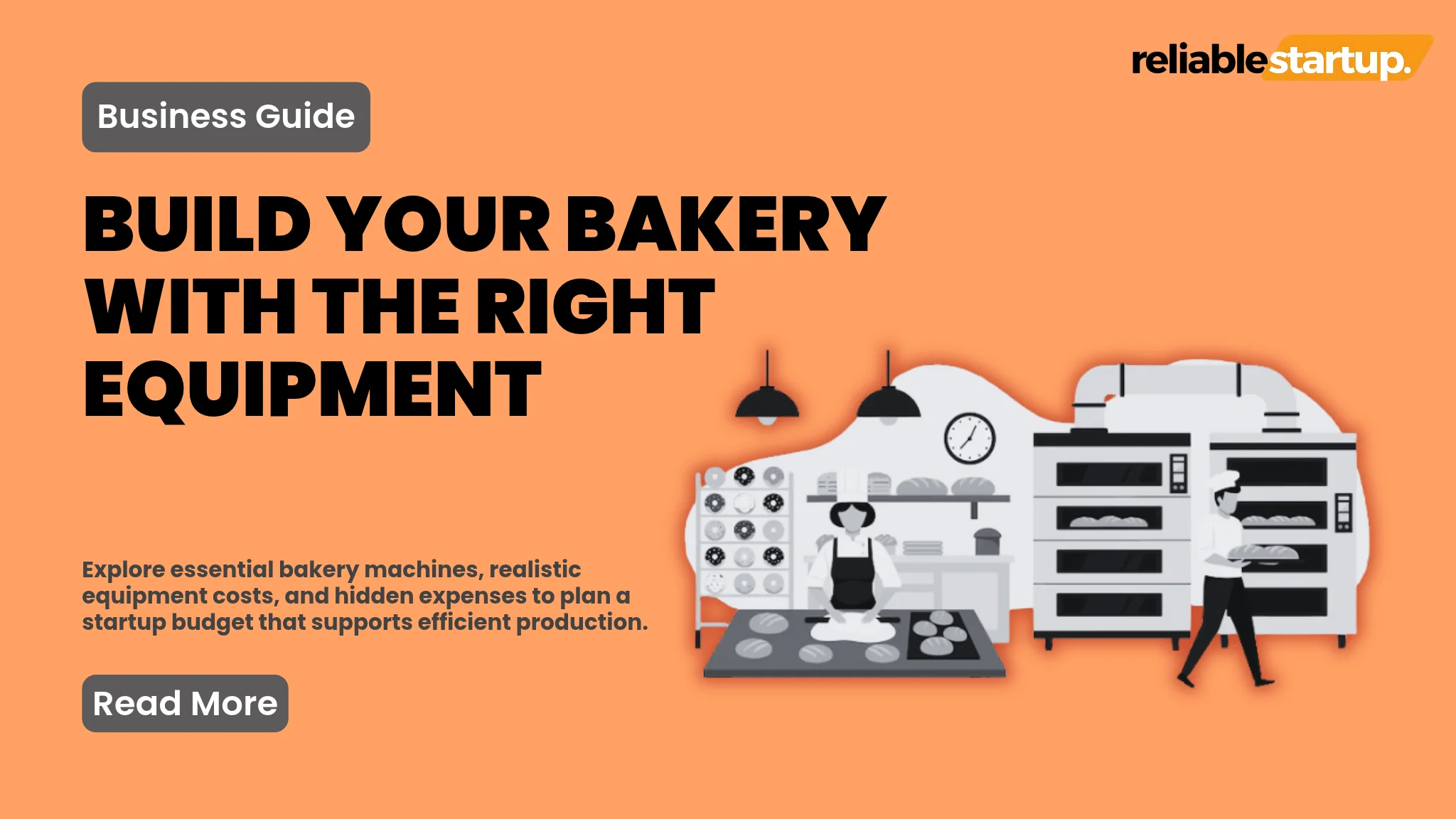
Setting up a commercial bakery requires a realistic budget, and the total bakery equipment list cost typically ranges from $15,000 to $100,000+ depending on your production volume, menu, and whether you buy new or used.
A small, boutique pastry shop or neighborhood café can launch with essential countertop and compact floor units at the lower end of that spectrum, while a high-volume artisan bread bakery or wholesale facility will easily surpass six figures once heavy-duty ovens, spiral mixers, and walk-in refrigeration are factored in.
For entrepreneurs looking to reduce upfront investment, exploring commissary kitchen costs can help determine whether renting an equipped commercial kitchen is a more affordable alternative to purchasing every piece of equipment.
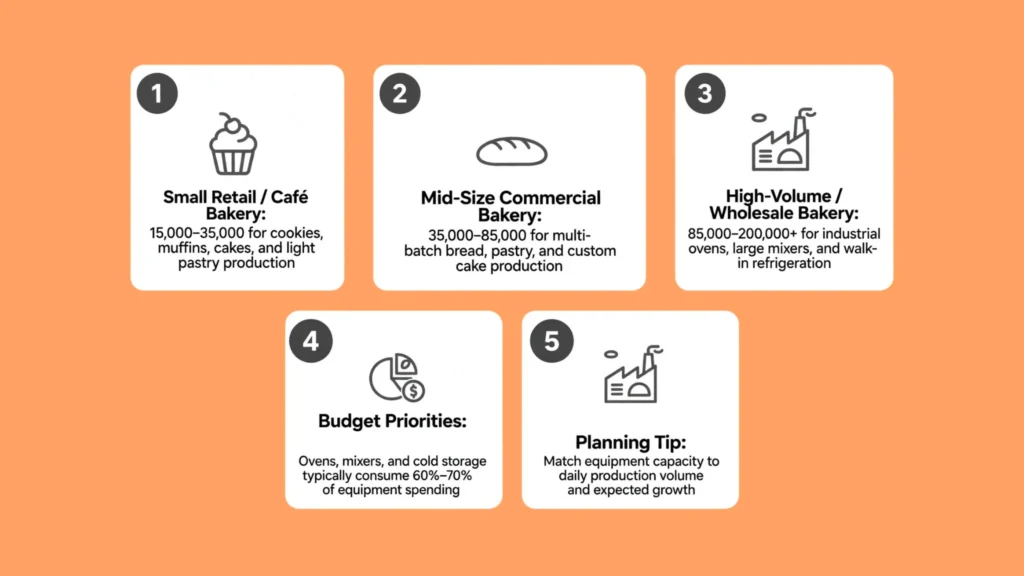
Understanding where your capital goes before signing equipment leases or supplier invoices helps prevent cash-flow bottlenecks during your build-out. Ovens, mixers, and cold storage generally consume 60% to 70% of an equipment budget, leaving the remainder for prep tables, proofing cabinets, display cases, and smallwares. Below is a practical, itemized breakdown of what you actually need to open your doors and what each piece costs.
Total Bakery Startup Equipment Budget by Scale
Before pricing individual machines, it helps to benchmark your overall budget against the size of your operation. Equipment requirements change dramatically depending on whether you are baking 50 croissants a morning or 1,000 sourdough loaves a day.
If you are still planning your business from the ground up, this guide on how to start a bakery covers the broader startup requirements beyond equipment purchasing.
| Bakery Scale | Typical Equipment Budget | Core Production Profile |
| Small Retail / Café Bakery | $15,000 – $35,000 | Cookies, muffins, layer cakes, and light pastry production using single-unit convection ovens and planetary mixers. |
| Mid-Size Commercial Bakery | $35,000 – $85,000 | Daily multi-batch production of breads, laminated pastries, and custom cakes with dedicated proofing and refrigeration. |
| High-Volume / Wholesale | $85,000 – $200,000+ | Industrial output requiring multi-deck or rotary rack ovens, large spiral mixers, dough dividers, and walk-in coolers. |
Core Production Equipment: Where Most of Your Budget Goes
Your heavy machinery dictates your daily production ceiling, labor efficiency, and product consistency. Cutting corners on primary thermal or mixing equipment often leads to burnout—both for your staff and the motors inside underpowered machines.
Commercial Oven Price Breakdown
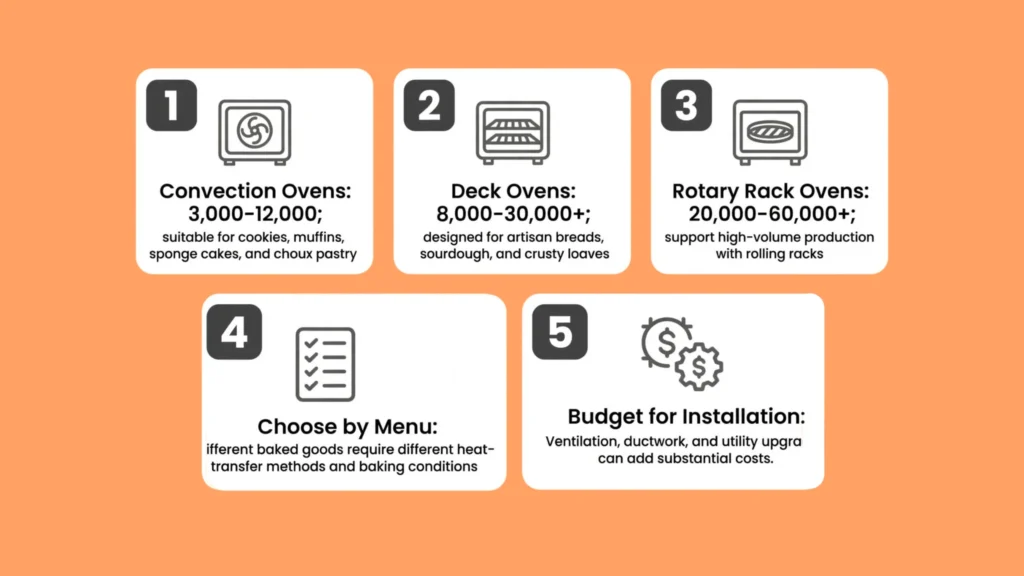
The oven is the heart of your kitchen and usually the single largest line item on your invoice. Because different baked goods require distinct heat transfer methods, your commercial oven price depends heavily on your menu:
Commercial Convection Ovens ($3,000 – $12,000): Ideal for cookies, muffins, sponge cakes, and choux pastry. Convection ovens use internal fans to circulate hot air, baking quickly and evenly across multiple racks. Double-stack gas or electric models sit toward the upper end of this range.
Deck Ovens ($8,000 – $30,000+): Essential for artisan breads, sourdough, baguettes, and crusty loaves. Deck ovens feature thick stone or ceramic hearths that radiate steady bottom heat and include steam-injection systems to create a blistered, caramelized crust. Multi-deck configurations with three or four chambers cost significantly more than single-deck units.
Rotary Rack Ovens ($20,000 – $60,000+): Built for wholesale and high-output bakeries. Rather than loading individual sheet pans by hand, bakers wheel an entire rolling rack directly into the oven chamber, maximizing throughput while minimizing labor hours.
Commercial Mixer Cost: Planetary vs. Spiral
A residential stand mixer will strip its gears within weeks under commercial workloads. Selecting the right commercial mixer—and understanding the mixer cost—comes down to what you are whipping or kneading:
Planetary Mixers ($2,000 – $15,000): Named for the way the attachment orbits around a stationary bowl, planetary mixers are the multi-taskers of the pastry kitchen. They come with a whisk, paddle, and dough hook, making them suitable for buttercream, meringues, cake batters, and light cookie doughs. A 20-quart countertop model starts around $2,000 to $3,500, while heavy-duty 60-quart floor models run $8,000 to $15,000+.
Spiral Mixers ($3,000 – $18,000+): Designed specifically for dense, low-hydration, or high-volume bread and pizza doughs. In a spiral mixer, both the spiral-shaped hook and the bowl rotate simultaneously, developing gluten gently without generating excess friction heat that could prematurely activate yeast.
Specialized Dough and Fermentation Equipment
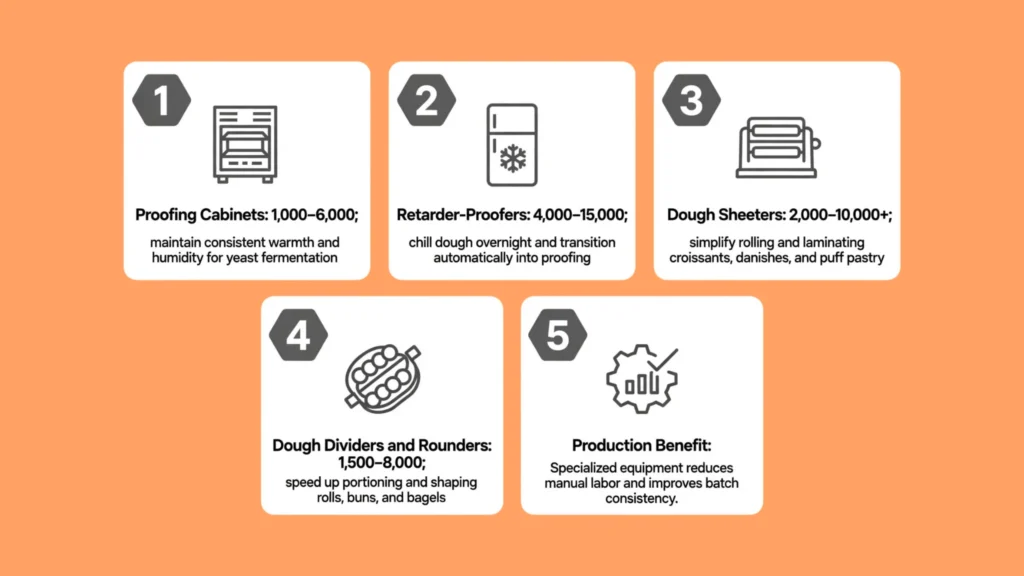
Once your foundational ovens and mixers are selected, specialized dough-handling gear saves hours of manual labor and ensures every batch rises predictably.
Proofing Cabinets and Retarder-Proofers ($1,000 – $15,000)
Yeast fermentation is sensitive to ambient kitchen drafts and seasonal humidity swings. A standard heated and humidified proofing cabinet ($1,000 – $6,000) maintains a consistent environment so loaves rise evenly on schedule. If you want to mix and shape dough the afternoon before and bake fresh at dawn without overnight labor shifts, a retarder-proofer combination unit ($4,000 – $15,000) chills the dough overnight and automatically transitions to a warm proofing cycle before your morning bakers arrive.
Dough Sheeters ($2,000 – $10,000)
If croissants, danishes, puff pastry, or rolled fondant cakes are on your menu, a reversible dough sheeter is practically mandatory. Countertop models start around $2,000 to $3,500, while floor-standing conveyor models designed for continuous lamination range from $5,000 to $10,000+.
Dough Dividers and Rounders ($1,500 – $8,000)
Hand-weighing and rounding hundreds of dinner rolls, burger buns, or bagel portions every day slows down production. Manual hydraulic dividers sit near the bottom of this price range, whereas semi-automatic divider-rounders cost more upfront but quickly pay for themselves in saved prep hours.
Cold Storage, Prep Stations, and Front-of-House Display
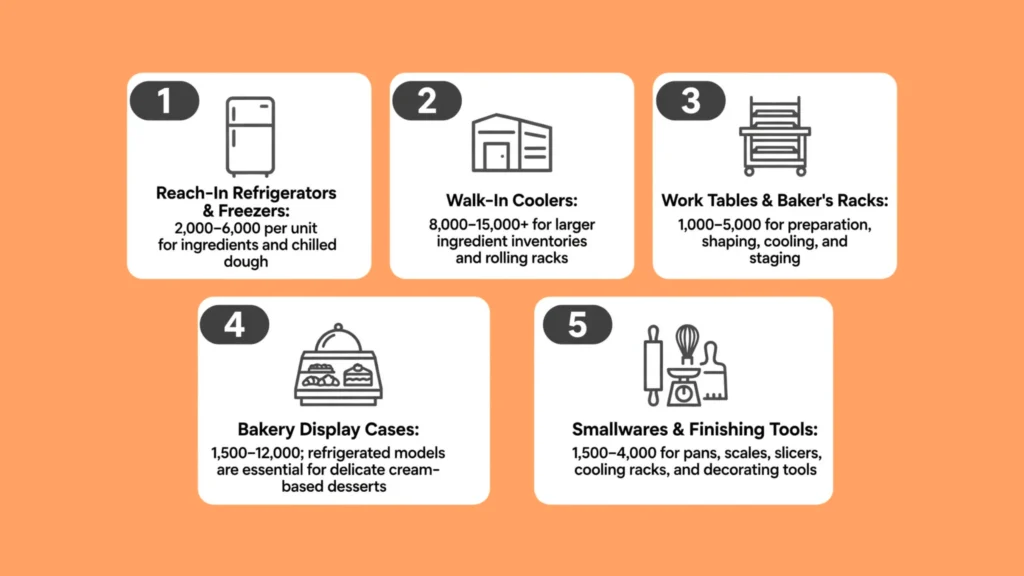
A smooth bakery workflow relies on keeping raw dairy and butter at food-safe temperatures while giving bakers ample surface area to shape, ice, and package finished goods.
Commercial Refrigeration and Freezers ($2,000 – $15,000+)
Every bakery needs reliable cold storage for butter, eggs, heavy cream, fillings, and chilled doughs:
Reach-In Refrigerators and Freezers ($2,000 – $6,000 per unit): Single-door and double-door stainless steel units are standard for small-to-mid-size kitchens. Look for models with bottom-mounted compressors in hot bakehouses, as they draw in cooler air near the floor rather than hot air near the ceiling.
Walk-In Coolers ($8,000 – $15,000+): High-volume shops storing palletized ingredients and rolling speed racks benefit from a dedicated walk-in cooler.
Stainless Steel Work Tables and Baker’s Racks ($1,000 – $5,000)
Plan on purchasing multiple NSF-certified stainless steel prep tables ($200 – $800 each) for scaling ingredients and decorating cakes, alongside a dedicated wood-top baker’s table ($600 – $1,800) if you do extensive hand-shaping of bread or pastry dough. Add several rolling aluminum speed racks ($150 – $350 each) to hold sheet pans during proofing, cooling, and staging.
Bakery Display Cases ($1,500 – $12,000)
For retail storefronts, your display case is your primary sales tool:
Dry Ambient Display Cases ($1,000 – $5,000): Used for croissants, loaves, cookies, and shelf-stable pastries.
Refrigerated Display Cases ($3,000 – $12,000): Required for cheesecakes, mousse tarts, eclairs, and whipped-cream cakes. Curved or straight glass cases with LED lighting and humidity control keep delicate desserts fresh without drying out sponge layers.
Smallwares, Pans, and Finishing Tools ($1,500 – $4,000)
First-time bakery owners routinely underestimate how fast smallwares add up. Entrepreneurs testing a smaller business model can also consider starting with a home kitchen before investing in a fully equipped commercial bakery.
A single sheet pan is inexpensive, but outfitting four rolling racks requires 80 to 100 pans. Budget for:
Commercial Sheet Pans and Loaf Pans: Heavy-gauge aluminum half-sheet and full-sheet pans, muffin tins, cake rings, and Pullman loaf pans.
Precision Scales: Digital bench scales capable of measuring to 0.1 grams for yeast and salt alongside high-capacity ingredient scales.
Slicing and Finishing Gear: Countertop commercial bread slicers ($1,500 – $6,000), immersion blenders, cooling racks, bench scrapers, piping tips, and polycarbonate ingredient bins.
Hidden Startup Costs That Catch New Bakers Off Guard
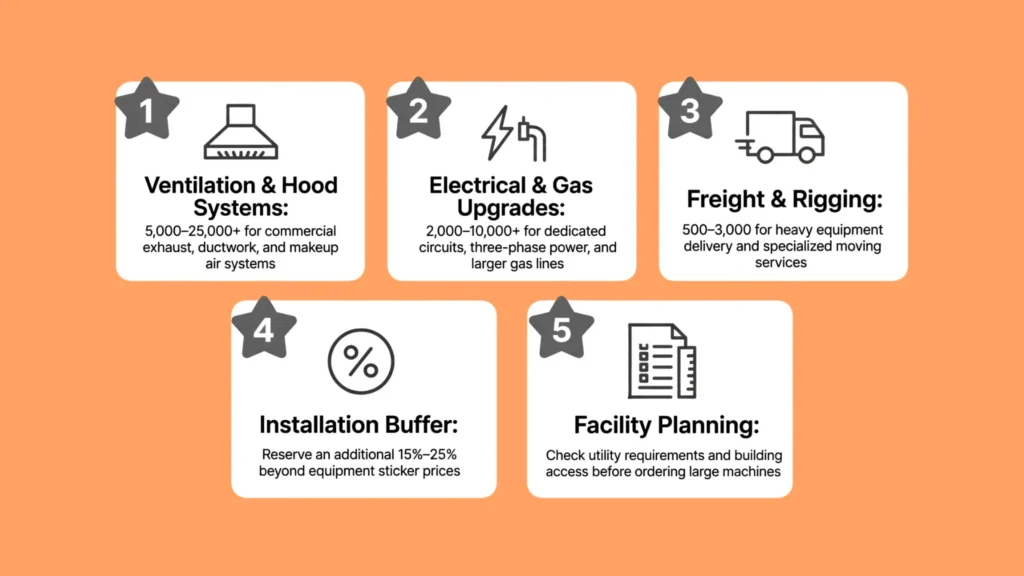
Sticker price is rarely the final price. When calculating your bakery startup equipment budget, leave a 15% to 25% buffer for installation and facility requirements:
Ventilation and Hood Systems ($5,000 – $25,000+): Local building codes frequently require Type I or Type II exhaust hoods over commercial ovens to handle heat, steam, and grease-laden vapors. Installing ductwork and makeup air systems can rival the cost of the oven itself.
Electrical and Gas Upgrades ($2,000 – $10,000+): Heavy-duty deck ovens and spiral mixers often require three-phase electrical power, dedicated 208V/240V circuits, or upgraded gas line diameters and water filtration lines for oven steam injection.
Freight, Liftgate Delivery, and Rigging ($500 – $3,000): Commercial ovens and mixers weigh hundreds or thousands of pounds. Standard freight drops equipment at the curb; moving a 1,200-pound deck oven through a narrow doorway requires specialized rigging.
Smart Tips for Buying Bakery Equipment
Match Capacity to Your Peak Hour, Not Your Average Day: Size your oven and mixer for Saturday morning rush volume rather than a quiet Tuesday afternoon, while leaving roughly 20% headroom for six-month growth.
Mix New and Used Strategically: Buy brand-new equipment for refrigeration (where compressor wear hurts efficiency) and high-tech ovens with digital controls. Look for certified used or refurbished deals on non-mechanical items like stainless steel prep tables, speed racks, sheet pans, and sturdy planetary mixers.
Check Doorway Widths and Ceiling Heights: Measure every hallway, threshold, and ceiling clearance—including utility hookups—before placing a non-refundable order on oversized mixers or rack ovens.
Verify Local Service Technicians: An affordable imported oven loses its value if replacement heating elements or control boards take six weeks to ship. Confirm that local technicians service the brands you choose.
Frequently Asked Questions
How much does it cost to equip a small bakery from scratch?
Equipping a small retail bakery or café typically costs between $15,000 and $35,000. This budget covers a commercial convection oven, a 20- to 30-quart planetary mixer, reach-in refrigeration, stainless steel worktables, speed racks, basic display cases, and essential smallwares.
What is the most expensive piece of equipment in a bakery?
The commercial oven is almost always the single most expensive purchase, ranging from $3,000 for a basic single convection oven to over $60,000 for a high-capacity rotary rack or multi-deck stone oven, especially once ventilation hoods and utility hookups are included.
Should I buy a planetary mixer or a spiral mixer?
Choose a planetary mixer if your menu centers on cakes, cupcakes, frostings, cookies, and general batters, as its interchangeable attachments handle a wide variety of tasks. Choose a spiral mixer if you specialize in artisan bread, bagels, or pizza dough, as its dual-rotation design kneads heavy doughs efficiently without overheating them.
Is buying used bakery equipment a good idea?
Yes, when done selectively. Used stainless steel tables, speed racks, bread pans, and older gear-driven planetary mixers offer substantial savings with minimal risk. However, buying new is generally safer for commercial refrigerators, freezers, and complex steam-injected ovens where warranty coverage and energy efficiency protect your operating margins.
What hidden costs should I include in my bakery equipment budget?
Set aside an extra 15% to 25% beyond equipment sticker prices to cover freight shipping, liftgate or rigging fees, three-phase electrical upgrades, gas line plumbing, water filtration systems for steam ovens, and commercial exhaust hood installation.
How can I reduce my initial bakery startup equipment costs?
Start with a focused, core menu so you don’t have to buy specialized machinery like dough sheeters or automated dividers on day one. You can also lease high-ticket ovens to preserve working capital, buy smallwares in bulk restaurant-supply lots, and source non-mechanical prep equipment secondhand.
Final Thoughts
Building an accurate bakery equipment list cost comes down to letting your menu dictate your machinery rather than buying every gadget in a catalog. Focus your capital first on reliable baking capacity, proper mixing mechanics, and compliant refrigeration, while keeping a healthy reserve for ventilation, electrical work, and delivery logistics.
By sizing your equipment to realistic daily output and mixing smart new purchases with durable secondhand basics, you can launch with a kitchen built for both consistency and healthy margins.
About The Author