Rental Damage Deposit Policy: How Much to Hold and When to Keep It
Renting out high-value equipment or real estate is a lucrative business model, but it comes with inherent risk. Every time a asset leaves your direct control, you run the chance of it returning broken, dirty, or completely ruined. Establishing a firm, transparent rental damage deposit policy is your primary defense against unexpected repair costs and protracted operational downtime.
Yet setting the right policy requires a delicate balancing act. Set your security deposit holds too high, and potential customers will abandon their carts for competitors. Set them too low, and a single instance of severe negligence can wipe out your profit margins for the entire quarter. Navigating these financial and legal boundaries requires clear guidelines, structured workflows, and realistic assessments of asset depreciation.
A strong rental damage deposit policy protects business assets by establishing standard hold amounts and clear deduction rules. Companies usually hold 10% to 20% of an asset’s total value or a fixed multiple of the daily rental rate. Landlords and rental operators can legally retain deposit funds for excessive damage, missing items, or breach of contract, but never for normal wear and tear. Transparent inspection logs prevent disputes and ensure quick returns.
Key Takeaways:
Standard equipment and property deposit holds generally range between 10% and 20% of total value or a fixed daily multiple.
Normal wear and tear cannot be deducted from a security deposit hold; only documented, excessive damage qualifies.
Thorough pre-rental and post-rental inspection checklists are the single most effective tool to prevent deposit disputes.
Local jurisdiction laws dictate strict timelines and accounting rules for returning or withholding deposit funds.
Understanding Security Deposit Mechanics Across Industries
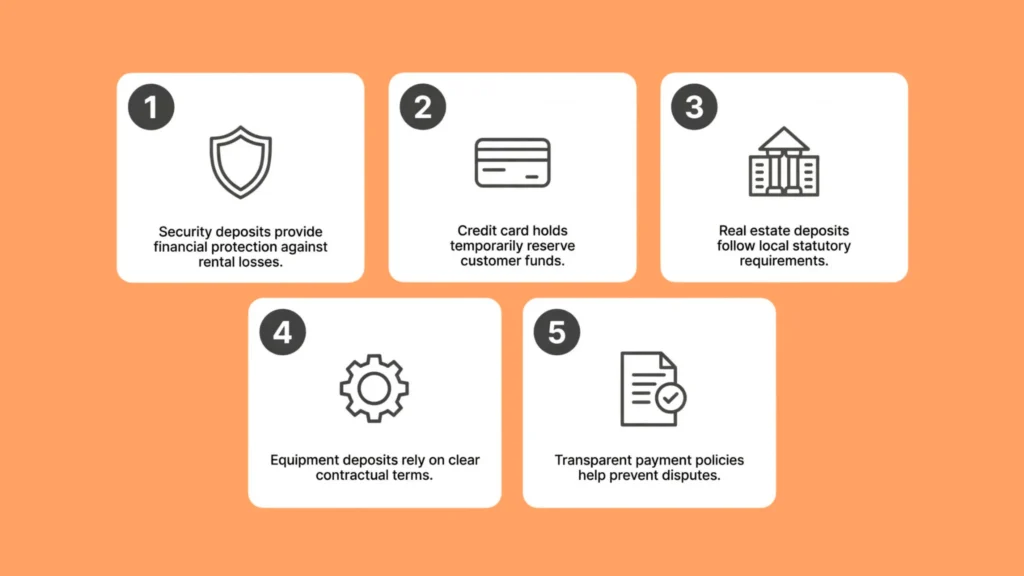
A security deposit serves as a financial performance bond. When a customer rents property or commercial machinery, they temporarily transfer risk back to themselves by authorizing a temporary credit card hold or paying an upfront cash reserve.
For real estate rentals, these funds are typically governed by strict state or municipal statutes. Residential properties usually cap deposit amounts at one to two months of rent and mandate that funds be held in designated escrow accounts.
In contrast, commercial equipment rentals operate under contract law and the Uniform Commercial Code. Whether you rent out heavy machinery, event staging, audio-visual gear, or specialty tools, your security deposit rental equipment protocols rely on explicit contractual terms rather than residential tenant protection acts.
Managing these financial flows requires clear payment processing infrastructure. Modern online booking engines help growing rental companies integrate automated card holds, manage reservations, and ensure funds are pre-authorized before gear leaves the warehouse.
Establishing the Right Deposit Hold Amount

Determining the exact deposit hold amount requires evaluating three primary variables: asset replacement value, repair complexity, and customer risk profiles.
Holding the full replacement value of high-ticket items is rarely practical. If a skid steer costs $40,000, requiring a matching deposit will eliminate 99% of your customer base. Instead, businesses use tiered risk matrices to establish reasonable pre-authorization thresholds.
Value-Based Hold Structures
For mid-range equipment and tool rentals, standard industry policy sets security deposit holds at 10% to 20% of the asset’s total fair market value. This becomes particularly important when managing high-value items such as construction machinery, skid steers, and industrial equipment.
This ensures enough coverage for common repairs, such as replacing damaged hydraulic hoses or cracked display screens, without creating an excessive barrier to entry.
Rate-Based Hold Structures
For short-term or high-turnover rentals, calculating holds as a multiple of the daily rate is often simpler. A common industry standard is holding the total estimated rental charge plus two extra days of rental value, or a flat fee such as $250 to $500 depending on the category.
| Asset Category | Typical Replacement Value | Recommended Deposit Hold Approach | Average Hold Range |
| Hand Tools & Light Equipment | Under $1,000 | Flat fee per item | $50 – $150 |
| Professional AV & Electronics | $1,000 – $10,000 | Percentage of replacement cost | 15% – 20% of value |
| Heavy Construction Gear | $10,000 – $50,000+ | Rental multiple plus flat tier | $500 – $2,500 hold |
| Residential Real Estate | Multi-year property | Monthly rent multiple | 1 to 2 months rent |
Dynamic Risk Adjustments
First-time customers, walk-ins, or out-of-state operators carry higher risk profiles than long-term corporate accounts with established credit lines. Your policy should allow for higher deposit requirements on high-risk transactions while offering waived or reduced holds for vetted, repeat clients.
Defining Normal Wear and Tear vs. Actual Damage

The single largest source of friction between rental operators and clients is distinguishing between expected deterioration and actionable damage. Without clear contractual definitions, any attempted deduction can escalate into an expensive credit card chargeback or formal dispute.
What Constitutes Normal Wear and Tear?
Normal wear and tear refers to the gradual decline in an asset’s condition resulting from ordinary, careful use over time. You cannot legally or ethically deduct funds from a deposit for routine aging.
Examples include:
Light surface scuffs, minor paint scratches, or worn handle grips on machinery.
Gradual tire tread loss from standard site operation.
Minor dust accumulation or light cosmetic smudges on electronic casings.
Fading paint or finish caused by routine sunlight exposure.
What Constitutes Actionable Damage?
Actionable damage stems from negligence, misuse, improper storage, operational accidents, or intentional abuse. These instances represent a clear drop in asset utility that requires active repair or component replacement.
Examples include:
Deep structural dents, bent frames, or cracked engine housings.
Internal component failure caused by running equipment without oil or using incorrect fuel types.
Severed cables, cracked lenses, or water damage on electronic gear.
Missing accessories, safety guards, or sub-assemblies.
Excessive grime, concrete splatter, or hazardous materials requiring professional detailing beyond standard cleaning.
When You Can Legally Keep a Deposit

Retaining part or all of a client’s deposit requires objective proof that a contractual breach occurred. You cannot arbitrarily claim funds simply because an interaction was difficult or gear returned slightly dirty.
Legitimate grounds for withholding funds include:
Physical damage requiring repairs or specialized cleaning.
Missing components, accessories, or total loss of the main asset.
Unpaid rental balances, late return fees, or unauthorized extension periods.
Breach of operating terms, such as using indoor equipment outdoors in rain.
When deducting funds, you must only retain the exact amount required to restore the asset to its pre-rental condition or cover documented financial losses. Keeping a $1,000 deposit for a $100 repair without refunding the remaining $900 is illegal conversion of funds.
Operators using management frameworks from reliablestartup.com often centralize damage logs directly alongside invoice records. Linking repair estimates straight to initial hold receipts makes partial captures transparent and simple to process.
The Inspection Workflow: Protecting Your Right to Claim
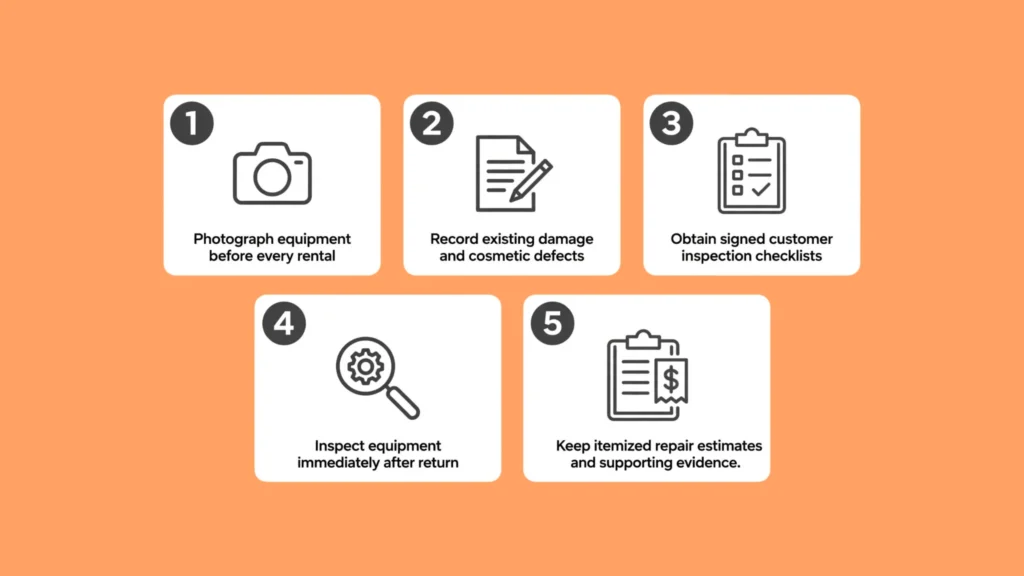
You cannot prove damage occurred during a rental window without establishing its baseline condition immediately before release. A airtight check-in and check-out protocol is essential for supporting any future claim.
Pre-Rental Digital Baseline: Before gear leaves your facility, perform a joint walk-around with the client. Document current condition using high-resolution photos or video stamped with date and time.
Signed Acknowledgment: Have the customer sign a digital checklist confirming that all listed components are present and functional, and acknowledging existing cosmetic blemishes.
Post-Rental Check-In: Upon return, conduct an initial visual inspection while the customer is present whenever possible. Log any immediate discrepancies.
Technical Evaluation Window: State in your rental damage deposit policy that complex mechanical or electronic equipment is subject to a 24- to 48-hour internal technical audit before holds are fully released.
Itemized Repair Estimates: If damage is found, secure third-party repair quotes or use standardized internal labor and parts rates to calculate exact repair costs.
Handling a Deposit Dispute
Even with detailed photo evidence, customers may challenge damage charges through bank chargebacks or online complaints. How you manage a deposit dispute determines whether you protect your revenue or damage your brand reputation.
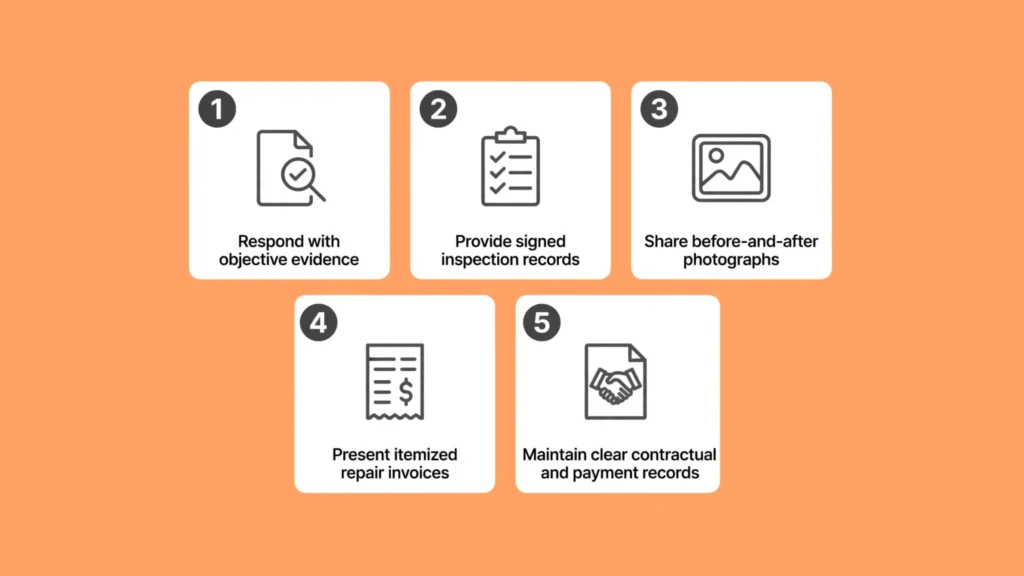
First, respond with objective evidence rather than emotion. Send the customer their signed pre-rental inspection sheet alongside post-rental photos, detailed repair invoices, and the specific section of your policy governing the charge.
If the customer escalates the claim to a credit card processor via a chargeback, merchant banks will evaluate whether your contract explicitly allowed the capture. Having clear signage, digital consent records, and itemized receipts makes surviving chargeback reviews straightforward.
Integrating your inventory engine with services like reliablestartup.com gives operational teams instant access to historical digital sign-offs, helping resolve payment disputes quickly before they reach bank arbitration.
Writing a Clear, Enforceable Policy Document
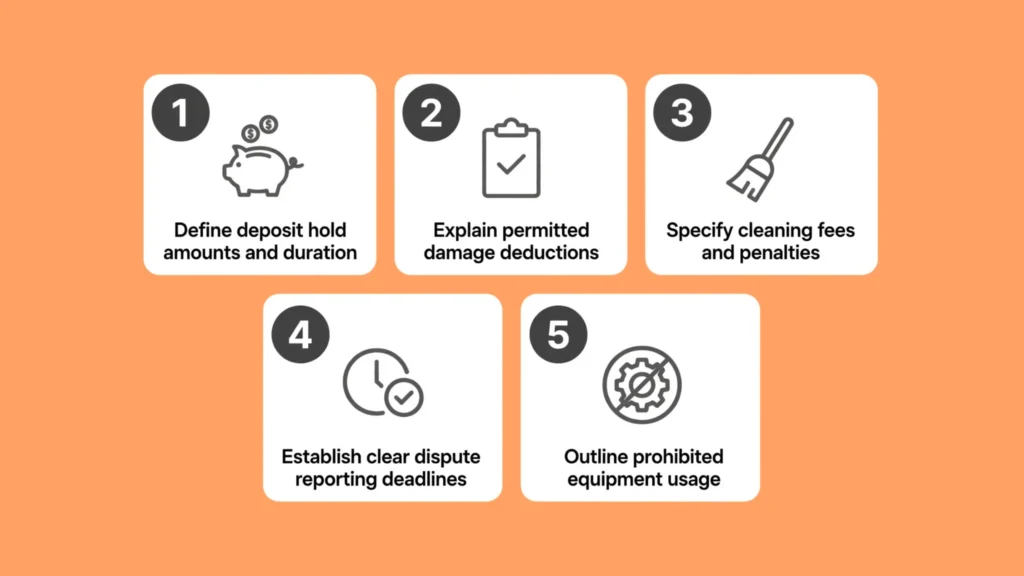
An effective policy protects your business while remaining easy for customers to read and understand. Plain language prevents misunderstandings and demonstrates good-faith business practices.
Key elements every written policy must include:
Hold Duration & Capture Terms: Specify when pre-authorizations are placed and how long financial institutions take to release pending holds after return (typically 3 to 7 business days depending on the card issuer).
Cleaning Fees & Operational Penalties: Clearly state flat charges for returning equipment dirty, uncharged, or without full fuel tanks.
Dispute Timelines: Provide a specific contact window (e.g., 5 business days from billing) for clients to query any damage assessments before final charges are finalized.
Permitted Usage Boundaries: Outline prohibited operational environments, such as sub-renting or exposed marine use, that immediately void liability caps and trigger full deposit forfeiture.
Frequently Asked Questions
How long can a company keep a security deposit hold?
Credit card pre-authorizations typically drop off automatically within 3 to 7 business days after release, depending on the customer’s issuing bank. For commercial equipment rentals with potential latent damage, internal policy should define an inspection window of 24 to 48 hours before initiating the release process.
Can you hold a deposit for equipment returned covered in mud or dirt?
Yes, if the equipment requires extraordinary cleaning beyond standard cosmetic dusting. Your rental agreement must explicitly define cleaning fees or state that detailing costs needed to restore the asset to operable condition will be deducted directly from the security deposit hold.
What is the difference between an outright charge and a credit card authorization hold?
An authorization hold temporarily reserves a portion of the client’s available credit line without processing an actual balance transfer. An outright charge moves funds immediately from the client to your merchant account. Holds are preferred for deposits because they carry lower processing fees upon release.
What happens if damage costs exceed the total deposit hold amount?
If repair costs exceed the deposit hold, you capture the full deposit amount and bill the remaining balance directly to the client. If the client refuses to pay the outstanding balance, the debt can be pursued through collections, small claims court, or insurance claims based on your rental contract terms and applicable coverage.
Is normal wear and tear deductible from an equipment deposit?
No. Normal wear and tear reflects expected deterioration from standard, careful use over time and is considered an operational cost of doing business. Attempting to deduct funds for routine cosmetic wear violates standard commercial contract principles and often leads to lost chargeback disputes.
Conclusion
A well-crafted rental damage deposit policy balances risk mitigation with a smooth customer experience. By setting clear hold amounts, training staff to distinguish normal wear from real damage, and backing every charge with photo documentation, you protect your inventory while maintaining customer trust. Transparency remains your best tool: when clients know exactly what to expect before taking equipment off your lot, disputes plummet and your bottom line stays protected.
About The Author