How to Write a Rental Business Plan That Gets Funded
Securing capital for a new venture requires proving your business idea to investors and lenders. Specifically, you must show that your concept is financially viable and operationally sound. Crafting a structured rental business plan is the single most effective way to demonstrate market demand. Moreover, it highlights your risk management strategies and your path to long-term profitability. On average, drafting a comprehensive plan takes two to four weeks of thorough research and financial modeling.
A well-crafted business plan serves a dual purpose. First, it acts as your internal operational roadmap. Second, it provides banks, angel investors, or venture capital firms with clear data. Consequently, this clear information helps them approve your financing quickly. In this complete guide, we cover every core section, financial requirement, cost structure, and profit expectation needed to write a funding-ready plan for your rental company.
Why a Business Plan Is Essential for Rental Operations
Rental companies differ from traditional service or retail models. They require heavy upfront capital investment to purchase fleet vehicles, real estate, heavy machinery, or event inventory. Therefore, you must acquire these assets before collecting your first dollar of customer revenue. Lenders and investors inspect rental proposals with extreme scrutiny. This is because your primary assets are physical goods subject to depreciation, maintenance costs, and liability risks.
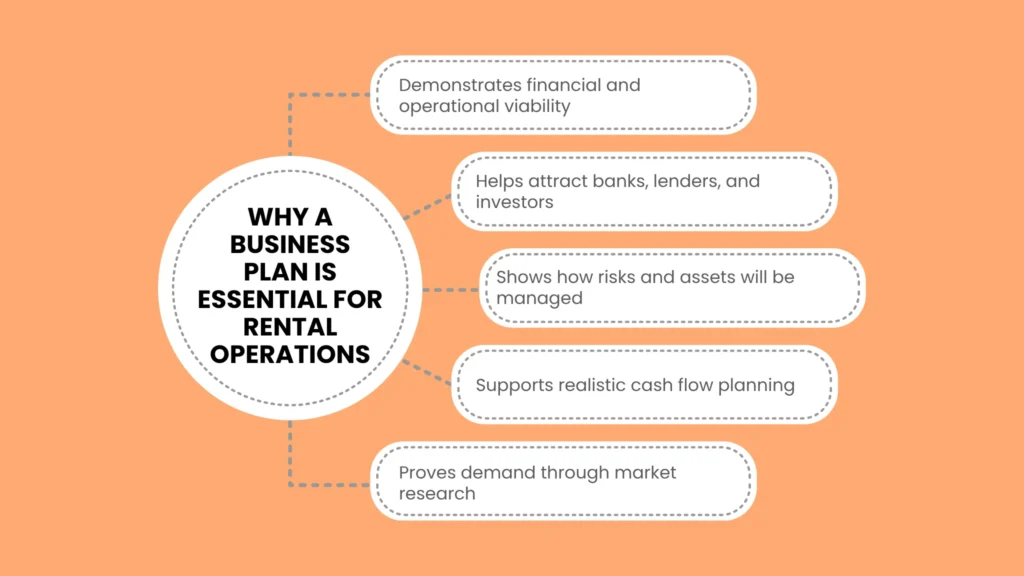
A clear business plan demonstrates your preparation to financial partners. As a result, it proves that you have accounted for unique operational factors and established realistic financial projections.
Core Objectives of a Funding-Ready Proposal
Capital Attraction: Banks require a formal document to evaluate Small Business Administration (SBA) loan applications or commercial line of credit requests.
Risk Mitigation: Outlining insurance strategies, asset maintenance protocols, and tenant screening procedures proves you can protect funded assets.
Cash Flow Management: Detailed financial statements show how seasonal demand variations will be managed without running out of working capital.
Market Validation: Competitor analysis and local demographic data prove that sufficient regional demand exists for your rental fleet or property portfolio.
Essential Sections of a Winning Rental Plan
To capture investor attention, your document must follow a logical structure. Furthermore, it should answer critical questions clearly and directly.
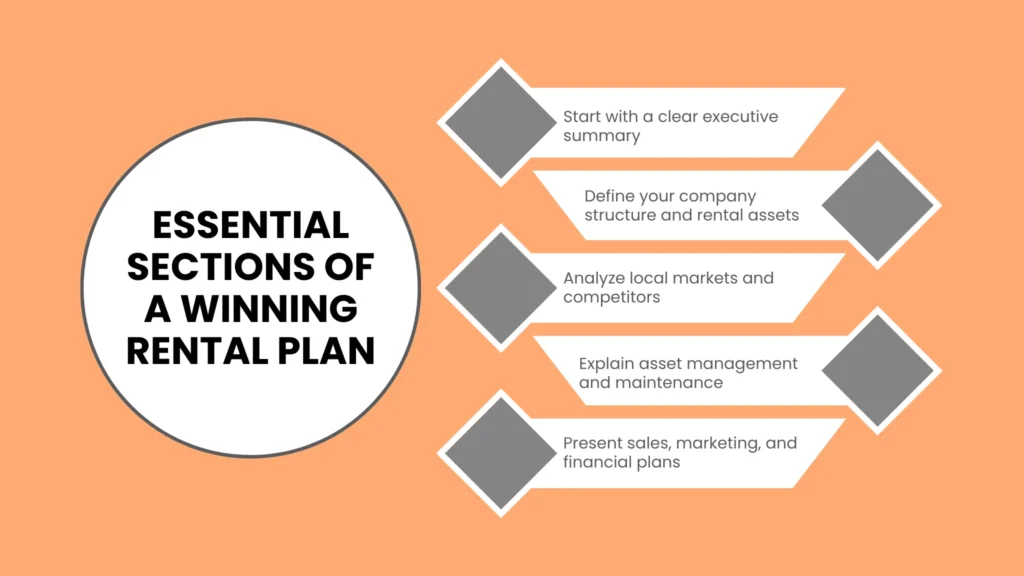
1. Executive Summary
Although it appears at the beginning of your plan, write this section last. It must provide a high-level overview of your rental model, target market, and competitive advantage. In addition, include your requested funding amount and projected financial returns.
2. Company Description and Business Structure
Detail your corporate entity structure, such as an LLC or C-Corporation. Next, outline your ownership split and location. Finally, specify the exact category of rental assets you manage, such as heavy construction equipment, residential real estate, or mobility fleets.
3. Market Analysis and Industry Trends
Demonstrate deep knowledge of your local market dynamics. For instance, include regional demographic data, corporate demand drivers, competitor pricing benchmarks, and seasonal utilization rates.
4. Fleet or Property Asset Management Plan
Explain how you select, purchase, store, maintain, and track your physical rental inventory. Investors want to see specific details regarding tracking software, preventative maintenance schedules, and insurance coverage limits. For vehicle-based models specifically, our boat rental business insurance guide shows how to document coverage for lenders.
5. Sales and Marketing Strategy
Outline how you plan to acquire clients and manage online bookings. Additionally, explain how you will build corporate accounts and maintain high asset utilization rates throughout the year.
6. Financial Projections and Funding Request
Provide a 3-year to 5-year financial model containing profit and loss statements, cash flow forecasts, balance sheets, and break-even analyses. Ultimately, specify exactly how much capital you need and how those funds will be allocated.
Standard Components of a Rental Business Plan Template
Utilizing a structured rental business plan template ensures you include all necessary data points. As a result, you will not miss critical operational variables. The checklist below outlines the standard framework for rental proposals.
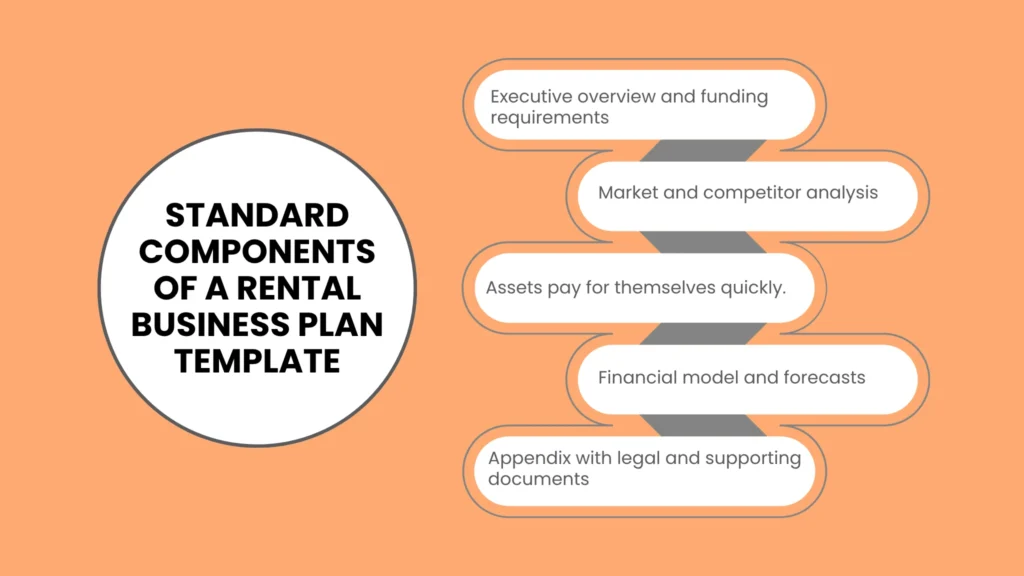
Section 1: Executive Overview: Mission statement, core rental offering, funding requirements, and expected return on investment (ROI).
Section 2: Market & Competitor Analysis: Target audience personas, local market sizing, rental rate benchmarks, and competitor gaps.
Section 3: Asset & Operational Strategy: Fleet acquisition costs, depreciation schedules, maintenance workflows, software tracking stack, and insurance policies.
Section 4: Financial Model & Forecasts: 3-year income statements, cash flow projections, capital expenditure schedules, and break-even metrics.
Section 5: Appendix: Founder resumes, credit reports, equipment vendor quotes, zoning approvals, and sample rental lease agreements.
Executive Overview: Financials, Requirements, and Margins
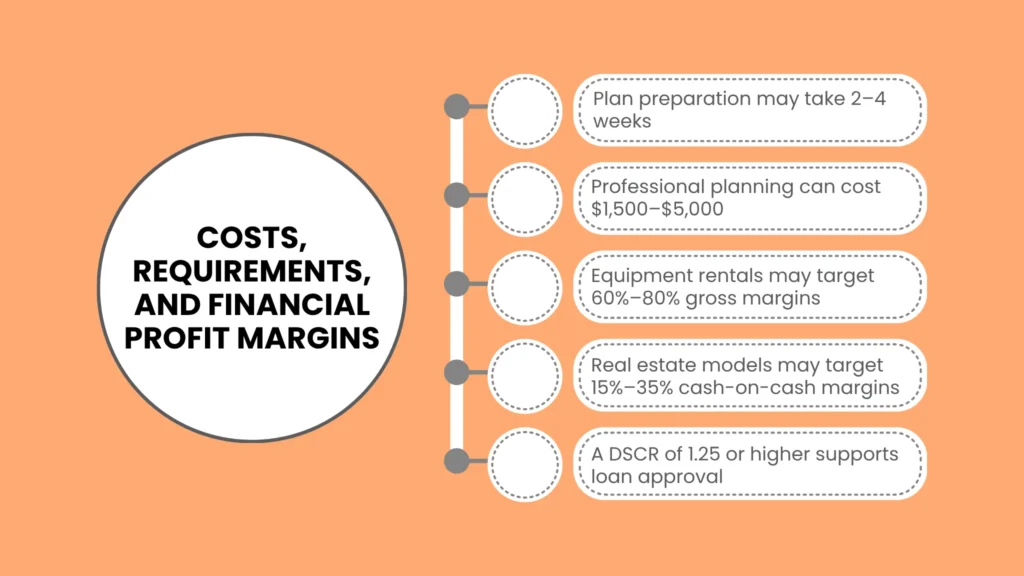
The table below summarizes key metrics and typical preparation costs. In addition, it outlines financial expectations for writing and executing a funding-focused plan.
| Planning Metric | Typical Industry Benchmark | Strategic Importance |
| Preparation Timeframe | 2 to 4 Weeks | Allows for thorough market research and financial modeling |
| Outsourced Creation Cost | $1,500 to $5,000 | Custom preparation by financial analysts or legal experts |
| Target Gross Margin Range | 60% to 80% (Equipment / Tools) | High gross margins support asset depreciation and fleet maintenance |
| Net Cash-on-Cash Margin | 15% to 35% (Real Estate / Vehicles) | Key metric evaluated by commercial lenders for debt coverage |
| Primary Approval Requirement | Debt Service Coverage Ratio (DSCR) ≥ 1.25 | Proves cash flow easily covers debt service obligations |
Costs, Requirements, and Financial Profit Margins
Lenders closely evaluate how your operational parameters and cost structures align with industry standards. Understanding these variables ensures your plan withstands professional review.
Evaluating the Rental Business Plan Cost
Developing a comprehensive plan incurs both direct and indirect expenses. These costs depend on whether you draft it yourself or hire professional advisors. Understanding the actual rental business plan cost structure helps you budget accurately during the pre-launch phase.
DIY Software Templates: Utilizing specialized business planning applications typically costs between $15 and $50 per month.
Professional Financial Analyst Fees: Hiring an experienced freelance financial modeling expert to build custom 5-year forecasts ranges from $500 to $2,000.
Full-Service Planning Agencies: Engaging specialized business consulting firms to write a complete investor-ready proposal generally costs between $1,500 and $5,000.
For most founders, spending $1,000 to $3,000 on professional planning tools and financial validation provides a strong return. Consequently, it significantly increases lender approval rates.
Core Rental Business Plan Requirements
To satisfy bank loan departments and private investors, your document must fulfill strict baseline data standards. Meeting these rental business plan requirements eliminates unnecessary delays during loan evaluations.
Detailed Asset Schedules: Clear line items showing purchase prices, expected useful lifespan, and residual values for all physical rental inventory, often benchmarked against SBA loan requirements for equipment financing.
Debt Service Coverage Ratio (DSCR): Financial projections showing a DSCR of at least 1.25x. This proves your net operating income covers loan repayments comfortably. If you’re still deciding between funding models, our comparison of bootstrapped vs VC-funded startups explains how DSCR expectations differ across financing types.
Comprehensive Insurance Estimates: Realistic quotes for commercial general liability, inland marine, or fleet auto insurance policies.
Maintenance & Turnaround Budgets: Allocated reserves designated specifically for asset repairs and routine maintenance.
Financial Modeling for Rental Business Plan Profit Margin
Investors pay close attention to your basic unit economics and profit expectations. Therefore, your plan must clearly illustrate how your margins scale as your inventory expands.
Gross Operating Margins: Equipment, tool, and event rental operations often project gross margins between 60% and 80%. Meanwhile, vehicle and real estate models typically operate around 40% to 60%.
Net Profit Margins: After factoring in asset depreciation, overhead, marketing, and loan interest, a healthy rental business plan profit margin projects net returns between 15% and 30%.
Break-Even Utilization Rates: Your financial model must state the exact utilization percentage required to cover fixed costs. For example, keeping fleet vehicles rented 55% of the month to break even.
Is Rental Business Plan Profitable as an Investment Tool?
Founders frequently ask whether investing time and money into a formal business plan delivers measurable value. So, is rental business plan profitable in terms of overall capital efficiency?
Yes, it is. Research consistently shows that entrepreneurs who complete a formal business plan are much more likely to secure bank financing. Furthermore, a structured plan prevents costly early mistakes. For example, it stops you from underestimating asset maintenance costs or overpaying for inventory. Thus, it directly preserves cash reserves and makes your business far more profitable over time.
Common Mistakes That Cause Lenders to Reject Plans
Steering clear of common financial modeling errors keeps your loan application moving smoothly through credit committees.
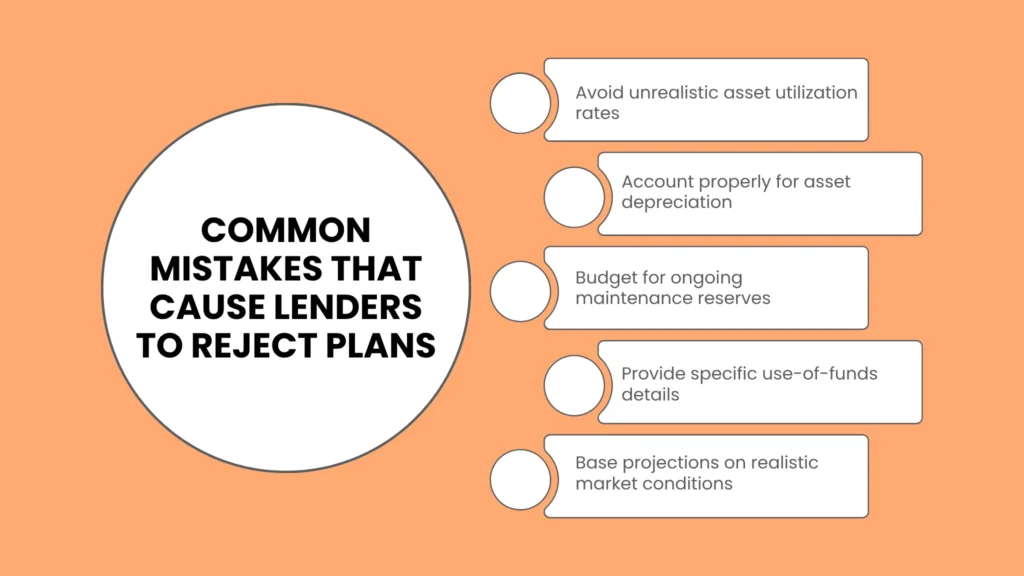
Unrealistic Utilization Rates: Projecting 90% to 100% asset utilization year-round ignores seasonal slowdowns, maintenance downtime, and turn-around periods.
Ignoring Asset Depreciation: Failing to account for annual asset depreciation distorts balance sheet accuracy and overstates company net worth.
Underestimating Maintenance Reserves: Equipment breaks down and properties require repair. Therefore, allocating zero funds for maintenance flags your plan as unrealistic.
Vague Use-of-Funds Statements: Requesting $500,000 for general working capital without itemizing exact vehicle prices, software setup costs, or marketing expenses leads to fast bank rejections.
Actionable Tips to Strengthen Your Funding Request
Implement these practical strategies to make your business proposal stand out to loan officers and investors:
Include Real Supplier Quotes: Attach actual dealer pricing sheets or manufacturer invoices for the equipment or inventory you intend to purchase.
Highlight Industry Experience: Emphasize the operational track record of your management team. Specifically, highlight past experience in logistics, fleet management, or real estate.
Present Stress-Tested Scenarios: Include conservative, expected, and aggressive financial cases to prove your business remains solvent during economic downturns.
Obtain Letters of Intent (LOIs): Secure non-binding commercial agreements from potential B2B clients to prove immediate demand upon launch.
Conclusion
Writing a structured rental business plan is the foundational step toward securing startup funding and building a sustainable business. By detailing market demand, providing clear asset management frameworks, and presenting realistic financial projections, you give lenders and equity partners the confidence required to fund your venture.
Invest time in refining your unit economics, preparing your financial statements, and establishing clear operational workflows to convert your business concept into a funded reality.
For more expert guides on business planning, financial modeling, startup incorporation, and growth execution, explore our comprehensive resources at reliablestartup.
Frequently Asked Questions
What is the most important section of a rental business plan for bank lenders?
The financial projections section is the most critical element for bank underwriters. Specifically, they examine the cash flow statement and Debt Service Coverage Ratio (DSCR). Lenders want clear proof that cash flow will cover principal and interest repayments across every month of the loan term.
How many years of financial projections should be included in a rental plan?
Standard investor-ready business plans require 3 to 5 years of financial projections. You should break down the first year on a month-by-month basis. Meanwhile, you can present years 2 through 5 quarterly or annually.
Can I write a funding-ready plan myself, or should I hire a professional?
You can draft the plan yourself using specialized software tools. However, you must thoroughly research local market benchmarks and understand financial statements. Alternatively, having a financial analyst review your financial model ensures your cash flow assumptions withstand bank audits.
What cash reserves should be built into a rental financial plan?
It is recommended to project a cash buffer equal to 3 to 6 months of fixed operating expenses plus expected debt service. This working capital cushion protects operations against seasonal demand drops or unexpected fleet repair costs.