Bootstrapped vs VC-Funded Startup: Which Path Is Right for You
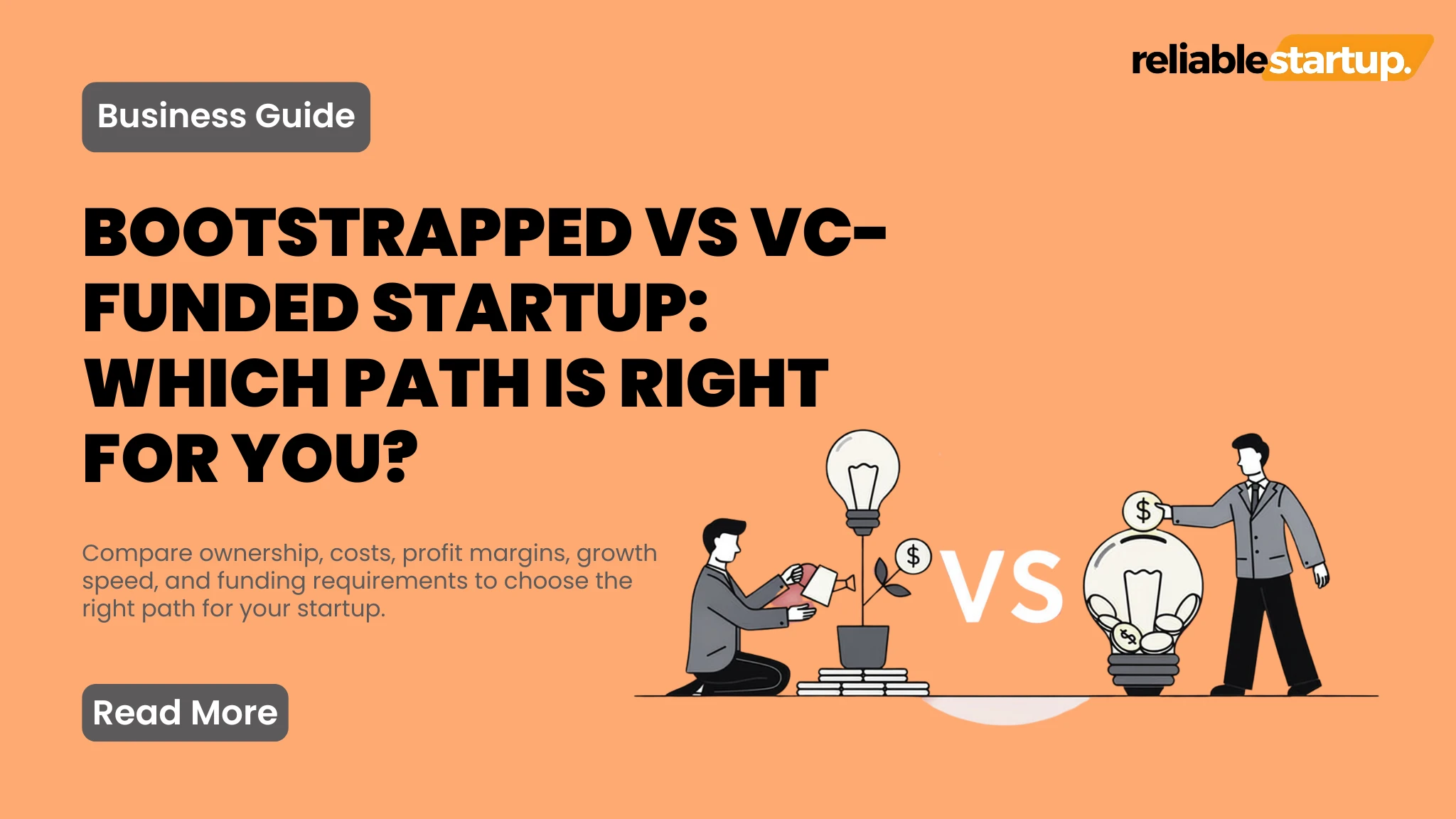
Choosing how to finance your business is one of the most critical decisions you will make as a founder. The choice between a bootstrapped vs vc funded startup determines your ownership equity, growth trajectory, operating pace, and long-term exit strategy.
While venture capital dominates tech headlines with mega-rounds and massive valuations, bootstrapping remains a powerful path that allows founders to build highly profitable, sustainable businesses on their own terms.
If you are asking yourself, “should i bootstrap my startup or raise venture capital?”, this guide breaks down the core financial trade-offs, operational requirements, profit margin realities, and cost structures of both funding models.
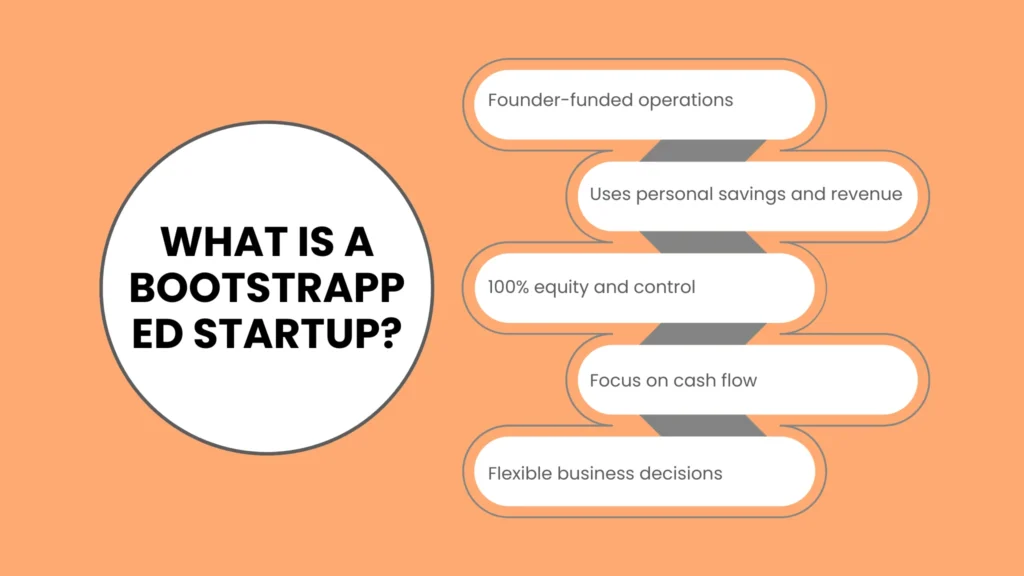
What Is a Bootstrapped Startup?
A bootstrapped business relies entirely on founder savings, personal credit, and early customer revenue to fund daily operations and organic growth. Instead of taking outside investment, bootstrapped founders reinvest profits directly back into product development, hiring, and customer acquisition.
Key Advantages of Bootstrapping
100% Equity and Control: You retain full ownership, maintain absolute decision-making power, and dictate your company’s strategic direction.
Focus on Cash Flow and Profitability: Without venture backing, your company must generate positive net cash flow early to survive.
Operational Flexibility: You can pivot, pause, or change direction without needing approval from a board of directors or investor group.
What Is a VC-Funded Startup?
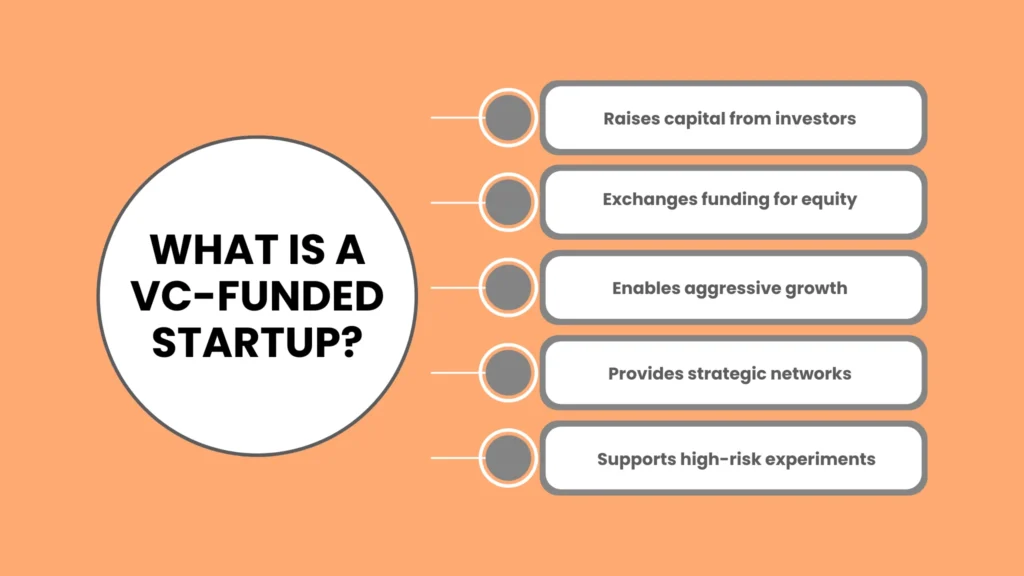
A VC-funded business raises capital from institutional investors, venture capital firms, or angel groups in exchange for equity ownership and equity board seats. The goal of venture capital is to inject cash into the business to achieve rapid, exponential market capture and scale toward a high-value acquisition or public offering (IPO).
Key Advantages of VC Funding
Aggressive Market Scale: Deep financial reserves allow you to hire senior talent, build complex technology, and capture market share quickly.
Strategic Networks and Governance: Top VC firms provide valuable industry intros, follow-on capital access, board guidance, and recruiting support.
High Financial Risk Tolerance: Investor capital shields personal wealth, enabling you to test ambitious, high-risk growth experiments.
Bootstrapped vs VC-Funded Startup Cost Dynamics
Evaluating the bootstrapped vs vc funded startup cost landscape involves looking at capital efficiency, burn rate management, and legal overhead.
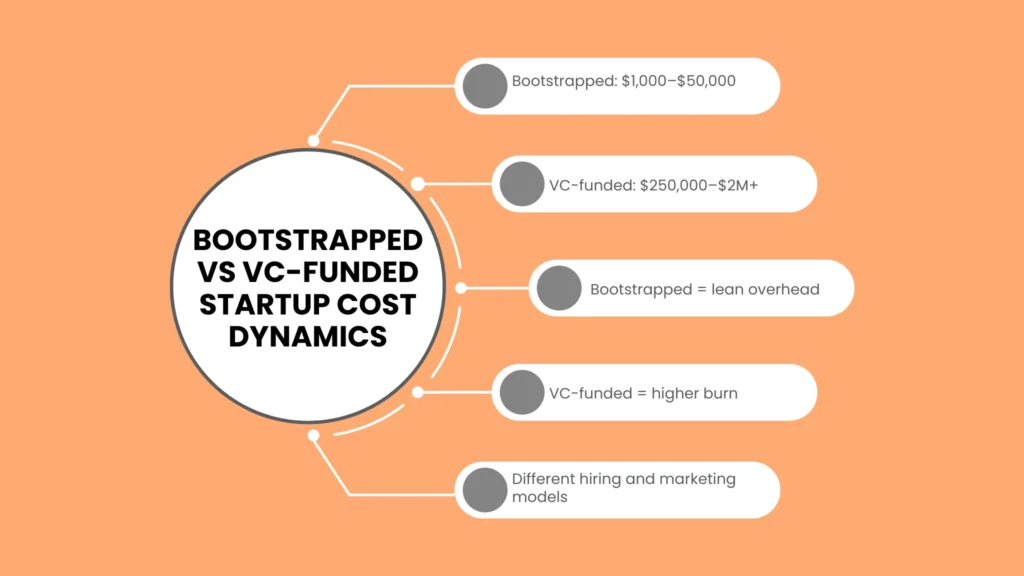
Bootstrapped startups focus heavily on lean operational expenditures (OpEx). Founders minimize fixed overhead by working remotely, utilizing off-the-shelf software, and delaying major hires until customer revenue justifies the expense. Capital is deployed cautiously because every dollar spent directly reduces founder profit distributions.
In contrast, VC-funded startups operate with intentionally high burn rates to accelerate growth. Capital is spent aggressively on competitive engineering salaries, paid media acquisition, legal filings, and international expansion.
Operational Cost Structure Comparison
| Operational Expense Category | Bootstrapped Startup Model | VC-Funded Startup Model |
| Initial Capital Investment | $1,000 – $50,000 (Personal Savings/Friends & Family) | $250,000 – $2,000,000+ (Pre-Seed / Seed Investment) |
| Legal & Governance Overhead | Minimal (Standard LLC/Inc setup, basic contracts) | High ($15k-$50k+ for SAFEs, Priced Rounds, Board Setup) |
| Hiring & Talent Acquisition | Lean teams, equity-free compensation, contractors | Competitive market salaries, stock option pools (ESOP) |
| Marketing & Customer Acquisition | Organic SEO, guerilla outreach, content, word-of-mouth | Heavy paid ad spend, enterprise sales teams, sponsorships |
| Growth Speed Expectation | Steady, linear growth tied directly to cash receipts | Hyper-exponential growth (3x-5x YoY benchmarks) |
Is Bootstrapped vs VC-Funded Startup Profitable?
Founders often ask: is bootstrapped vs vc funded startup profitable in the long run? Profitability looks fundamentally different depending on the financing model you select.
Bootstrapped startups must achieve net profitability quickly. Because there is no institutional cash safety net, a bootstrapped business that runs out of revenue faces immediate closure. However, once profitable, 100% of the net cash flow belongs to the founding team.
VC-funded startups intentionally defer profitability for years to maximize market share. Investors encourage founders to reinvest every dollar of gross margin plus raised capital back into growth engines. While a VC-backed startup may generate millions in top-line revenue, its net profitability may remain negative until it reaches massive operational scale.
Bootstrapped vs VC-Funded Startup Profit Margin Differences
The connection between funding type and your bootstrapped vs vc funded startup profit margin comes down to capital allocation priorities.
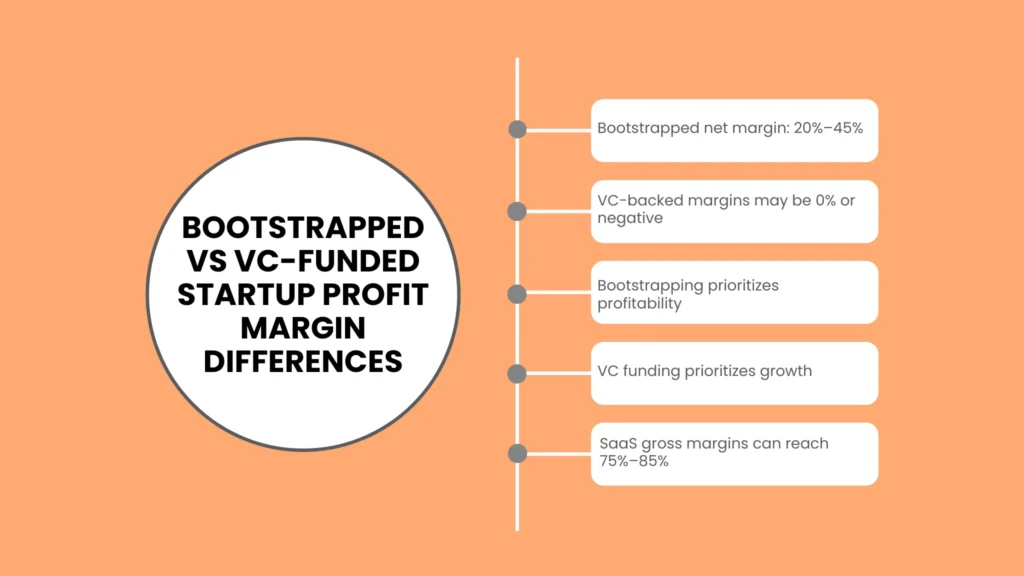
Bootstrapped companies maintain high gross and net profit margins by prioritizing low-cost customer acquisition channels, maintaining lean engineering teams, and maintaining low fixed overhead. Net profit margins for successful bootstrapped SaaS or digital service businesses often hover between 20% and 45%.
VC-funded companies often sacrifice net profit margins in pursuit of raw top-line recurring revenue growth. Customer acquisition costs (CAC) are elevated because the sales team must hit aggressive quarterly revenue targets. While gross margins may remain high (75%-85% for SaaS), net profit margins are typically zero or negative during the early and growth stages.
Key Bootstrapped vs VC-Funded Startup Requirements
Choosing between these paths requires meeting distinct operational and strategic criteria. Reviewing these bootstrapped vs vc funded startup requirements helps determine which model aligns with your business idea.
Requirements to Bootstrap Successfully
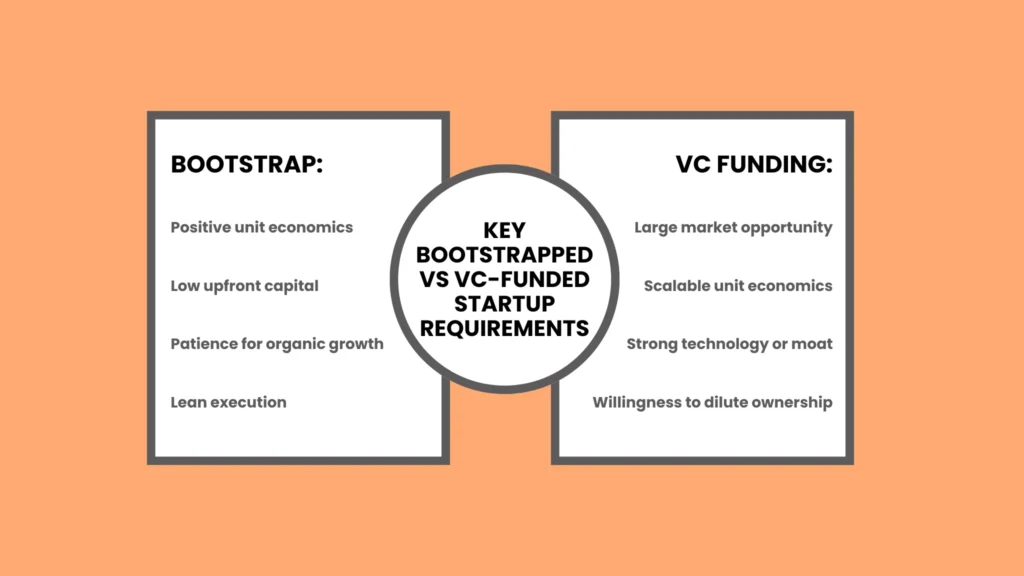
Immediate Unit Economics: Your product or service must generate positive gross margins from day one.
Low Upfront Capital Intensity: The business model cannot require millions in upfront infrastructure, hardware R&D, or regulatory approvals before launching.
Patience for Organic Traction: The founding team must be comfortable building domain authority, organic SEO, and sales velocity over 2 to 4 years.
Lean Execution Skills: Founders must wear multiple hats—handling product design, customer support, and sales independently to keep overhead low.
Requirements to Raise VC Funding Successfully
Massive Total Addressable Market (TAM): Venture capital funds look for multi-billion-dollar addressable markets capable of supporting a $1B+ exit valuation.
Scalable Unit Economics: Your customer lifetime value (LTV) must comfortably exceed customer acquisition cost (LTV:CAC ratio of 3:1 or higher).
Proprietary Technology or Network Effects: The business needs strong moats—such as proprietary software, network effects, or patents—that prevent fast followers from copying the product.
Willingness to Relinquish Control: Founders must accept board oversight, dilution of ownership, and the pressure to deliver a high-value exit within 7 to 10 years.
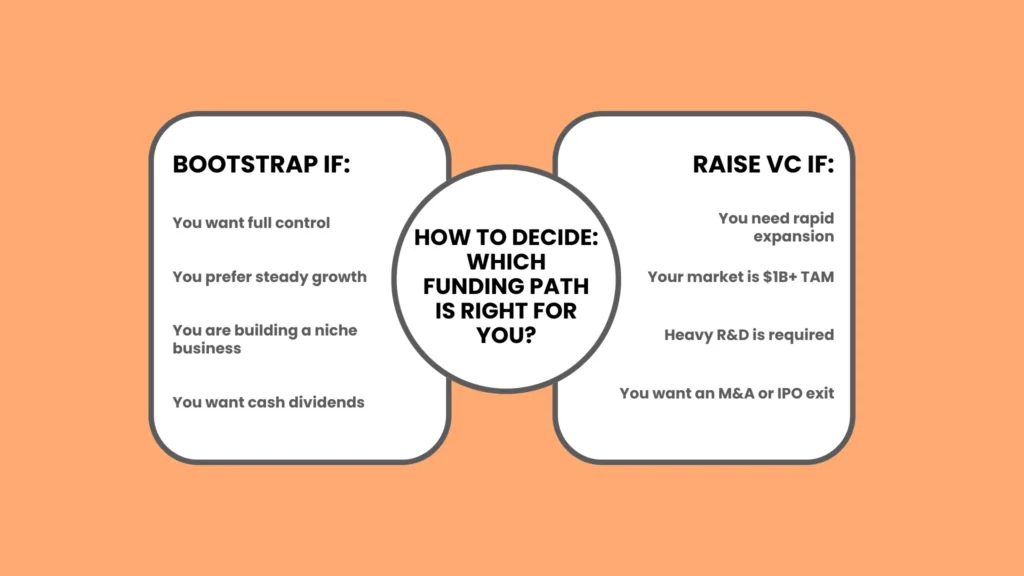
How to Decide: Which Funding Path Is Right for You?
Use this decision matrix to evaluate your startup idea, personal goals, and risk tolerance:
Final Thoughts: Building a Business on Your Terms
Deciding between a bootstrapped vs vc funded startup is not about which model is objectively superior, but which path matches your vision, market opportunity, and lifestyle preferences.
Bootstrapping gives you full autonomy, steady profitability, and 100% equity retention. Venture capital provides the capital needed to capture large markets at breakneck speed.
Analyze your total addressable market, evaluate your upfront cash requirements, and choose the funding strategy that positions your business for sustainable long-term success. For comprehensive financial models, cap table calculators, and startup growth strategies, explore the additional guides available at reliablestartup.com.
Frequently Asked Questions
Can a bootstrapped startup raise VC funding later?
Yes. Many successful companies bootstrap in their early stages to achieve product-market fit and prove unit economics before raising institutional capital. Bootstrapping early preserves founder equity and gives you significantly better valuation leverage when negotiating with venture capitalists.
How much equity do founders typically lose in VC funding rounds?
Founders typically sell 15% to 25% of their company’s equity in each priced funding round (Seed, Series A, Series B). By the time a company reaches an IPO or acquisition, the founding team collectively owns 15% to 30% of the total equity.
What happens to a VC-backed startup if it stops growing rapidly?
Venture capital models require high-speed returns. If a VC-backed startup stops growing rapidly, it enters what investors call the “sideways” zone. It may struggle to raise follow-on funding, face down-rounds, or be pressured into an early sale to recover investor capital.
Is bootstrapping safer than raising venture capital?
Bootstrapping protects your personal financial control and ownership, reducing governance risk. However, because you lack institutional cash reserves, a sudden drop in sales or an unexpected expense can create immediate cash flow pressure if you do not manage burn rate carefully.