Franchise Territory Rights and Why They Decide Your Ceiling
Franchise territory rights define the geographic boundaries where you can operate, market, and serve customers and whether the franchisor can open competing units or sell through alternative channels nearby.
Because those boundaries govern your total customer pool, unit economics, and expansion runway, the territory section of a franchise agreement directly determines your long-term revenue ceiling.
Many prospective franchisees focus heavily on initial franchise fees, royalty percentages, and brand recognition while treating territory language as routine legal boilerplate. That oversight can prove costly.
Two operators running identical concepts under the same brand can experience vastly different financial outcomes simply because one secured a generous, well-protected market while the other signed onto a narrow or non-exclusive zone.
Understanding how territory grants work before you sign gives you leverage to evaluate true market capacity, spot hidden loopholes, and protect the business you plan to build.
What Are Franchise Territory Rights?
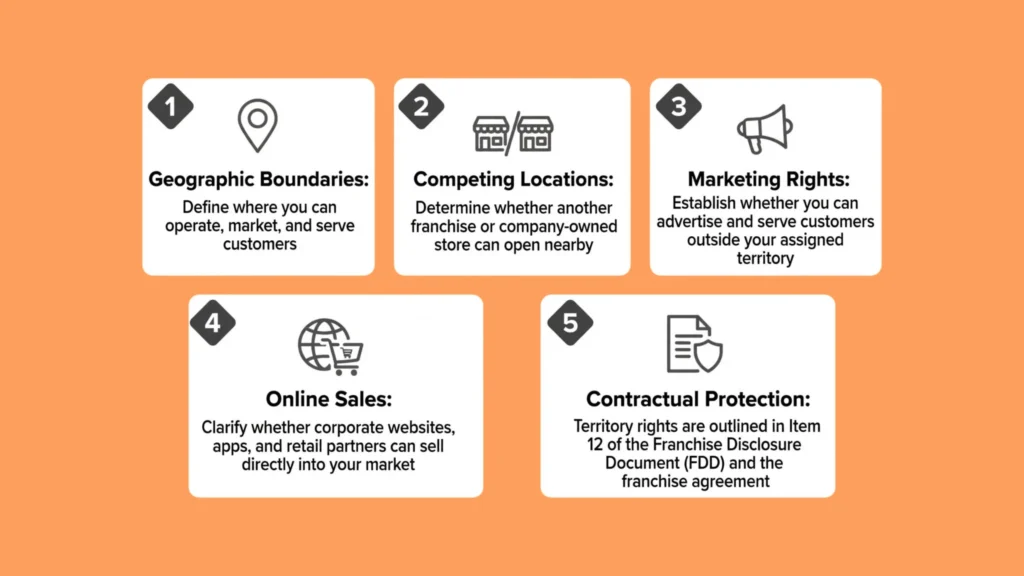
Franchise territory rights are the contractual rules in Item 12 of the Franchise Disclosure Document (FDD) and the franchise agreement that specify where your business is authorized to operate and what protection you receive against internal brand competition.
Rather than granting ownership of a region, a territory clause defines your operational footprint and restricts or permits other locations bearing the same trademark within a designated area.
These provisions answer four fundamental business questions:
Where can you establish a physical location or dispatch service vehicles?
Can another franchisee or company-owned store open inside your market?
Are you allowed to market or fulfill orders outside your assigned boundary?
Can the franchisor sell products or services into your area through websites, apps, or retail partners?
When your territory rights are clearly defined and enforceable, you gain predictable demand and confidence to invest in local marketing. When they are vague or full of carve-outs, you risk sharing your hard-won customer base with the brand itself.
Protected Territory Franchise vs. Non-Exclusive Territory
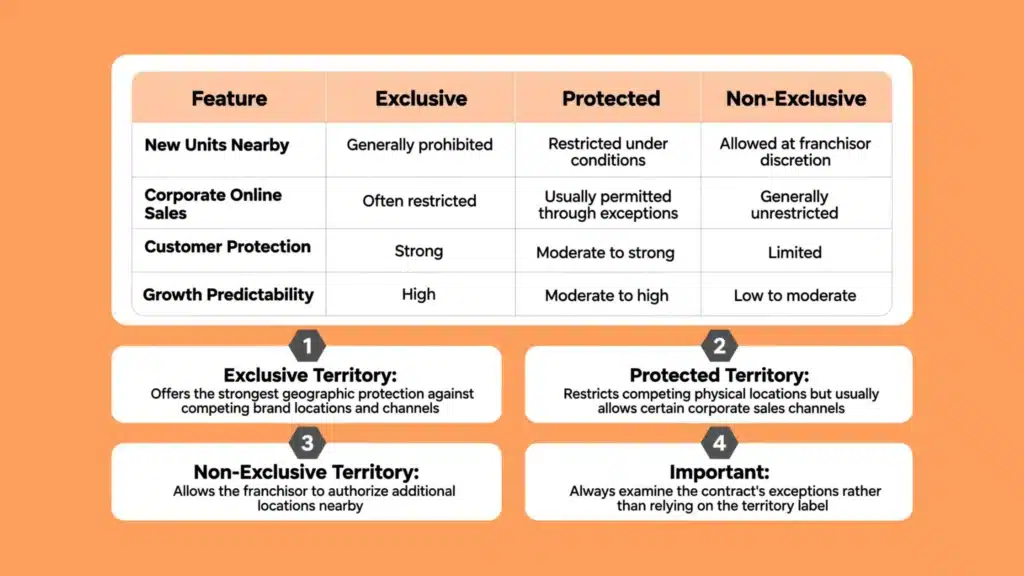
Not every franchise system offers geographic exclusivity. Recognizing the difference between a protected territory franchise and a non-exclusive model helps you match a concept to your growth goals.
| Feature | Exclusive Territory | Protected Territory | Non-Exclusive Territory |
| New Units Nearby | Strictly prohibited inside boundary | Restricted under specific conditions | Allowed at franchisor discretion |
| Corporate / Online Sales | Often restricted or revenue-shared | Usually reserved by the franchisor | Unrestricted for the franchisor |
| Customer Poaching Rules | Strong cross-border limits | Moderate marketing boundaries | Minimal or no boundary protection |
| Typical Business Model | Home services, B2B, route-based | Retail, fitness, quick-service food | Kiosks, delivery-only, dense urban brands |
| Growth Ceiling Predictability | High | Moderate to High | Low to Moderate |
Exclusive Territory
An exclusive territory provides the strongest level of protection. The franchisor agrees not to open company-owned locations, grant new franchises, or distribute competing brand channels inside your defined zone as long as you remain in good standing.
True exclusivity has become less common because modern franchisors preserve e-commerce and national account rights, so verify whether a brand labeled “exclusive” actually restricts digital sales.
Protected Territory
A protected territory franchise prevents the franchisor from placing another brick-and-mortar unit or awarding another franchise within your borders, yet it preserves specific exceptions.
Under most protected models, the franchisor keeps the right to sell branded goods online, supply grocery or retail chains, or operate inside non-traditional venues such as airports, stadiums, universities, and hospitals. For most service and retail operators, a well-structured protected territory offers solid protection if the exceptions are clearly bounded.
Non-Exclusive Territory
In a non-exclusive arrangement, you receive permission to operate at a specific street address without any promise that another unit will not open nearby.
While some dense urban brands succeed with high store counts that build brand awareness, non-exclusive territories expose you to cannibalization. If a second location opens a mile away, your customer acquisition costs can rise while your average ticket volume drops.
How Territory Size Shapes Your Revenue Ceiling
Territory size is the single clearest cap on how large a single franchise unit can grow. Even an exceptional operator cannot generate $2 million in annual revenue from a geographic area that only contains enough qualified buyers to support $800,000 in demand.
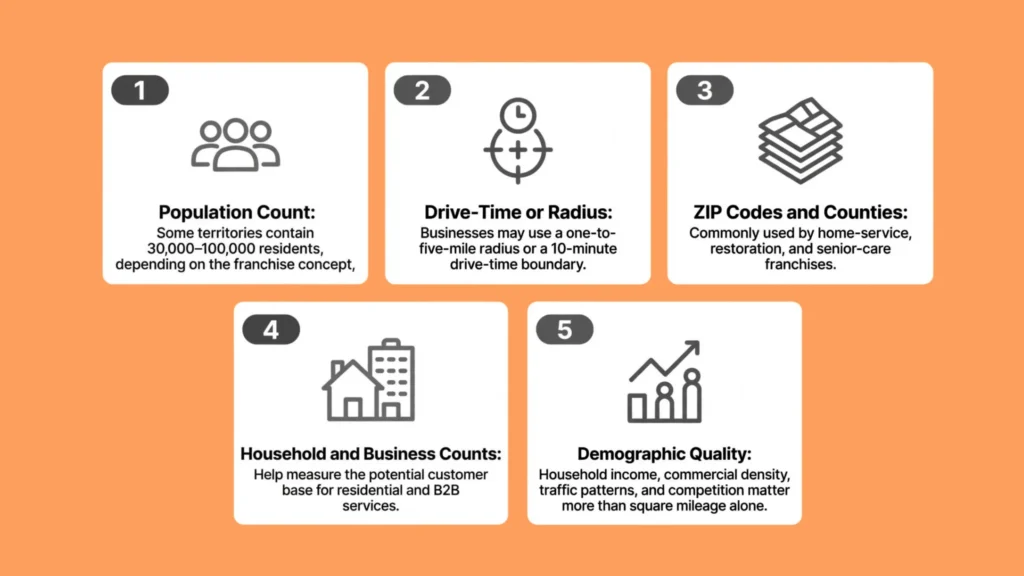
Franchisors generally define territory size using one of four metrics:
Population Count: Many service and retail concepts grant territories containing 30,000 to 100,000 residents. However, raw headcount can mislead you if a large share of the population falls outside your target age, income, or homeownership profile.
Drive-Time or Radius Rings: Brick-and-mortar businesses often rely on a one-mile to five-mile radius or a 10-minute drive-time polygon. In dense cities, a two-mile radius might hold 150,000 people; in suburban or rural counties, the same radius might cover farmland and sparse housing.
ZIP Codes or Municipal Boundaries: Home-service, restoration, and senior-care franchises frequently assign territories by contiguous ZIP codes or county lines. ZIP codes are easy to track in customer relationship management software, though odd postal boundaries can split natural neighborhoods.
Household or Business Count: B2B and residential maintenance franchises often size territories by the number of single-family homes, commercial buildings, or registered businesses within the map.
Why Demographics Matter More Than Square Miles
A physically large territory is not automatically a lucrative one. Ten square miles of affluent, growing suburbs will usually outperform fifty square miles of stagnant or low-density terrain.
Before accepting a proposed map, analyze household income, commercial density, traffic patterns, and local competition inside the exact lines. If the franchisor relies on outdated census figures, your territory size may look generous on paper while delivering thin demand in practice.
Understanding the Encroachment Clause and Hidden Loopholes
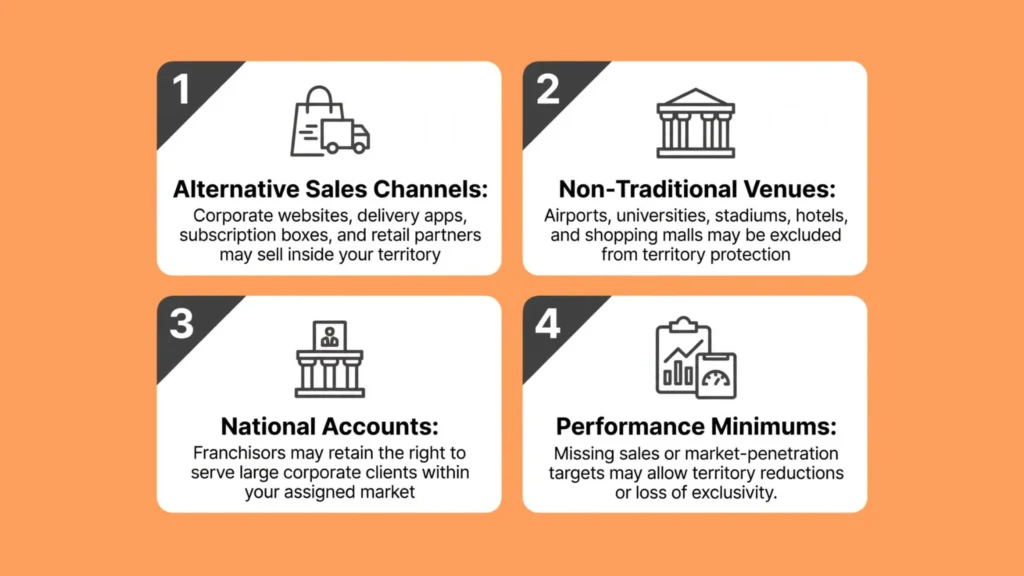
An encroachment clause addresses what happens when a franchisor establishes a new unit, distribution channel, or alternative outlet close enough to pull customers away from an existing franchisee.
Many franchise agreements contain an explicit “no encroachment” disclaimer stating that you have no protection outside your exact street address or that specific channel expansions never count as encroachment.
Watch closely for four common carve-outs that quietly lower your ceiling:
1. Alternative Channels of Distribution
Franchisors routinely reserve the right to sell branded products through e-commerce sites, third-party delivery apps, subscription boxes, or big-box retailers inside your territory.
If customers can buy the exact same packaged coffee, pet food, or skincare line online directly from corporate without triggering a commission or credit to your store, your local sales ceiling shrinks.
2. Non-Traditional Venues
Contracts often exclude airports, military bases, college campuses, shopping malls, hotels, and transit hubs from territory protection. A kiosk placed inside a busy commuter station across the street from your storefront can capture your weekday foot traffic without technically violating your territory map.
3. National and Regional Accounts
In commercial cleaning, staffing, logistics, and B2B services, the franchisor may reserve the right to negotiate directly with multi-location corporate clients. Check whether you receive mandatory sub-contracting rights, fair service rates, or royalty relief when corporate services a national account inside your territory.
4. Performance Minimums and Territory Reductions
Some agreements tie your protected territory to annual minimum sales quotas or household penetration targets. If you miss a benchmark even during an economic slowdown or local road construction the franchisor may gain the right to shrink your territory boundaries, remove your exclusivity, or place a second franchisee inside your original map.
Practical Ways to Evaluate and Negotiate Territory Terms
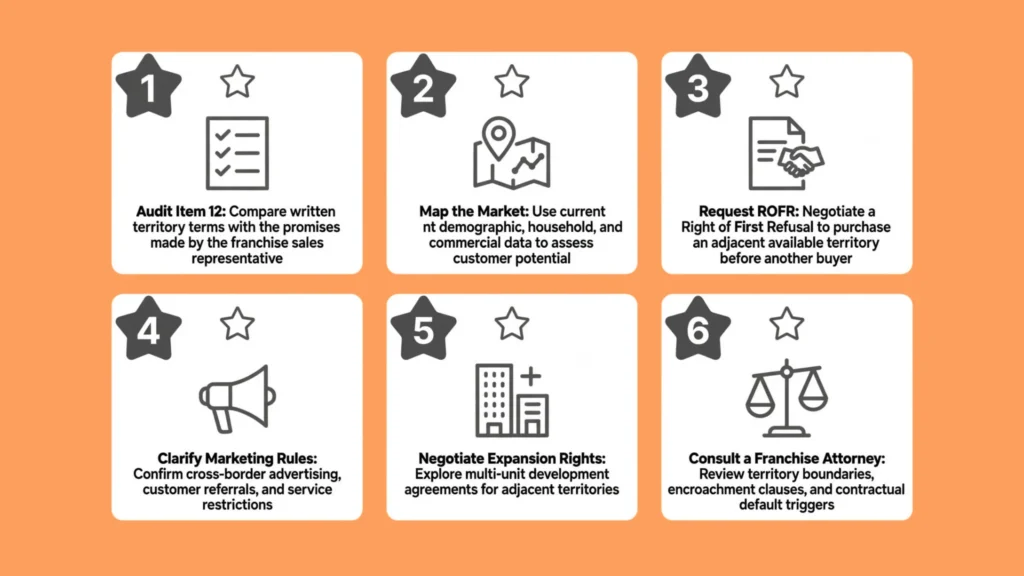
While franchisors rarely rewrite their core agreement from scratch, territory boundaries and operating details are among the most negotiable elements of a franchise deal before signing.
Audit Item 12 of the FDD Line by Line: Compare what the sales representative promised verbally against the written text in Item 12. Oral assurances do not override the integration clause in a franchise contract.
Map the Territory Using Current Data: Pull current demographic, housing, and commercial data for the proposed ZIP codes or drive-time boundaries. Confirm that the market holds enough target customers to hit the financial performance benchmarks shown in Item 19.
Request Right of First Refusal (ROFR): If adjacent territories are still open, ask for a Right of First Refusal. An ROFR gives you a set window—often 30 to 60 days—to match an outside buyer’s offer on a neighboring territory before the franchisor awards it to someone else.
Clarify Cross-Border Marketing and Service Rules: Find out whether you can advertise on digital platforms whose targeting radius spills into neighboring territories, and whether you can accept inbound referrals from unallocated “white space” outside your borders.
Negotiate Multi-Unit Development Rights: If a single territory feels tight, explore an area development agreement that locks in two or three contiguous territories upfront on a staggered opening schedule. Securing adjacent territory early protects your expansion path at a lower per-unit fee.
Consult a Franchise Attorney: Have an experienced franchise lawyer review the territory exhibit, encroachment clause, and default triggers before you sign or wire funds.
Common Mistakes Franchise Buyers Make With Territory Rights
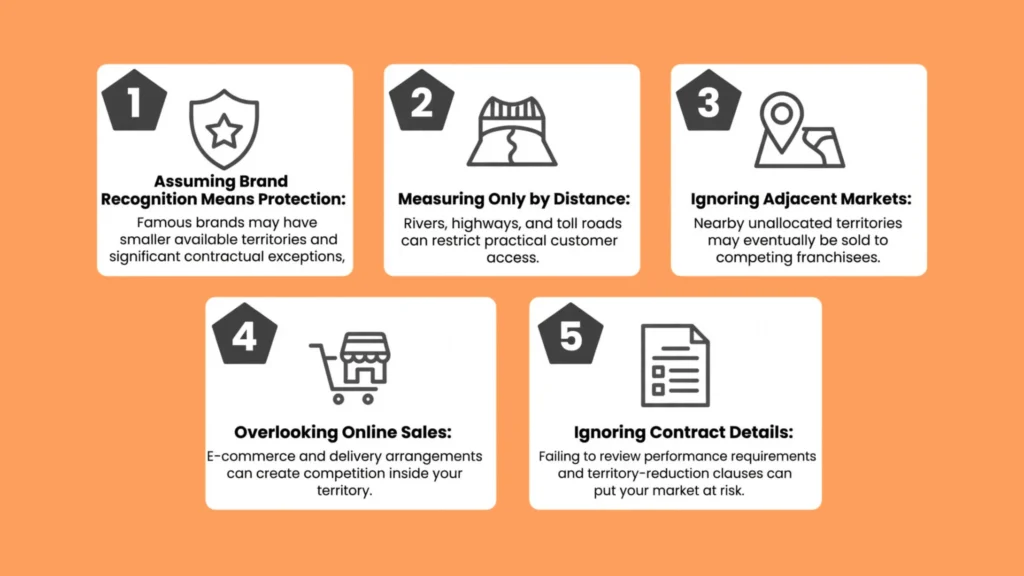
Even careful investors fall into avoidable traps when reviewing territory maps:
Assuming a Famous Brand Means Strong Protection: Established brands often have smaller remaining territories and stricter carve-outs than emerging systems because prime markets are already sold.
Measuring Territory Only by Distance: A three-mile radius blocked by a river, highway, or toll bridge can cut off half of your practical customer base. Always evaluate natural traffic flow and commuter habits.
Ignoring Adjacent “Open” Markets: Buying a single unit surrounded by unallocated territories leaves you exposed if aggressive operators buy the surrounding zones and saturate local digital ads.
Overlooking E-Commerce and Delivery Overlap: Failing to ask how online orders, gift cards, and third-party delivery zones are credited among neighboring franchisees can spark ongoing disputes once you open.
Frequently Asked Questions: Franchise Territory Rights
What is the difference between an exclusive territory and a protected territory in franchising?
An exclusive territory bars the franchisor from opening any competing unit or selling through competing channels inside your geographic boundary. A protected territory prevents the franchisor from opening another physical franchise or corporate store inside your area, but typically allows corporate e-commerce sales, retail distribution, or non-traditional venues like airports.
Where can I find a franchise’s territory rules before buying?
You can review the exact territory rules in Item 12 of the Franchise Disclosure Document (FDD) and in the territory exhibit attached to the franchise agreement. Franchisors are legally required to provide the FDD at least 14 calendar days before you sign an agreement or pay any money.
Can a franchisor reduce my territory size after I open?
Yes, if your franchise agreement ties territory protection to minimum sales quotas, unit development schedules, or market penetration benchmarks. If you fail to meet those contractual thresholds, the franchisor may have the right to revoke exclusivity or carve out part of your territory for another operator.
Are franchise territory boundaries negotiable?
Yes. While franchisors seldom alter core legal clauses, they frequently negotiate specific map boundaries, ZIP code swaps, drive-time adjustments, and Right of First Refusal options for adjacent open territories prior to signing.
What happens if a neighboring franchisee markets inside my territory?
Most franchise agreements prohibit targeted advertising or direct solicitation inside another franchisee’s protected territory, though passive digital spillover and inbound customer referrals are often allowed. Your franchise agreement will outline the dispute resolution process and whether the franchisor enforces cross-border marketing rules.
How big should a franchise territory be?
An ideal territory size depends on your industry, unit economics, and local demographics rather than square mileage alone. The territory should contain enough qualified households or businesses to comfortably support your target break-even volume and desired profit margin without relying on customers outside your borders.
Final Thoughts: Franchise Territory Rights
Franchise territory rights are far more than lines drawn on a map they define the addressable market, competitive insulation, and scalability of your investment. A strong brand and proven operating system can only take you as far as your territory allows you to grow.
By scrutinizing Item 12, testing the real demographic capacity behind your territory size, and spotting carve-outs in the encroachment clause before signing, you give yourself a clear runway to build lasting value.
About The Author