Hiring Cleaners: Employee or Contractor and What It Costs
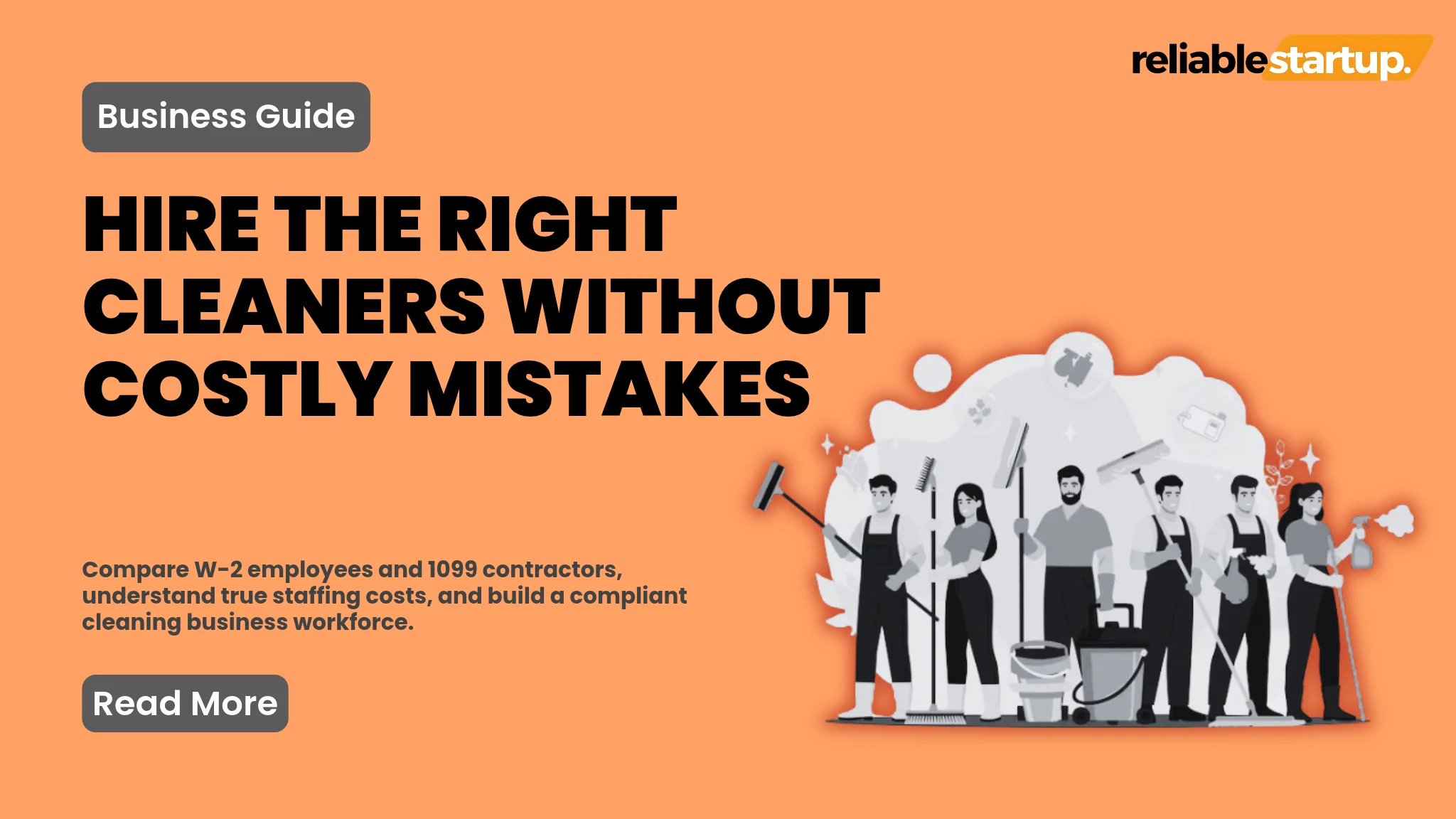
When expanding a cleaning business or bringing on custodial help, deciding between hiring cleaners as W-2 employees or 1099 independent contractors comes down to legal control rather than personal preference.
If you set a cleaner’s schedule, supply their cleaning products, train them on your specific checklists, and assign them to your regular clients, federal and state regulators generally classify them as W-2 employees. Independent contractors, by contrast, operate their own independent businesses, bring their own supplies, set their own hours, and serve multiple clients.
Understanding this distinction protects your business from costly tax penalties while helping you price your services profitably. While 1099 contractors appear cheaper on paper because you skip payroll taxes and benefits, misclassifying an employee as a contractor can trigger thousands of dollars in back taxes, unpaid overtime, and regulatory fines.
Understanding Worker Classification in the Cleaning Industry
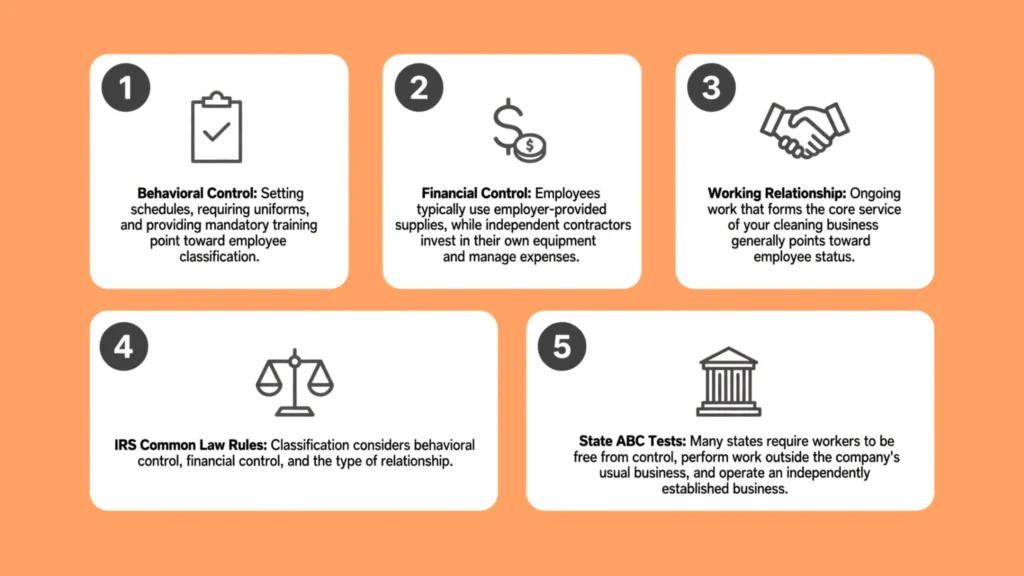
Worker classification determines how a worker is paid, how taxes are handled, and what labor protections apply. If you are still building your business foundation, this guide on starting a cleaning business covers essential setup requirements, including registration, insurance, and preparing for future growth.
In the cleaning industry, misclassification is heavily scrutinized because residential and commercial cleaning companies often rely on recurring schedules and standardized quality checklists.
You cannot make someone an independent contractor simply by having them sign an independent contractor agreement or paying them via invoice. Regulators evaluate the actual working relationship using specific legal frameworks.
The IRS Common Law Rules
The Internal Revenue Service evaluates worker classification across three primary categories of control and independence:
Behavioral control: Does your company control or have the right to control what the cleaner does and how they do their job? Requiring uniforms, mandating specific cleaning sequences, or conducting mandatory training points toward employee status.
Financial control: Are the business aspects of the cleaner’s job controlled by you? Independent contractors invest in their own commercial vacuums and chemicals, incur unreimbursed expenses, and have the opportunity to make a profit or suffer a loss based on how efficiently they price and finish jobs.
Type of relationship: Are there written contracts or employee-style benefits such as paid time off, health insurance, or mileage reimbursement? Furthermore, if the cleaner performs work that is the core service of your company on an ongoing, indefinite basis, the IRS generally views them as an employee.
Department of Labor and State ABC Tests
Beyond tax rules, the U.S. Department of Labor evaluates economic dependence under the Fair Labor Standards Act. In February 2026, the Department of Labor proposed a streamlined economic reality test focusing on two core factors: the nature and degree of control over the work, and the worker’s opportunity for profit or loss.
If a cleaner relies economically on your company for steady weekly hours rather than operating an independent enterprise, they likely qualify for minimum wage and overtime protections.
Many states apply an even stricter standard known as the ABC test. Under the ABC test, a worker is automatically presumed to be an employee unless the hiring business proves all three conditions:
The worker is free from control and direction in performing the work, both under the contract and in practice.
The work performed is outside the usual course of the hiring company’s business.
The worker is customarily engaged in an independently established trade, occupation, or business of the same nature.
Because cleaning is the usual course of business for a cleaning company, passing the second prong of the ABC test is nearly impossible when hiring individual cleaners in states like California, Massachusetts, and New Jersey.
1099 vs W2 Hiring Cleaners: Side-by-Side Comparison
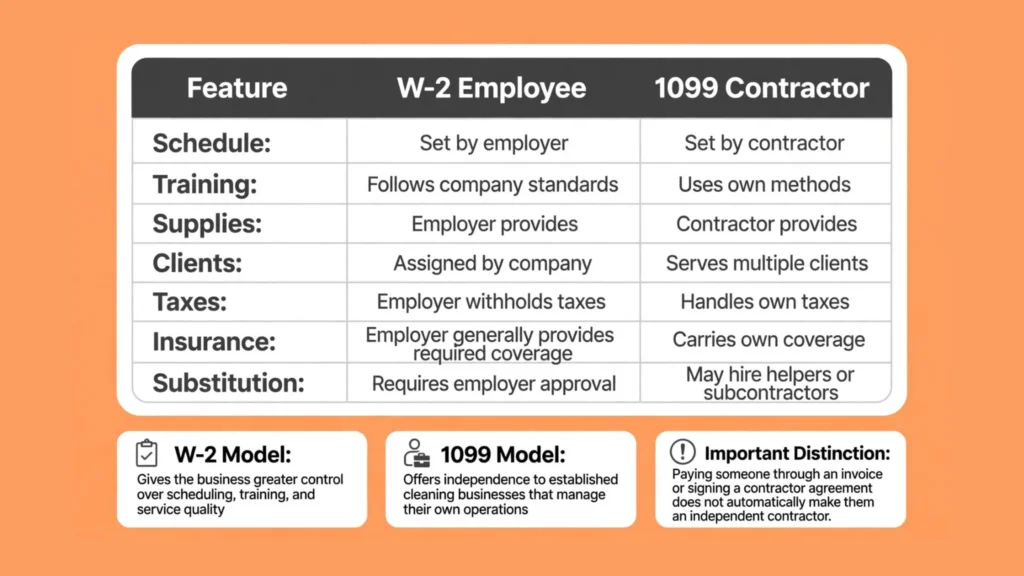
Comparing 1099 vs W2 cleaners side by side highlights how operational control and administrative obligations shift between the two models.
| Feature | W-2 Cleaning Employee | 1099 Independent Contractor |
| Schedule and Hours | Set by the employer | Set by the contractor |
| Training and Methods | Trained on company standards and checklists | Uses their own methods and expertise |
| Supplies and Equipment | Provided by the employer | Provided and maintained by the contractor |
| Client Ownership | Clients belong to the company | Serves multiple clients independently |
| Tax Withholding | Employer withholds income and FICA taxes | Contractor handles self-employment and estimated taxes |
| Year-End Tax Form | Form W-2 | Form 1099-NEC (for payments of $2,000 or more in 2026) |
| Workers’ Compensation | Required in most states for employees | Contractor carries their own policy |
| Substitution Rights | Cannot send a replacement without approval | Can hire their own helpers or subcontractors |
True Cost Breakdown: Cleaning Staff Payroll vs Contractor Rates
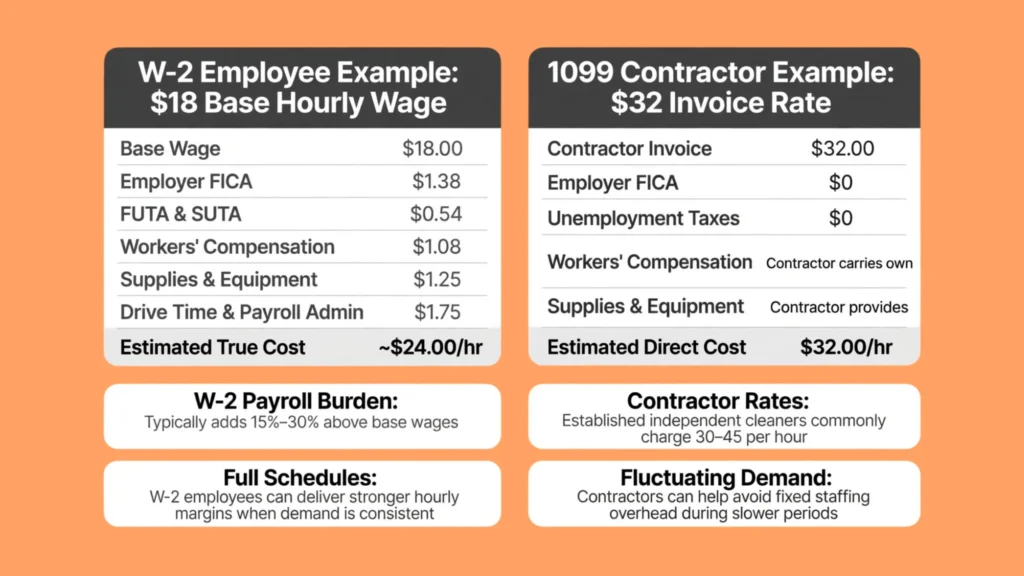
Business owners often assume a 1099 cleaner saves money because there are no payroll taxes. In reality, independent contractors charge higher hourly or per-job rates to cover their own self-employment taxes, insurance, supplies, and unpaid travel time. Meanwhile, cleaning staff payroll carries predictable overhead expenses on top of base wages.
What a W-2 Cleaner Actually Costs
When you hire a W-2 cleaner at a base hourly wage, your true labor cost includes mandatory taxes, insurance, and operational overhead. For most cleaning businesses, this payroll burden adds 15% to 30% above the base hourly wage, depending on state insurance rates and benefits.
Employer FICA taxes: You must pay 7.65% of gross wages to cover the employer match for Social Security (6.2%) and Medicare (1.45%).
Federal Unemployment Tax (FUTA): You pay 0.6% on the first $7,000 of each employee’s annual wages, assuming you qualify for the standard state credit.
State Unemployment Tax (SUTA): Rates vary widely by state and company claims history, typically ranging from 1% to 5% on a state-defined wage base.
Workers’ compensation insurance: Because cleaning involves physical labor, repetitive motion, and chemical exposure, workers’ compensation rates for janitorial and residential cleaning classifications often run between $3 and $8 per $100 of payroll.
General liability insurance and bonding: Commercial policies covering property damage and theft scale based on total payroll or headcount.
Non-billable time and mileage: Under federal and state wage laws, W-2 cleaners must generally be paid for mandatory training, morning supply loading, and travel time between job sites during the workday.
Payroll administration and benefits: Automated payroll software costs a monthly base fee plus a per-employee charge, alongside any paid time off or health stipends you choose to offer.
As your team grows, using reliable cleaning business software can simplify employee scheduling, payment tracking, client management, and daily crew coordination.
For example, if you pay a W-2 cleaner $18.00 per hour, adding 7.65% FICA ($1.38), unemployment taxes ($0.54), workers’ compensation ($1.08), and non-billable drive time allocation ($1.50) brings your real cost to roughly $22.50 per billable hour.
What a 1099 Contractor Actually Costs
With a legitimate independent contractor, your direct cost is the agreed invoice amount. You do not pay employer FICA, unemployment taxes, or paid drive time between appointments.
However, legitimate independent cleaning contractors or subcontracted cleaning crews rarely work for $18.00 per hour. Because they pay a 15.3% self-employment tax, buy their own commercial insurance, supply their own vacuums and solutions, and cover their own vehicle expenses, an established independent cleaner typically charges $30.00 to $45.00 per hour, or takes 50% to 70% of the client job fee.
| Cost Category | W-2 Employee ($18/hr Base Wage) | 1099 Contractor ($32/hr Invoice Rate) |
| Base Pay / Invoice Rate | $18.00 / hr | $32.00 / hr |
| Employer FICA (7.65%) | $1.38 / hr | $0.00 |
| FUTA & SUTA Taxes | ~$0.54 / hr | $0.00 |
| Workers’ Compensation | ~$1.08 / hr | $0.00 (Contractor carries own) |
| Supplies & Equipment | ~$1.25 / hr | $0.00 (Contractor supplies own) |
| Drive Time & Payroll Admin | ~$1.75 / hr | $0.00 |
| Estimated True Hourly Cost | ~$24.00 / hr | $32.00 / hr |
When your client schedule is consistently full, W-2 employees deliver stronger profit margins per hour. Contractors make financial sense when demand fluctuates, because you only pay when a job is booked and avoid fixed overhead during slow weeks.
When to Hire W-2 Employees vs 1099 Contractors
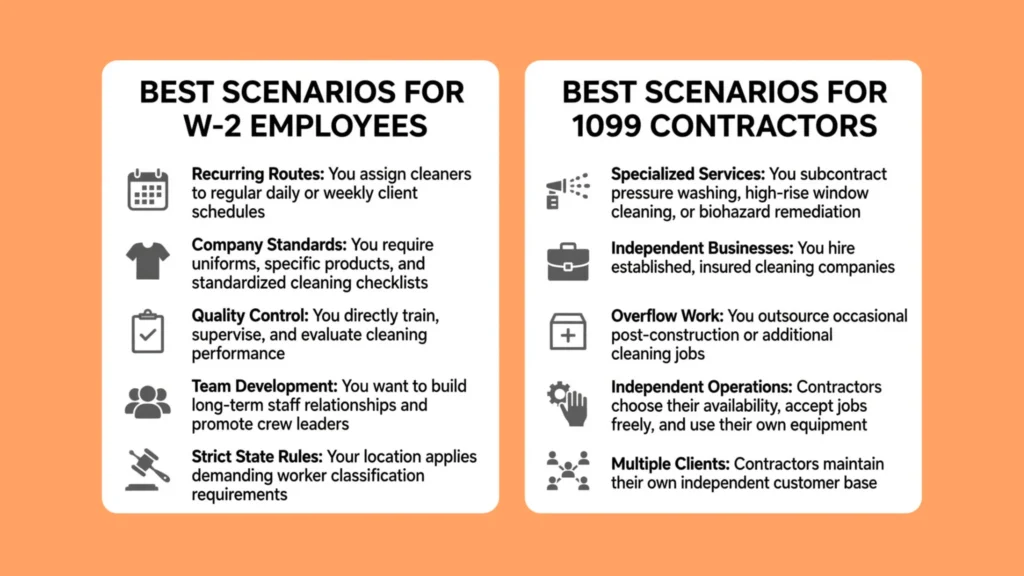
Choosing the right model depends on your business structure, quality control needs, and state regulations.
Best Scenarios for W-2 Employees
Hiring W-2 employees is the standard, compliant model for most residential maid services and commercial janitorial companies. It works best when:
You promise clients a consistent cleaning system, branded uniforms, and specific eco-friendly or proprietary products.
You assign cleaners to recurring daily or weekly routes.
You want to build long-term team retention, promote crew leads, and protect your client relationships with valid non-solicitation agreements.
You operate in a state with strict ABC worker classification laws.
Best Scenarios for 1099 Contractors
Hiring 1099 contractors works well when you act as a referral agency, general contractor, or overflow coordinator rather than a traditional employer.
Understanding how to recruit, manage, and compensate independent workers is essential, so explore this guide to cleaning business subcontractors before expanding your cleaning operations. It fits best when:
You subcontract specialized services you do not normally offer, such as exterior pressure washing, high-rise window cleaning, or biohazard remediation.
You hire an established, insured small cleaning business (LLC or sole proprietor) to handle overflow jobs or post-construction cleanups.
The cleaner sets their own availability, accepts or declines jobs freely without penalty, uses their own equipment, and serves their own independent client base.
Common Mistakes and Misclassification Risks
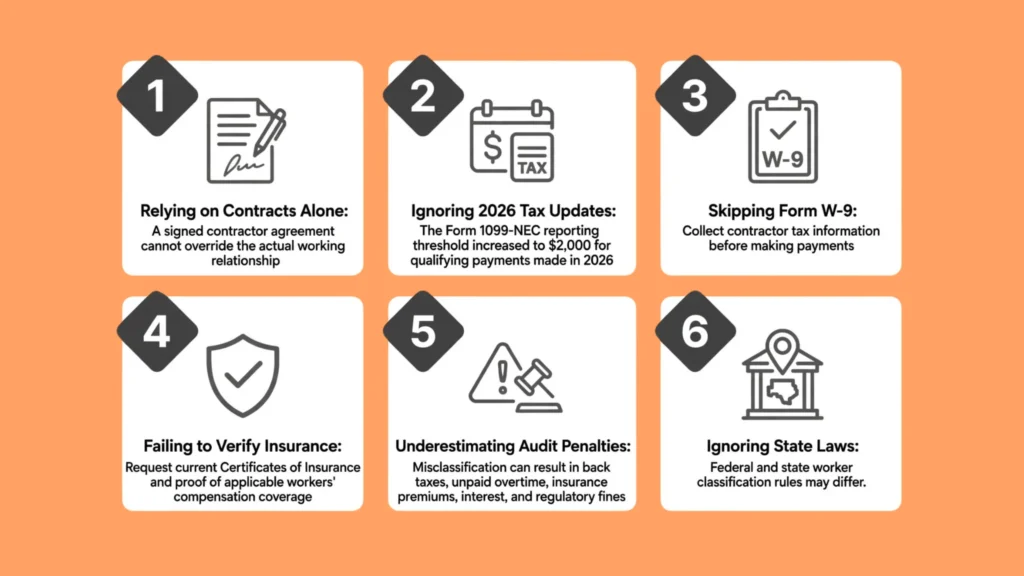
Many new cleaning business owners start with 1099 contractors to avoid setting up payroll, intending to switch to W-2 employees later. This approach carries severe financial hazards.
Relying on a Written Contract Alone
Having a cleaner sign a document stating they are an independent contractor offers zero protection during an audit if you dictate their arrival times, inspect their work against a mandatory checklist, and provide their mop and vacuum. Agencies look at day-to-day reality, not contract titles.
Ignoring 2026 Tax Reporting Updates
For payments made in 2026, the IRS reporting threshold for Form 1099-NEC increased from $600 to $2,000 per unincorporated contractor. However, this higher threshold only affects whether you must issue a tax form at year-end. It does not change the legal definition of an independent contractor, and you should still collect a completed Form W-9 before paying any contractor.
Failing to Verify Subcontractor Insurance
If you hire an uninsured 1099 cleaner and they get injured on a client’s property or damage expensive flooring, your own general liability or workers’ compensation insurer may hold you liable.
Always collect a current Certificate of Insurance (COI) naming your business as an additional insured, along with proof of workers’ compensation coverage or a valid state exemption.
Choosing appropriate coverage is equally important when expanding your workforce, and understanding cleaning business insurance can help protect your company against employee injuries, property damage, and other operational risks.
Underestimating Audit Penalties
If the IRS or a state labor board reclassifies your 1099 cleaners as W-2 employees, your business can be held liable for unpaid employer FICA taxes, a portion of unwithheld employee taxes, federal and state unemployment taxes, unpaid overtime, workers’ compensation premiums, and statutory interest and penalties. Depending on team size and audit timeframe, back assessments can easily reach tens of thousands of dollars per worker.
Frequently Asked Questions: Hiring Cleaners
Can I hire cleaners as 1099 contractors at first and switch them to W-2 later?
No. Worker classification is based on your working relationship from day one, not your company’s revenue stage. If you control how and when they clean during a trial period, they must be paid as W-2 employees from their first shift.
What is the 1099-NEC reporting threshold for cleaning contractors in 2026?
For payments made in 2026, you must file Form 1099-NEC for any unincorporated independent contractor to whom you paid $2,000 or more during the calendar year.
Can a W-2 employee also do extra cleaning work for me as a 1099 contractor?
Generally, no. Paying an existing W-2 employee on a 1099 for additional or after-hours cleaning work is a major audit red flag and usually violates overtime rules under the Fair Labor Standards Act.
Do I need workers’ compensation insurance if I only use 1099 cleaners?
In many states, if you subcontract work that is part of your core business and the subcontractor lacks their own workers’ compensation policy, your insurance carrier will charge you premiums for those payments during your annual audit. Requiring a valid Certificate of Insurance from every subcontractor prevents unexpected audit bills.
How much should I mark up W-2 cleaner wages when pricing cleaning jobs?
To cover payroll taxes, workers’ compensation, supplies, non-billable travel time, marketing, and net profit, most residential and commercial cleaning companies price their services at 2 to 2.5 times the cleaner’s base hourly wage.
What if I am hiring a cleaner for my own private home rather than a cleaning business?
If you hire an individual to clean your personal home on a regular schedule using your supplies and pay them above the annual IRS household employee threshold, they are classified as a household employee rather than an independent contractor, requiring Schedule H tax reporting. Hiring an established cleaning company avoids household employer obligations.
Final Thoughts: Hiring Cleaners
Deciding between W-2 employees and 1099 contractors shapes every part of your cleaning operation, from daily scheduling and quality training to pricing and insurance coverage. If you want direct control over service quality, branded uniforms, recurring routes, and customer retention, building a W-2 cleaning staff payroll gives you legal security and stronger hourly margins at scale.
Reserve 1099 contracts strictly for independent, insured cleaning businesses or specialty subcontractors who operate on their own terms. Before onboarding your first worker, consult a certified public accountant or employment attorney in your state to ensure your hiring model matches local labor laws.
About The Author