Cleaning Business Subcontractor Guide: How to Hire, Manage, and Pay Cleaning Subcontractors
Scaling a residential or commercial cleaning company beyond your personal capacity requires additional labor. However, hiring full-time employees brings significant fixed expenses, payroll taxes, and administrative burdens. Consequently, learning how to use a subcontract for cleaning business expansion allows you to scale operations quickly while maintaining low overhead.
Working with independent contractors offers flexibility for fluctuating job volumes. However, misclassifying workers or using vague contracts can lead to severe legal and financial liabilities. In this comprehensive guide, you will learn how to recruit reliable cleaning business subcontractors, draft a bulletproof cleaning subcontractor agreement, manage quality control on subcontract cleaning jobs, and set up fair payment structures.
Executive Summary: Scaling with Subcontractors
Using independent contractors allows cleaning business owners to accept larger commercial contracts and more residential jobs without committing to permanent payroll. When managed correctly, a subcontract for cleaning business growth serves as an agile bridge between solo operations and a full-scale corporate workforce.
Relying on specialized subcontractors provides four major advantages:
Lower Fixed Costs: You avoid paying employee benefits, payroll taxes, unemployment insurance, and worker compensation fees.
Flexible Staffing: You bring on extra labor only when you secure active client bookings or large commercial projects.
Rapid Market Expansion: You can quickly offer specialized services, such as high-rise window washing or carpet extraction, by partnering with experienced pros.
Reduced Equipment Expenses: Independent contractors typically bring their own commercial-grade supplies and vehicles to the job site.
Adopting this labor model gives you the agility to expand your service territory while keeping operating costs predictable.
Employees vs. Subcontractors: Navigating Legal Rules
Before you hire your first contractor, you must understand the legal differences between an employee and an independent contractor. Government labor boards and tax agencies inspect labor classification closely. Therefore, misclassifying an employee as a contractor can result in steep tax fines and legal penalties. Along with worker classification, you also need to stay on top of health and safety regulations, regardless of whether you’re working with employees or subcontractors.
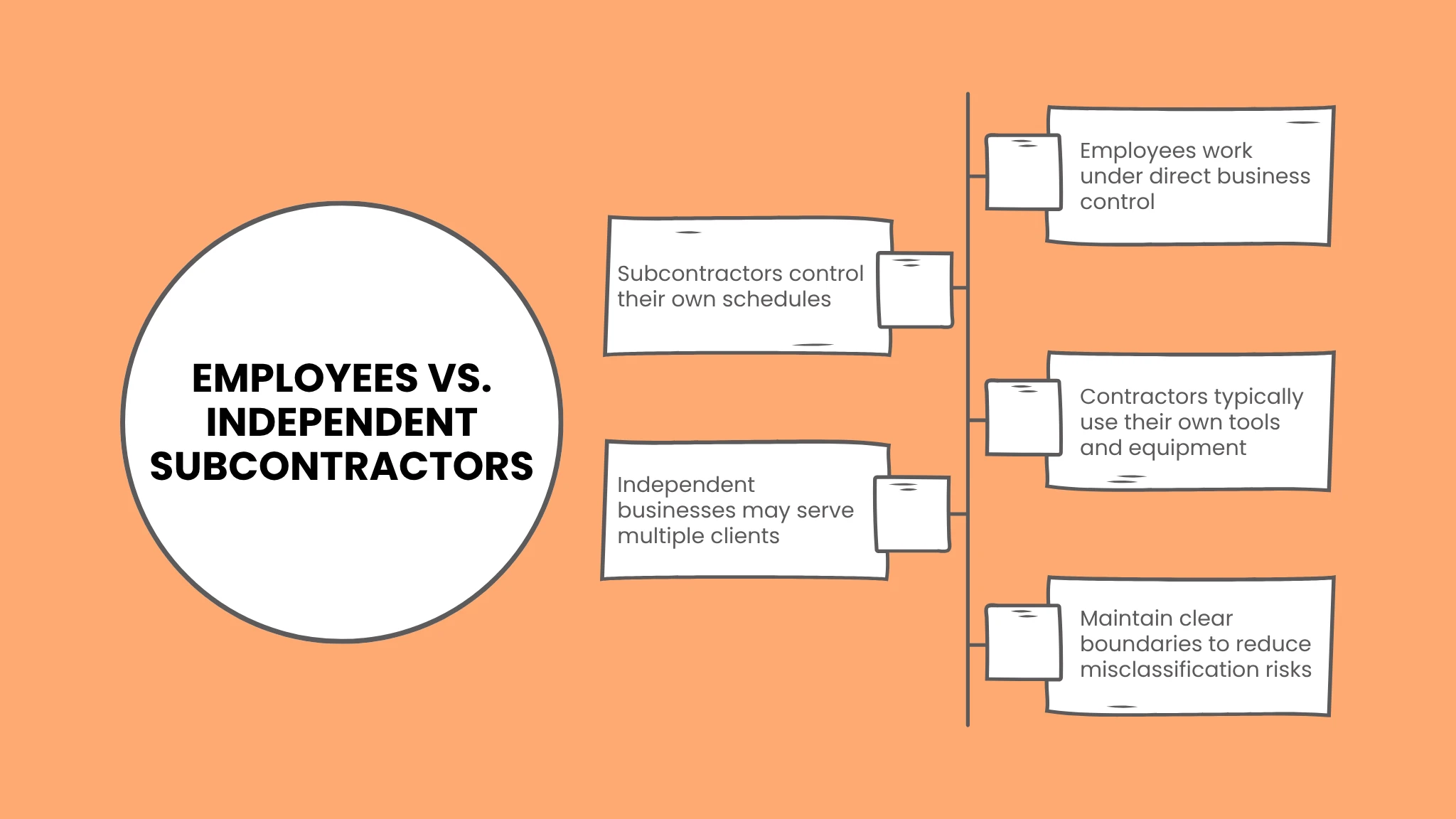
The main test revolves around how much control you exert over the worker:
Employees: You set their exact work hours, specify their daily cleaning methods, provide their uniforms and supplies, and pay them an hourly wage or salary.
Subcontractors: They run their own registered business, control their own schedules, use their own professional tools, and serve multiple clients. You specify only the required final result of the job.
If you dictate every step of how a cleaner works, labor agencies will classify that worker as an employee. Consequently, maintain clear operational boundaries to protect your company from worker misclassification claims. “For the official legal boundary on worker classification, the IRS independent contractor vs employee guidelines serve as an authoritative reference point, setting the government-level compliance standard.
Essential Clauses in a Cleaning Subcontractor Agreement
Never allow a contractor to step foot on a client property without a signed cleaning subcontractor agreement. A well-written contract protects your client relationships, outlines clear quality expectations, and limits your liability.
Key Clauses Your Contract Must Include
Non-Solicitation Clause: This critical clause prevents the contractor from poaching your clients or offering side services directly to your customer base.
Scope of Work and Quality Standards: Clearly define the required outcomes for subcontract cleaning jobs, including detailed room checklists and completion timelines.
Insurance and Liability Limits: Require contractors to carry their own general liability insurance and name your company as an additional insured party.
Independent Contractor Status: Explicitly state that the agreement creates an independent contractor relationship, not an employment relationship or joint venture.
Using a standardized cleaning contractor agreement protects your hard-won client roster while establishing professional boundaries from day one.
How to Find and Vetting Quality Cleaning Business Subcontractors
Finding reliable contractors who treat your clients’ property with care requires a systematic vetting process. Because these workers operate independently, thorough screening before signing a contract is essential.
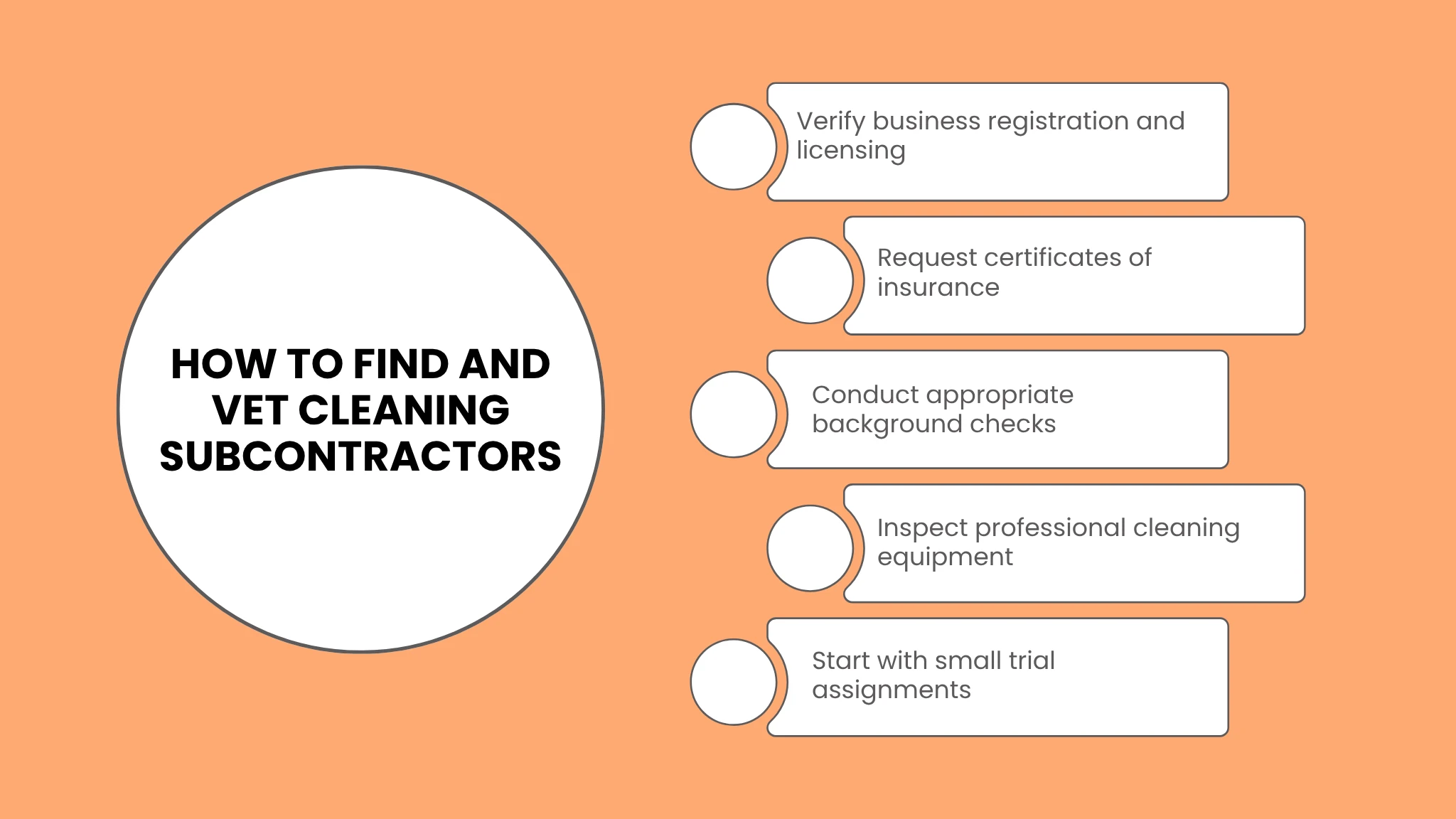
Step-by-Step Vetting Framework
Verify Business Registration: Ensure the candidate operates a legitimate business entity (such as an LLC) with an active business license.
Request Certificates of Insurance: Collect proof of general liability insurance and janitorial bonding before assigning any accounts.
Run Background Checks: Conduct background checks on all individuals who will access your residential or commercial client properties.
Inspect Equipment and Gear: Verify that the contractor owns commercial-grade vacuums, microfibers, and safety gear suitable for professional work.
Start with Trial Jobs: Assign small, low-risk jobs first to evaluate their attention to detail, punctuality, and professionalism.
Pricing Models and Pay Structures for Subcontractors
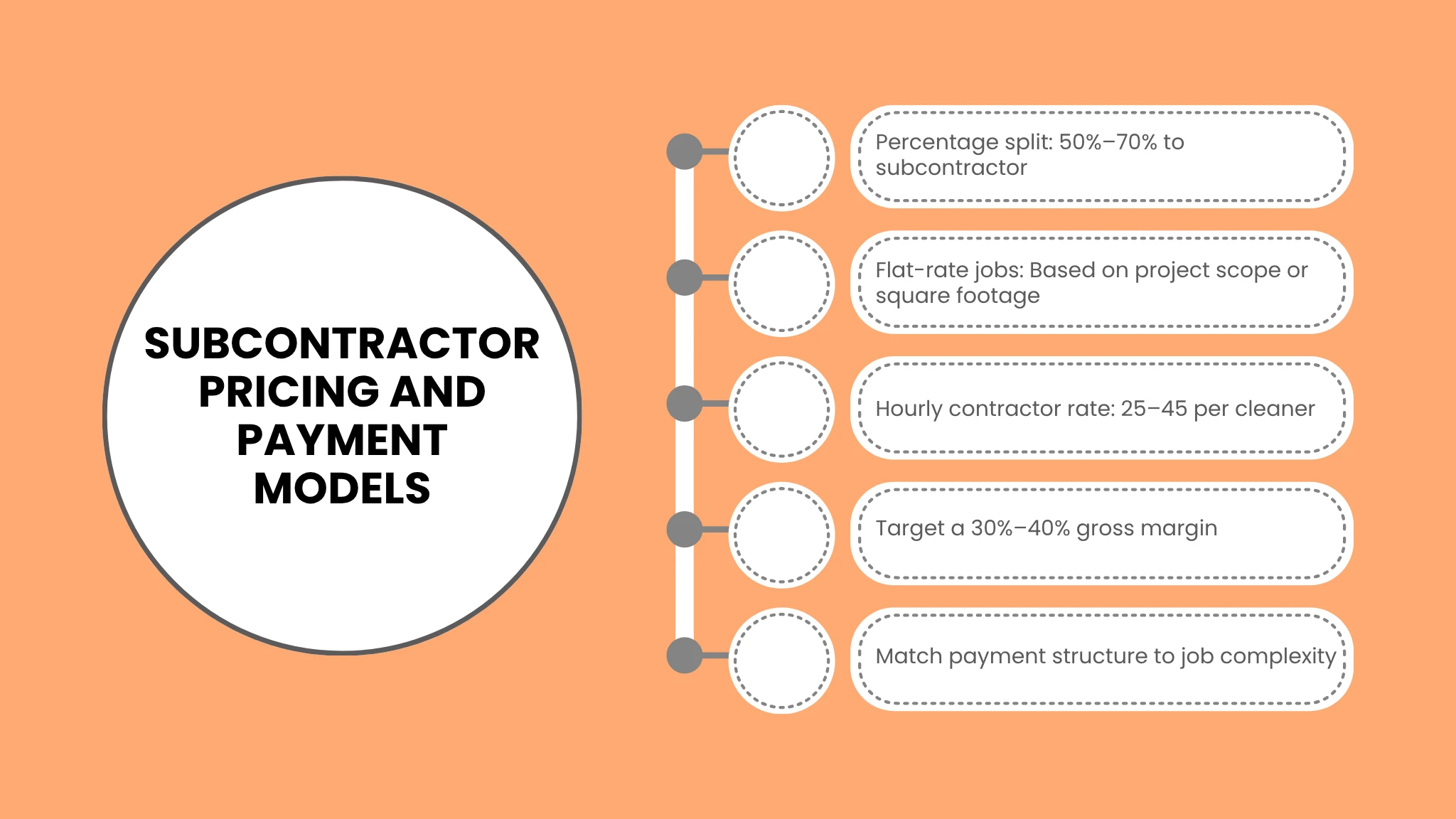
Setting fair payment rates ensures you attract top-tier contractors while keeping your gross profit margins healthy. Unlike hourly employees, contractors usually charge flat rates per job or a set percentage of the total client invoice.
| Payment Model | Average Industry Split / Rate | Primary Advantages | Main Considerations |
| Percentage Split | 50% – 70% to Subcontractor | Aligns cleaner pay with job value; simple to calculate | Can lower your profit margin on high-value jobs |
| Flat Rate Per Job | Based on square footage ($100–$250) | Predictable labor costs for your office | Requires accurate upfront job estimates |
| Hourly Contractor Rate | $25 – $45 per hour / cleaner | Flexible for unpredictable, dirty jobs | Requires clear verification of completed hours |
To maintain healthy company profitability, target a gross margin of at least 30% to 40% after paying your subcontractor. For example, if you charge a client $300 for a deep clean, your payment to the subcontractor should not exceed $180 to $210.
Managing Quality Control Without Micromanaging
Because you cannot legally dictate a subcontractor’s exact working methods, maintaining consistent cleaning quality requires a focus on clear expectations and final results.
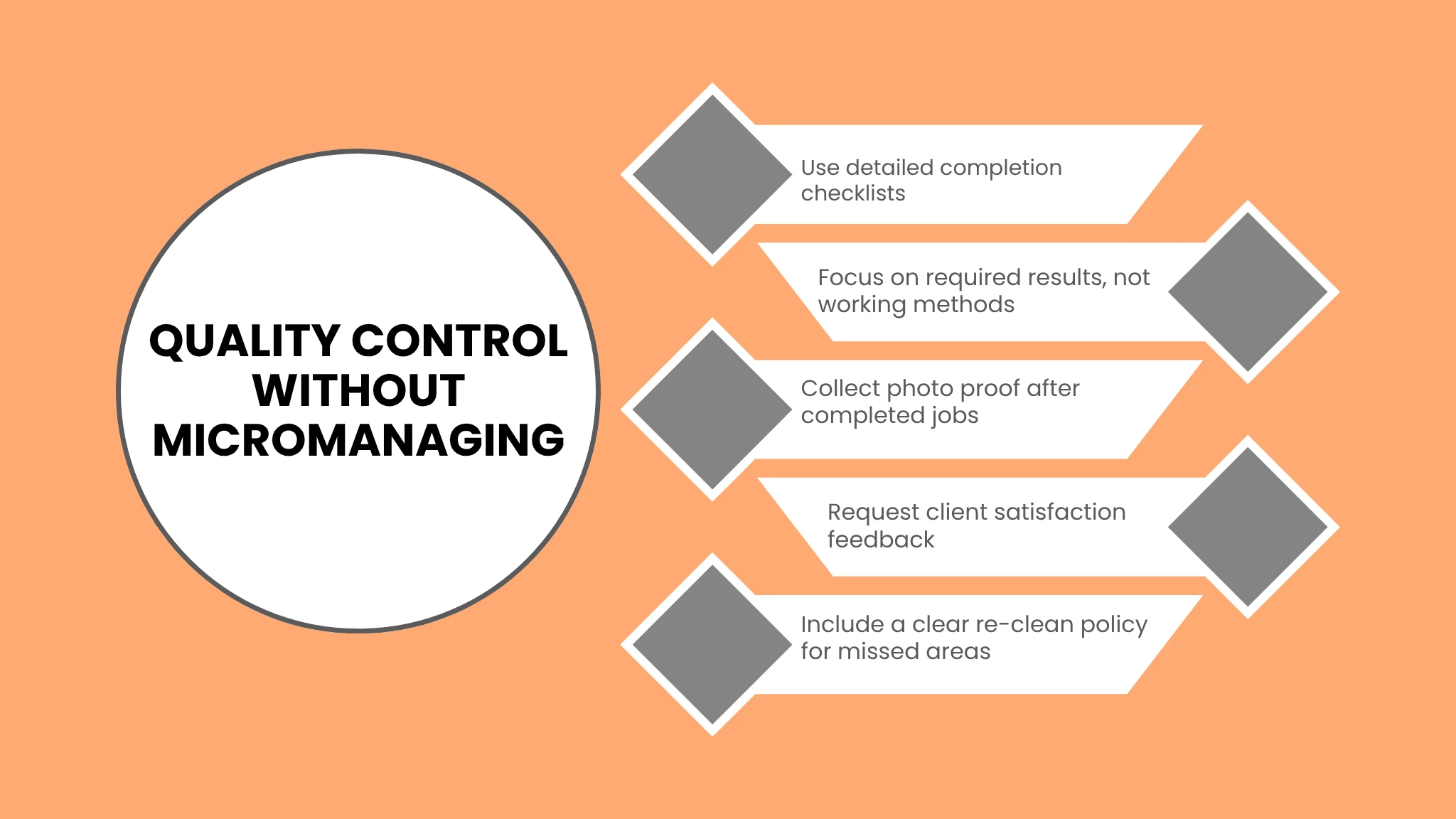
Effective Quality Management Tools
Detailed Completion Checklists: Provide visual room checklists that clearly display the required final result for each service.
Photo Proof Upon Completion: Ask contractors to upload completion photos of key areas (such as clean bathrooms, shiny floors, and cleared trash cans) through a mobile app.
Client Satisfaction Ratings: Follow up with clients immediately after service to gather feedback and digital star ratings.
Re-Clean Policies: Include a contract clause stating that if a client reports missed areas, the contractor must return to fix the issue at their own expense within 24 hours.
Focusing on measurable outcomes rather than minute-by-minute supervision allows you to maintain high service quality while respecting the worker’s independent status.
Final Thoughts on Scaling Your Cleaning Business
Scaling your enterprise through contractor partnerships offers a flexible, low-overhead path to higher monthly revenue. By using a legally sound subcontract for cleaning business operations, verifying insurance coverage, setting fair payment rates, and focusing on clear final results, you can build a highly profitable cleaning organization.
Take action today: review your legal agreements, set up contractor vetting systems, and expand your service capacity. To explore more operational guidebooks, financial templates, and business management tools, visit reliablestartup.
Frequently Asked Questions
What is a subcontract for cleaning business growth?
A subcontract for cleaning business operations is a legal agreement where a primary cleaning company hires an independent worker or third-party business to perform specific cleaning jobs rather than using direct employees.
Can a cleaning subcontractor steal my clients?
A subcontractor could attempt to approach your clients directly if you lack legal protections. Therefore, you must include a enforceable non-solicitation clause in your cleaning subcontractor agreement to prevent client poaching.
Do cleaning business subcontractors need their own insurance?
Yes, independent contractors should always carry their own general liability insurance. Furthermore, requiring them to provide a certificate of insurance protects your primary business from liability claims caused by accidental property damage.
How much should I pay a cleaning subcontractor?
Most cleaning companies pay subcontractors between 50% and 70% of the total client invoice value, or a negotiated flat fee per job. This payment split allows your business to cover sales, customer support, and administrative overhead while keeping a healthy profit.
What is the difference between a cleaning employee and a subcontractor?
An employee works under your direct control regarding schedules, methods, and equipment. Conversely, a subcontractor controls their own schedule, uses their own gear, operates an independent business, and receives pay per project rather than an hourly wage.