Cleaning Route Density: Why Your Cleaning Schedule Decides Your Profit

Your cleaning schedule decides your profit long before a mop ever touches a floor. While most residential and commercial cleaning business owners obsess over marketing leads, hourly rates, and supply expenses, the silent profit killer sits right on the dispatch calendar: cleaning route density.
When cleaners spend hours crisscrossing town between appointments, your business absorbs unpaid labor, fuel burn, and missed revenue opportunities. Improving route density through deliberate job clustering and cleaning schedule optimisation turns dead windshield time into billable hours—often doubling net profit margins without requiring a single new client.
What Is Cleaning Route Density?
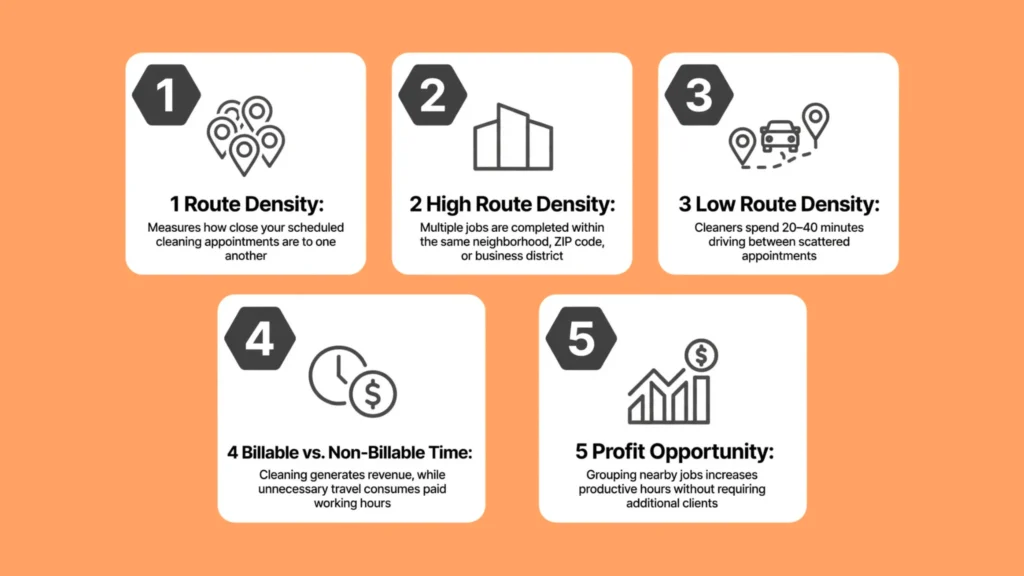
Cleaning route density measures how physically close your scheduled appointments are to one another on any given workday. High route density means your teams service multiple homes or commercial facilities within the same neighborhood, zip code, or office park. Low route density means teams drive twenty, thirty, or forty minutes across service areas between jobs.
In service-based businesses, you sell time and labor. Every minute a cleaner spends inside a house or office generates revenue. Every minute that same cleaner spends sitting in traffic burns cash. Route density directly dictates the ratio between billable production hours and non-billable transit hours.
The Hidden Financial Drain of Drive Time Costs
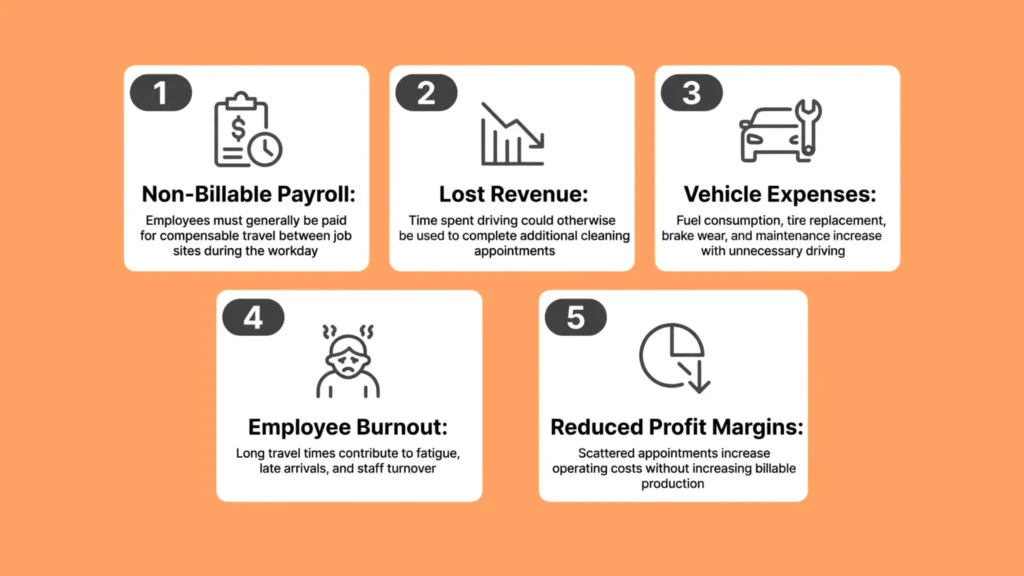
Many owners underestimate drive time costs because fuel receipts are the only expense visibly tied to driving. In reality, poor routing erodes your margins across four distinct categories:
Non-Billable Payroll: Under standard labor laws, travel time between job sites during the workday is compensable hours worked. If a two-person crew drives 90 minutes total per day between four houses, you pay for three hours of labor that produced zero revenue.
Lost Revenue Capacity: Those same 90 minutes of transit could have been used to complete an additional recurring maintenance clean. Over a five-day week, lost capacity easily equals two to three missed jobs per vehicle.
Vehicle Wear and Fuel: Stop-and-go city driving accelerates brake wear, oil degradation, tire replacement, and fuel consumption, steadily driving up fleet overhead.
Employee Burnout and Turnover: Cleaners dislike long commutes between clients just as much as owners dislike paying for them. High transit stress leads to late arrivals, rushed work, and higher staff turnover.
Scattered Schedule vs. Dense Route: A Daily Comparison
To see how schedule structure impacts daily profitability, compare two realistic scenarios for a two-person residential cleaning team working an 8-hour shift at a standard billing rate of $50 per labor hour ($100/hour team rate).
| Daily Metric | Scattered Schedule (Low Density) | Clustered Schedule (High Density) |
| Jobs Completed | 3 homes (2 hours each) | 4 homes (1.75 hours each) |
| Total Drive Time | 2.0 hours (40 mins between stops) | 0.5 hours (10 mins between stops) |
| Billable Team Hours | 6.0 hours | 7.0 hours |
| Gross Daily Revenue | $600 | $700 |
| Non-Billable Transit Wage Cost | 4 labor hours paid with $0 return | 1 labor hour paid with $0 return |
| Net Profit Impact | Thin margin after payroll & fuel | Significantly higher net profit per van |
That single extra hour of billable production—gained purely by tightening the map—adds $500 in weekly revenue per crew, or roughly $26,000 annually, with virtually zero additional marketing spend.
Core Strategies for Cleaning Schedule Optimisation
Achieving high route density does not happen by accident. When clients dictate which day and time they want service, your calendar naturally fractures. Reclaiming control requires systematic cleaning schedule optimisation.
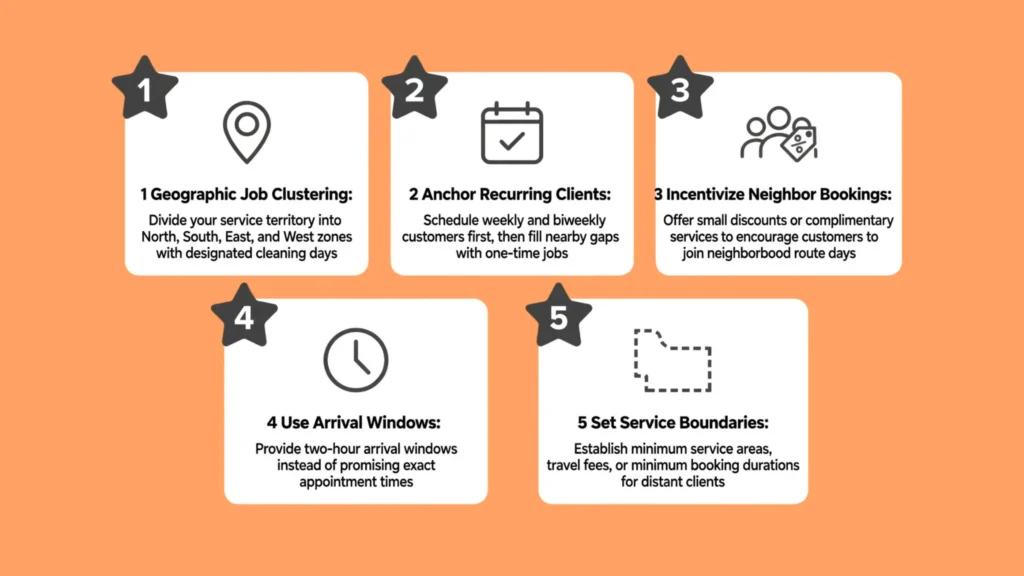
1. Implement Geographic Job Clustering
Job clustering is the practice of dividing your total service territory into distinct geographic zones—such as North, South, East, and West—and assigning specific days of the week to each zone.
Monday & Thursday: Northside neighborhoods
Tuesday & Friday: Southside and Downtown
Wednesday: Westside suburbs
When a new prospect calls from the Northside, your office staff does not ask, “What day works best for you?” Instead, they offer: “Our Northside team is in your neighborhood every Monday and Thursday. Would you prefer Monday morning or Thursday afternoon?” Most clients gladly accept the available slot when framed around local availability.
2. Anchor Routes Around Recurring Clients
Recurring weekly and bi-weekly accounts form the backbone of predictable routing. Lock your most reliable recurring clients into fixed geographic days first. Once those anchor points are established on the map, use one-time deep cleans, move-in/move-out jobs, and post-construction cleanups strictly to fill gaps within that day’s designated zone.
For businesses managing multiple crews, employee scheduling software can help assign recurring jobs, coordinate staff availability, and maintain consistent weekly cleaning schedules.
3. Incentivize Off-Peak and Neighbor Bookings
If you have legacy clients scattered outside their designated zone days, avoid abruptly canceling their service. Instead, offer small incentives to shift them onto the right day—such as a complimentary fridge clean-out, interior window treatment, or a one-time $15 discount for moving to your neighborhood route day.
Similarly, empower your teams with neighborhood referral cards. When a crew finishes a home, leaving a “We’re already on your street” offer with immediate next-door neighbors builds hyper-local density where travel time between jobs drops to two minutes on foot.
4. Set Strict Arrival Windows Over Exact Appointment Times
Promising exact arrival times (e.g., “We will be at your door at 10:15 AM”) traps your dispatchers. If traffic backs up or a prior home takes 15 minutes longer than estimated, the entire day cascades out of order. Use two-hour arrival windows (e.g., 8:00 AM–10:00 AM for first stops, 12:00 PM–2:00 PM for afternoon stops). Windows give dispatchers the flexibility to sequence stops in the most logical geographic order each morning.
Using dedicated cleaning business software can make this process easier by centralizing appointment schedules, tracking crew availability, and helping dispatchers adjust routes when unexpected changes occur.
5. Enforce Minimum Service Areas and Travel Fees
Not every lead is a good lead. Accepting a single bi-weekly client 35 minutes outside your core service radius drains profit every time you visit. Define hard boundaries for your service map. If you choose to service outlying areas, attach a transparent travel surcharge or require a minimum booking duration to offset the extra transit overhead.
Common Routing Mistakes That Quietly Erode Margins
Even experienced cleaning operators fall into scheduling habits that undermine route density:
Saying “Yes” to Every First-Time Inquiry: Taking an out-of-zone job just to keep a schedule full often blocks a high-density local lead from booking that same slot later in the week.
Ignoring Traffic Patterns and Natural Barriers: Two homes might sit only three miles apart on a map, but if a river, railway crossing, or congested highway interchange separates them, the real-world drive time behaves like fifteen miles. Always route based on drive duration, not straight-line distance.
Over-Reliance on Manual Calendar Booking: Booking appointments in a standard list-view calendar hides geographic chaos. Visual map-based scheduling makes clustering errors immediately obvious.
Inconsistent Job Time Estimates: When job durations are guessed rather than standardized by square footage and condition, crews either finish early and sit idle waiting for the next arrival window, or run late and force dispatchers to scramble routes mid-day.
Step-by-Step Guide to Auditing Your Current Routes
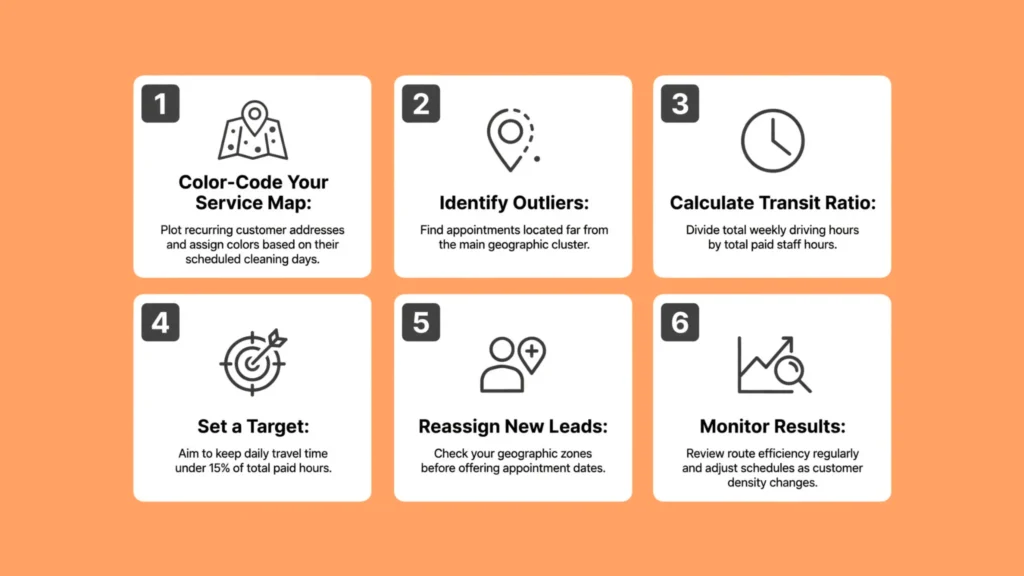
You do not need an enterprise software overhaul to start tightening your schedule. Run a quick manual audit this week:
Color-Code Your Service Map: Export your active recurring client addresses and plot them on a digital map, color-coding pins by the day of the week they are currently serviced.
Identify Outliers: Look for Monday pins sitting inside a sea of Thursday pins. Those outliers are your immediate optimization targets.
Calculate Your Current Transit Ratio: Total the hours your teams spent driving last week and divide that number by total paid clock-in hours. Aim to keep transit time under 15% of total paid hours.
Reassign New Leads Immediately: Train whoever answers the phone or manages online booking to check the zone map before offering appointment dates.
Frequently Asked Questions
What is a good route density target for a cleaning business?
For residential cleaning businesses operating in suburban or urban areas, a healthy benchmark is keeping drive time between jobs to 10–15 minutes or less, with total daily transit representing under 15% of paid staff hours. Commercial janitorial routes serviced overnight can often achieve even tighter density within single business districts.
How do I move existing clients to new schedule days without losing them?
Communicate proactively at least two to three weeks in advance. Frame the change around reliability—explain that grouping neighborhood routes ensures their team arrives more consistently on time and reduces weather or traffic delays. Offering a small one-time perk, like a complimentary add-on service, smooths the transition for hesitant clients.
Should I charge a travel fee for out-of-area cleaning jobs?
Yes, if a client falls outside your primary service zones, charging a flat trip fee or requiring a higher minimum booking spend protects your margin. Alternatively, designate one specific day per month for outlying areas so you can cluster distant jobs together rather than making isolated trips.
Does route density matter for solo cleaners as well as multi-crew companies?
Route density is arguably even more critical for solo operators. Because a solo cleaner cannot delegate driving or split tasks, every hour spent behind the wheel directly caps personal daily income and increases physical fatigue.
How does job clustering affect customer satisfaction?
Job clustering improves customer satisfaction by making arrival times far more predictable. When crews travel short distances between homes, minor delays at one house rarely spiral into major late arrivals across the rest of the afternoon.
Final Thoughts
Growing a profitable cleaning company is rarely about working harder or simply stacking more appointments onto an already chaotic calendar. True profitability comes from operational discipline designing a schedule where every mile driven supports maximum billable output. By committing to geographic job clustering, setting smart arrival windows, and protecting your zone boundaries, you lower overhead, reduce crew burnout, and turn your daily schedule into a reliable profit engine.
About The Author