Gutter Cleaning Business: Season, Safety and Pricing

Starting and running a successful gutter cleaning business relies on three core pillars: mastering seasonal workflow cycles, enforcing strict ladder safety protocols, and setting profitable pricing structures.
Because residential and commercial properties require regular drainage maintenance to prevent foundation damage and roof leaks, gutter cleaning offers low startup costs and high recurring revenue potential provided operators manage peak demand periods and physical risks effectively.
Unlike year-round landscaping or indoor cleaning services, exterior drainage maintenance fluctuates dramatically with the weather. Understanding how to navigate peak autumn and spring rushes, keep crews safe at height, and quote jobs accurately separates sustainable companies from short-lived side hustles.
Understanding the Seasonal Gutter Work Cycle

Demand in a gutter cleaning business follows predictable weather patterns. Most regions experience two major surges alongside two quieter shoulder seasons. Planning marketing, staffing, and equipment maintenance around these shifts ensures steady cash flow throughout the year.
Peak Seasons: Late Autumn and Mid-Spring
Late autumn is universally the busiest period for seasonal gutter work. Once deciduous trees shed their leaves, homeowners rush to clear troughs before freezing temperatures turn wet debris into solid ice dams. During this six-to-eight-week window, schedules often book out weeks in advance, allowing businesses to maximize daily route density.
Mid-spring represents the second major wave. Melting snow, spring storms, helicopter seeds, pollen, and tree blossoms clog downspouts just as heavy rainstorms arrive. Many customers who skipped fall maintenance call for emergency clearing when they notice water overflowing near their foundations.
Off-Peak Strategies: Summer and Winter
During summer, debris accumulation slows down in most climates, though dry pine needles, roof grit, and storm branches still create localized demand. Smart operators use slower summer months to:
Upsell gutter guard installations and minor fascia or downspout repairs.
- Offer bundled exterior services such as pressure washing, soft washing, or window cleaning to generate additional revenue during slower months.
Target commercial properties, apartment complexes, and homeowners associations (HOAs) on quarterly maintenance contracts.
In winter, freezing conditions halt standard cleaning in northern climates. Businesses in cold regions often pivot to holiday light installation, snow removal, or ice dam mitigation, while operators in milder southern or coastal climates enjoy steady year-round gutter maintenance.
Essential Ladder Safety and Risk Management
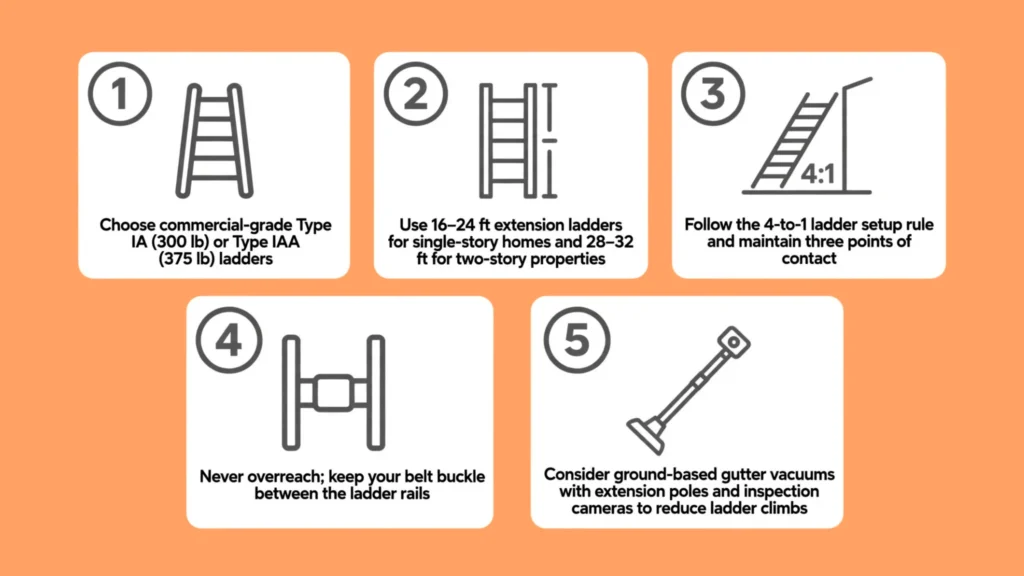
Falls from height represent the single greatest hazard in exterior home maintenance. Prioritizing ladder safety protects workers from life-altering injuries, prevents property damage to customer homes, and keeps commercial insurance premiums manageable.
Choosing the Right Ladder Equipment
A reliable gutter cleaning business requires commercial-grade ladders rated for heavy daily use—typically Type IA (300-pound capacity) or Type IAA (375-pound capacity). Most residential portfolios require a combination of:
A 16-foot to 24-foot extension ladder for standard single-story and split-level homes.
A 28-foot to 32-foot extension ladder for two-story properties and walkout basements.
A multi-position articulating ladder for uneven terrain, staircases, and tight courtyards.
Non-Negotiable Ladder Safety Practices
Every technician should follow standardized setup and climbing habits on every single job:
Install ladder stabilizers (standoffs): Standoff arms rest against the roof deck or siding rather than the fragile aluminum gutter trough. This prevents crushing the customer’s gutters while widening the contact base for superior lateral stability.
Follow the 4-to-1 setup rule: For every four feet of vertical height to the support point, place the base of the ladder one foot away from the wall.
Maintain three points of contact: Always keep two hands and one foot, or two feet and one hand, on the ladder while ascending or descending.
Never overreach: Keep your belt buckle between the side rails at all times. Climbing down and moving the ladder five feet takes thirty seconds; overreaching causes sudden lateral slips.
Use levelers on uneven ground: Adjustable leg levelers eliminate the dangerous temptation to prop ladder feet up on bricks, scrap wood, or soft mulch.
Inspect overhead hazards: Before raising any aluminum or fiberglass ladder, scan the area for overhead electrical service drops and tree limbs.
Ground-Based Alternatives and Insurance
Modern gutter vacuum systems with carbon-fiber extension poles and wireless inspection cameras allow technicians to clear many two- and three-story gutters safely from the ground. While hand-clearing from a ladder remains necessary for compacted sludge and stubborn downspout elbows, combining vacuums with traditional methods reduces ladder climbs significantly.
Before servicing any client property, carry comprehensive general liability insurance to cover accidental damage to roofs, siding, or landscaping. Understanding cleaning business insurance can help operators evaluate appropriate coverage options, along with workers’ compensation coverage as soon as they hire their first employee.
How to Structure Gutter Cleaning Rates
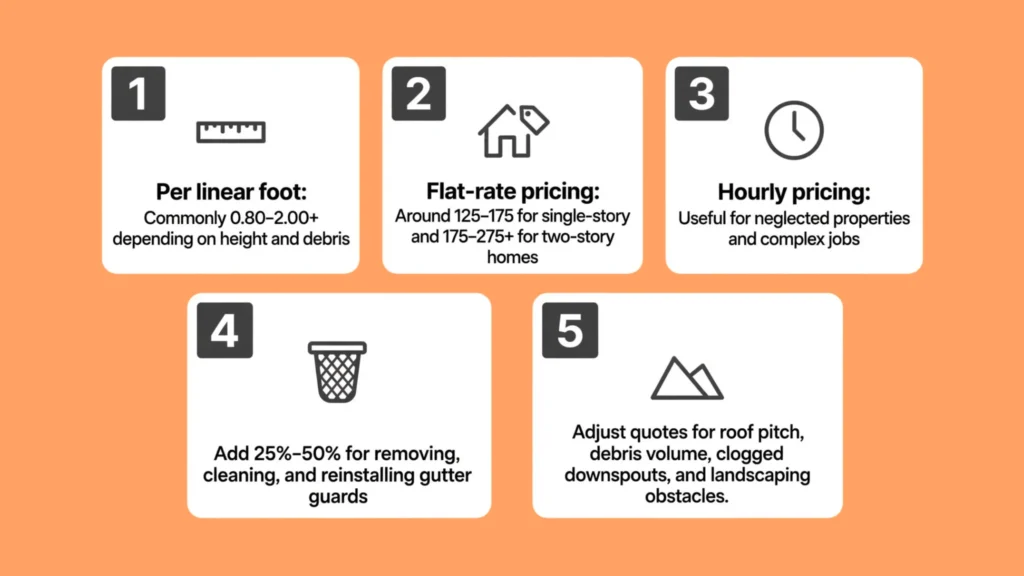
Setting accurate gutter cleaning rates requires balancing local market expectations against job complexity, travel time, and labor costs. Underpricing wins quick jobs but leaves no margin for insurance, fuel, equipment replacement, or marketing.
Common Pricing Models
Most established companies use one of three pricing structures—or a combination of all three. Understanding different cleaning business pricing models can also help new operators develop a profitable pricing strategy.
| Pricing Model | How It Works | Best Used For |
| Per Linear Foot | Charges a set rate per foot of gutter (commonly $0.80 to $2.00+ per linear foot depending on height and debris). | Large custom homes, commercial buildings, and estimates built using satellite measurement tools. |
| Flat-Rate Tiered | Groups homes by square footage and story count (e.g., $125–$175 for a standard single-story; $175–$275+ for a two-story). | Fast phone or online quoting for standard suburban residential neighborhoods. |
| Hourly / Time-and-Materials | Bills a set hourly labor rate per technician plus disposal or repair materials. | Severely neglected properties, heavy roof moss, or complex historic homes with unpredictable conditions. |
Key Variables That Adjust Your Quote
A base rate only works when adjusted for site-specific friction factors. Always factor in:
Building height and roof pitch: Two- and three-story structures require heavier ladders, slower setups, and higher risk allowances. Steep roofs prevent technicians from walking the roofline, forcing more frequent ladder moves.
Debris volume and condition: Dry leaves blow or scoop out quickly. Wet, compacted silt, sprouted weeds, and heavy pine needles take twice as long to remove and bag.
Existing gutter guards: Cleaning gutters fitted with mesh screens, foam inserts, or snap-in covers requires removing, cleaning, and reinstalling the guards, which should carry an upcharge of 25% to 50%.
Downspout clogs: Flushing downspouts to confirm clear drainage is standard practice, but disassembling elbows to extract impacted root balls or tennis balls warrants additional labor fees.
Landscaping obstacles: Dense thorn bushes, steep hillsides, koi ponds, and delicate garden beds restrict ladder placement and slow down workflow.
Practical Tips for Running a Profitable Operation
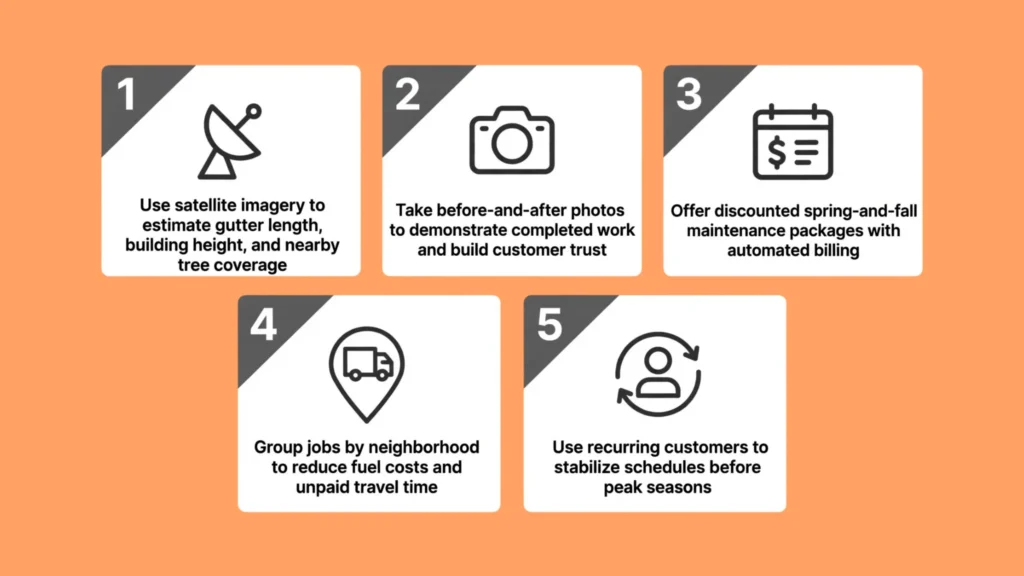
Beyond seasonal scheduling, safety, and pricing, operational discipline determines long-term profitability.
Use satellite imagery for remote quoting: Aerial mapping tools let you measure roofline linear footage, check story counts, and spot nearby tree canopy from your desk, saving hours of unpaid driving for estimates.
Document every job with before-and-after photos: Snapping quick photos of clogged troughs and clean, flushed channels builds immediate trust with homeowners who cannot see their own rooflines and prevents disputes over pre-existing roof or fascia damage.
Build recurring maintenance plans: Offer discounted spring-and-fall packages on automated billing. Recurring clients stabilize your schedule before peak season even begins and lower your customer acquisition costs.
Group routes by neighborhood: Concentrated routing minimizes windshield time, reduces fuel spend, and increases the number of billable jobs each crew completes per day.
Common Mistakes to Avoid
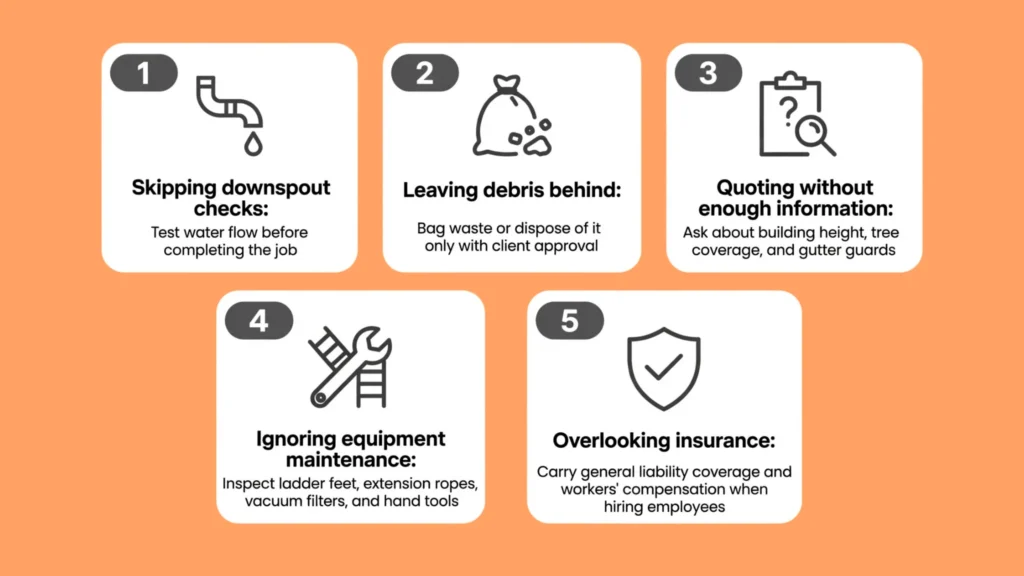
New owners frequently run into avoidable setbacks during their first year in business:
Skipping downspout checks: Clearing the horizontal trough means nothing if the vertical downspout remains plugged. Always test water flow with a hose or verify clear air flow before packing up.
Leaving debris scattered on lawns or patios: Homeowners judge service quality by what they see at eye level. Always bag debris or neatly disperse organic leaves in wooded areas only when explicitly approved by the client, and blow off walkways, decks, and driveways before leaving.
Quoting sight-unseen without qualifying questions: Giving a rock-bottom flat quote over the phone without asking about story count, tree coverage, or gutter guards leads to unprofitable jobs when you arrive on site.
Neglecting equipment maintenance: Worn ladder feet, frayed extension ropes, clogged vacuum filters, and dull hand tools slow down crews and introduce unnecessary safety hazards.
Final Thoughts: Gutter Cleaning Business
Building a dependable gutter cleaning business comes down to execution rather than complexity. By aligning your marketing and staffing with seasonal gutter work cycles, treating ladder safety as an unbreakable daily standard, and structuring gutter cleaning rates around real labor and site conditions, you can create a resilient service company with strong margins and repeat customers year after year.
Frequently Asked Questions: Gutter Cleaning Business
How much does it cost to start a gutter cleaning business?
Startup costs are relatively low compared to most trades, typically ranging from $1,500 to $5,000 if you already own a reliable truck, van, or SUV with a ladder rack. Core expenses include commercial-grade extension ladders, ladder stabilizers, safety harnesses, hand tools, a leaf blower, basic business registration, and general liability insurance.
What is the most profitable season for gutter cleaning?
Late autumn is the highest-revenue season in most regions because falling leaves create urgent demand across nearly every tree-lined neighborhood at once. Mid-spring is the second most profitable window, driven by spring storms, pollen, and tree seeds.
Should you charge by the linear foot or by the house?
Both approaches work well when calibrated properly. Flat-rate tiered pricing based on home size and story count is faster for standard suburban homes, while per-linear-foot pricing ensures accuracy on sprawling custom properties and commercial buildings.
Do I need insurance to clean gutters professionally?
Yes. Carrying general liability insurance protects your business if a ladder damages siding, gutters, windows, or landscaping, and most commercial clients and HOAs require proof of coverage before hiring you. Workers’ compensation insurance is also legally required in most jurisdictions once you hire employees.
How can I get gutter cleaning work during the off-season?
Operators bridge slow summer and winter months by offering complementary exterior services such as gutter guard installation, minor gutter and downspout repairs, pressure washing, soft washing, window cleaning, or seasonal holiday lighting.
How do you clean gutters safely on a two-story house?
Use a properly rated commercial extension ladder equipped with a stabilizer bar, set at a 4-to-1 angle on firm, level ground. Maintain three points of contact while climbing, avoid overreaching past the ladder rails, or use a ground-based gutter vacuum system with extension poles where conditions allow.
About The Author