High-Ticket Cleaning Services That Generate Recurring Revenue
In the high-stakes 2026 economy, top companies have ditched the mop and bucket mentality for specialized facility management. High-ticket cleaning services like medical-grade sanitation and biohazard remediation now command premium rates that dwarf standard fees.
By targeting these niches, you secure stable, recurring cleaning income from clients who prioritize liability protection over the lowest bid. Also, while general janitorial work stagnates, specialized tech and bio sectors are exploding.
Consequently, you must prove you aren’t just cleaning a room you are protecting a multi-million dollar investment. Ultimately, the choice is simple: compete on price at the bottom, or command authority at the top.
Why High-Ticket Cleaning is the Future of Recurring Income
The cleaning industry in the USA has undergone a fundamental shift. Following the 2026 emphasis on Healthy Buildings and the widespread adoption of Integrated Facility Management (IFM) models, facility managers are no longer looking for a vendor to simply empty the trash. They are searching for strategic partners who manage operational risk.
When you operate a premium cleaning business in the USA, you aren’t just selling a clean floor; you are selling compliance, employee retention, and asset preservation. These services are naturally sticky. Once a client finds a provider that handles complex high-ticket tasks correctly, they rarely switch, leading to stable and predictable recurring cleaning income.
This stability allows for better labor planning, higher wages for special
ized staff, and improved profit margins that general cleaning companies simply cannot achieve.
1. Top Profitable Niches in the High-Ticket Sector
To reach the four- or five-figure mark per contract, you must abandon generalism. In 2026, Expertise is the most valuable commodity. Here are the specialized niches currently dominating the high-ticket market.
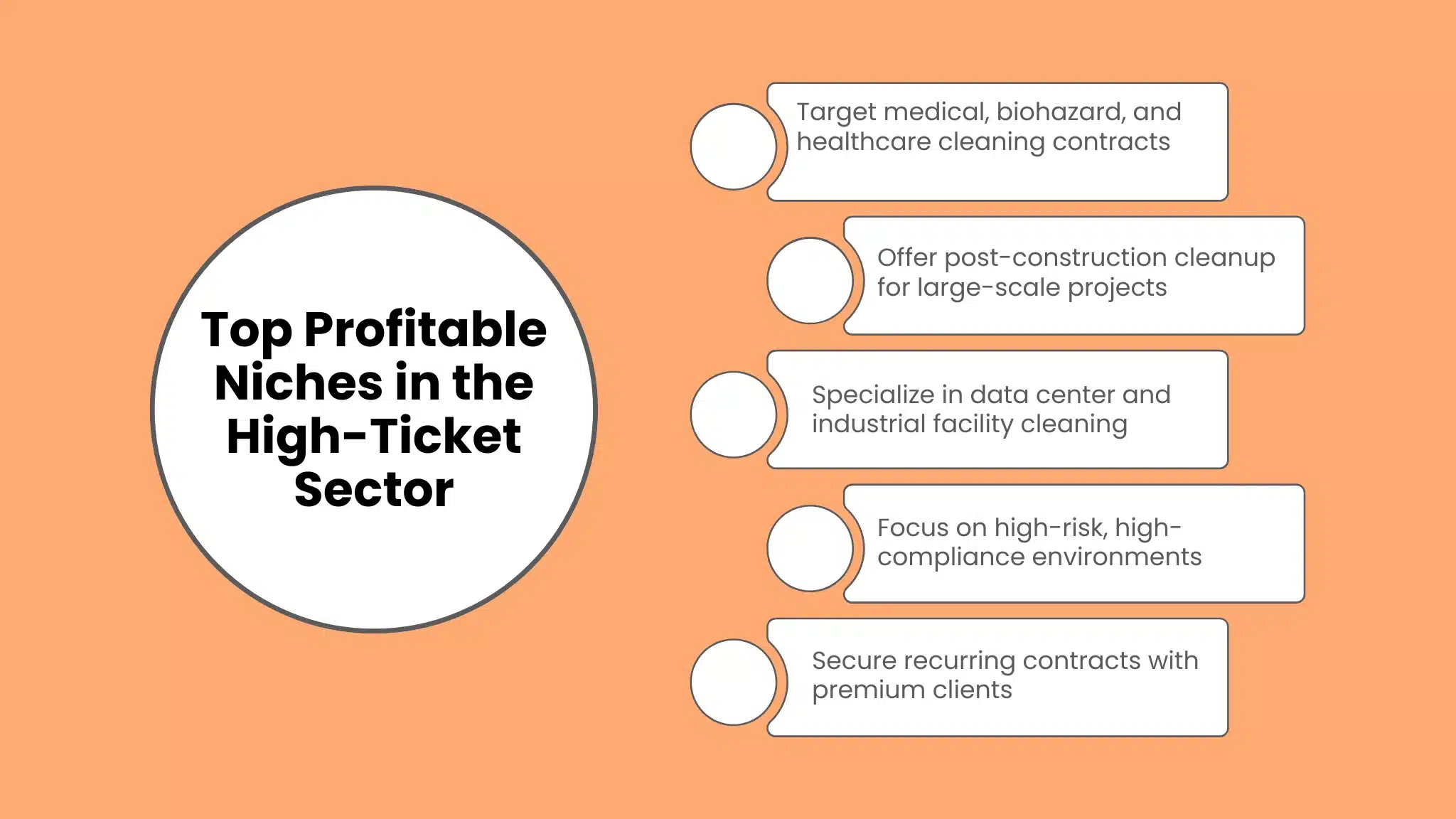
The reason these services are high ticket is the specialized knowledge and risk management required to execute them. In 2026, premium value is tied directly to the technical difficulty of the task and the potential financial cost of failure for the client.
Medical and Healthcare Specialized High Ticket Cleaning Services
Healthcare facilities operate under the strictest regulatory oversight in the country. Cleaning a surgical suite, an oncology ward, or a bio-research lab requires deep knowledge of dwell times for disinfectants and stringent cross-contamination protocols. Because the stakes include patient safety and legal HIPAA/OSHA compliance, these contracts are lucrative and almost always structured as recurring monthly agreements.
High-ticket providers in this space often use ATP (Adenosine Triphosphate) testing to provide scientific proof that surfaces are biologically clean, not just visually tidy. For a healthcare administrator, paying a premium is an insurance policy against healthcare-associated infections (HAIs) that could cost the hospital millions.
Post-Construction Phase High Ticket Cleaning Services
Construction firms manage multi-million dollar projects where the final handover is the most stressful phase. The white glove clean before a building is presented to the owner is a high-ticket service because it must be flawless and completed on a razor-thin timeline.
While the initial job might be a one-off project, building relationships with developers leads to a subscription cleaning business model where you are the preferred partner for every new build in their portfolio. This niche requires heavy-duty equipment industrial vacuums for silica dust, floor scrubbers for grout film, and high-reach tools for atrium windows all of which justify a higher ticket price.
Data Center and Industrial High Ticket Cleaning Services
In the age of AI and massive data processing, static electricity and microscopic dust are the primary enemies of high-end server hardware. Cleaning a Tier 4 data center requires specialized HEPA-filtered vacuums and anti-static treatments. Because this requires extreme expertise and specialized equipment, providers can charge 3x to 5x more than standard office rates.
One missed speck of dust in a server rack can cause thousands of dollars in downtime, making the insurance of a high-ticket specialist a bargain for the client. These environments are often cleaned on a quarterly recurring schedule, providing consistent high-margin work.
2. Transitioning to Luxury Cleaning Services
If your business model leans toward the residential side, the luxury cleaning services market offers a parallel path to high-ticket recurring revenue by targeting the demographic that values time and asset care above all else.
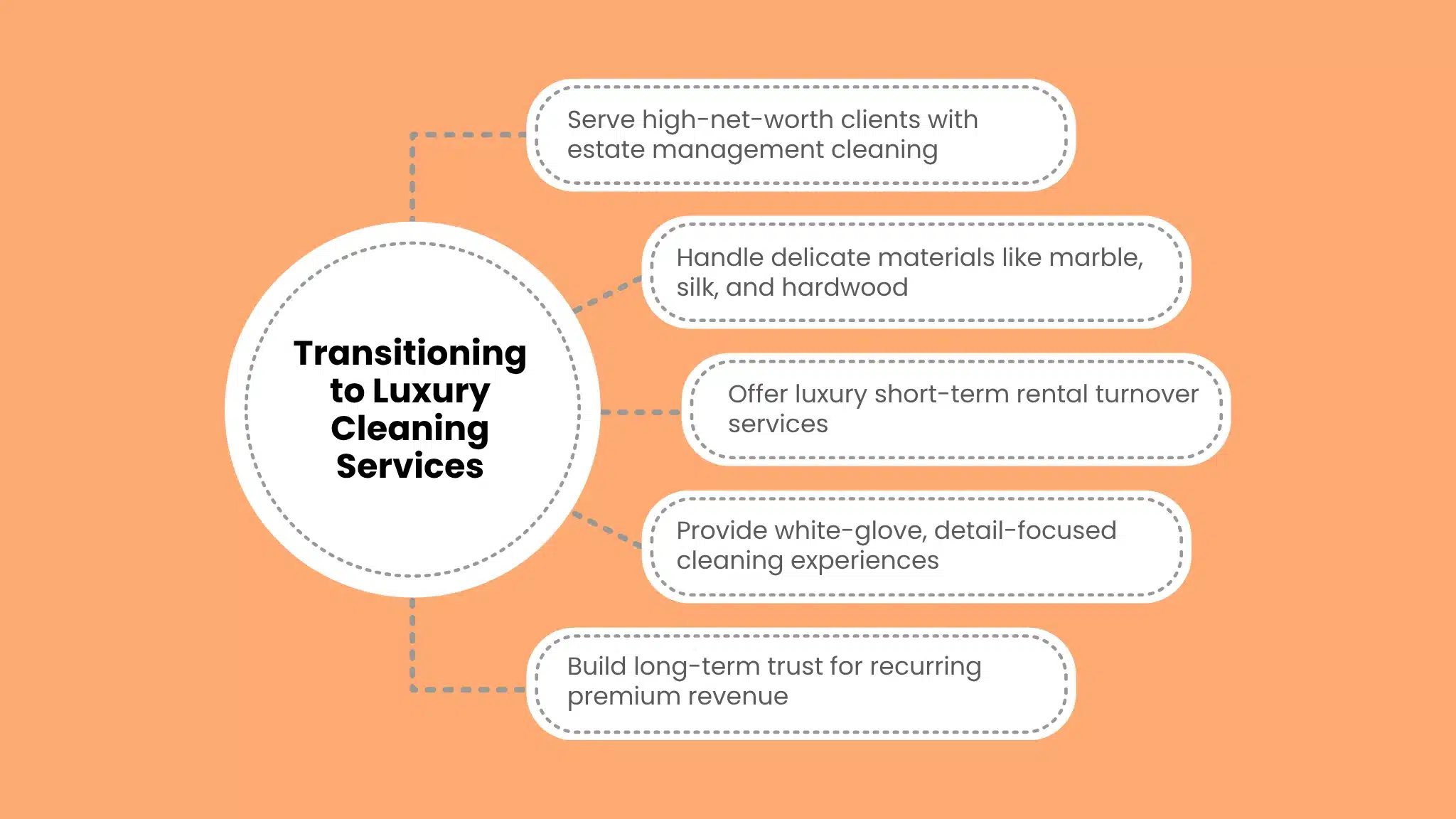
Estate Management and Recurring High Ticket Cleaning Services
High-net-worth individuals in the USA own homes with delicate, high-value materials: hand-honed Carrara marble, silk wall coverings, and centuries-old hardwoods. A standard maid service does not have the expertise to handle these materials without causing permanent damage.
By positioning yourself as an estate-care specialist, you can command premium rates for weekly visits that include specialized stone sealing, textile care, and silver polishing. This creates a subscription cleaning business where the revenue is high and the client relationship is built on deep trust and personal familiarity.
High-End Short-Term Rental High Ticket Cleaning Services
The luxury vacation rental market has exploded, with properties commanding thousands per night. Property owners need hotel-standard turnovers that include laundry services, staging, and meticulous sanitization to maintain their 5-star ratings.
These clients are a reliable source of recurring cleaning income because their entire business model depends on your team’s consistency. Unlike standard Airbnb cleaning, luxury turnovers often involve restocking premium amenities and providing white glove inspections, allowing you to charge significantly higher per-turnover rates.
3. The Science of the Premium Price Tag
Many cleaning business owners struggle to justify their high-ticket prices. To win these contracts, you must move away from labor talk and speak the language of ROI.
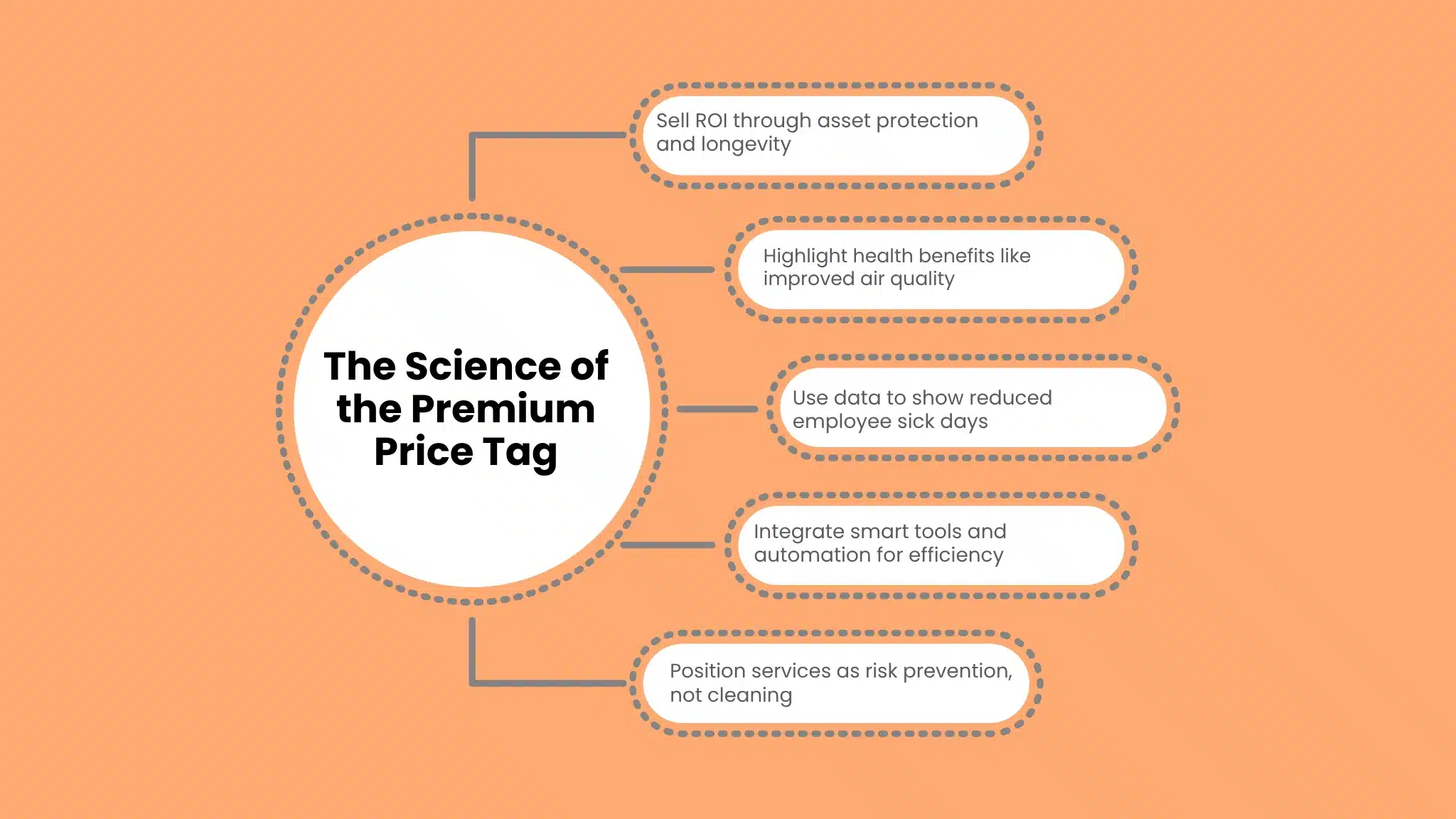
In the commercial sector, cleaning is an investment in capital assets. When you pitch a high-ticket contract, focus on these three pillars:
Asset Longevity: Explain how professional floor care and HVAC-aligned dusting prevents a $100,000 capital expenditure for carpet or equipment replacement.
Health & Productivity: Use 2026 data to show how improved Indoor Air Quality (IAQ) and standardized sanitization reduce employee sick days by an estimated 15-20%. In a large office, this translates to tens of thousands of dollars in reclaimed productivity.
Technology Integration: High-ticket providers in 2026 use AI-driven tools. Mention your use of autonomous floor scrubbers or IoT sensors that track high-traffic areas in real-time. This shows the client that you are a modern, efficient operation that doesn’t waste their money on ghost hours.
4. How to Structure for Recurring Cleaning Income
The secret to a million-dollar cleaning company isn’t working more hours; it’s the contract structure. You need to move from on-call to integrated.
The Retention-First Model for High Ticket Cleaning Services
Offer Integrated Facility Management where you handle everything from waste management and recycling to deep window cleaning under one monthly fee. This makes you indispensable to the client.
By bundling high-margin tasks (like carpet steam cleaning) into a regular monthly fee, you smooth out your cash flow and ensure you are never shopped around for a lower price.
Performance-Based SLAs (Service Level Agreements)
Instead of billing for 40 hours of work, bill for meeting the hygienic standard. This rewards your team for being efficient and using modern technology. If you can achieve a 99% disinfection rate in 20 hours using electrostatic sprayers, you should still be paid the full contract value.
This shift is essential for maintaining high profit margins in a high-ticket model.
5. Overcoming the Budget Objection
High-ticket services will always face price resistance initially. The key is to reframe the conversation around the Cost of Cheap.
When a client chooses a low-cost provider, they aren’t saving money; they are deferring costs. Cheap services often lead to:
Micro-Damages: Using the wrong chemicals on luxury stone or electronic equipment.
Security Risks: High turnover in low-paid staff leads to security vulnerabilities.
Failed Inspections: In medical or industrial settings, a failed audit can lead to a complete shutdown of operations.
By highlighting these risks, you position your premium cleaning business in the USA as the safe, logical, and ultimately more cost-effective choice for serious business owners.
Conclusion
Ultimately, success in 2026 relies on specializing deeper rather than working harder. By pivoting toward high ticket cleaning services, you can exit the price-war basement and partner with clients who truly value facility health.
Whether you offer medical-grade disinfection or luxury estate management, you must demonstrate expertise through data and certifications. Furthermore, as AI and automation reshape the industry, staying ahead of the curve is essential.
Consequently, for those scaling professional ventures, Reliable Startup provides the foundational tools to build a high-authority brand. By solving high-stakes problems, recurring cleaning income becomes a natural result of your specialized value.
Frequently Asked Questions
What is a high-ticket cleaning service?
It is a specialized, high-stakes offering like medical sanitation or data center cleaning—that requires expert certification and commands premium rates due to the technical complexity and risk involved.
How do I find clients for a premium cleaning business in the USA?
Focus on B2B networking through trade associations like BOMA or IREM. High-ticket clients prioritize professional authority and referrals over low-cost leads from discount platforms.
Can a small cleaning business offer high-ticket services?
Yes. Boutique providers often win these contracts by offering higher accountability and specialized expertise that large, generalized franchises cannot match.
How do I ensure recurring cleaning income?
Secure long-term service agreements (12–24 months) that bundle daily maintenance with specialized quarterly tasks into a single, predictable monthly subscription fee.