Solar Panel Cleaning: A Service Growing With Installations
As residential rooftops and commercial warehouses increasingly adopt photovoltaic technology, launching a solar panel cleaning business has become one of the most practical, accessible service opportunities in the renewable energy sector. While solar arrays are built to endure harsh weather, they are not self-cleaning. Dust, pollen, bird droppings, sea salt, and industrial grime gradually coat the glass surface, blocking sunlight and reducing energy output.
For property owners, dirty panels mean higher utility bills and a slower return on investment. For entrepreneurs and existing exterior cleaning operators, this ongoing maintenance requirement creates steady, repeat demand.
Building a successful operation requires more than a garden hose and a ladder. Like any other specialty cleaning business, it demands specialized panel washing equipment, smart pricing structures, strict safety protocols, and recurring solar maintenance contracts.
Why Demand for Solar Panel Cleaning Is Accelerating?
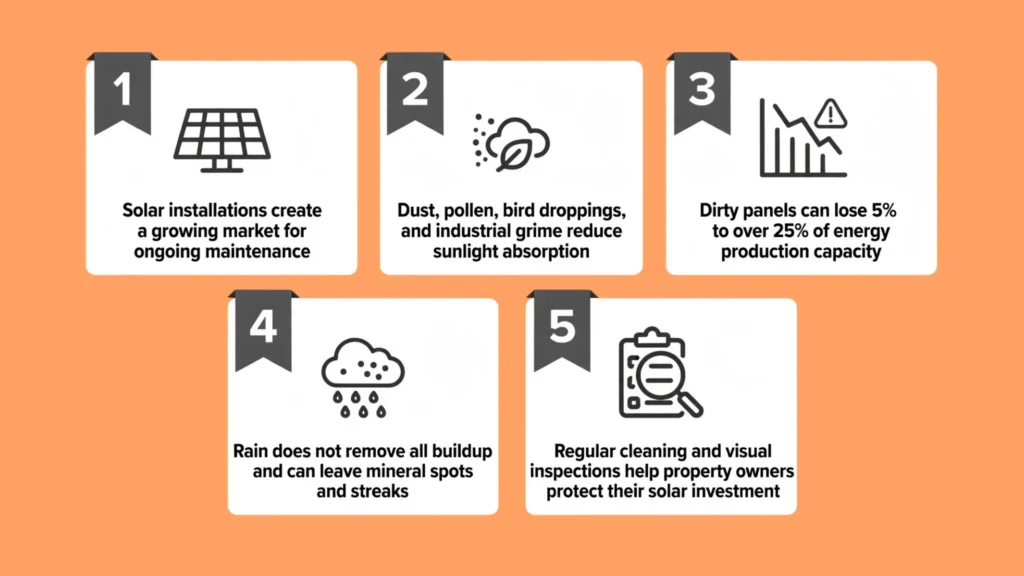
Every newly installed solar system immediately enters a multi-decade lifecycle that requires routine upkeep. Most residential and commercial installations operate for 25 to 30 years, meaning the total addressable market expands with every passing quarter.
The Efficiency Drop From Soiling
Solar panels generate electricity by absorbing photons through tempered, anti-reflective glass. When environmental debris accumulates—a process known in the industry as soiling—light transmission drops. Depending on local climate and nearby environmental factors, uncleaned panels can lose anywhere from 5% to over 25% of their energy production capacity. In arid, agricultural, or coastal regions, efficiency losses happen even faster.
Why Rain Is Not Enough
A common misconception among homeowners is that rainfall naturally washes solar arrays clean. In reality, rain often makes the problem worse. Airborne dust mixes with water droplets and dries into a baked-on mineral film, leaving water spots and streaks that scatter sunlight. Furthermore, sticky organic matter like tree sap and bird droppings will not rinse away in a standard rainstorm and can create localized “hot spots” that permanently degrade individual solar cells.
Warranty and Inspection Needs
Many solar manufacturers and installers include regular cleaning and visual inspection clauses in their performance warranties. Property owners rarely want to climb onto pitched roofs or navigate electrical arrays themselves, making professional third-party technicians the preferred choice.
Core Services Offered by a Solar Panel Cleaning Business
While basic glass washing is the foundation, profitable operators structure their offerings around distinct customer segments and complementary services.
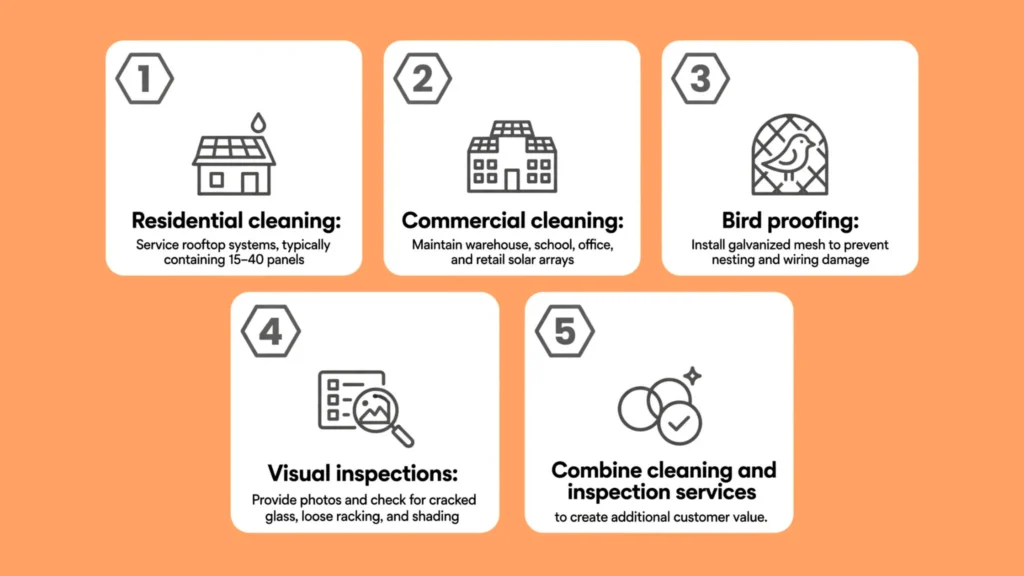
Residential Rooftop Cleaning: Fast, high-volume service calls focusing on single-family homes, typically involving 15 to 40 panels.
Commercial and Industrial Array Washing: Large-scale flat-roof, carport, or ground-mounted systems for warehouses, schools, retail centers, and offices.
Bird Proofing and Critter Guard Installation: Installing galvanized steel mesh around the perimeter of rooftop arrays to prevent pigeons and rodents from nesting underneath and chewing through wiring.
Visual Inspections and Reporting: Providing before-and-after photos alongside basic visual checks for cracked glass, loose racking, or shading issues from overgrown trees.
Essential Panel Washing Equipment
Using standard pressure washers or abrasive household cleaners can void manufacturer warranties and ruin anti-reflective coatings. Professional panel washing equipment is specifically engineered to clean gently without leaving mineral deposits behind.
| Equipment Category | Purpose | Key Selection Criteria |
| Deionized (DI) Water System | Removes dissolved minerals from tap water so panels dry spot-free without squeegeeing | Choose multi-stage resin tanks or Reverse Osmosis (RO/DI) carts based on local water hardness (TDS levels) |
| Water-Fed Poles | Allows technicians to reach rooftop arrays safely from the ground or secure ladders | Carbon fiber construction for lightweight rigidity; telescoping lengths from 20 to 60 feet |
| Solar-Specific Brushes | Agitates stubborn grime without scratching tempered glass or anti-reflective coatings | Soft, flagged nylon or boar’s hair bristles with built-in pencil or fan water jets |
| Automated Cleaning Robots | Increases speed and consistency on large commercial or utility-scale installations | Battery-powered, remote-controlled rotary brush units suitable for flat or low-tilt arrays |
| Safety and Fall Protection | Protects technicians working at heights and prevents roof damage | OSHA-compliant harnesses, roof anchors, ridge hooks, and non-slip soft-soled footwear |
Understanding Total Dissolved Solids (TDS)
The single most important technical concept in solar cleaning is water purity. Tap water contains calcium, magnesium, and other minerals measured in parts per million (ppm) of Total Dissolved Solids (TDS). If you wash a hot solar panel with tap water, those minerals bake onto the glass as the water evaporates. Professional operators use a handheld TDS meter to verify that their purification system brings water down to 000 ppm before spraying a single panel.
How to Structure Solar Cleaning Rates?
Setting competitive yet profitable solar cleaning rates requires balancing travel time, setup effort, roof pitch, and panel count. Understanding cleaning business pricing can also help new operators develop a sustainable pricing strategy. Most established businesses use a hybrid pricing model rather than a single flat rate.
Common Pricing Models
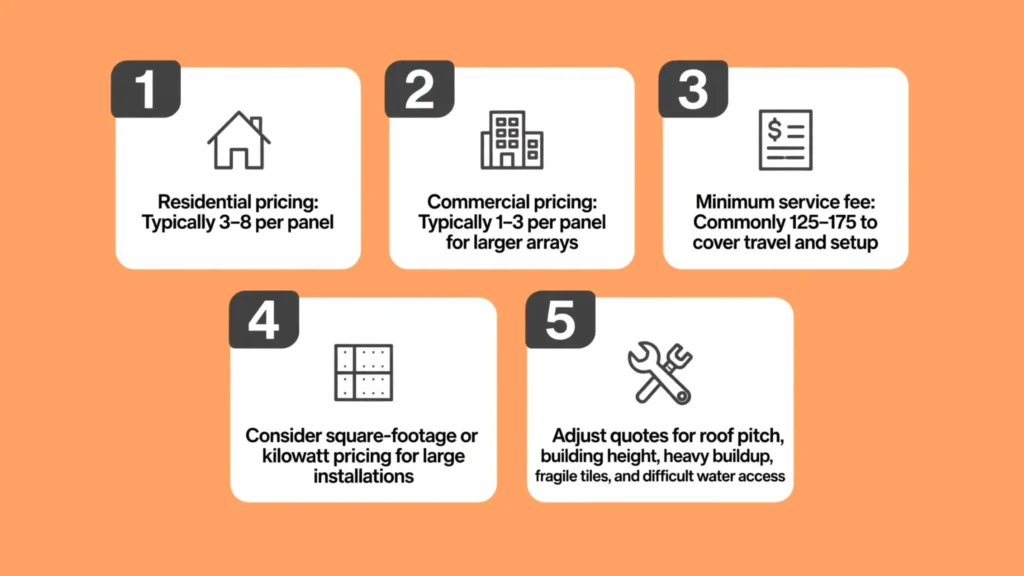
Per-Panel Pricing: The industry standard for residential and mid-sized commercial jobs. Rates typically range from $3 to $8 per panel for residential systems, dropping to $1 to $3 per panel for large commercial arrays due to economies of scale.
Minimum Service Call Fee: Because driving to a site, testing water TDS, and setting up safety gear takes time regardless of system size, most operators enforce a minimum charge often between $125 and $175 for small residential systems.
Square-Footage or Kilowatt (kW) Pricing: Useful for large ground-mounted or commercial installations where estimating by total system capacity (e.g., per kW) aligns better with commercial facility budgets.
Factors That Adjust Your Quote
Always account for site complexity before finalizing an estimate. Two-story homes, steep roof pitches, fragile Spanish clay tiles, heavy bird dropping buildup, and lack of on-site water spigots all require extra labor and specialized gear, warranting higher rates.
Building Recurring Revenue With Solar Maintenance Contracts
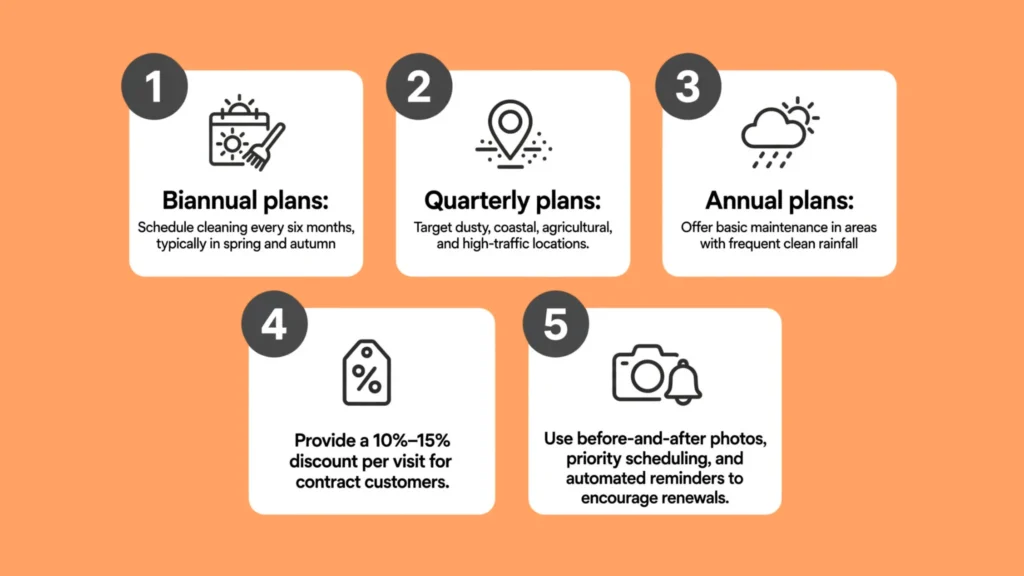
One-time cleanings pay the bills, but recurring solar maintenance contracts build long-term enterprise value and predictable cash flow. Because panels accumulate grime year-round, clients benefit from scheduled service intervals.
Structuring Service Tiers
Biannual Plan (Every 6 Months): The most popular option for standard suburban homes, usually scheduled in late spring (after heavy pollen) and autumn (before winter).
Quarterly Plan (Every 3 Months): Ideal for properties near farms, highways, construction zones, coastal salt spray, or heavy tree cover.
Annual Plan: A baseline option suited for regions with frequent, clean rainfall and low airborne dust.
How to Sell Maintenance Agreements
The easiest time to pitch a recurring plan is immediately after completing a first-time cleaning, while showing the client side-by-side before-and-after photos of their array. Offering a 10% to 15% discount per visit for enrolled contract members paired with priority scheduling and automated reminders converts one-off buyers into multi-year clients.
Safety, Compliance, and Risk Management
Working around rooftop electrical systems and sloped surfaces carries real physical and financial risks. Operating professionally means prioritizing safety before every job.
Electrical Awareness: Solar panels generate direct current (DC) electricity whenever exposed to sunlight—they cannot simply be “turned off” at the roof level. Technicians must inspect for frayed wires, damaged conduits, or cracked junction boxes before applying water.
Temperature Shock Prevention: Spraying cold water onto scorching-hot glass in the middle of a summer afternoon can cause thermal stress cracking. Schedule washings during early mornings, late afternoons, or overcast days whenever possible.
Insurance Coverage: Carry general liability insurance that specifically covers roofing and solar photovoltaic work. Understanding cleaning business insurance can help operators identify essential coverage options and avoid gaps in their protection.
Standard window-washing policies sometimes exclude rooftop solar arrays, leaving operators exposed if a panel or roof tile is damaged.
Common Mistakes to Avoid When Starting Out
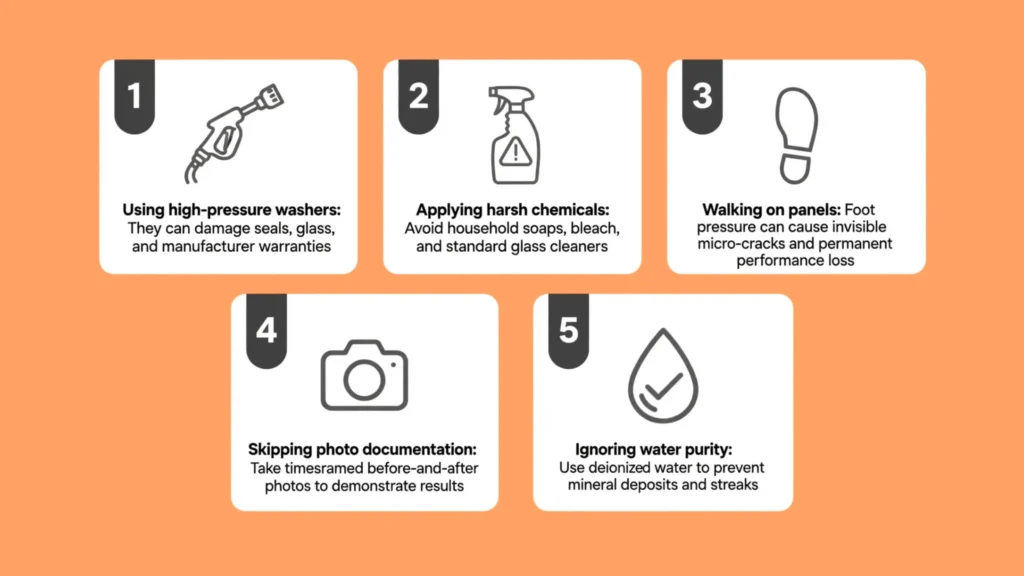
New entrants often stumble by treating solar maintenance identically to standard pressure washing or window cleaning. Avoiding these early missteps protects your reputation and equipment:
Using High-Pressure Washers: High PSI forces water past panel frame seals, causing internal moisture damage and instantly voiding manufacturer warranties. Rely on gentle agitation and pure water rinsing instead.
Applying Harsh Soaps or Detergents: Dish soap, bleach, and standard glass cleaners leave chemical residues that attract dust faster and degrade anti-reflective coatings. Stick strictly to 000 ppm deionized water unless a specific, manufacturer-approved biodegradable solar wash is required for heavy grease.
Walking on Solar Panels: Stepping on panel glass or frames—even briefly—causes invisible micro-cracks in the silicon cells that permanently degrade power output. Always work from walkways, ladders, or safe roof decking.
Skipping Photo Documentation: Without clear before-and-after photos, homeowners standing on the ground cannot verify the quality of your work. Timestamped photos prove value, justify your rates, and protect you against false damage claims.
Final Thoughts
A solar panel cleaning business sits at the intersection of renewable energy growth and essential property maintenance. As rooftop and commercial installations continue to multiply, property owners increasingly recognize that protecting their solar investment requires routine, professional care. By investing in proper pure-water filtration, pricing jobs accurately around site complexity, prioritizing rooftop safety, and converting one-time washings into recurring maintenance contracts, operators can build a resilient, high-margin service company that grows alongside the solar industry itself.
Frequently Asked Questions
How much does it cost to start a solar panel cleaning business?
A lean, entry-level residential setup—including a deionized water tank, carbon fiber water-fed pole, solar brush, TDS meter, safety harness, and basic marketing—typically costs between $1,500 and $4,500. Adding a commercial trailer, RO/DI filtration system, water storage tank, and insurance brings startup costs closer to $8,000 to $15,000.
Do I need a special license to clean solar panels?
In most jurisdictions, cleaning solar panels does not require an electrical contractor license because you are not installing, rewiring, or repairing electrical components. However, you will need a standard local business license, general liability insurance, and compliance with regional water-runoff and occupational safety regulations.
How often should solar panels be cleaned?
Most residential and commercial arrays benefit from professional cleaning twice a year. Properties located in dusty desert climates, agricultural areas, coastal zones, or neighborhoods with heavy bird activity often require quarterly cleanings to prevent significant energy loss.
Can you use a pressure washer on solar panels?
No. High-pressure water can crack tempered glass, compromise waterproof frame seals, and void the solar manufacturer’s warranty. Professional cleaning relies on soft-bristled brushes and low-pressure purified water.
Is a solar panel cleaning business profitable?
Yes, because overhead costs are relatively low once core equipment is purchased, and deionized resin refills represent a minor per-job expense. Profitability scales quickly when routes are densely clustered and clients are enrolled in recurring maintenance contracts.
What is the best time of day to clean solar panels?
Early morning and late afternoon are ideal. During these hours, the panels are cooler, which prevents cold water from causing thermal shock to the glass and stops purified water from evaporating too rapidly before dirt is fully rinsed away.
About The Author