How to Start a Non Emergency Medical Transport Business
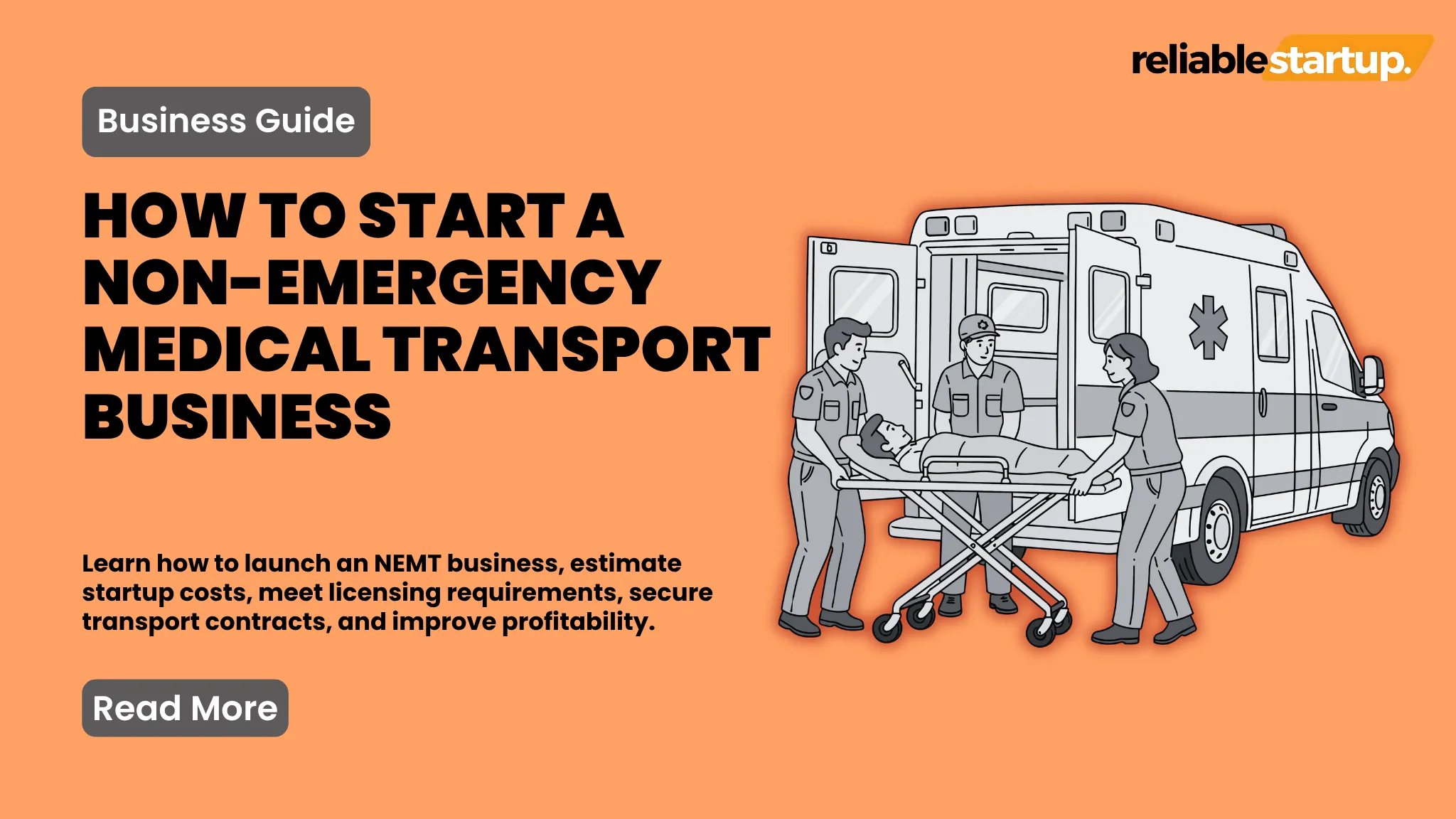
Starting a non-emergency medical transport business involves arranging safe, reliable transport for patients who need help reaching medical appointments but do not require emergency care.
This guide explains how to start a non-emergency medical transport business step by step, including NEMT startup cost, licensing requirements, vehicle selection, Medicaid transport contracts, insurance, customer acquisition and profit margin.
It also covers what the business costs to set up, how operators earn revenue and what makes the service profitable. Requirements and funding options depend on your location, state regulations and chosen business model.
What Is a Non Emergency Medical Transport Business?
A non emergency medical transport business provides scheduled transportation for people who cannot easily travel to healthcare appointments using ordinary transport. Common customers include older adults, people with disabilities, patients receiving dialysis and individuals recovering from surgery.
The service is commonly called NEMT in the United States. It is different from an ambulance service because NEMT does not provide emergency medical treatment or transport patients who require emergency care.
Typical services include:
- Ambulatory transport: Helping passengers who can walk independently or with limited assistance.
- Wheelchair transport: Moving passengers in vehicles equipped with suitable wheelchair access and securement systems.
- Recurring medical trips: Providing regular transport for dialysis, physical therapy and other scheduled treatments.
- Hospital discharge transport: Taking patients home after treatment when they do not require an ambulance.
- Senior transport: Helping older adults reach medical appointments, rehabilitation centres and healthcare facilities.
The business earns revenue through private customer payments, healthcare facility agreements, managed transportation networks and approved Medicaid transport arrangements. The available options depend on local regulations and payer contracts.
How to Start a Non Emergency Medical Transport Business Step by Step
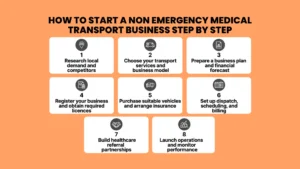
Starting this business requires market research, business registration, appropriate vehicles, insurance, licensing and a reliable customer acquisition plan. Complete the following 10 steps before accepting your first passenger.
Step 1: Research Local Market Demand
Local market research identifies the number of potential customers, the types of transport they require and the competition in your service area. It is an important first step when evaluating healthcare-related business ideas, such as starting a Non-Emergency Medical Transportation (NEMT) business.
Start by studying a defined service area, such as one city or a group of nearby towns. Review the local population of older adults, the location of dialysis centres, rehabilitation clinics, hospitals and assisted living facilities.
Check these five factors:
- Customer demand: Estimate the number of patients who require recurring medical transport.
- Competitor coverage: Identify existing NEMT operators, wheelchair transport providers and ambulance companies.
- Service gaps: Find locations where patients face long waiting times or limited transport options.
- Payment sources: Identify private-pay customers, Medicaid programmes and healthcare organisations that purchase transport.
- Travel distances: Estimate average trip lengths, waiting periods and return-trip requirements.
Speak with at least 10 potential referral partners before investing heavily in vehicles. Their feedback helps you understand actual transport needs rather than relying only on general population statistics.
The US Centers for Medicare and Medicaid Services provides guidance on NEMT benefits, provider requirements and transportation delivery arrangements. Use the applicable state Medicaid agency’s information to understand the rules in your target market.
Step 2: Choose Your NEMT Business Model
Your business model determines the vehicle investment, licensing process, staffing needs and payment arrangements.
Three common models are suitable for different budgets.
| Business model | Main service | Investment level |
| Ambulatory transport | Passengers who can enter and exit a standard suitable vehicle | Lower |
| Wheelchair transport | Passengers requiring accessible vehicles and securement equipment | Medium to high |
| Multi-vehicle operation | Multiple vehicles, drivers and service categories | High |
A new operator can begin with one properly licensed vehicle and expand when demand becomes consistent. Wheelchair transport can serve a specialised customer group, but the vehicle, insurance and accessibility requirements add to the initial cost.
Choose a model based on local demand, not simply the cheapest vehicle available. Confirm the licensing and insurance requirements for that exact model before purchasing equipment.
Step 3: Prepare a Business Plan
A business plan explains how your company will serve patients, obtain contracts, control costs and generate revenue.
Include these seven sections:
- Business description and service area.
- Target customers and market research.
- Vehicle and equipment requirements.
- Licensing, compliance and insurance costs.
- Customer acquisition and referral strategy.
- Revenue forecast and monthly operating costs.
- Funding requirements and expansion plans.
Calculate expected revenue per trip, average distance, fuel costs, driver wages and unpaid travel time. These figures show how many completed trips you need to cover monthly expenses.
The US Small Business Administration recommends researching the market, estimating startup costs and arranging suitable funding before launching a business.
Step 4: Register Your Business
Registering your company establishes the legal and financial structure under which it operates.
In the United States, many small operators choose a limited liability company, commonly called an LLC, because it can separate business liabilities from personal assets when properly maintained. Other structures include sole proprietorships and corporations.
Complete the applicable requirements:
- Select and register a business name.
- Establish the appropriate legal structure.
- Obtain an Employer Identification Number (EIN) when required.
- Open a dedicated business bank account.
- Register for applicable state and local taxes.
- Obtain required business licences and permits.
An LLC does not replace vehicle insurance or protect an owner from every form of liability. Ask a qualified accountant or business attorney to assess the appropriate structure for your circumstances.
Registration fees and documentation differ by state and locality, so confirm the exact requirements before filing.
Step 5: Complete NEMT Licensing Requirements
NEMT licensing requirements depend on the state, municipality, vehicle category and type of transportation offered. There is no single nationwide NEMT licence that automatically authorises every operator to work in every state.
Contact the relevant state transportation agency, Medicaid agency and local licensing office to establish which approvals apply to your business.
Your compliance checklist can include:
- General business registration and local permits.
- Commercial passenger transportation authority.
- Vehicle registration and applicable inspections.
- Commercial auto insurance.
- Driver licence and driving record checks.
- Background screening and other required driver checks.
- Disability access and wheelchair securement standards.
- Training in passenger assistance and emergency procedures.
- Required drug testing or related compliance procedures.
Medicaid transportation providers also need to meet applicable programme requirements. Federal law includes minimum assurances concerning driver licences, exclusion from federal healthcare programmes and processes addressing state drug-law violations. State requirements and provider contracts can impose additional conditions.
Do not accept Medicaid trips or advertise yourself as an approved provider until the relevant approvals are in place. Keep copies of licences, insurance certificates, inspection records and driver documentation in an organised compliance file.
Step 6: Purchase or Lease Suitable Vehicles
The right vehicle depends on the passengers you intend to serve and the accessibility requirements in your market.
A standard passenger vehicle can suit eligible ambulatory transport, while wheelchair transport requires a vehicle configured for safe boarding, securement and passenger protection.
Evaluate these vehicle features:
- Reliable mechanical condition and maintenance history.
- Accessible entry and exit arrangements.
- Suitable wheelchair ramps or lifts where required.
- Approved wheelchair securement systems.
- Passenger restraints and adequate seating.
- Easy-to-clean interiors and suitable climate control.
- Sufficient space for mobility aids.
- Compliance with applicable inspection standards.
Buying a used vehicle can reduce initial expenditure, but repairs and downtime can quickly affect profitability. Leasing reduces the upfront purchase payment but creates ongoing financial commitments and may restrict vehicle modifications.
Get a pre-purchase inspection and confirm that the vehicle qualifies for the intended service before signing a purchase or lease agreement.
Step 7: Arrange Insurance and Driver Training
Insurance and driver training protect passengers, employees and the business against preventable risks.
Ask an insurance broker familiar with passenger transportation to assess the coverage required for your operation. Policies commonly considered include commercial auto liability, general liability, workers’ compensation where applicable and additional coverage for the business’s specific risks.
Train drivers to:
- Assist passengers safely when entering and leaving the vehicle.
- Secure wheelchairs and mobility equipment correctly.
- Communicate respectfully with passengers and caregivers.
- Follow scheduled pickup and drop-off procedures.
- Respond to falls, sudden illness and other unexpected situations.
- Protect confidential passenger information.
- Record trip details and report incidents promptly.
Drivers must understand the limits of their role. NEMT drivers do not provide emergency medical treatment unless they hold the necessary qualifications and are operating within an authorised service.
Step 8: Set Up Dispatch and Billing
A dispatch and billing system helps manage bookings, vehicle availability, driver schedules and payment records.
At the beginning, a suitable scheduling platform may be sufficient for a one-vehicle business. Larger operations often require dedicated dispatch software with trip tracking, recurring bookings, electronic records and billing support.
Maintain accurate records of:
- Passenger and authorised contact details.
- Pickup and destination addresses.
- Appointment and return-trip times.
- Trip authorisations and eligibility details where applicable.
- Mileage, waiting time and completed services.
- Invoices, payments and outstanding claims.
- Cancellations and service incidents.
Medicaid and broker trips require particular attention to authorisation, documentation, billing codes where applicable and contract terms. Never bill for a trip that did not occur or claim a service that was not authorised.
Step 9: Secure Customers and Transport Contracts
Customer acquisition becomes easier when you build relationships with organisations that regularly need reliable patient transport.
Potential referral sources include dialysis centres, hospitals, rehabilitation facilities, senior living communities, medical practices and social service organisations.
Create a professional business profile, maintain a clear service area and explain the passenger categories you can safely accommodate. Ask referral partners about their procurement procedures rather than assuming that a direct relationship automatically leads to a contract.
Step 10: Launch, Measure and Expand
Start with a manageable number of trips and track performance before adding more vehicles.
Monitor completed trips per day, revenue per trip, empty mileage, fuel costs, cancellations, late pickups, claims rejected for payment and customer complaints.
Expand when the current operation consistently covers its expenses and has enough demand to support additional capacity. Adding vehicles before securing reliable bookings increases financial risk.
What Does a Non Emergency Medical Transport Business Cost to Set Up?
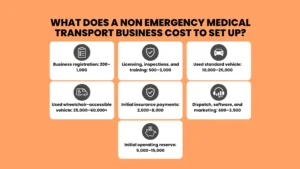
The NEMT startup cost depends mainly on vehicle type, location, insurance, licensing and whether the owner drives or employs staff. The following figures are illustrative US-dollar planning estimates, not official industry averages or supplier quotations.
| Startup expense | Illustrative budget |
| Business registration and administration | 200–1,000 |
| Licensing, inspections and training | 500–3,000 |
| Used standard vehicle | 10,000–25,000 |
| Used wheelchair-accessible vehicle | 25,000–60,000+ |
| Initial insurance payments | 2,000–8,000 |
| Dispatch, phone and software setup | 300–2,000 |
| Marketing and business materials | 300–1,500 |
| Initial operating reserve | 5,000–15,000 |
Actual expenses can fall outside these ranges, especially where specialised vehicles or expensive insurance are required.
A basic one-vehicle operation using an existing suitable vehicle can start with less capital than a company purchasing a wheelchair-accessible van and hiring drivers. A new wheelchair-accessible vehicle can substantially increase the investment.
How to Calculate Your Startup Budget
Add your one-time costs to the working capital required to operate until customer payments arrive.
For example, a business purchasing a used accessible vehicle for $35,000, spending $6,000 on initial insurance, $2,000 on compliance and setup, and retaining $10,000 for working capital needs approximately $53,000 before any additional costs.
This example excludes unexpected repairs, financing charges and other location-specific expenses. Build a separate contingency reserve rather than spending every available dollar on the vehicle.
How to Find Medicaid Transport Contracts
Medicaid transport contracts can provide recurring trip opportunities, but providers must meet programme and contract requirements before receiving authorised work.
Medicaid-funded NEMT services are administered through state-specific systems. Some states use transportation brokers to arrange eligible trips, while others use different delivery arrangements. A broker can contract with transport providers and coordinate approved services within a designated area.
Follow these steps to explore contract opportunities:
- Contact your state Medicaid agency. Ask how NEMT services are administered and which organisations manage transportation in your area.
- Identify the relevant broker or administrator. Confirm the provider application process and whether new operators are being accepted.
- Review provider requirements. Check vehicle standards, insurance limits, driver qualifications and required documentation.
- Submit an application. Provide the business, vehicle and compliance information requested by the organisation.
- Complete credential checks. Respond to screening, inspection and verification requirements.
- Review the contract carefully. Understand payment rates, authorised service areas, trip assignment rules, cancellations and claim deadlines.
- Maintain compliance. Keep accurate records and follow the contract’s service and billing rules.
Do not assume that every Medicaid member is eligible for every trip or that all transport costs are reimbursed. Verify eligibility, authorisation and payment conditions before providing the service.
How to Get Private-Pay Customers
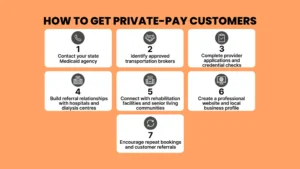
Private-pay customers provide another revenue source and reduce dependence on a single payer or contract.
Develop a straightforward customer acquisition strategy using the following channels.
Build Healthcare Referral Relationships
Contact local healthcare facilities and explain your operating hours, service area, vehicle accessibility and booking process. Ask about vendor registration, patient transport policies and the appropriate person to contact.
Create a Local Online Presence
Maintain a business website and an accurate business profile on relevant local directories. Include your service area, phone number, booking process and the types of transport you offer.
Connect With Senior Living Communities
Assisted living facilities and senior communities often need dependable transport arrangements for scheduled appointments. Offer clear booking terms and communicate any accessibility limitations.
Encourage Repeat Bookings
Patients receiving regular treatment often need transport on a recurring schedule. With the customer’s permission, arrange future trips and send reminders through an appropriate communication method.
Avoid guaranteeing arrival times that traffic, appointment delays or other operational factors make impossible to control. Reliable communication is more valuable than promises your business cannot consistently meet.
Is a Non Emergency Medical Transport Business Profitable?
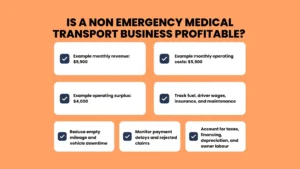
A non emergency medical transport business can be profitable when trip revenue consistently exceeds driver wages, vehicle expenses, insurance, administration and other operating costs. Profitability depends on paid trip volume, route efficiency, contract rates and the amount of empty mileage.
A business with frequent recurring trips and limited downtime can perform better than one that completes a few long-distance trips with unpaid return journeys.
Example of Monthly NEMT Profit
Consider a one-vehicle operation completing 10 paid trips per working day for 22 days, with average revenue of $45 per trip.
| Financial measure | Monthly amount |
| Paid trips | 220 |
| Revenue at $45 per trip | $9,900 |
| Driver wages or owner-driver labour allowance | $3,000 |
| Fuel and vehicle maintenance | $1,300 |
| Insurance | $800 |
| Dispatch, phone and software | $300 |
| Administration and marketing | $500 |
| Total operating costs | $5,900 |
| Operating surplus before other costs | $4,000 |
This example produces an operating surplus of approximately 40.4% before financing costs, taxes, depreciation and any expenses not included above. It is a hypothetical calculation, not a forecast or a typical industry margin.
An owner-driver should include a reasonable allowance for their own labour. Otherwise, the accounts can make the business appear more profitable than it actually is.
Five Factors That Affect Profit Margin
- Paid utilisation: The proportion of available working hours spent on billable trips.
- Empty mileage: Distance travelled without a paying passenger.
- Driver costs: Wages, payroll taxes, benefits and overtime.
- Vehicle reliability: Repairs, replacement costs and lost bookings during downtime.
- Payment timing: The gap between completing a trip and receiving the payment.
Review these figures monthly. If revenue increases but cash flow worsens, investigate unpaid claims, late customer payments and higher operating costs before adding vehicles.
Common Mistakes to Avoid When Starting an NEMT Company
New operators often face financial and compliance problems because they purchase vehicles or accept trips before understanding the local rules.
Avoid these six mistakes:
- Buying a vehicle too early: Confirm demand, licensing and vehicle eligibility first.
- Underestimating insurance: Obtain written quotations based on the exact service you plan to provide.
- Depending on one contract: Develop private-pay and additional referral channels where feasible.
- Ignoring empty mileage: Include unpaid travel and repositioning time in pricing calculations.
- Submitting incorrect claims: Verify authorisation, trip completion and documentation before billing.
- Expanding too quickly: Add drivers and vehicles only when demand supports the additional costs.
A written operating procedure for bookings, passenger assistance, incident reporting and billing reduces confusion as the business grows.
Frequently Asked Questions
How much money do you need to start a NEMT business?
A one-vehicle operation can require several thousand dollars when the owner already has a suitable vehicle, while purchasing an accessible vehicle can push the total startup budget into the tens of thousands of dollars. The actual amount depends on insurance, licensing, vehicle condition and working capital.
Do you need a special licence to operate an NEMT business?
You need the business, transportation and vehicle approvals applicable to your location and service type. Medicaid participation also involves programme-specific requirements. Confirm the rules with the relevant state and local authorities before operating.
Can one person start a non-emergency medical transport company?
Yes. An owner can begin with one vehicle and handle driving, scheduling and administration if the owner meets all applicable requirements. The business still needs appropriate insurance, permits, vehicle compliance and a safe operating process.
How long does it take to start an NEMT business?
The timeline depends on vehicle availability, insurance approval, licensing, inspections and contract processing. Private-pay operations can have a different launch timeline from businesses waiting for Medicaid or broker approval.
Is NEMT the same as an ambulance service?
No. NEMT provides non-emergency transportation for passengers who do not require emergency medical treatment during transport. Ambulance services operate under different medical, staffing and regulatory requirements.
Can NEMT providers work without Medicaid contracts?
Yes. A business can serve private-pay customers and enter into permitted arrangements with healthcare organisations or other purchasers. Medicaid-funded trips require compliance with the applicable programme and contracting arrangements.
Conclusion: How to Start a NEMT Business
Starting a non-emergency medical transport business requires more than purchasing a vehicle and finding passengers. You need to validate local demand, complete the applicable licensing process, obtain suitable insurance, establish a reliable dispatch system and secure a realistic source of revenue.
Before launch, confirm these five essentials:
- A defined service area with evidence of customer demand.
- A vehicle that meets the requirements for the intended passenger category.
- Completed business registration, licences, insurance and inspections.
- A clear pricing model and enough working capital to cover early expenses.
- A customer acquisition plan covering healthcare referrals, private bookings and eligible contract opportunities.
Build the operation around safe transport, accurate records and reliable service. Expand only when the revenue and cash flow support the additional investment.
Disclaimer: The prices shown in this article are estimates and may vary depending on your location, vehicle type, licensing requirements, insurance, equipment, and business operating costs.