Mobile Car Detailing Business: Startup Cost and Pricing
A mobile car detailing business provides professional vehicle cleaning and detailing services at customers’ homes, offices, and other convenient locations.
The startup cost typically ranges from $2,000 to $25,000 for a basic to professionally equipped operation, depending on the vehicle, equipment, insurance, and water supply system.
This guide explains how to start a mobile car detailing business step by step, calculate car detailing startup cost, set detailing packages pricing, meet licensing requirements, and estimate profit margins. It also covers operating costs, customer acquisition, and team expansion.
What Is a Mobile Car Detailing Business?
A mobile car detailing business cleans, restores, and protects vehicles at the customer’s preferred location. Unlike a traditional car wash, detailing focuses on deeper interior cleaning, paint care, upholstery treatment, and protective finishes.
The business earns money by charging per vehicle, selling service packages, and offering additional treatments. Customers include private car owners, busy professionals, used-car dealers, corporate fleets, and vehicle rental companies.
The main services include:
- Interior detailing: Vacuuming, carpet shampooing, seat cleaning, dashboard treatment, and odour removal.
- Exterior detailing: Hand washing, wheel cleaning, paint decontamination, waxing, and polishing.
- Paint protection: Ceramic coatings, paint correction, and protective sealants.
- Maintenance plans: Scheduled cleaning for regular customers and business fleets.
This model suits entrepreneurs who want to start a service business without renting a commercial shop. It also fits within the broader category of mobile business ideas, where the service provider travels directly to the customer.
What Does a Mobile Car Detailing Business Cost to Set Up?
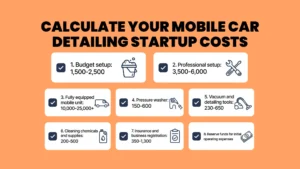
The cost to set up a mobile car detailing business typically ranges from $1,500 to $6,000 for a lean or standard setup, excluding the purchase of an expensive dedicated vehicle. A fully equipped van-based operation can cost $10,000 to $25,000 or more.
The final investment depends on the equipment quality, transport arrangement, cleaning services, insurance, and local regulations.
Mobile Car Detailing Startup Cost Breakdown
The following estimates provide a practical starting budget for a small business in the United States.
| Startup expense | Estimated cost |
| Pressure washer and accessories | 150–600 |
| Wet and dry vacuum | 80–250 |
| Dual-action polisher | 150–400 |
| Microfibre towels, brushes, and wash tools | 100–250 |
| Cleaning chemicals and starter products | 200–500 |
| Water tank and hoses | 150–600 |
| Generator or portable power supply | 300–1,000 |
| Business registration and permits | 50–300 |
| Initial insurance costs | 300–1,000 |
| Website, branding, and launch marketing | 150–500 |
| Emergency working capital | 300–600 |
These are planning estimates, not fixed supplier quotations. Some equipment costs vary with capacity and quality, and insurance costs depend on coverage and location.
Buying every item at once is not necessary. A new operator can start with interior cleaning, hand washing, and basic exterior detailing, then invest in advanced equipment after securing regular customers.
Three Mobile Detailing Startup Budgets
1. Budget setup
1,500–2,500
Best for testing local demand
Basic cleaning tools, a vacuum, starter chemicals, reusable towels, and simple marketing. This setup works best when you already own a suitable vehicle and can access water and electricity.
2. Professional setup
3,500–6,000
Best for full-time solo operators
Better equipment, a wider product range, a polisher, portable water storage, suitable insurance, and a more reliable booking process.
3. Fully equipped mobile unit
10,000–25,000+
Best for premium services
A dedicated vehicle, upgraded equipment, power and water systems, professional branding, and additional tools for advanced detailing.
These budget tiers reflect common planning ranges rather than guaranteed totals. Vehicle purchase costs, financing, wastewater recovery equipment, and local permit requirements can increase the initial investment.
What Mobile Detailing Equipment Do You Need?
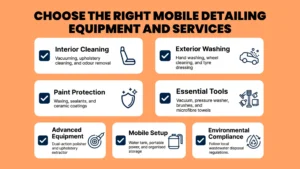
The essential mobile detailing equipment includes a vacuum, washing tools, cleaning chemicals, microfibre towels, brushes, and a reliable transport arrangement. Advanced services require additional tools.
Essential Equipment for Beginners
Start with equipment that supports the services you plan to sell.
- Wet and dry vacuum: Removes dust, loose dirt, and debris from vehicle interiors.
- Pressure washer: Cleans exterior panels, wheels, and heavily soiled areas.
- Microfibre towels: Help clean surfaces while reducing the risk of scratches when used correctly.
- Detailing brushes: Clean air vents, seams, badges, and narrow interior spaces.
- Cleaning chemicals: Include vehicle shampoo, glass cleaner, interior cleaner, tyre cleaner, and suitable protectants.
- Buckets, hoses, and spray bottles: Support washing, rinsing, and controlled chemical application.
- Portable lighting: Helps identify dirt, stains, and paint defects during inspection.
Advanced Equipment for Premium Services
A professional operator can add a dual-action polisher, upholstery extractor, steam cleaner, paint thickness gauge, and ceramic coating supplies. These tools support higher-value services but require suitable training and correct product use.
A water tank and generator also improve independence at customer locations without convenient water or power access. Check payload limits before fitting a tank because water adds substantial weight.
Wastewater collection equipment is equally important in areas where runoff rules restrict vehicle washing. Never assume that water containing detergents, oil, or vehicle contaminants can drain into a stormwater system.
How to Start a Mobile Car Detailing Business Step by Step
Starting a mobile car detailing business requires a clear service offering, a realistic budget, suitable equipment, legal compliance, and a reliable way to attract customers.
Step 1: Research Local Market Demand
Local market research identifies the customers, vehicle types, service prices, and competition in your target area. Study at least 10 competing detailers and compare their packages, reviews, travel charges, and booking availability.
Look for customer groups with repeat requirements, such as apartment residents, office workers, luxury car owners, used-car dealerships, and small business fleets.
Estimate the number of jobs needed each week before investing in expensive equipment. For example, completing 15 jobs per week at an average price of $150 generates $2,250 in weekly sales before expenses.
Step 2: Choose Your Services and Business Model
Select services based on your skills, available time, equipment, and customer demand. A beginner can focus on maintenance washes, interior cleaning, and complete detailing before adding paint correction or ceramic coatings.
Choose one of these models:
- Solo operator: Performs every job and keeps the operation simple.
- Premium detailer: Focuses on paint correction, protective coatings, and high-value vehicles.
- Fleet service provider: Serves dealerships, rental companies, and business fleets.
- Maintenance subscription provider: Offers repeat appointments at agreed intervals.
A focused service menu makes equipment purchases easier and reduces the risk of spending money on tools that remain unused.
Step 3: Register the Business and Meet Licensing Requirements
Business registration, local permits, tax obligations, and environmental rules depend on your operating location. In the United States, requirements can differ between states, counties, and cities.
Before accepting payments, check these areas:
- Business name registration and the appropriate business structure.
- Local business licences and mobile vendor permits, where applicable.
- Sales tax registration, where required.
- Commercial vehicle registration and insurance requirements.
- Wastewater collection, water discharge, and chemical handling rules.
- Permission to work at commercial properties or private sites.
Contact the relevant local authorities to confirm the rules for your service area. An ordinary business registration does not automatically authorise every type of mobile washing activity.
Step 4: Arrange Business Insurance
Business insurance protects the operation against specific financial risks. Speak with an insurance provider about general liability, commercial vehicle coverage, and protection for customer vehicles in your care.
Garagekeepers coverage is one option to discuss, although the appropriate policy depends on your operations and insurer’s terms. Confirm whether damage during detailing, vehicle movement, and work at customer premises is covered.
Step 5: Buy Equipment and Prepare Your Vehicle
Purchase equipment according to the services you intend to offer during the first 30 days. Organise towels, chemicals, brushes, hoses, and tools so that each job follows the same process.
Test your setup before visiting customers. Check power supply, water capacity, chemical dilution, equipment storage, and wastewater handling.
Step 6: Set Your Prices and Booking Process
Create three clearly defined packages and publish the starting price for each vehicle category. Explain what is included, how long the service takes, and which conditions trigger extra charges.
Start booking process by booking form to collect the vehicle type, location, service choice, condition, and preferred appointment time. Request photographs for heavily soiled vehicles so you can estimate the work before confirming a price.
Step 7: Find Your First Customers
Use a business profile on local search platforms, before-and-after photographs taken with customer permission, referral offers, and partnerships with nearby businesses.
Ask satisfied customers for honest reviews after completing the service. Offer repeat maintenance appointments to customers who value convenience and consistent vehicle care.
Avoid spending heavily on advertising before measuring how many enquiries turn into paid bookings.
Mobile Detailing Packages Pricing: How Much Should You Charge?
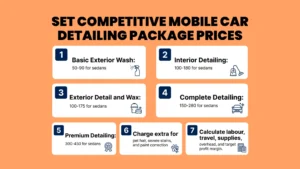
Mobile detailing packages pricing typically ranges from $50 to $130 for basic cleaning, $150 to $300 for a complete detail, and $300 to $550 or more for premium services, depending on vehicle size, condition, location, and the work included.
Use the following US pricing estimates as a starting point, then compare them with local competitors.
| Service package | Sedan | SUV or large vehicle |
| Basic exterior wash | 50–90 | 65–130 |
| Interior detailing | 100–180 | 150–300 |
| Exterior detail and wax | 100–175 | 130–250 |
| Complete interior and exterior detail | 150–280 | 200–350 |
| Premium detailing | 300–450 | 350–550+ |
Prices are illustrative estimates based on published 2026 pricing guides. Actual rates vary by market and service scope.
What Should Each Detailing Package Include?
A clear package structure helps customers choose a service and understand the price.
Basic package: Include an exterior hand wash, wheel cleaning, tyre dressing, interior vacuuming, and surface wipe-down. This package suits regularly maintained vehicles that need routine cleaning.
Standard package: Include deeper interior cleaning, carpet and mat treatment, detailed wheel cleaning, exterior decontamination where required, and a suitable paint protectant. Set a clear limit on stain removal and heavily soiled surfaces.
Premium package: Include intensive interior cleaning, upholstery extraction where suitable, paint decontamination, machine polishing, or a ceramic coating when purchased as a specific service. Explain which treatments are included because these services require different amounts of time and skill.
Charge separately for services such as pet hair removal, severe stain treatment, engine bay cleaning, and paint correction. This prevents a difficult vehicle from consuming the time budgeted for an ordinary appointment.
How to Calculate Your Prices
Calculate your minimum price using labour, travel, materials, overhead, and the profit you want to earn.
For example, a complete detail takes three hours, uses $20 in supplies, and requires $15 in travel expenses. If you value your labour at $30 per hour and allocate $15 for overhead, your total cost is $140.
A $200 selling price leaves $60 before tax and any other uncounted expenses.
Use this formula to set a target margin:
Sellingprice=Totalcost1-Targetmargin
For a $140 total cost and a 30% target margin, the selling price is $200. This is more reliable than copying a competitor’s rate without checking your own expenses.
What Are the Monthly Operating Costs?
Monthly operating costs include fuel, cleaning products, insurance, vehicle maintenance, marketing, payment processing, software, and equipment repairs. A solo operator using an existing vehicle generally has lower expenses than a business financing a dedicated van.
| Monthly expense | Illustrative budget |
| Fuel and travel | 200–500 |
| Cleaning products and consumables | 150–400 |
| Insurance | 100–250 |
| Marketing | 100–400 |
| Vehicle maintenance | 75–250 |
| Booking software and phone | 30–120 |
| Equipment maintenance | 50–150 |
| Payment processing and miscellaneous costs | 50–150 |
These figures are planning estimates, not fixed costs. Vehicle payments, employee wages, taxes, and major equipment purchases require separate budgeting.
Keep enough working capital to cover at least one to three months of expected expenses. This reserve helps manage slow weeks, cancellations, repairs, and delayed payments from commercial clients.
Is a Mobile Car Detailing Business Profitable?
Yes, a mobile car detailing business can be profitable when average job value, bookings, travel efficiency, and operating expenses are managed carefully. However, revenue is not the same as profit, and results vary with local demand and the owner’s working capacity.
Example of Monthly Revenue and Profit
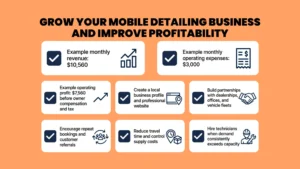
Consider a solo operator who completes three jobs per working day for 22 days each month, charging an average of $160 per vehicle.
| Financial measure | Monthly amount |
| Completed jobs | 66 |
| Average price per job | $160 |
| Total revenue | $10,560 |
| Supplies and travel | $1,650 |
| Insurance, marketing, and other overhead | $1,350 |
| Total operating expenses | $3,000 |
| Operating profit before owner compensation and tax | $7,560 |
This example is a simplified illustration, not a guaranteed income forecast. It excludes certain costs, including loan repayments, depreciation, and any additional labour. If the owner treats their own labour as an expense, the remaining business profit will be lower.
How to Improve Your Profit Margin
Focus on earning more per working hour rather than simply completing more vehicles.
- Increase average order value: Offer suitable add-ons such as upholstery extraction, paint protection, and pet hair removal.
- Reduce travel time: Group appointments by neighbourhood and charge appropriately for longer journeys.
- Encourage repeat bookings: Offer scheduled maintenance services to customers who want regular cleaning.
- Control chemical usage: Follow dilution instructions and track product consumption per vehicle.
- Protect your schedule: Collect deposits for large jobs and establish clear cancellation terms.
- Track job profitability: Record revenue, labour time, supplies, fuel, and payment fees for every appointment.
Premium services can increase revenue per booking, but they also require additional training, tools, and time. Sell them only when you can deliver consistent results.
How to Market a Mobile Car Detailing Business
Local visibility and customer trust are important because customers allow a service provider to work on a valuable personal asset. Start with channels that reach people in your service area.
Five Ways to Find Customers
- Create a local business profile. Add your service area, operating hours, contact details, package descriptions, and genuine customer photographs.
- Build a simple website. Include services, starting prices, booking details, FAQs, and the locations you cover.
- Publish before-and-after results. Show real cleaning work with customer permission and avoid misleading edits.
- Partner with local businesses. Approach used-car dealers, offices, apartment managers, and small vehicle fleets.
- Encourage customer referrals. Provide a clear referral offer that rewards repeat business without reducing profit excessively.
Track enquiries, confirmed bookings, average order value, repeat customers, and advertising costs every month. These figures show which marketing activities generate paying customers instead of just website visits.
How to Scale the Business and Hire a Team
Scaling the team becomes practical when demand regularly exceeds your available appointment hours and the business can cover additional wages. Hiring too early increases operating costs before the extra capacity generates enough revenue.
Start by documenting the cleaning process, equipment checklist, customer communication, inspection procedure, and quality standards. These steps make it easier to train another technician and maintain consistent results.
Consider these three growth stages:
- Stage 1: Operate alone and establish a reliable base of repeat customers.
- Stage 2: Hire one technician when bookings consistently exceed your available capacity.
- Stage 3: Add another vehicle or service team when demand supports the extra fixed costs.
Fleet contracts can provide recurring work, while premium detailing can increase revenue per appointment. Compare both opportunities against the labour, equipment, travel, and service standards they require.
Entrepreneurs exploring other transport-related services can also review the [Mobile Tyre Recycling Business] and [Mobile EV Charging Business] as separate business opportunities. Each model has different equipment, regulatory, and revenue requirements.
Common Mistakes to Avoid
The most expensive mistakes usually involve buying unnecessary equipment, setting prices too low, or overlooking compliance requirements.
Avoid these five problems:
- Overspending before validating demand: Start with essential equipment and upgrade after securing paying customers.
- Offering unlimited cleaning within a fixed price: Define the scope and charge extra for unusually difficult jobs.
- Ignoring wastewater regulations: Check local discharge rules before choosing your washing method.
- Underestimating travel and setup time: Include driving, unloading, cleaning, and packing when calculating hourly earnings.
- Confusing revenue with profit: Deduct operating costs, owner labour, taxes, and financing expenses when evaluating business performance.
A simple monthly profit-and-loss statement helps identify whether prices need to increase or operating costs need to decrease.
Frequently Asked Questions
How much money do you need to start mobile car detailing?
A basic setup costs approximately $1,500 to $2,500 when you already own a suitable vehicle. A professional setup can cost $3,500 to $6,000, while a dedicated van-based operation can exceed $10,000.
How much should a mobile detailer charge per car?
A basic wash can cost $50 to $130, while a complete detail often falls between $150 and $350. Vehicle condition, location, service scope, and travel expenses determine the final price.
Can you start mobile detailing without a van?
Yes. You can begin with a suitable existing car or another vehicle that safely carries your equipment. Confirm that its payload, storage, and transport arrangements meet your operational needs.
What services make the most money?
Paint correction, ceramic coatings, intensive interior restoration, and fleet maintenance can generate higher-value bookings. Profitability depends on job duration, material costs, skill level, and customer demand.
How long does it take to become profitable?
The timeline depends on startup investment, customer acquisition, pricing, and operating expenses. Calculate your break-even point using actual monthly costs and realistic booking estimates rather than relying on a fixed industry timeline.
Conclusion
A mobile car detailing business offers a practical way to enter the vehicle care industry without renting a permanent shop. Start with essential equipment, research local prices, meet licensing and environmental requirements, and build a service menu that covers labour and operating costs.
The strongest foundation is a repeatable booking process, consistent cleaning quality, and pricing based on real expenses. Expand into premium services or hire technicians only when customer demand supports the additional investment.
Disclaimer: The prices mentioned in this article are estimates and may vary depending on location, equipment quality, service requirements, and market conditions.