ATM Business: How Operators Actually Earn Per Withdrawal
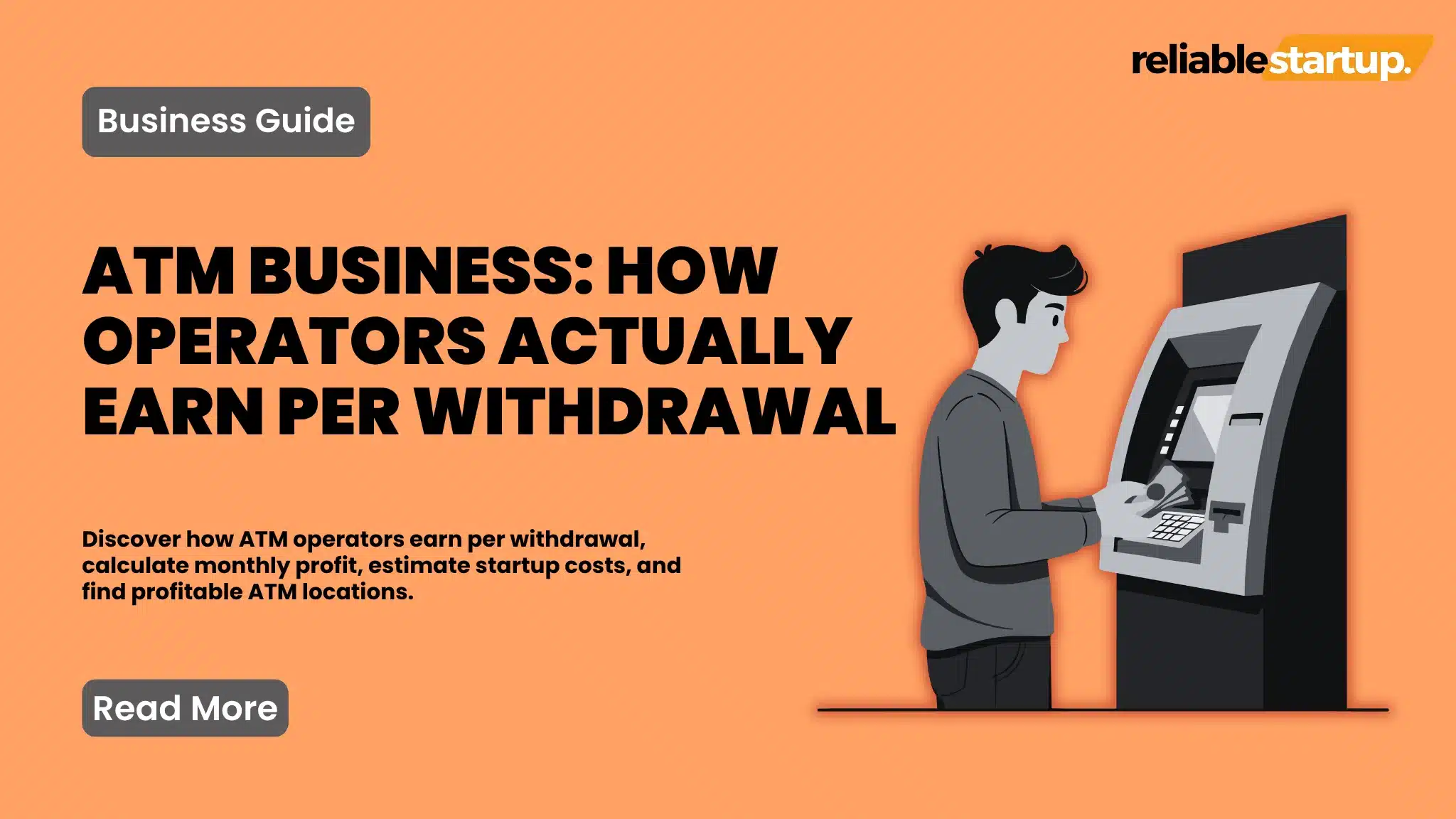
An ATM business earns money mainly through surcharge fees charged to customers for cash withdrawals, while some operators also receive income from interchange fees or share revenue with the businesses hosting their machines.
The actual ATM machine business profit depends on monthly withdrawals, surcharge revenue, cash replenishment costs, processing fees, rent, and maintenance.
This guide explains how an ATM business works, how much operators earn per withdrawal, the startup capital required, and how to calculate the break even point. It also covers ATM placement, market demand, customer acquisition, and practical ways to grow a profitable operation.
How Does an ATM Business Work?
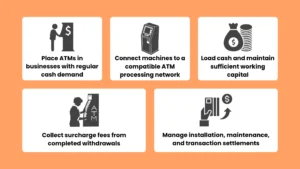
An ATM business works by placing cash machines in locations where customers need convenient access to cash, then earning a fee from completed withdrawals.
The operator owns the machine or operates it under an agreement, connects it to an ATM processing network, arranges cash loading, and receives transaction revenue. A customer pays the displayed surcharge before completing an eligible withdrawal.
The business involves 4 main activities:
- Securing locations: Finding convenience stores, bars, laundromats, hotels, and other businesses with regular cash demand.
- Installing machines: Purchasing or leasing compatible ATMs and arranging installation.
- Managing cash: Keeping enough cash inside each machine to meet withdrawal demand.
- Collecting revenue: Receiving surcharge income through the processing and settlement arrangement.
The ATM operator does not earn the entire amount withdrawn by a customer. The withdrawal amount comes from the operator’s cash float and is replenished through the settlement process. The surcharge, rather than the withdrawn cash, is the primary source of revenue.
How ATM Operators Earn Per Withdrawal
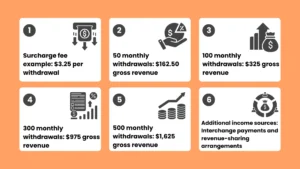
ATM operators primarily earn through surcharge revenue, which is the convenience fee customers pay when they use an out-of-network ATM.
In the United States, Bankrate’s 2025 ATM fee study reported an average operator surcharge of $3.22 per withdrawal. The customer’s own bank can charge an additional out-of-network fee, but that separate fee does not automatically belong to the ATM operator.
1. Surcharge fees
Surcharge fees generate the main income for independent ATM operators. The operator establishes the fee according to the location, local competition, transaction demand, and applicable rules.
For example, an ATM charging $3.25 for each completed withdrawal generates $325 from 100 withdrawals before expenses. At 300 withdrawals, the same machine generates $975 in gross surcharge revenue.
2. Interchange income
Interchange income is a payment associated with processing an ATM transaction through the banking network. The operator’s processor agreement determines whether this income reaches the machine owner.
Some agreements pass through part of the interchange payment, while others retain it within the processing arrangement. Do not include interchange income in your forecast until your processor confirms the amount you receive.
3. Revenue sharing
Revenue sharing allows a location owner and ATM operator to divide the income generated by withdrawals.
A typical agreement gives the host business a fixed payment per transaction or a percentage of the surcharge. For example, if the host receives $0.50 per withdrawal and the ATM completes 300 withdrawals, the operator pays the host $150 for that month.
The operator keeps the remaining eligible revenue after the agreed share and other expenses.
ATM Machine Business Profit: Real Numbers
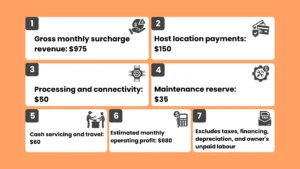
ATM machine business profit depends on the number of successful withdrawals, the fee collected per transaction, and the costs required to maintain the machine.
The following examples use illustrative US-dollar estimates, not guaranteed industry earnings. They assume a $3.25 surcharge and exclude any interchange income.
| Monthly withdrawals | Gross surcharge revenue |
| 50 | $162.50 |
| 100 | $325 |
| 200 | $650 |
| 300 | $975 |
| 500 | $1,625 |
These figures show why location quality matters more than the number of machines alone. An ATM processing 300 withdrawals per month generates three times the surcharge revenue of a machine processing 100 withdrawals at the same fee.
Example of monthly net profit
Consider an ATM that processes 300 withdrawals per month at a $3.25 surcharge.
| Income or expense | Monthly amount |
| Gross surcharge revenue | $975 |
| Host location payments at $0.50 per withdrawal | $150 |
| Processing and connectivity | $50 |
| Maintenance reserve | $35 |
| Cash servicing and travel | $60 |
| Estimated operating profit | $680 |
This example assumes that the operator pays the listed expenses and that the $975 in surcharge revenue is fully received. It excludes taxes, financing, depreciation, and the owner’s unpaid labour.
The $680 figure is a planning example, not a typical or guaranteed profit. Actual expenses depend on location, processor pricing, cash handling, and service requirements.
What Affects ATM Business Earnings?
ATM business earnings depend on 6 major factors: transaction volume, surcharge rates, placement costs, competition, cash availability, and machine uptime.
1. Transaction volume
Transaction volume determines how often an ATM generates revenue. A busy venue with regular cash purchases usually offers stronger potential than a quiet shop with limited customer traffic.
Estimate demand by examining daily footfall, existing payment methods, nearby ATMs, opening hours, and the number of customers who need cash.
2. Surcharge rates
A higher surcharge increases gross revenue per withdrawal but can discourage customers from using the machine. Compare nearby ATM fees and account for the type of venue before setting a rate.
3. Location commission
A host business might request a fixed payment per transaction or a percentage of the surcharge. A high commission reduces the operator’s earnings, particularly when transaction volume is low.
4. Cash availability
An ATM that runs out of cash cannot complete withdrawals. Operators need sufficient working capital and a replenishment schedule based on actual withdrawal patterns.
5. Competition
Nearby ATMs, cashback services, and cashless payment options can reduce demand. A location with limited convenient alternatives offers a stronger opportunity when customers still need cash.
6. Machine uptime
Network failures, hardware faults, and empty cash cassettes reduce completed transactions. Remote monitoring and regular servicing help operators identify problems before they cause extended downtime.
How to Find Profitable ATM Placement Opportunities
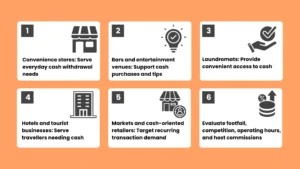
Profitable ATM placement starts with identifying businesses where customers regularly need cash and where existing cash access is inconvenient.
The best location is not necessarily the busiest location. It is the location that combines suitable footfall, repeat demand, manageable operating costs, and a fair agreement with the host business.
5 locations worth evaluating
- Convenience stores: Customers buy everyday products and sometimes need cash for small purchases.
- Bars and entertainment venues: Customers use cash for tips, entry fees, and selected purchases.
- Laundromats: Customers need convenient payment options for washing and drying clothes.
- Hotels and tourist businesses: Travellers sometimes need cash for local purchases and services.
- Markets and cash-oriented retailers: Customers and vendors can create regular demand for cash withdrawals.
These are potential placement opportunities, not guaranteed profitable sites. Evaluate each location individually.
How to evaluate a location before installing an ATM
Follow this process before investing in a machine:
- Count customer visits during different days and operating hours.
- Check whether an existing ATM serves the same customers.
- Ask the business owner about customer requests for cash access.
- Estimate monthly withdrawals using realistic assumptions.
- Calculate the host commission, service expenses, and cash replenishment costs.
- Sign a written placement agreement before installation.
For example, a location with 10 daily withdrawals produces approximately 300 monthly transactions over a 30-day month. At a $3.25 surcharge, gross monthly revenue reaches $975 before expenses.
However, 10 withdrawals per day is a forecast, not an established result. Validate demand before committing startup capital.
How Much Startup Capital Does an ATM Business Require?
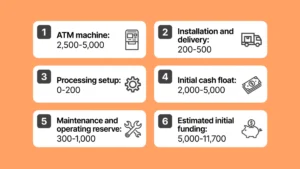
Startup capital covers the ATM, installation, payment processing, working cash, and initial operating expenses.
The following estimates provide an illustrative US planning budget for one independently operated machine. Actual supplier quotations, machine specifications, and location requirements determine the final amount.
| Startup expense | Illustrative cost |
| ATM machine | $2,500 to $5,000 |
| Installation and delivery | $200 to $500 |
| Processing setup | $0 to $200 |
| Initial cash float | $2,000 to $5,000 |
| Initial maintenance and operating reserve | $300 to $1,000 |
| Estimated initial funding | $5,000 to $11,700 |
The cash float is working capital, not an ordinary operating expense. It remains tied up in the business until the operator recovers the cash through settlement and subsequent cash management.
A machine with greater withdrawal demand needs a larger cash float. Operators must also account for insurance, business registration, financing, taxes, and any location-specific requirements that the initial budget does not cover.
Buying an ATM versus using a placement partner
Buying a machine gives the operator more control over equipment and revenue arrangements, but it requires more upfront capital and direct responsibility for maintenance and cash management.
A placement partner can supply the machine, arrange installation, manage processing, and handle cash replenishment. The operator or host business receives the agreed share of revenue, so the income per withdrawal is usually lower than in a fully self-operated arrangement.
Choose the model that matches your capital, available time, and willingness to manage operational responsibilities.
How to Calculate the ATM Business Break Even Point
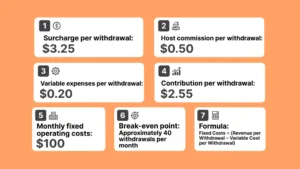
The break even point is the number of monthly withdrawals required to cover the machine’s operating costs and any monthly capital repayment included in the calculation.
Use this formula:
Break-evenwithdrawals=MonthlyfixedcostsRevenueperwithdrawal-Variablecostperwithdrawal
Consider a machine that charges $3.25 per withdrawal, pays the host $0.50 per transaction, and incurs another $0.20 in variable transaction-related expenses. Monthly fixed operating costs are $100.
The contribution per withdrawal is: $3.25 – $0.50 – $0.20= $2.55
The monthly break even point is: $100 divide by $2.55 approx 40
The machine therefore needs approximately 40 completed withdrawals per month to cover the assumed $100 in fixed costs, before taxes, financing, depreciation, and owner labour.
This calculation also shows why operators need to include every relevant expense. A machine can generate positive cash flow while still taking a long time to recover its purchase price.
How to Start an ATM Business Step by Step
Starting an ATM operation requires market research, a suitable machine, a reliable processor, a written location agreement, and enough working cash to maintain service.
Step 1: Research market demand
Identify businesses where customers regularly need cash. Compare potential locations based on footfall, nearby alternatives, opening hours, and estimated withdrawal volume.
Speak with business owners before purchasing equipment. Their willingness to host a machine does not prove demand, but it helps establish whether a placement agreement is realistic.
Step 2: Register the business
Choose an appropriate business structure and complete the registration, tax, and banking requirements applicable to your jurisdiction.
In the United States, ATM operators must also review relevant federal and state requirements, including accessibility, transaction disclosures, security, and any applicable registration obligations. Confirm requirements with the relevant authorities before operating.
Step 3: Select the ATM and processor
Choose equipment that meets the needs of the location and is compatible with your processing network.
Check cash capacity, connectivity, security features, warranty coverage, spare-part availability, and service support.
Compare processors based on transaction fees, settlement arrangements, network compatibility, reporting, and technical support. Confirm the actual income and expenses in writing.
Step 4: Secure the placement agreement
The written agreement needs to specify who owns the machine, who supplies cash, how the host gets paid, who handles repairs, and who is responsible for damage or theft.
It should also cover the contract term, surcharge decisions, access to transaction reports, insurance responsibilities, and termination conditions.
Step 5: Fund and install the machine
Arrange the purchase, delivery, installation, and initial cash float. Test the machine, verify processing connectivity, and confirm that transaction receipts and fee disclosures work correctly.
Keep records of the machine’s serial number, installation details, service contacts, and cash reconciliation.
Step 6: Monitor performance every month
Review withdrawal counts, surcharge income, processor deductions, cash shortages, downtime, and host payments.
Compare actual results with the original forecast. Relocate a consistently underperforming machine when the placement agreement permits it and the expected improvement justifies the cost.
How to Get ATM Customers and Secure More Locations
Customer acquisition for an ATM business mainly means winning placement agreements with businesses that already attract customers who need cash.
Unlike a typical retail business, ATM operators do not usually need to attract every withdrawal customer through advertising.
The host location supplies the foot traffic, while the operator focuses on securing suitable sites and keeping machines available.
Use these 4 methods to acquire locations:
- Direct business outreach: Contact convenience stores, laundromats, bars, and independent retailers to discuss their customers’ cash requirements.
- Local business networking: Build relationships with commercial property managers, shop owners, and business associations.
- Placement referrals: Ask existing host businesses to introduce you to other owners in their network.
- Clear financial proposals: Explain installation responsibilities, revenue sharing, servicing, and the benefits of providing convenient cash access.
Prepare a short proposal showing the responsibilities of both parties and the estimated revenue under different transaction volumes. Avoid promising fixed income unless your agreement genuinely supports that commitment.
How to Scale an ATM Business
Scaling an ATM business means increasing the number of profitable placements while controlling servicing costs, cash requirements, and administrative work.
Adding machines increases potential revenue, but each new location also requires working capital, monitoring, and operational support.
Expand using verified results
Start with one machine and record its performance for at least 3 months. Use actual withdrawal data to identify the locations, surcharge levels, and host agreements that produce the strongest contribution.
For example, if 5 machines each generate $300 in monthly operating profit, the combined operating profit is $1,500 per month. This calculation assumes all 5 machines achieve the same results and excludes central overhead, taxes, and financing.
Improve cash management
Set replenishment schedules according to actual transaction patterns. Remote monitoring, transaction reports, and cash-level alerts help operators reduce unnecessary trips and avoid machines running out of cash.
Plan for scaling the team
An operator with a small route can manage routine visits independently. As the network expands, cash servicing, repairs, bookkeeping, and location acquisition can require additional staff or specialist contractors.
Hire or outsource only when the additional cost is justified by time savings, improved machine uptime, or increased transaction revenue.
Reinvest in profitable locations
Prioritise new placements with proven demand instead of buying additional machines simply to increase the fleet size. A smaller network of profitable machines can outperform a larger network of weak locations.
Is an ATM Business a Good Passive Income Opportunity?
An ATM business can produce recurring income, but it is not completely passive because cash replenishment, maintenance, compliance, and location management require ongoing attention.
The workload depends on the operating model. A placement partner can handle much of the day-to-day work, while a self-operated machine gives the owner greater control and responsibility.
For readers exploring Business Ideas, this model offers a way to build a location-based service business. It also belongs in discussions about passive income business ideas usa, provided the distinction between recurring revenue and genuinely hands-off income remains clear.
The same principle applies when comparing unrelated opportunities, such as a spice business. Each business needs its own assessment of capital, customer demand, operating costs, and realistic returns.
Before investing, consider whether you can fund the cash float, maintain reliable service, and secure locations with enough demand to cover expenses.
Common ATM Business Mistakes to Avoid
The most expensive mistakes involve overestimating withdrawals, overlooking costs, and committing to unsuitable locations.
Avoid these 5 errors:
- Buying machines before securing locations: Equipment without a suitable placement can remain unused while tying up capital.
- Forecasting revenue from footfall alone: Busy premises do not automatically produce high ATM transaction volumes.
- Ignoring cash requirements: The machine needs enough available cash to meet demand, particularly during busy periods.
- Accepting unclear agreements: Unspecified commissions, repair responsibilities, and termination conditions can reduce profitability.
- Treating gross revenue as profit: Surcharge income must cover operating expenses, host payments, financing, and taxes before the owner can determine actual earnings.
Review these risks before expanding the network or committing to a long-term placement.
Frequently Asked Questions
How much does an ATM operator earn per withdrawal?
An ATM operator earns primarily from the surcharge paid by the customer. In the United States, the average surcharge was $3.22 in 2025, according to Bankrate’s annual fee study.
The operator’s actual earnings per withdrawal are lower after host commissions, processing charges, and other applicable expenses.
How many withdrawals does an ATM need to be profitable?
The required number depends on the surcharge, variable cost per withdrawal, and monthly fixed expenses. Use the break even formula to calculate the minimum volume rather than relying on a general industry estimate.
Who pays for the cash inside an ATM?
In a self-operated model, the operator usually supplies the working cash. Under a managed placement arrangement, the placement company can supply and replenish the cash according to the contract.
Can one ATM generate monthly income?
Yes. One ATM can generate recurring surcharge revenue when customers use it regularly. The amount left after expenses depends on the location, transaction volume, fee structure, cash servicing, and maintenance requirements.
Is an ATM business suitable for beginners?
An ATM business can suit beginners who understand cash management, can secure appropriate locations, and have enough capital for equipment and working cash.
Starting with one well-researched placement makes it easier to understand the operating costs before expanding.
Conclusion
An ATM business earns money by providing convenient access to cash and collecting a surcharge on completed withdrawals.
Its profitability depends on the number of transactions, the fee collected per withdrawal, the host’s commission, and the costs of operating the machine.
The practical approach is to research market demand, secure a suitable location, calculate the break even point, and monitor actual results before adding more machines. A profitable ATM operation starts with strong placement economics, not simply with purchasing an ATM.
Disclaimer: The prices mentioned in this article are estimates and may vary depending on location, equipment, supplier, market conditions, and business requirements.