How to Write a Startup Pitch Deck Investors Actually Read

Securing venture capital or angel investment begins long before a formal presentation it starts with an irresistible presentation deck. Knowing how to write a startup pitch deck that commands attention, communicates value, and drives follow-up meetings is essential for turning startup vision into funded reality.
Investors review hundreds of decks every month, spending an average of less than three minutes on an initial pass. To stand out in a crowded inbox, your deck must combine sharp storytelling, clear market validation, and concise financial modeling. This guide breaks down essential pitch deck templates, operational requirements, cost dynamics, and profit impacts to help you build a deck that converts casual glances into serious investor meetings.
What Is an Investor Pitch Deck?
An investor pitch deck is a concise 10-to-15 slide presentation designed to give venture capitalists, angel investors, and strategic partners a quick overview of your business model, market opportunity, and growth potential. Once your deck opens the door, the real challenge begins in the room our guide on how to pitch VC investors as a first-time startup founder covers what happens after the slides
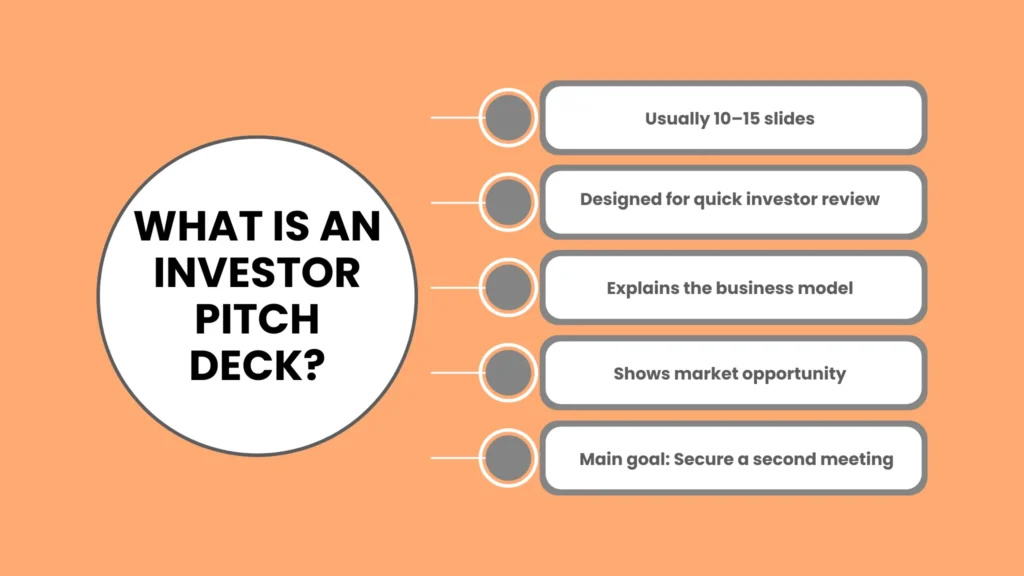
Unlike an internal business plan or operational roadmap, an external pitch deck is a high-level sales tool. Its primary goal is not to close an investment immediately, but to spark enough interest to secure a second, deeper meeting with fund partners.
Essential Pitch Deck Template for Startups
Structure is everything when catching an investor’s eye. Deviating too far from standard formats forces readers to hunt for critical details, increasing the chance they pass on your opportunity.
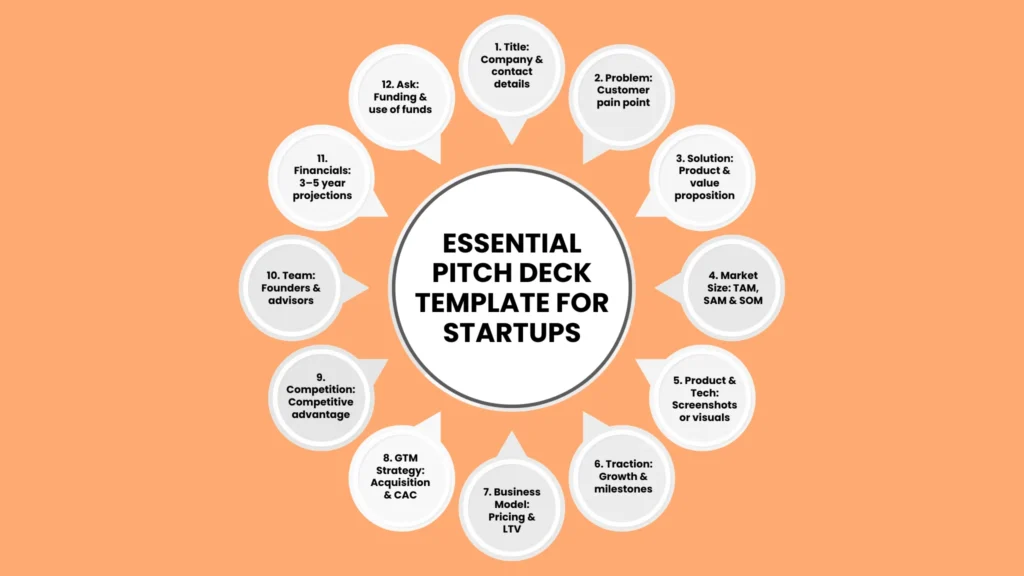
A proven, 12-slide pitch deck template for startups includes:
Title Slide: Company name, tag line, and contact info.
The Problem: The specific pain point your target audience experiences daily.
The Solution: Your product, unique value proposition, and key features.
Market Size (TAM, SAM, SOM): The total addressable market opportunity in dollars.
Product & Tech: Screenshots, dynamic workflows, or physical product visuals.
Traction & Milestones: Key metrics, subscriber growth, recurring revenue, or pilot results.
Business Model: How you make money, pricing tiers, and customer lifetime value (LTV).
Go-To-Market (GTM) Strategy: Customer acquisition channels, distribution partners, and CAC.
Competitive Landscape: A clear visual grid showing your strategic advantage.
Team: Founders, key executives, and notable advisors with relevant industry backgrounds.
Financial Projections: 3-to-5-year revenue, gross margin, and cash burn projections.
The Ask / Use of Funds: Target funding amount, key milestones to achieve, and runway timeline.
Is Write a Startup Pitch Deck Profitable?
Founders often ask: is write a startup pitch deck profitable for an early-stage business? While crafting a presentation deck is an administrative and strategic process rather than a direct sales activity, its return on investment (ROI) is massive when executed correctly.
A well-crafted pitch deck directly unlocks seed or growth capital, giving your startup the cash reserves needed to scale operations, hire senior talent, and capture market share.
Beyond capital generation, the process of writing a pitch deck forces founders to refine their core unit economics, sharpen their value proposition, and evaluate their long-term write a startup pitch deck profit margin potential. Clearly defining gross margins, customer acquisition costs, and churn rates in your deck ensures you build a sustainable business model long before meeting with venture capitalists.
Write a Startup Pitch Deck Cost Dynamics
Understanding the write a startup pitch deck cost landscape helps founders balance speed, design quality, and financial resources. Expenses range from completely free DIY approaches to high-end boutique agency engagements.
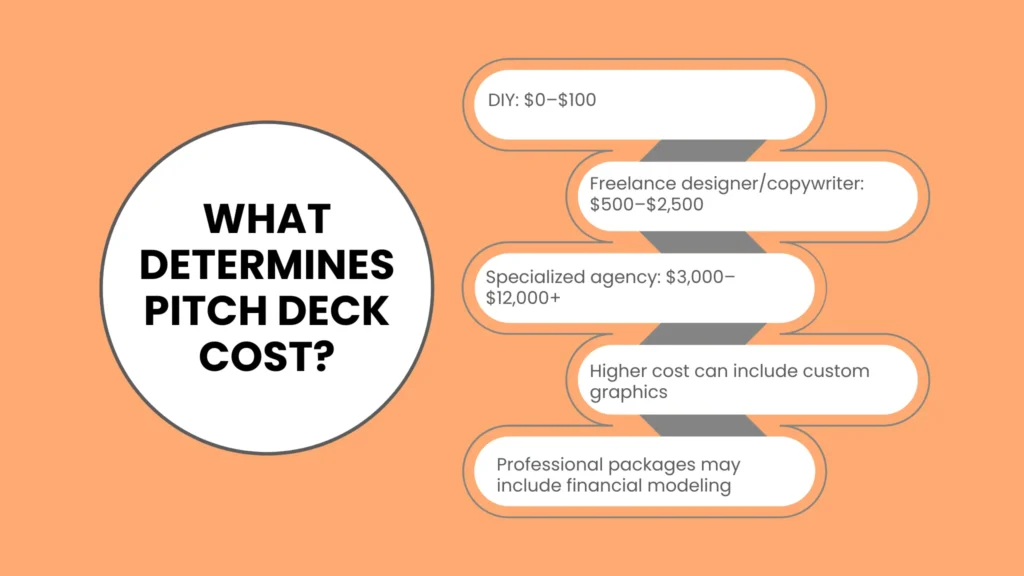
Based on available market data, founders can choose from three main creation paths:
Pitch Deck Creation Cost Options
Core Write a Startup Pitch Deck Requirements
Meeting baseline structural and analytical criteria is necessary before sending slides to potential backers. Fulfilling these write a startup pitch deck requirements keeps your deck polished and persuasive.
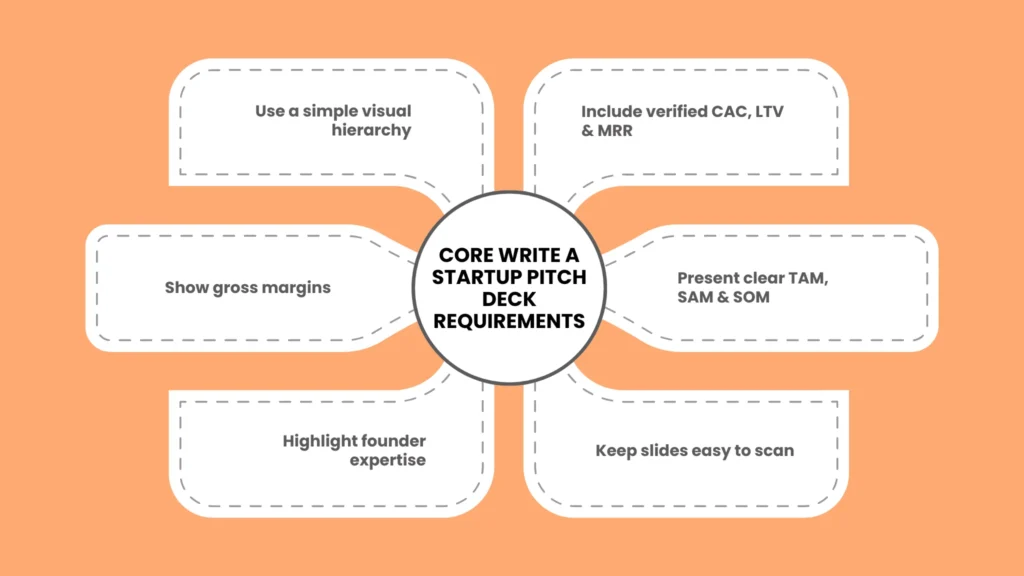
1. Simple, Legible Visual Hierarchy
Avoid dense text blocks, tiny font sizes, and complex diagrams. Use bold headers, high-contrast text, clear visual spacing, and minimal bullet points to ensure slides can be scanned in seconds.
2. Validated Financial and Unit Economic Metrics
Investors immediately analyze your financial assumptions. Include verified metrics for Customer Acquisition Cost (CAC), Lifetime Value (LTV), Monthly Recurring Revenue (MRR), and Gross Margins.
3. Clear Target Addressable Market (TAM) Analysis
Demonstrate that your market is large enough to yield venture-scale returns. Break your market slides into Total Addressable Market (TAM), Serviceable Addressable Market (SAM), and Serviceable Obtainable Market (SOM).
4. Direct Founder and Team Attribution
Highlight past domain expertise, technical accomplishments, and previous exits. Investors place high weight on the team’s ability to execute the stated business plan.
7 Actionable Rules to Write a Pitch Deck Investors Love
Apply these principles to refine your presentation narrative:
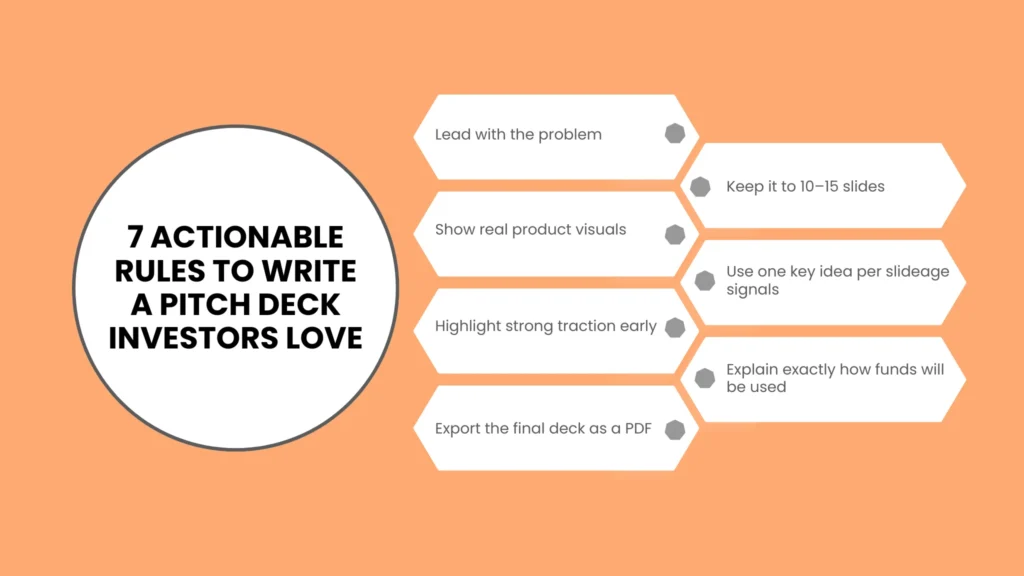
Rule 1: Lead with a Relatable Problem
Hook the reader on slide two with a sharp, relatable problem statement. Quantify the market inefficiency using clear metrics or time lost to show why current market alternatives fail.
Rule 2: Keep Total Slide Count Lean
Resist the temptation to include every detail about your product features. Limit your primary deck to 10-15 slides, moving technical architecture, legal agreements, and deep financial models to an appendix slide section.
Rule 3: Display Actual Product UI and Workflows
Replace generic clip art or abstract stock photography with high-resolution screenshots, product renders, or short video demos. Show exactly how users interact with your technology.
Rule 4: Focus on One Core Idea per Slide
Cramming multiple complex ideas onto a single slide confuses readers. Ensure each slide delivers one memorable takeaway reinforced by bold headers and visual graphics.
Rule 5: Highlight Traction Early
If you have strong user growth, active waitlists, or revenue traction, move your traction slide toward the front of your presentation. Early proof of market demand immediately changes how investors read the remaining slides.
Rule 6: Detail the Use of Raised Capital
Be transparent about how much capital you are raising and how funds will be split across product development, hiring, and customer acquisition. Show the exact runway milestone (e.g., 18 months of runway to reach $2M ARR) the investment delivers.
Rule 7: Format and Export for Mobile Review
Over 40% of investor reviews happen on mobile devices or tablets. Always export your final presentation as a clean PDF file to prevent broken fonts, shifted margins, or media playback failures.
Common Pitch Deck Mistakes to Avoid
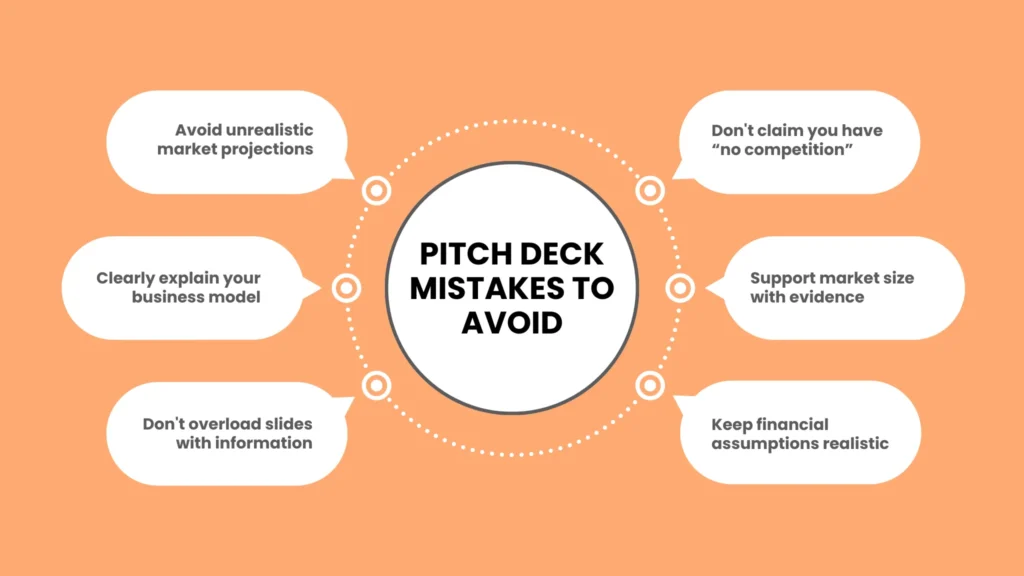
Overly Optimistic Market Projections: Claiming you will easily capture “1% of a $100B market” without showing an actionable customer acquisition plan signals a lack of strategic depth.
Ignoring Direct Competitors: Stating you have “no direct competition” is a red flag. It tells investors either the market does not exist or you have not researched competitors thoroughly.
Unclear Business Model: If an investor cannot tell how your company makes money by slide seven, your narrative lacks clarity.
Final Thoughts: Pitching with Clarity and Confidence
Learning how to write a startup pitch deck effectively is an indispensable founder skill. A polished pitch deck acts as your business’s visual ambassador, translating complex product features into a compelling investment thesis.
Focus on clear visual structure, substantiate your growth metrics, and refine your pitch narrative until every slide serves a distinct purpose. For customizable presentation frameworks, dynamic financial modeling sheets, and fundraising guides, explore the resources at reliablestartup.
Frequently Asked Questions
What is the ideal slide count for an initial investor pitch deck?
The optimal deck size is between 10 and 15 slides. This allows you to cover all key business areas without losing the reader’s attention during an initial screen.
Should I send my deck as a PDF file or a presentation link?
Send a trackable PDF or a viewable presentation link via specialized pitch deck hosting platforms. Avoid sending raw PowerPoint files, which can alter formatting across different operating systems.
What is the difference between a read-deck and a pitch-deck?
A “read-deck” is sent via email for independent reading and contains slightly more descriptive text. A “presentation-deck” is designed to be projected behind a speaker during a live pitch and relies primarily on visual elements with minimal slide text.
How detailed should my financial slides be?
Keep your primary financial slide high-level, showing 3-to-5-year projections for revenue, gross margin, cash burn, and EBITDA. Keep comprehensive financial models and line-item budgets in your appendix or virtual data room.