How to Sell a Rental Business and What Buyers Look At
Selling a rental business, whether your inventory spans heavy equipment, tools, real estate, event supplies, or party rentals, demands a clear strategy that extends far beyond creating an asset list. Understanding how to sell a rental business successfully requires a clear assessment of asset values, recurring revenue potential, operational efficiency, and customer retention.
Traditional retail models depend on one-off transactional inventory sales. In contrast, a rental company’s enterprise value is anchored in asset utilization rates, recurring revenue potential, detailed maintenance histories, and deep customer retention.
To command a peak market valuation and navigate a smooth transition of ownership, you need to analyze your company through the eyes of a potential buyer. Ultimately, executing a high-value transaction requires disciplined exit planning, immaculate financial reporting, and a clear grasp of industry-standard valuation metrics.
1. Understanding Rental Business Valuation: What Is Your Business Worth?
A realistic valuation forms the cornerstone of every successful deal. Therefore, prospective buyers focus primarily on how reliably your operations generate predictable cash flow while accounting for the capital expenditure (CapEx) required to maintain and replace aging rental assets.
SDE vs. EBITDA
The right financial metric depends heavily on the size, scope, and leadership structure of your operation:
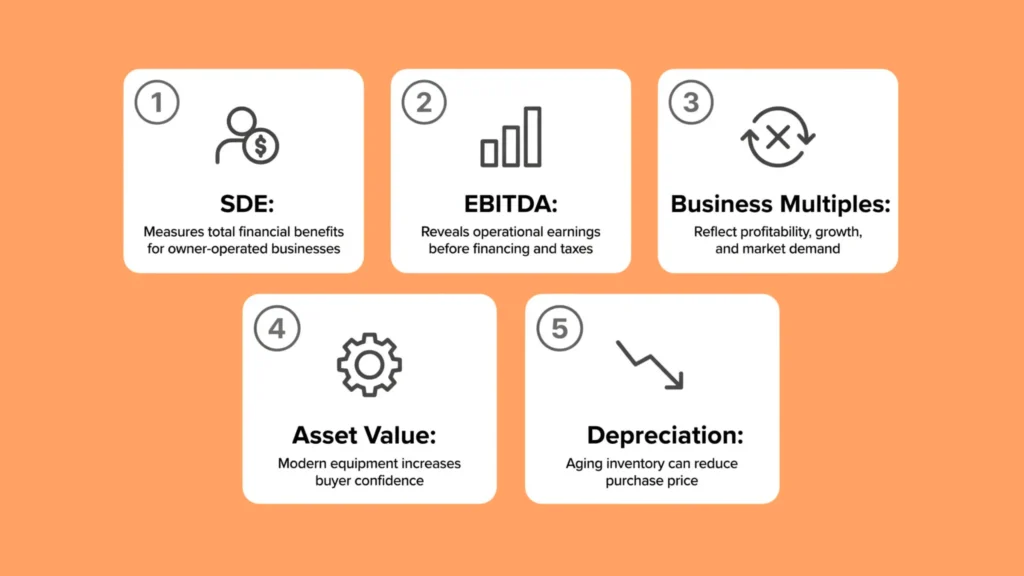
Seller’s Discretionary Earnings (SDE): Best suited for smaller, owner-operated setups generating under $1 million in annual revenue. Specifically, SDE recalculates net profit by adding back owner compensation, discretionary perks, and non-recurring expenses to reveal the full financial yield available to a single operator.
Earnings Before Interest, Taxes, Depreciation, and Amortization (EBITDA): Standard for mid-sized to enterprise-level businesses. Consequently, EBITDA reflects core operational cash flow by stripping out capital structure nuances and tax environments.
Understanding how buyers evaluate comparable equipment rental businesses for sale can also help sellers establish realistic expectations before entering negotiations.
The EBITDA Multiple in the Rental Industry
Rental enterprises typically command purchase multiples between 3.5x and 7x EBITDA, with precise pricing shaped by market trends, company size, and growth trajectory. Furthermore, buyers pay premium multiples for businesses featuring:
High asset utilization metrics
Long-term commercial service contracts
Modern, well-maintained fleets or inventory units
Integrated rental management software and automated operational workflows
Evaluating rental business profit margins alongside EBITDA helps owners understand how operational profitability influences overall business value.
Equipment and Asset Depreciation
Buyers perform deep audits of your balance sheet. While fixed depreciation schedules impact reported net profits, acquirers evaluate the actual Fair Market Value (FMV) alongside the Original Equipment Cost (OEC) of your fleet. As a result, up-to-date equipment with substantial remaining useful life reduces downstream CapEx exposure, boosting buyer confidence and enterprise value.
Understanding the resale market and considerations involved in buying used rental equipment can help sellers estimate the remaining market value of their existing fleet.
2. Key Metrics Buyers Analyze During Due Diligence
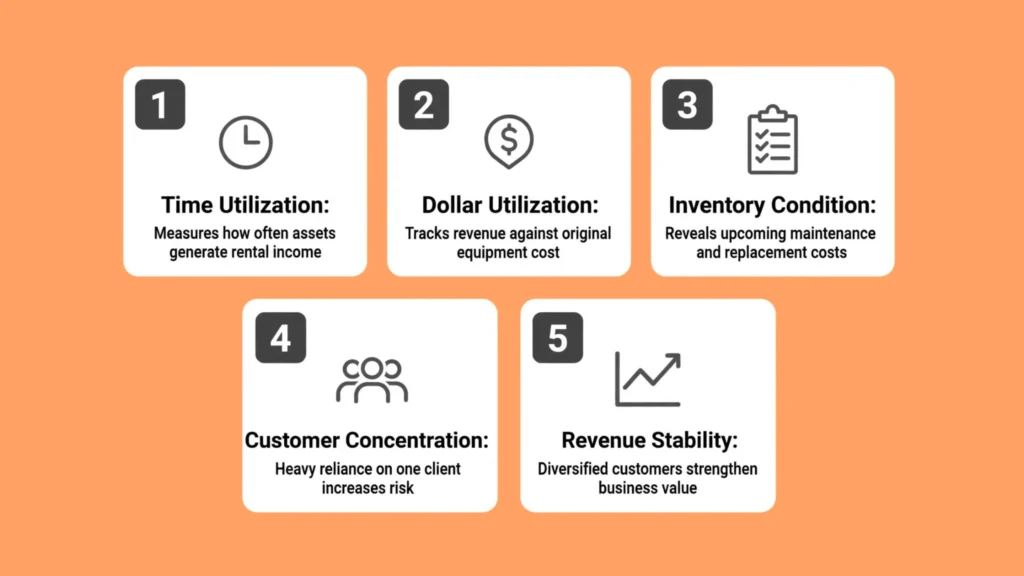
During financial and operational due diligence, buyers inspect specific key performance indicators (KPIs) to measure efficiency, asset performance, and overall risk.
Time Utilization vs. Dollar Utilization: Time utilization calculates the percentage of total available time an asset spends on rent, serving as a clear gauge of market demand. Meanwhile, dollar utilization divides annual rental revenue by original equipment cost, demonstrating how effectively your capital investments generate top-line earnings.
Age and Condition of Inventory: Older equipment flags impending capital replacement costs. If assets are reaching the end of their operational lifespan, buyers will discount their purchase offers to cover future equipment replacements. Thus, maintaining complete, digitized service records protects your asking price from such clawbacks.
Customer Concentration and Revenue Stability: Relying on a single customer for more than 10% to 15% of overall revenue introduces a noticeable risk profile. On the other hand, spreading your revenue across a balanced base of commercial, construction, event, and residential client segments establishes stability that earns higher valuation multiples.
3. Step-by-Step Guide: How to Sell a Rental Business
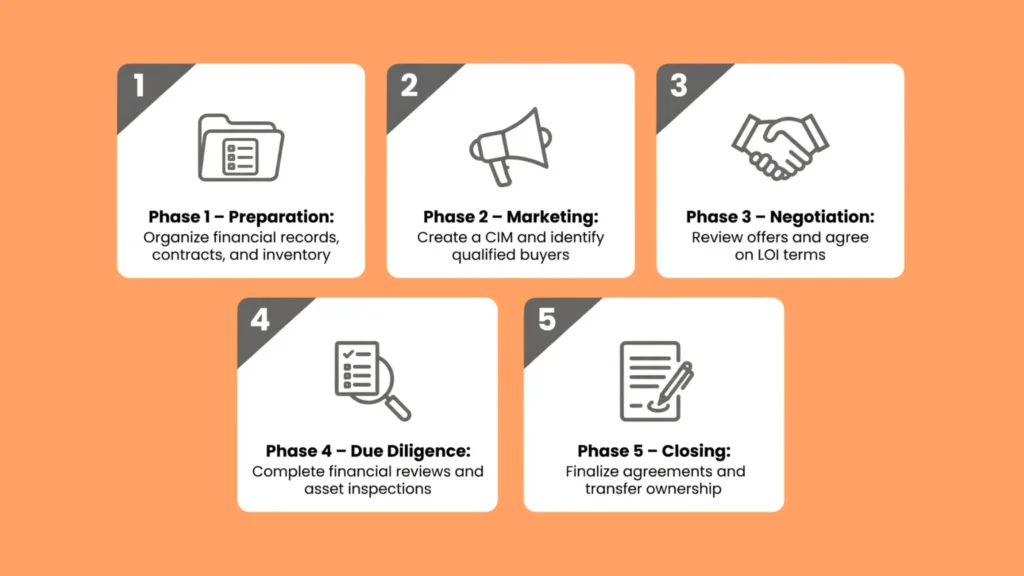
Selling your business requires a structured, multi-phase execution strategy. Following this step-by-step roadmap allows you to keep daily operations thriving while working through transaction milestones.
Phase 1: Preparation and Planning
Audit financial records thoroughly and eliminate personal or non-essential business expenses.
Formalize vendor agreements, client leases, and property contracts.
Organize granular service logs and equipment maintenance histories.
Reduce owner dependency by cross-training operational managers to handle daily activities.
Phase 2: Marketing and Negotiation
Collaborate with your advisor to author a compelling Confidential Information Memorandum (CIM).
Vet prospective buyers rigorously and secure executed Non-Disclosure Agreements (NDAs) before sharing materials.
Compare competing acquisition offers and negotiate key transaction terms inside a structured Letter of Intent (LOI).
Phase 3: Due Diligence and Closing
Support Quality of Earnings (QoE) audits and detailed financial verification.
Facilitate hands-on asset counts and third-party physical equipment inspections.
Draft final legal agreements, execute the definitive purchase contract, and finalize wire transfers.
4. Operational Factors That Increase Business Value
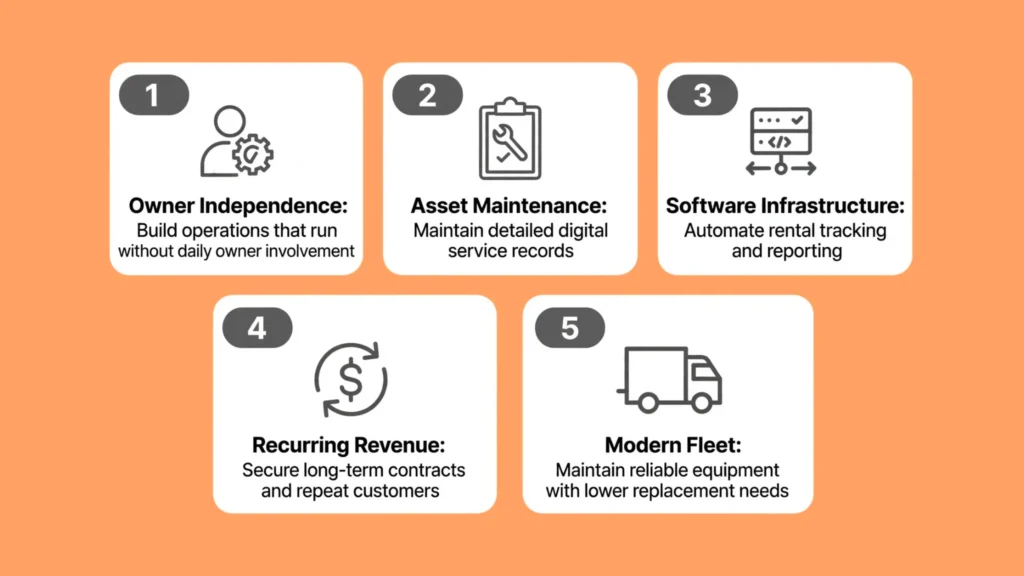
Optimizing core operational drivers well in advance of hitting the market will directly enhance your ultimate deal terms:
| Operational Vector | Low-Valuation Profile | High-Valuation Profile |
| Owner Involvement | Owner handles daily repairs, scheduling, and logistics. | Business runs autonomously under capable middle management. |
| Asset Maintenance | Missing, informal, or paper-based service notes. | Comprehensive digital service records categorized per serial number. |
| Software Infrastructure | Manual tracking via physical clipboards or isolated spreadsheets. | Fully integrated specialized rental ERP/CRM software platforms. |
| Revenue Model | Heavily dependent on ad-hoc, single-use rentals. | High percentage of recurring service contracts and long-term lease agreements. |
| Equipment Fleet | Aging inventory near end-of-life with deferred maintenance. | Staggered fleet age balance with minimal deferred maintenance. |
5. Common Pitfalls to Avoid When Selling
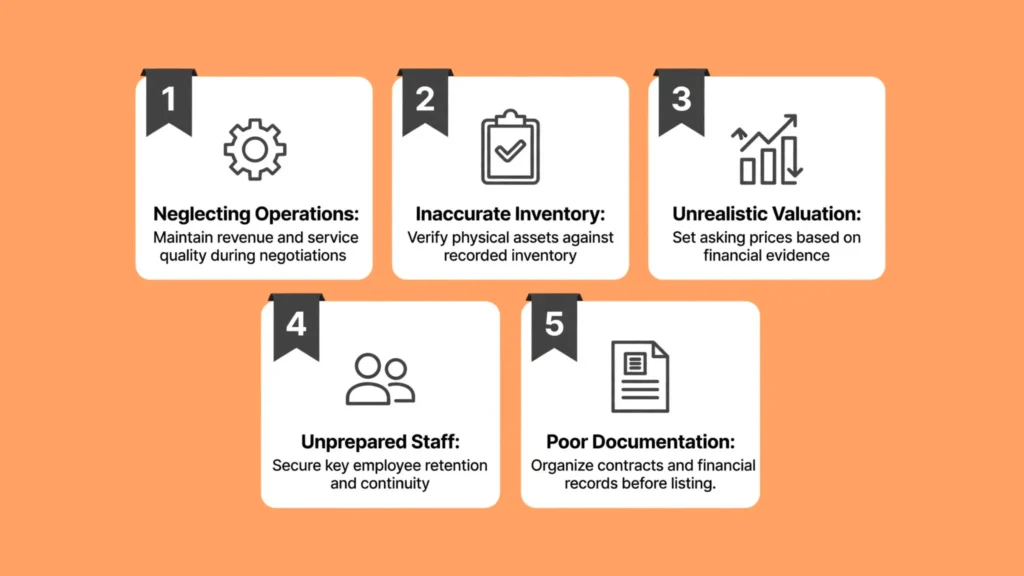
Neglecting the Business During the Sale Process: Becoming consumed by transaction negotiations often causes owners to let operational standards or sales slip. Consequently, a sudden dip in performance during due diligence can derail the entire transaction or force price renegotiations.
Inaccurate Inventory Counts: Discrepancies between physical assets on hand and your central asset register erode buyer trust. For this reason, complete a full physical inventory audit before launching marketing efforts.
Overestimating Business Worth: Setting an ungrounded asking price scares away credible acquirers and leaves your business stagnant on the market, signaling potential red flags.
Failing to Prepare Key Staff: Key employees are essential for operational continuity post-closing. Therefore, put retention plans or stay bonuses in place for vital personnel to reassure acquirers during the transition.
Frequently Asked Questions
How long does it take to sell a rental business?
The typical deal cycle takes 6 to 12 months from initial exit planning through to final closing. Generally, diligent asset evaluations, financial audits, and buyer financing approvals account for the majority of this window.
How are rental fleet assets valued during a sale?
Rental fleets are analyzed by combining Original Equipment Cost (OEC), Fair Market Value (FMV), and current depreciated book value. In addition, on-site physical inspections verify actual operational conditions and remaining useful life.
Should I sell asset-by-asset or sell the entire business entity?
Most buyers favor an Asset Purchase Agreement, taking over equipment, contracts, brand collateral, and intellectual property while leaving historical corporate liabilities behind with the seller. However, stock purchases transfer the legal entity entirely, though they are less frequent in lower-middle-market deals.
What is seller financing, and is it required?
Seller financing occurs when you defer a portion of the purchase price into a buyer note paid back over time with interest. While not mandatory, holding 10% to 30% in seller notes signals deep confidence in the ongoing stability of your company and attracts a broader pool of buyers.
What happens to existing customer contracts when I sell?
Customer lease contracts must typically be assigned to the incoming buyer. Fortunately, ensuring your contracts include standard assignability clauses allows revenue streams to transfer without requiring formal client renegotiations.
Final Thoughts
Selling a rental business represents the ultimate payoff for years spent committing capital, managing assets, and building customer relationships. By understanding buyer metrics, presenting transparent financials, tracking key utilization data, and executing a disciplined exit roadmap, you position your firm to secure a top-tier valuation. Ultimately, early planning combined with seasoned advisors remains your best investment for achieving a high-yield exit.
About The Author