Equipment Rental Businesses for Sale: How to Find, Evaluate, and Buy a Profitable Rental Business
The commercial equipment rental sector remains one of the most resilient, high-cash-flow opportunities in small-to-midmarket private equity. Driven by rising equipment purchase costs, supply chain considerations, and a permanent shift among contractors toward capital preservation, the global equipment rental market generates well over $130 billion annually. This growth trajectory is tracked closely by the American Rental Association, the industry’s leading trade association for equipment and event rental businesses.
Buying an existing rental company allows you to step directly into established cash flow, immediate fleet utilization, and a loyal B2B client base. However, acquiring an equipment rental business for sale is vastly different from buying a traditional service or software company. Equipment rental is fundamentally a heavy-asset logistics operation.
This guide breaks down how to source target acquisitions, navigate equipment rental business valuation, inspect a used equipment rental business fleet, and execute a profitable transaction when buying a rental business.
The Economics of an Equipment Rental Business
Understanding why entrepreneurs actively seek equipment rental businesses for sale requires looking at the core operational drivers of the model:
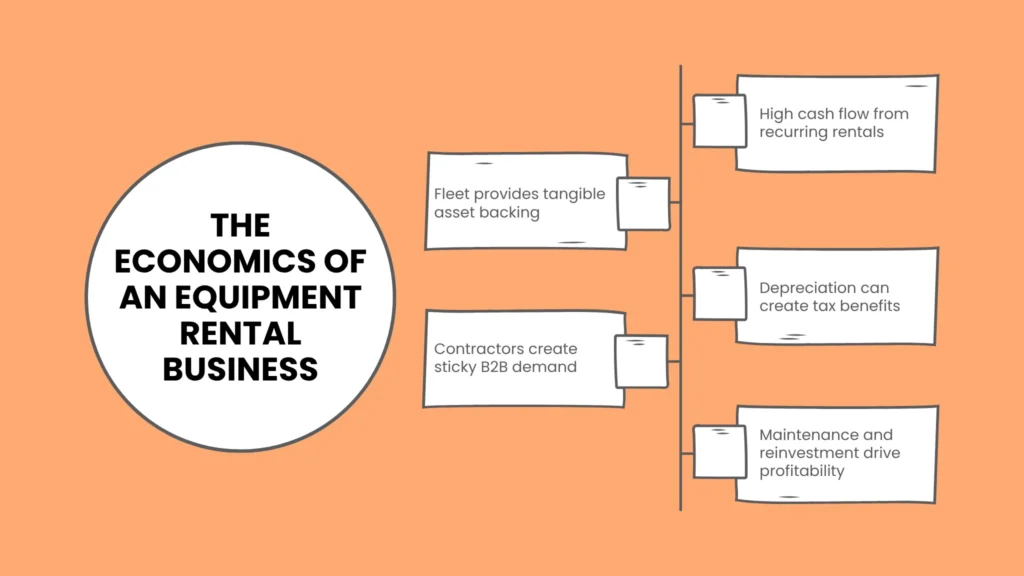
High Cash Flow Generation: Rental businesses produce significant EBITDA and Seller’s Discretionary Earnings (SDE).
Asset-Backed Security: Unlike service agencies where goodwill makes up the majority of the purchase price, a heavy equipment business is backed by tangible fleet machinery (skid steers, boom lifts, mini-excavators, generators).
Tax Benefits: Bonus depreciation and standard asset depreciation schedules offer buyers powerful tax shielding strategies.
Sticky B2B Relationships: General contractors, subcontractors, and industrial accounts rely heavily on predictable rental partners for ongoing jobs. For a broader look at how these margins compare across the sector, see our full equipment rental business plan guide.
Where to Find Equipment Rental Businesses for Sale
Finding viable targets requires balancing deal-sourcing channels—combining public market listings with direct, off-market outreach.
1. Business Brokerage Networks & Marketplaces
Main street and lower-midmarket deal sites are great starting points:
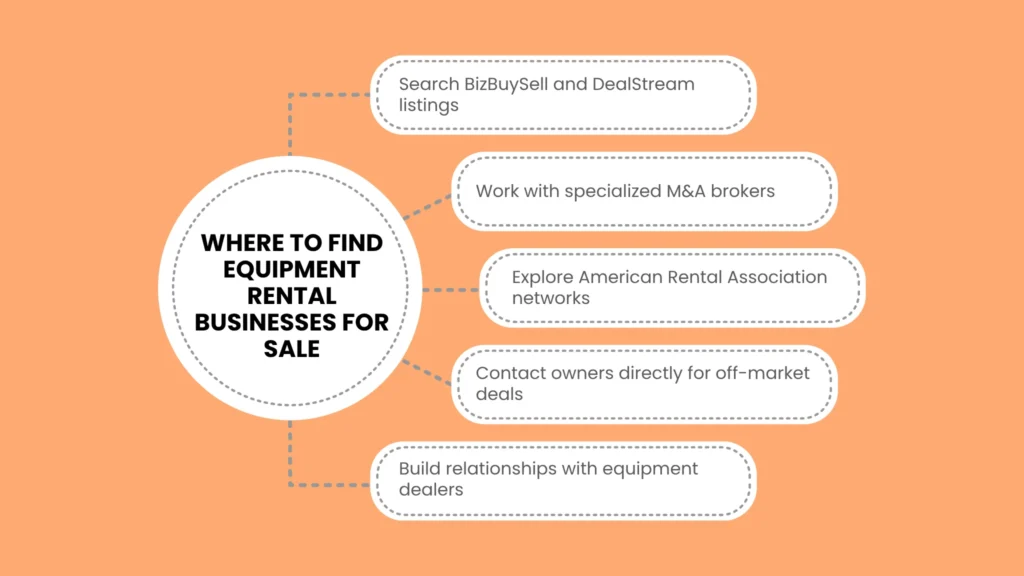
BizBuySell & DealStream: Filter for “Equipment Rental,” “Tool Rental,” or “Party & Event Rental”.
Niche Mergers & Acquisitions (M&A) Brokers: Middle-market M&A firms often maintain exclusive listings for multi-branch general equipment rental operations.
2. Direct Off-Market Deal Sourcing
The most lucrative targets are often owner-operated stores where the founder is nearing retirement age but hasn’t formalised a sales listing:
American Rental Association (ARA) Member Directories: Cross-reference local, independent regional rental stores with public records to identify owners who have operated for 15+ years.
Cold Outreach: Send tailored direct mail or LinkedIn outreach to owners offering a confidential, direct-buyer acquisition discussion (eliminating broker fees for the seller).
Equipment Dealer Representatives: Local machinery sales representatives (CAT, Bobcat, Kubota, John Deere) always know which independent rental yard owners are scaling down or considering exit strategies.
Equipment Rental Business Valuation: What Is a Rental Company Worth?
Valuing a rental operation requires running two parallel calculations: an earnings-based calculation and an asset appraisal. Lenders and buyers merge both to establish a fair market purchase price.
Benchmark Valuation Multiples
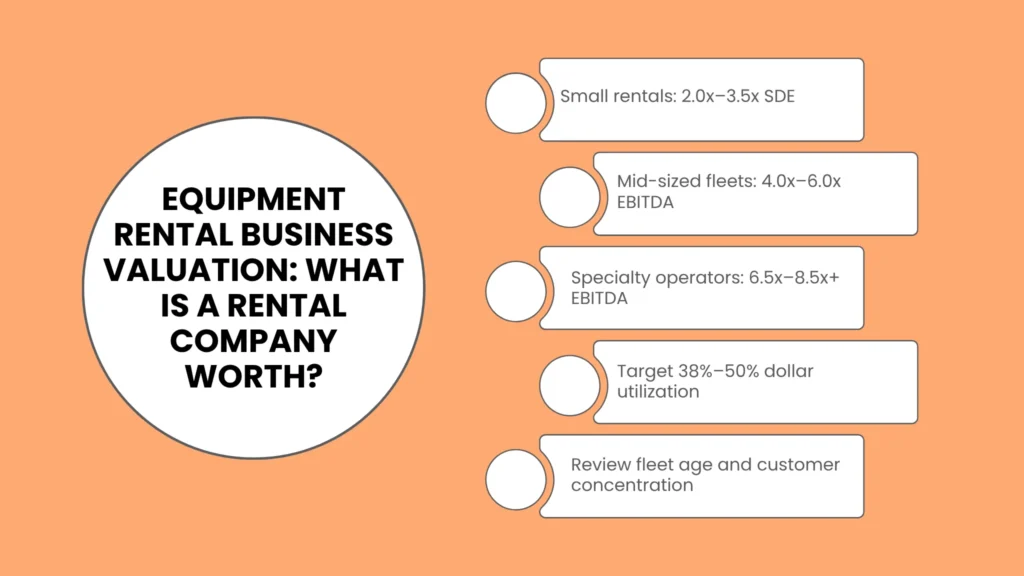
| Business Size & Segment | Typical SDE / EBITDA Multiple Range | Primary Valuation Anchor |
| Small Tool / General Rental ($100k–$400k SDE) | 2.0x – 3.5x SDE | Cash Flow / Owner Earnings |
| Mid-Sized Commercial Fleet ($500k–$2M EBITDA) | 4.0x – 6.0x EBITDA | EBITDA + Fleet Asset Appraisal |
| Specialty / Multi-Branch ($2M+ EBITDA) | 6.5x – 8.5x+ EBITDA | Strategic Scale & Market Share |
Key Valuation Formulas
1. Earnings Multiple Approach
$$\text{Enterprise Value} = \text{Normalized EBITDA} \times \text{Industry Multiple}$$2. Asset Liquidation Floor (OLV)
$$\text{Asset Floor} = \text{Orderly Liquidation Value (OLV) of Fleet} + \text{Working Capital}$$
Critical Metrics That Drive Valuation
Dollar Utilization (Financial Yield): Annual rental revenue divided by the Original Equipment Cost (OEC). A healthy target benchmark for mixed general construction fleets ranges from 38% to 50%.
Time Utilization: The percentage of days a machine is out on rent versus sitting in the yard. Healthy operations sit around 60% to 70%.
Fleet Age & Deferred CapEx: If the average age of the fleet is high, the seller’s reported cash flows may be artificially inflated due to deferred capital expenditures (not buying new machinery).
Customer Concentration: No single contractor account should represent more than 10% to 15% of total annual rental revenue.
Inspecting a Used Equipment Rental Business Fleet
When evaluating a used equipment rental business, the fleet is your primary asset. Conducting rigorous asset due diligence prevents unexpected capital outlays immediately after closing.
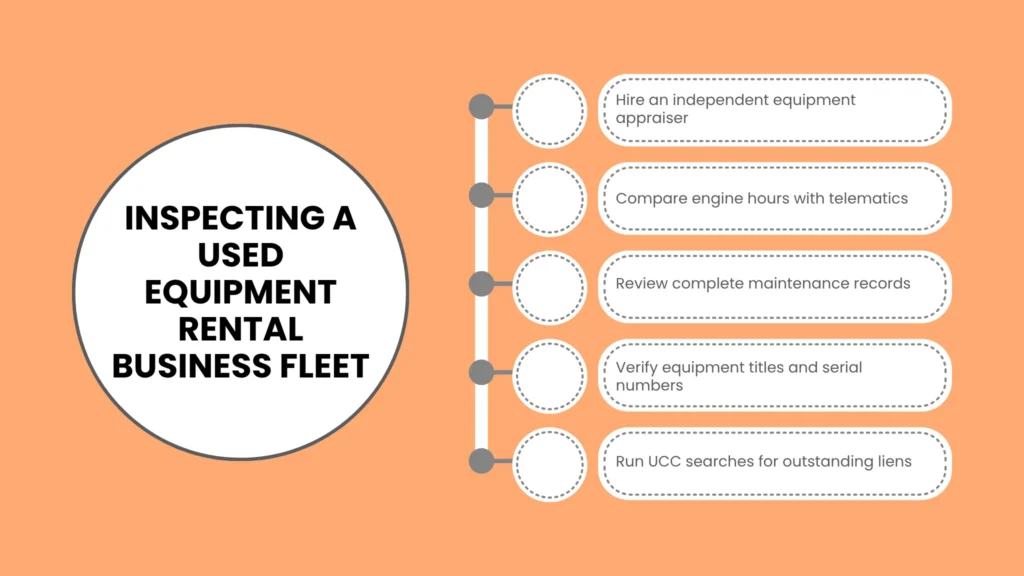
Essential Fleet Evaluation Checklist
Third-Party Equipment Appraisal: Hire an independent certified appraiser to establish the Orderly Liquidation Value (OLV) and Fair Market Value (FMV) of the entire fleet. Lenders use OLV to underwrite the loan.
Engine Hours vs. Age: Cross-check hour meters on key heavy assets (excavators, lifts, loaders) against telematics logs to confirm accurate usage recording.
Maintenance Logs: Review service records for all heavy assets. Irregular oil changes or skipped hydraulic servicing signals future maintenance backlogs.
Lien & UCC Searches: Run comprehensive UCC-1 lien searches to confirm every machine in the fleet is clear of third-party debt or claims.
Step-by-Step Process for Buying a Rental Business
Buying a rental business requires structured deal execution to protect your capital and ensure a smooth operational handoff.
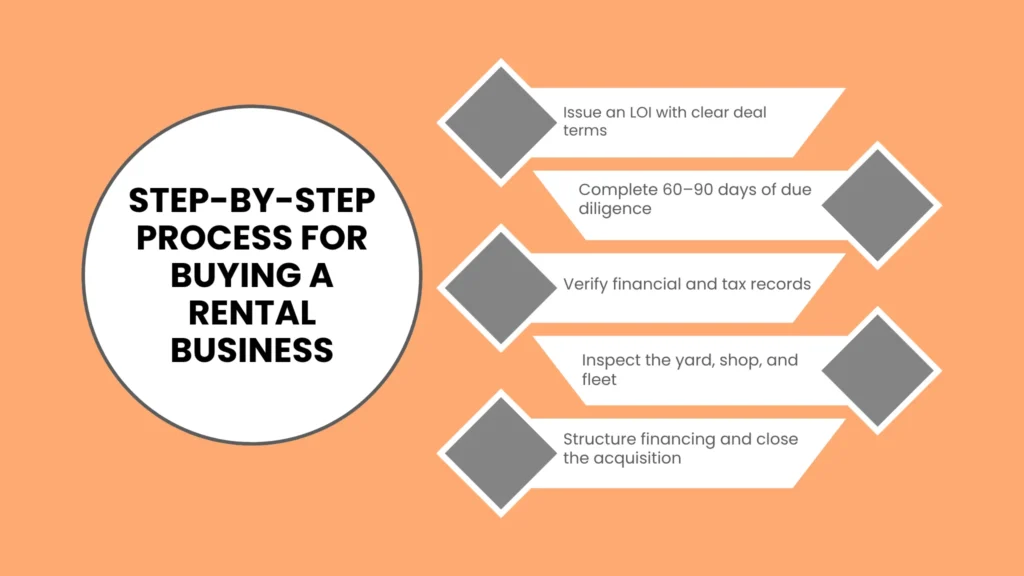
1. Issue a Letter of Intent (LOI)
Your LOI must outline the proposed purchase price, debt structure, working capital peg, and specific inclusions (all fleet inventory, delivery trucks, brand assets, and customer accounts).
2. Comprehensive Due Diligence
During the 60-to-90-day diligence window:
Financial Audit: Verify tax returns against quality-of-earnings (QofE) reports.
Yard & Shop Inspection: Inspect shop tools, wash bays, mechanics’ gear, and hazardous material storage compliance (waste oil, fuel tanks).
Contract Review: Review customer account terms, ongoing contractor service agreements, and commercial yard lease agreements.
3. Deal Structuring & Financing
Most small-to-midmarket equipment rental acquisitions rely on a combination of financing sources. If financing a full acquisition feels out of reach, our overview of rental business funding options covers alternative paths including SBA loans and seller financing.
Post-Acquisition Growth Strategies: Scaling Your New Rental Business
Once you assume ownership, focus on implementing high-leverage growth drivers:
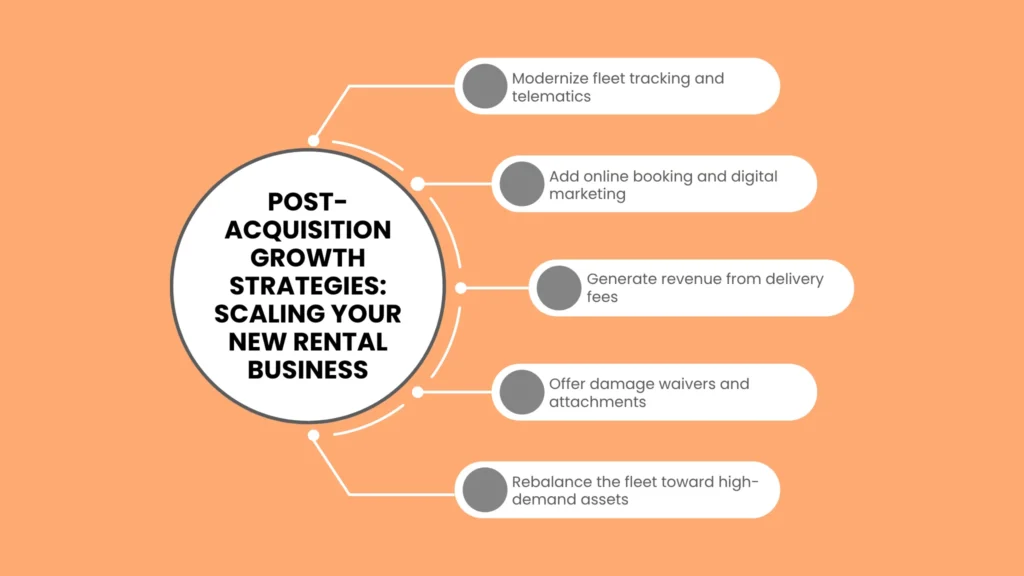
Modernize Telematics & Fleet Tracking: Equip every major asset with GPS tracking and telematics to monitor remote usage, track engine fault codes, and automate maintenance scheduling.
Optimize Digital Marketing & Online Booking: Transition from traditional counter-booking systems to web platforms with real-time fleet availability, direct online reservation capability, and transparent delivery pricing.
Introduce Ancillary Revenue Streams:
Delivery & Pickup Fees: Optimize route scheduling to make transportation a profitable profit center.
Damage Waivers: Offer optional 10% to 15% damage waiver insurance charges on rentals to generate high-margin revenue.
Consumable & Attachment Sales: Cross-sell safety gear, fuel, auger bits, and bucket attachments at checkout.
Rebalance Fleet Mix: Sell underperforming, low-utilization units via online auctions and reinvest the capital into high-demand, high-dollar-utilization assets.
Conclusion
Finding and acquiring the right equipment rental business for sale offers an exceptional entry point into an asset-backed, high-cash-flow industry. By rigorously appraising the fleet, conducting thorough due diligence on utilization rates, and structuring a balanced deal, you can acquire an operation designed for long-term compounding growth. For more guides, financial modeling frameworks, and acquisition strategies for your next venture, visit reliablestartup for practical resources for growing entrepreneurs.
Frequently Asked Questions
What is the most important metric when buying an equipment rental business?
Dollar utilization (annual rental revenue divided by the original equipment cost). It demonstrates how efficiently the fleet generates revenue relative to the capital invested in the machinery.
Should I buy the real estate along with the equipment rental business?
If possible, acquiring the yard real estate provides long-term stability, as relocation costs for heavy equipment yards (requiring specific industrial zoning, wash bays, and heavy vehicle turning radiuses) are substantial. If purchasing the property isn’t viable, secure a long-term lease (minimum 10 years with renewal options).
How do lenders view equipment rental acquisitions?
Lenders view equipment rental acquisitions favorably because the loan is collateralized by hard, tangible equipment assets with verifiable liquidation values.