How Much Does a Franchise Actually Cost to Open?
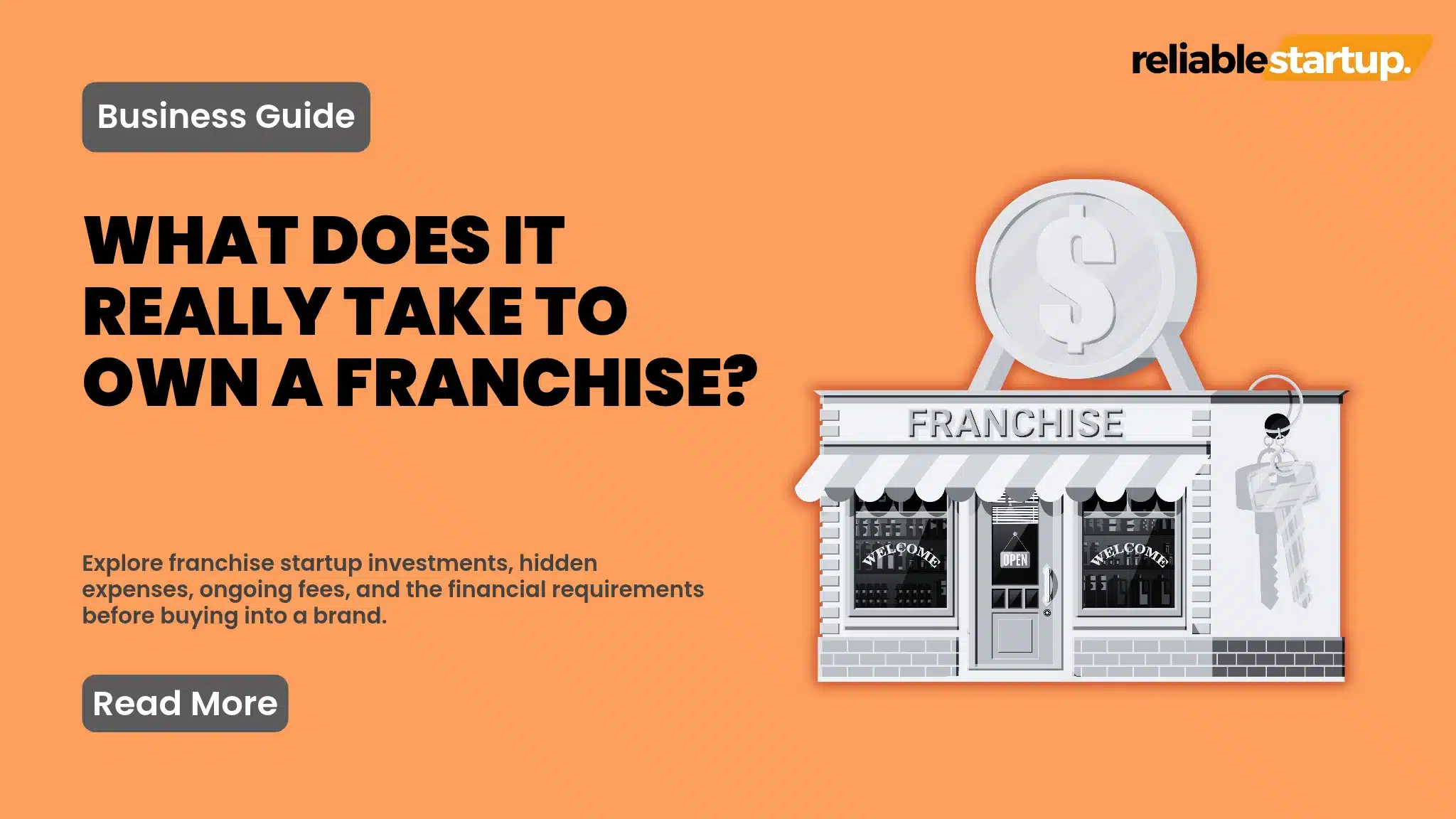
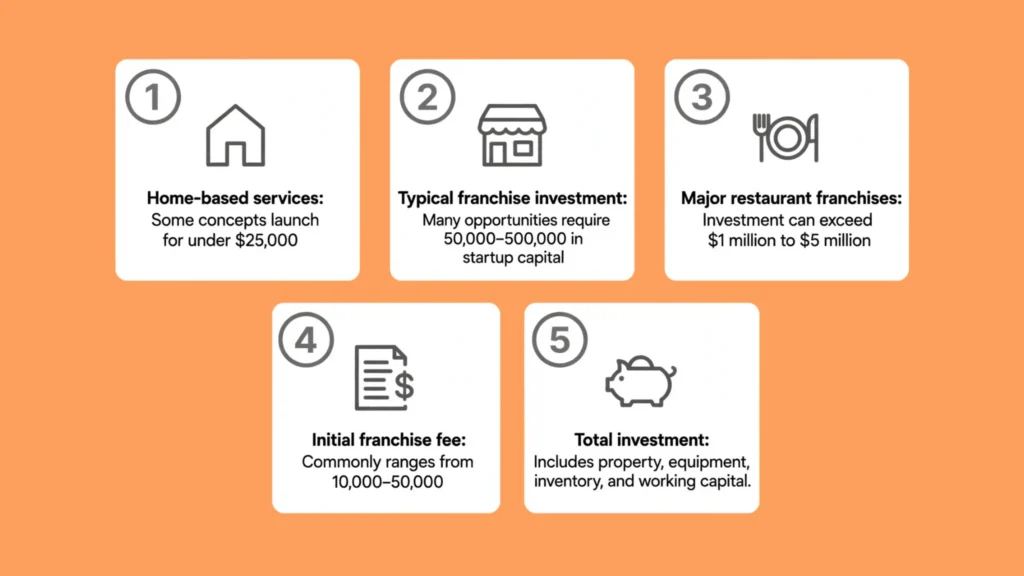
How Much Does a Franchise Cost? Opening a franchise typically costs between $50,000 and $500,000 in total startup capital, though home-based service concepts can launch for under $25,000 and major fast-food or hotel franchises often exceed $1 million to $5 million.
While marketing brochures often highlight an upfront franchise fee of $15,000 to $50,000, that payment is merely the admission ticket.
Understanding how much a franchise costs requires looking far beyond the initial brand licensing fee. Real estate build-outs, commercial equipment, initial inventory, working capital, and ongoing royalty percentages make up the bulk of your financial commitment.
For prospective business owners, separating headline fees from true launch expenses is the difference between a well-capitalized grand opening and running out of cash before reaching profitability.
Franchise Fee vs. Total Investment Range: What Is the Difference?
One of the most common misconceptions among first-time buyers is confusing How Much Does a Franchise Cost?
Initial Franchise Fee: This is a one-time, typically non-refundable lump sum paid directly to the franchisor when you sign the franchise agreement. For most brands, this fee falls between $10,000 and $50,000. It compensates the franchisor for trademark rights, initial training, proprietary operations manuals, and pre-opening support.
Total Investment Range: Disclosed in Item 7 of the Franchise Disclosure Document (FDD), this figure represents the complete franchise startup capital required to secure a location, build it out, stock it, open the doors, and sustain operations during the initial months.
Because the franchise fee usually accounts for less than 10% to 15% of total launch costs on brick-and-mortar concepts, evaluating an opportunity based solely on a low entry fee often leads to severe undercapitalization.
Typical Franchise Costs by Industry
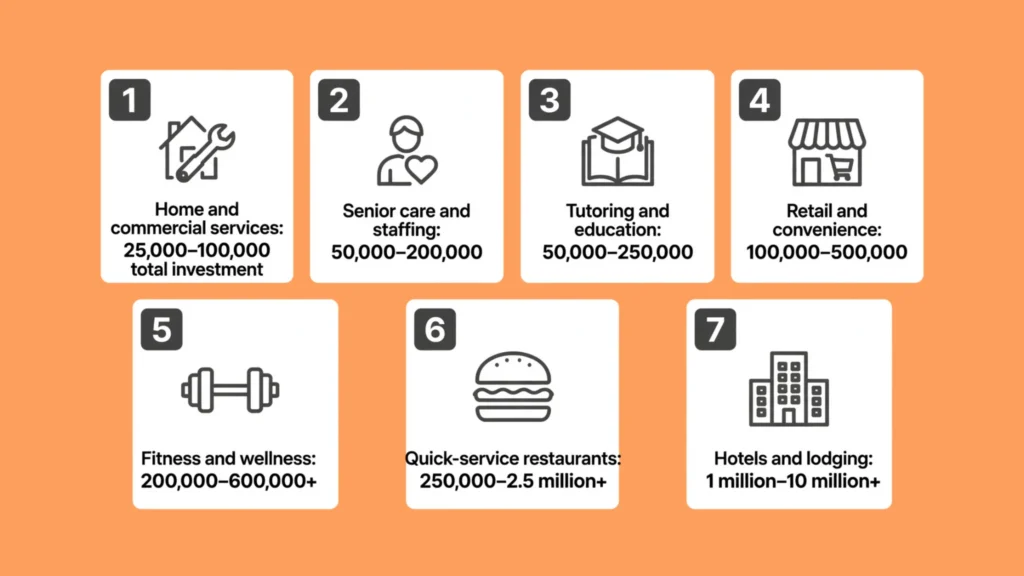
The total investment range varies dramatically depending on whether a business operates out of a van, a retail storefront, or a freestanding restaurant with a drive-thru. For example, service-based ventures such as a box truck business without a CDL may require a different startup budget, depending on vehicle costs, insurance, permits, and operating expenses.
| Industry Category | Typical Franchise Fee | Total Investment Range | Primary Cost Drivers |
| Home & Commercial Services (Cleaning, lawn care, repair) | $10,000 – $35,000 | $25,000 – $100,000 | Branded vehicles, tools, local digital marketing |
| Senior Care & Staffing | $25,000 – $50,000 | $50,000 – $200,000 | Office lease, licensing, caregiver recruiting, payroll |
| Tutoring & Education | $20,000 – $40,000 | $50,000 – $250,000 | Classroom build-out, curriculum materials, signage |
| Retail & Convenience | $20,000 – $45,000 | $100,000 – $500,000 | Opening merchandise inventory, shelving, POS systems |
| Fitness & Wellness Studios | $30,000 – $50,000 | $200,000 – $600,000+ | Specialized exercise equipment, flooring, sound systems |
| Quick-Service Restaurants (QSR) | $25,000 – $50,000 | $250,000 – $2.5 million+ | Commercial kitchen hoods, grease traps, drive-thru construction |
| Hotels & Lodging | $40,000 – $75,000+ | $1 million – $10 million+ | Land acquisition, ground-up construction, furnishings |
Line-by-Line Breakdown of Franchise Startup Capital
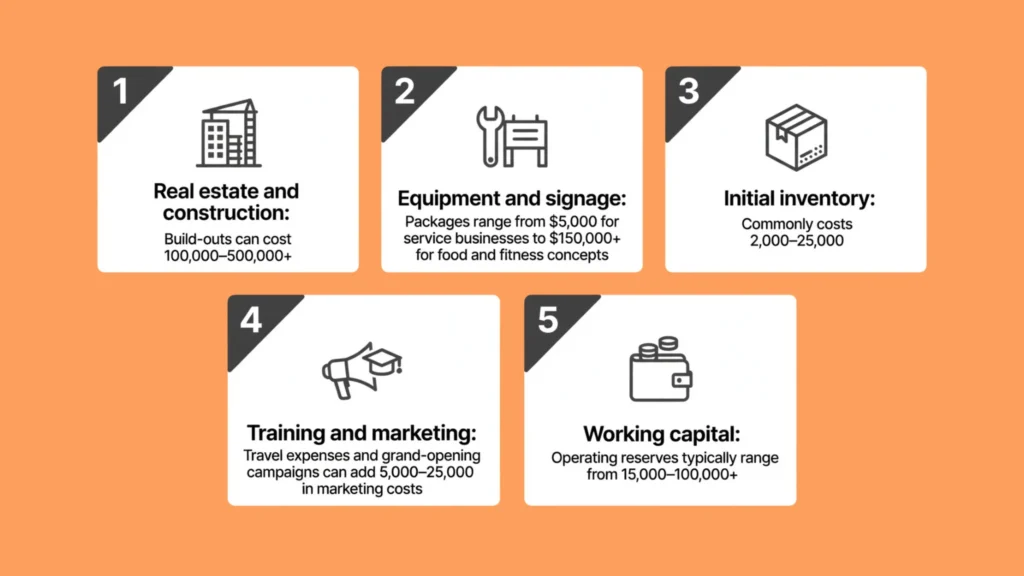
When reviewing a Franchise Disclosure Document, Item 7 itemizes every pre-opening expense into specific buckets. Understanding where your money goes helps you identify which estimates are fixed and which fluctuate based on your local market. For example, launching a senior home care business involves evaluating staffing, licensing, insurance, and initial operating expenses before opening.
1. Real Estate and Leasehold Improvements
For brick-and-mortar franchises, construction and build-out represent the single largest expense. Landlords sometimes offer Tenant Improvement (TI) allowances to offset construction, but converting a vanilla-shell retail space into a branded restaurant or medical clinic can easily cost $100,000 to $500,000 or more. Second-generation spaces such as moving a sandwich shop into a former café, can significantly reduce plumbing and electrical expenses.
2. Equipment, Fixtures, and Signage
Franchisors enforce strict brand uniformity, meaning you must buy specific ovens, computers, point-of-sale (POS) terminals, furniture, and exterior illuminated signs from approved vendors. Depending on the business model, equipment packages range from $5,000 for a service business to $150,000+ for food and fitness concepts.
3. Initial Inventory and Supplies
Before opening day, you must stock enough raw ingredients, retail merchandise, packaging, or cleaning supplies to handle initial customer demand. Opening inventory typically costs $2,000 to $25,000, though retail franchises carrying high-value goods may require substantially more.
4. Training, Travel, and Grand Opening Marketing
While initial training tuition is usually covered by your franchise fee, you are responsible for airfare, hotels, meals, and wages for yourself and your general manager during training sessions. Most brands also mandate a dedicated grand opening marketing budget often $5,000 to $25,000 to drive local awareness during your first 60 to 90 days.
5. Working Capital Reserves
Working capital is the cash cushion set aside to cover payroll, rent, utilities, and loan payments while your revenue ramps up. FDD Item 7 tables generally calculate three months of operating reserves, typically ranging from $15,000 to $100,000+.
However, because many locations take six to twelve months to reach cash-flow breakeven, seasoned operators often keep additional reserves beyond the minimum disclosure.
Ongoing Franchise Fees to Budget For After Opening
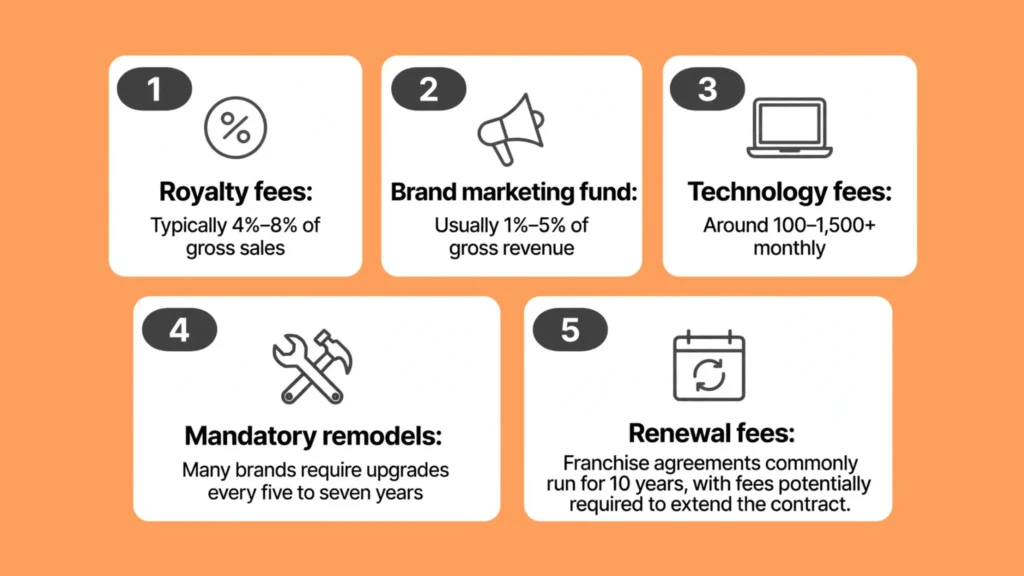
Startup capital gets your doors open, but ongoing contractual fees directly affect your monthly profit margins. Before signing an agreement, verify these recurring expenses in Item 6 of the FDD:
Royalty Fees: Typically 4% to 8% of gross sales (paid weekly or monthly regardless of whether your location turned a profit that month), though some service brands charge a flat monthly fee.
Brand Marketing / Ad Fund: Usually 1% to 5% of gross revenue, pooled by the franchisor to pay for national advertising, website maintenance, and creative campaigns.
Technology and Software Fees: Monthly charges of $100 to $1,500+ for proprietary CRM platforms, POS software licenses, and online ordering portals.
Mandatory Remodels and Renewals: Most franchise agreements run for 10 years and require store refreshes or equipment upgrades every five to seven years, alongside a renewal fee when extending your contract.
Financial Qualification Requirements: Liquidity vs. Net Worth
Even if you plan to finance 70% to 80% of your startup costs with a business loan, franchisors will not approve your application unless you meet strict personal financial thresholds.
Liquid Capital: Cash, checking/savings balances, or non-retirement marketable securities you can access immediately. Franchisors typically require liquid capital equal to 25% to 40% of the total investment often at least $50,000 to $150,000 for mid-tier concepts, and $500,000+ for major fast-food brands.
Minimum Net Worth: Your total assets minus total liabilities (including home equity and retirement accounts). Required net worth generally ranges from $150,000 to over $1.5 million, proving to both the franchisor and lenders that you can weather unexpected economic downturns.
Common Financial Mistakes First-Time Franchisees Make
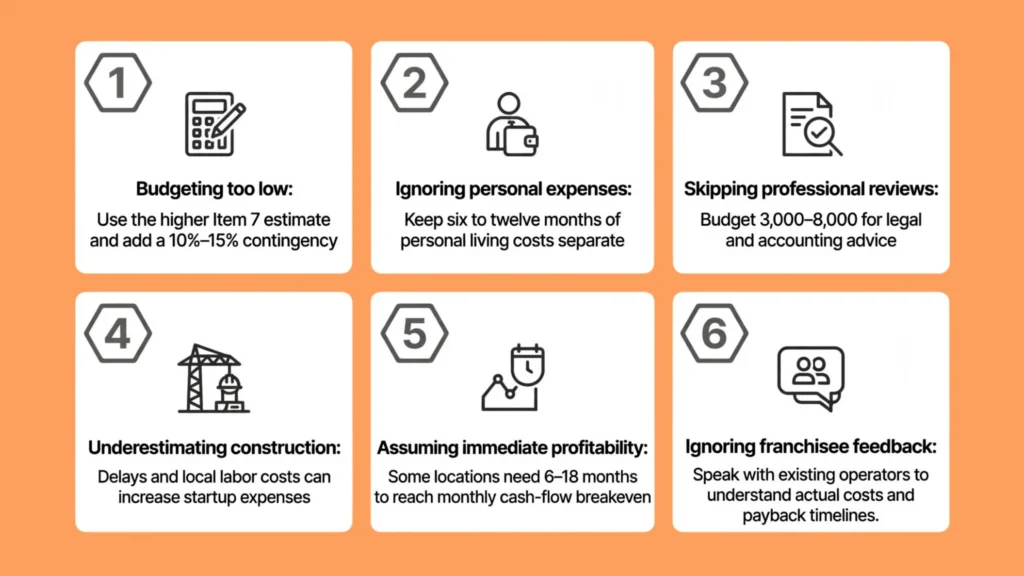
Budgeting for the Low End of the Range: Item 7 presents a low-to-high investment spectrum. Construction delays, permitting bottlenecks, and local labor rates frequently push actual costs toward the upper third of the estimate. Always build your budget around the high estimate plus a 10% to 15% contingency buffer.
Forgetting Personal Living Expenses: Working capital in the FDD covers business bills not your personal mortgage, groceries, or healthcare. Plan to have six to twelve months of personal living expenses saved separately so you do not drain cash from a young business.
Skipping Legal and Accounting Reviews: Franchise agreements heavily favor the franchisor. Hiring a specialized franchise attorney and CPA to review the FDD and commercial lease typically costs $3,000 to $8,000, a fraction of what an unfavorable lease guarantee or territory dispute can cost later.
Underestimating the Ramp-Up Timeline: Assuming a new store will be profitable on day one creates immediate cash strain. Speak directly with existing franchisees listed in Item 20 of the FDD to learn how many months it actually took their locations to break even.
Frequently Asked Questions: How Much Does a Franchise Cost
How much does a franchise cost on average?
Across all industries, the average total investment to open a single-unit franchise is roughly $150,000 to $350,000, with a median around $250,000 excluding real estate purchases. Service-based franchises often fall well below $100,000, while brick-and-mortar restaurants and hospitality brands regularly surpass $1 million.
Can you open a franchise with no money?
No. Because franchisors require minimum liquid capital and lenders require a cash down payment (typically 10% to 30% of the project cost), you cannot open a legitimate franchise with zero personal capital. However, buyers can combine personal savings with SBA loans, Rollovers for Business Startups (ROBS) using eligible retirement funds, or equipment leasing.
Is the franchise fee refundable if I change my mind?
In almost all cases, the initial franchise fee is non-refundable once you sign the franchise agreement. A small number of franchisors refund a partial portion if you fail to complete initial training or cannot secure an approved site within a set timeframe, which will be explicitly stated in Item 5 of the FDD.
Why do franchisors charge ongoing royalties?
Ongoing royalties pay for continuous brand infrastructure, including supply chain negotiating power, research and development, proprietary technology, field coaching, and trademark protection. Ideally, the bulk purchasing discounts and customer brand recognition provided by the franchisor outweigh the cost of the royalty percentage.
Are franchise startup costs tax-deductible?
Many startup expenses are deductible or amortizable, though tax rules treat different categories uniquely. Generally, businesses can deduct up to $5,000 in qualifying startup costs in their first year (subject to phase-out limits) and amortize the remainder, as well as the initial franchise fee, over 15 years. Always consult a CPA to structure deductions properly.
How long does it take to make your money back on a franchise?
Most franchisees take two to four years to recoup their full initial investment, though individual locations often reach monthly cash-flow breakeven within 6 to 18 months. High-investment concepts like hotels or large restaurants can take three to five years or longer to achieve full payback.
Final Thoughts: How Much Does a Franchise Cost
Determining how much a franchise costs comes down to looking at the complete financial picture rather than a single upfront number. While the initial franchise fee buys you access to a proven playbook and recognizable brand, your true launch budget is shaped by build-out expenses, equipment, local real estate rates, and having enough working capital to carry the business until sales stabilize.
By studying Item 7 and Item 19 of the Franchise Disclosure Document, validating real-world numbers with current franchisees, and keeping a healthy personal cash reserve, you can choose a franchise model that aligns comfortably with both your budget and long-term income goals.
About The Author