Best Franchises You Can Open Under 50000 Dollars

Buying into a proven business model does not require hundreds of thousands of dollars in liquid capital. While fast-food chains and large retail stores often demand massive build-out budgets, dozens of franchises under 50k operate from home offices, mobile vans, or small local territories.
By eliminating expensive commercial real estate and heavy inventory, these lean business models allow aspiring entrepreneurs to launch with lower financial risk and faster break-even timelines. Understanding a startup’s financial model can also help buyers evaluate initial costs, operating expenses, and potential profitability.
Whether you want a flexible side business or a full-time enterprise you can scale over time, choosing an affordable franchise comes down to matching your daily strengths with the right industry. Below is a practical guide to the top low cost franchise opportunities available under fifty thousand dollars, how to evaluate true startup expenses, and what to watch out for before signing an agreement.
What Makes a Franchise Under $50,000 Possible?
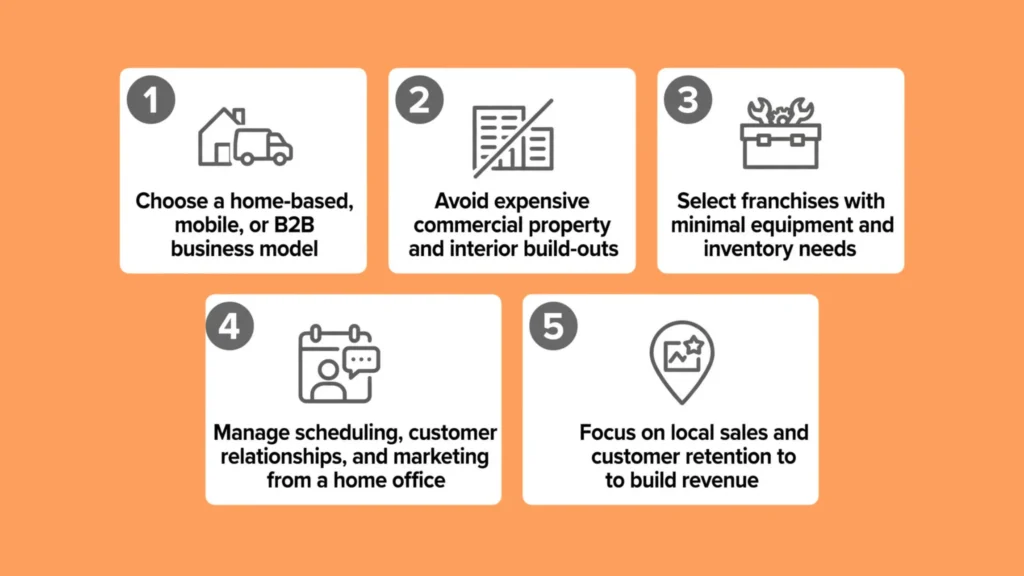
Most high-cost franchises tie up capital in three areas: commercial real estate leases, interior build-outs, and initial product inventory. Brands that keep total startup costs below $50,000 strip away those heavy fixed expenses. Instead of brick-and-mortar storefronts, these businesses typically rely on one of three operational setups:
Home-Based Operations: You manage scheduling, client relationships, and marketing from a home office using software provided by the franchisor.
Mobile Service Models: You bring the service directly to residential or commercial customers using a single vehicle and specialized equipment.
B2B and Consulting Frameworks: You sell ongoing services such as logistics, digital marketing, or executive coaching to other local businesses without needing a public retail space.
Because overhead stays low, a cheap franchise to buy often reaches profitability faster than a traditional storefront, provided the owner focuses heavily on local sales and customer retention.
Top Categories for Franchises Under 50k
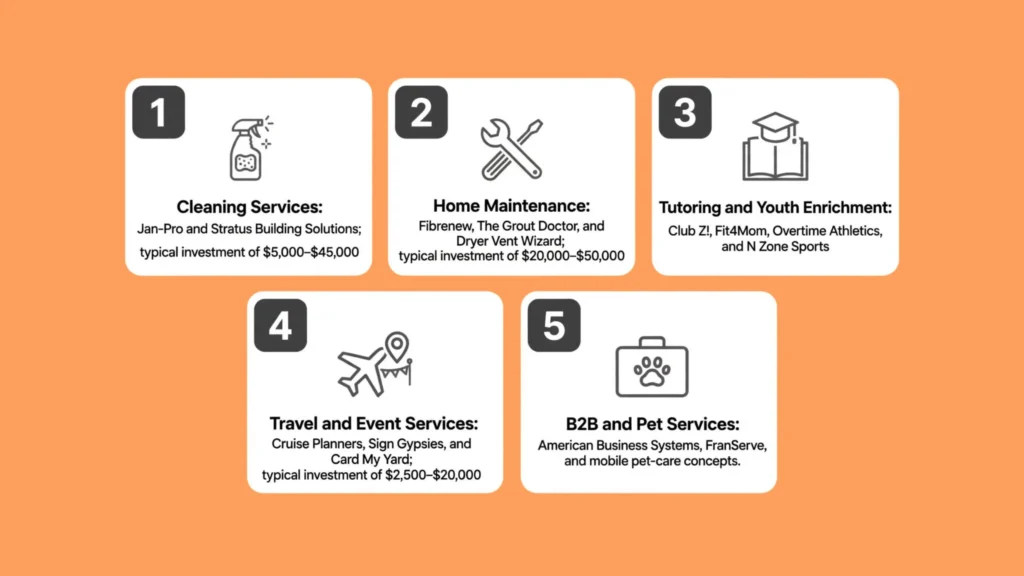
Rather than chasing fleeting trends, first-time buyers generally see the best stability in service-oriented industries with recurring demand. Here are the strongest categories where you can find reputable brands under the $50,000 mark.
1. Commercial and Residential Cleaning Services
Cleaning and janitorial brands remain some of the most accessible entry points in franchising. Commercial cleaning franchises in particular benefit from recurring contracts with offices, medical clinics, and retail spaces.
Why it works: Demand stays steady regardless of economic shifts, and initial equipment and supply packages are modest.
Notable examples: Brands like Jan-Pro Cleaning & Disinfecting and Stratus Building Solutions offer entry-level investment tiers well below $50,000, allowing owners to start small and expand their client roster over time.
2. Home Maintenance and Niche Repair
Homeowners continually outsource specialized upkeep they cannot easily handle themselves. Niche repair and maintenance franchises focus on high-margin, repeatable services rather than full-scale remodeling.
Why it works: Low material costs, minimal staffing at launch, and strong word-of-mouth referrals within local neighborhoods.
Notable examples: Fibrenew (leather, plastic, and vinyl restoration) starts around $25,000, while The Grout Doctor (tile and grout restoration) and Dryer Vent Wizard (dryer vent cleaning and safety inspections) offer entry tiers under $50,000.
3. Tutoring and Youth Enrichment
Education and youth activity franchises rarely require dedicated commercial buildings. Instead, owners partner with local schools, community centers, and parks—or deliver lessons directly in clients’ homes and online.
Why it works: Parents consistently prioritize academic support and extracurricular enrichment, creating predictable seasonal and school-year revenue.
Notable examples: Club Z! Tutoring, Fit4Mom, and youth sports programs like Overtime Athletics and N Zone Sports operate with low overhead and startup costs under $50,000.
4. Travel Planning and Event Services
If you enjoy relationship-building and event coordination, travel agencies and celebration rental franchises offer very low barriers to entry.
Why it works: These models are almost entirely home-based, relying on supplier partnerships, booking platforms, and local community networking rather than payroll.
Notable examples: Cruise Planners, Travel Leaders Network, and yard-greeting rental franchises like Sign Gypsies and Card My Yard frequently feature startup costs between $2,500 and $25,000.
5. B2B Consulting, Billing, and Logistics
Business-to-business franchises allow you to leverage corporate software and bulk vendor pricing to help other companies save money or streamline operations.
Why it works: High client lifetime value and standard weekday business hours.
Notable examples: American Business Systems (medical billing and revenue management) starts around $35,000, while franchise consulting networks like FranServe start near $25,000.
6. Pet Care and Mobile Services
Pet spending continues to grow, and mobile or route-based pet franchises eliminate the cost of building a kennel or retail storefront.
Why it works: Pet owners book recurring weekly or monthly appointments, creating reliable cash flow.
Notable examples: Pet waste removal services (such as Poop Away) and mobile pet care concepts allow owners to operate out of a single vehicle with minimal startup inventory.
Comparing Low-Cost Franchise Models
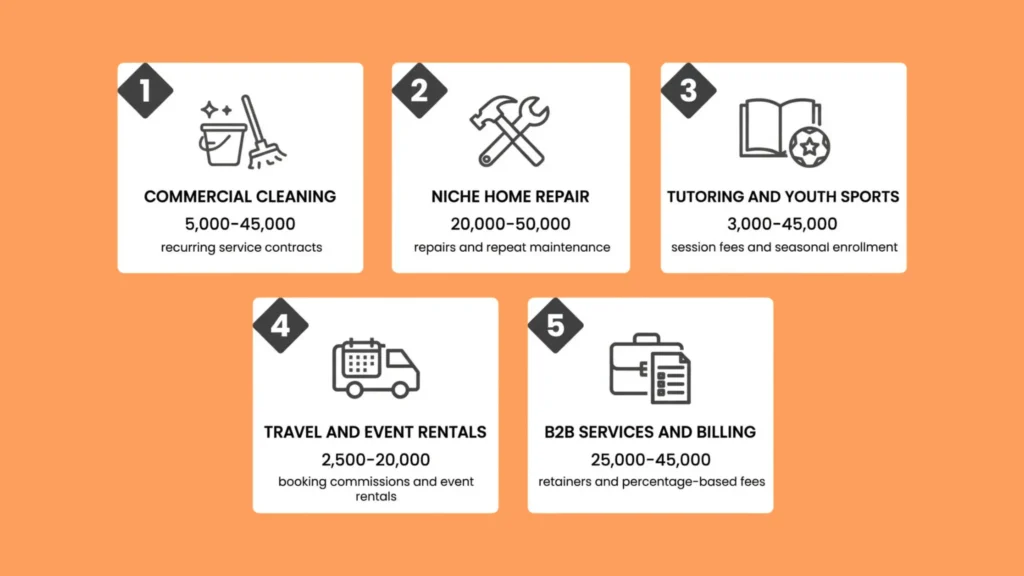
| Franchise Category | Typical Startup Range | Primary Location Type | Core Revenue Driver |
| Commercial Cleaning | $5,000 – $45,000 | Home-based / Client sites | Recurring monthly service contracts |
| Niche Home Repair | $20,000 – $50,000 | Mobile van / Home office | One-off repairs & repeat maintenance |
| Tutoring & Youth Sports | $3,000 – $45,000 | Schools, parks, or in-home | Per-session & seasonal enrollment fees |
| Travel & Event Rentals | $2,500 – $20,000 | Home-based | Booking commissions & event rentals |
| B2B Services & Billing | $25,000 – $45,000 | Home office | Retainers & percentage-based fees |
Understanding the True Cost of an Affordable Franchise
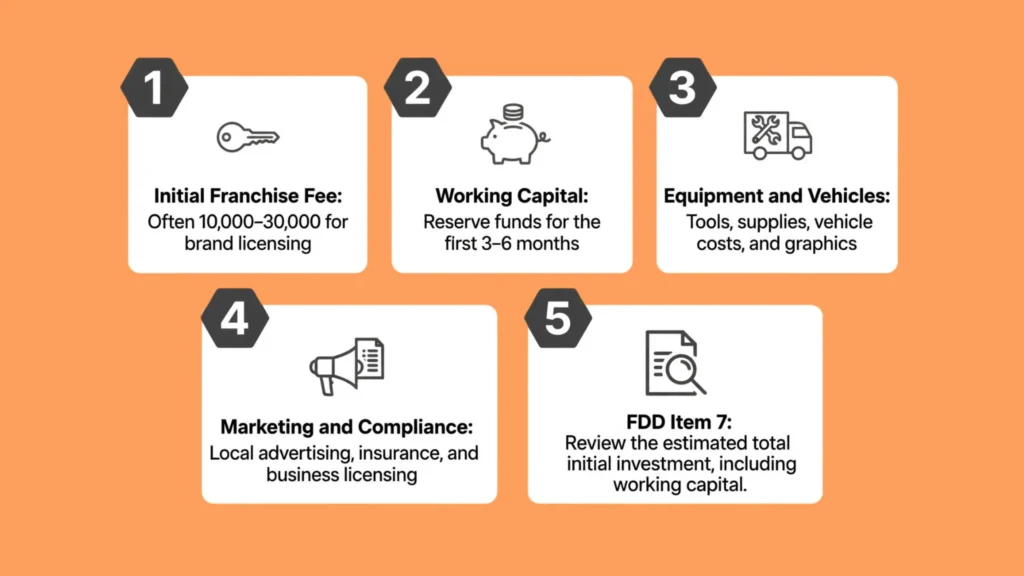
When researching low cost franchise opportunities, one of the biggest traps is confusing the franchise fee with the total initial investment.
The initial franchise fee is simply the upfront licensing payment you make to join the brand often between $10,000 and $30,000. However, your actual cash outlay includes several additional expenses:
Working Capital: Cash reserves needed to cover personal living expenses and business bills during your first three to six months before revenue stabilizes.
Equipment and Vehicles: Wrap graphics, tools, initial supplies, or a down payment on a cargo van.
Local Launch Marketing: Digital ads, print mailers, and networking memberships required to land your first customers.
Insurance and Licensing: General liability insurance, local business permits, and entity formation fees.
In the United States, every legitimate franchisor provides a Franchise Disclosure Document (FDD). Always review Item 7 of the FDD, which breaks down the estimated low-to-high initial investment range, including three months of working capital. If a brand advertises a $15,000 franchise fee, check Item 7 to confirm that the total launch cost still fits comfortably beneath your $50,000 ceiling.
How to Choose the Best Franchise Under 50k
Selecting the right opportunity requires balancing your budget with your day-to-day lifestyle goals. Keep these practical steps in mind during your search:
Audit Your Core Strengths: Most sub-$50k franchises require the owner to act as the primary salesperson and operator during year one. If you dislike cold outreach or networking, avoid B2B consulting and look toward models where the franchisor runs a centralized call center or national lead-generation engine.
Verify Ongoing Royalties and Fees: Low upfront costs sometimes come with higher ongoing royalty percentages (typically 5% to 10% of gross revenue) plus national marketing fund contributions. Calculate how much margin remains after royalties and local ad spend.
Speak With Current Franchisees: Item 20 of the FDD lists contact information for existing and former franchise owners. Call at least five current owners and ask how long it took them to break even, how responsive corporate support is, and whether actual startup costs matched Item 7 estimates.
Confirm Territory Protections: Make sure your agreement grants a clearly defined, protected geographic territory so another franchisee from the same brand cannot open down the street and compete for your clients.
Common Mistakes First-Time Franchise Buyers Make
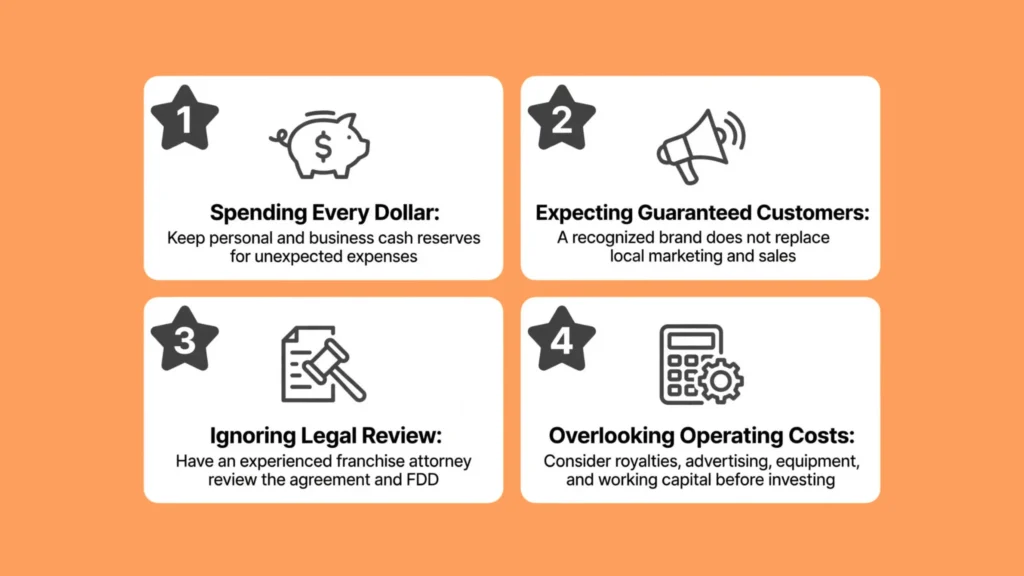
Spending Every Dollar on the Buy-In: If you have $50,000 in total savings, do not buy a franchise whose total startup cost is $49,000. Always keep a personal and business cash cushion for unexpected delays.
Assuming the Brand Guarantees Customers: A recognizable name and proven playbook give you a head start, but local hustle drives early revenue. You still have to market locally, follow up on leads, and deliver great service.
Skipping Legal Review: Even when buying a cheap franchise to buy, franchise agreements are binding multi-year contracts. Have an experienced franchise attorney review the FDD before you wire any funds.
Frequently Asked Questions
Can you really buy a good franchise for under $50,000?
Yes. Many established, reputable franchises operate with total initial investments between $10,000 and $50,000. These brands keep costs down by avoiding brick-and-mortar retail storefronts and focusing instead on home-based, mobile, or B2B service models.
What is the difference between liquid capital required and total investment?
Total investment is the full estimated amount needed to launch the business and fund early operations. Liquid capital is the amount of cash (or easily accessible funds like savings or non-retirement investments) a franchisor requires you to have on hand so you do not over-leverage yourself with debt.
Which franchises under 50k have the fastest break-even timelines?
Service-based franchises with minimal equipment—such as commercial cleaning, tutoring, travel planning, and digital B2B services—often break even faster than retail or food concepts because fixed monthly overhead is very low. Your exact timeline depends on how aggressively you pursue local clients during your first 90 days.
Do low-cost franchises offer financing options?
Yes. Many franchisors offer in-house financing for a portion of the franchise fee, accept Rollovers as Business Startups (ROBS) from retirement accounts, or partner with third-party lenders that specialize in small business microloans and equipment financing.
Are franchises under 50k passive investments?
Rarely at the beginning. Almost all franchises under 50k are designed as owner-operator businesses during the launch phase. Once you build a steady client base and generate enough cash flow, you can hire technicians, managers, or staff to step back from daily operations.
Final Thoughts: Franchises Under 50k
Launching one of the best franchises under 50k offers a practical middle ground between starting a business from scratch and taking on massive commercial debt.
By focusing on low-overhead service industries, verifying the full startup numbers in Item 7 of the Franchise Disclosure Document, and talking directly with existing owners, you can find an affordable franchise that fits both your budget and your long-term income goals.
About The Author