Food and Beverage Startup Funding: How to Raise Your First Round
Launching a consumer packaged goods (CPG) or food tech brand requires navigating production scale-ups, inventory holding costs, regulatory approvals, and slotting fees. Unlike pure software companies, physical food brands face tangible supply chain demands that make securing initial capital essential for early growth.
Understanding food and beverage startup funding gives founders the tools to transition from a kitchen prototype to retail shelves. To secure early capital, you must present a clear market gap, demonstrate unit economic viability, and target investors who specialize in the food space. Seed stage rounds often carry gross profit margins between 35% and 55%, making well-funded brands attractive to strategic buyers and venture groups.
Below is an actionable guide breaking down funding requirements, fundraising costs, profit expectations, and the exact step-by-step process to raise your first round.
What Is Food and Beverage Startup Funding?
Food and beverage startup funding refers to the initial capital raised by emerging CPG brands, functional beverage companies, and food tech platforms to finance early operations. This capital covers critical activities including commercial co-packer production runs, ingredient sourcing, nutritional testing, FDA compliance, branding, and distribution setup.
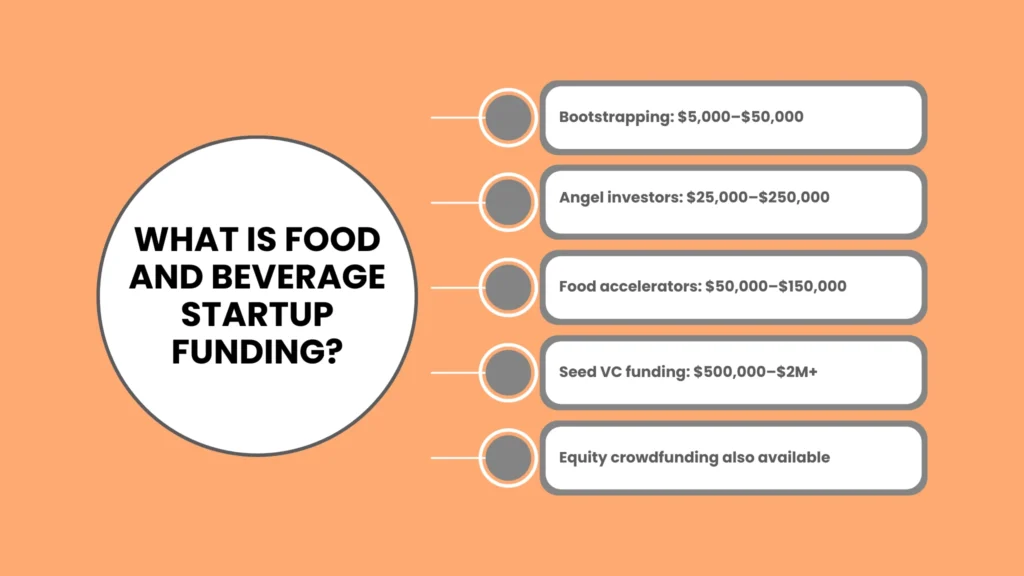
Early-stage capital typically flows from several primary sources:
Bootstrapping and Friends & Family: Personal savings or small early investments ($5,000 to $50,000) used to finalize recipes and prove initial consumer demand.
Angel Investors and CPG Networks: High-net-worth individuals providing $25,000 to $250,000 in exchange for equity, along with hands-on industry connections.
Specialized Food Accelerators: Programs offering $50,000 to $150,000 alongside structured mentorship, distributor introductions, and co-packer sourcing.
Equity Crowdfunding: Direct-to-consumer campaigns on platforms like Republic or Wefunder that convert passionate early customers into equity shareholders.
Institutional Seed VCs: Venture capital funds focusing on high-growth food tech, functional beverages, and disruptive CPG brands seeking $500,000 to $2,000,000+.
Is Food and Beverage Startup Funding Profitable?
Founders often wonder: is food and beverage startup funding profitable for both the entrepreneur and the investor? The short answer is yes, provided the brand establishes strong unit economics and clear distribution velocity.
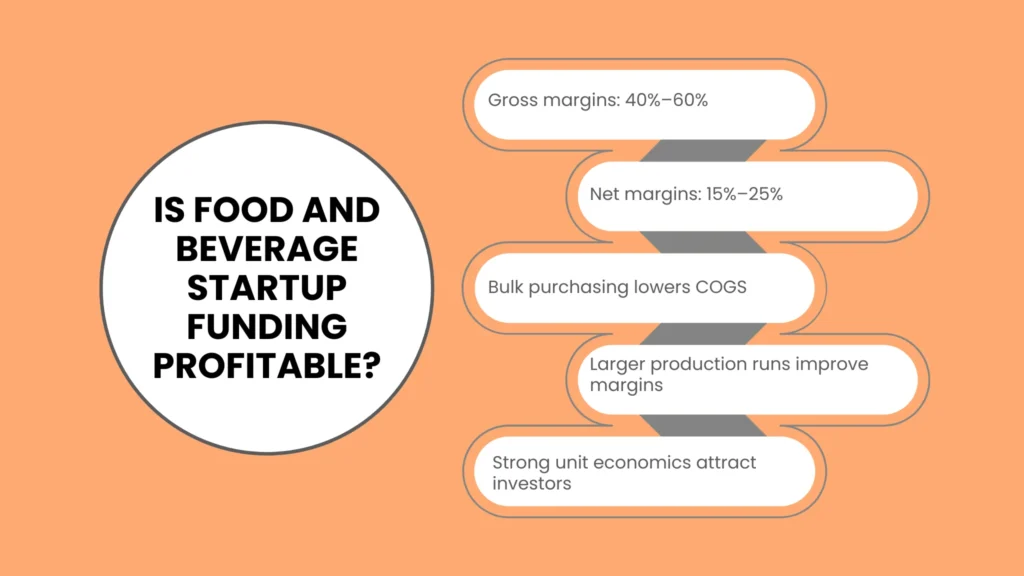
Securing early capital allows brands to buy ingredients in bulk, reduce unit production costs, and negotiate lower fees with co-packers. This drop in Cost of Goods Sold (COGS) directly expands your gross margins, allowing the business to achieve profitability much faster than a bootstrapped operation struggling with small, expensive batch runs.
Investors target an overall food and beverage startup funding profit margin of 40% to 60% on gross product sales at the brand level. Net profit margins typically land between 15% and 25% once the company reaches scale, delivering sustainable cash flow and making the brand an attractive target for acquisition by major food conglomerates.
Food and Beverage Startup Funding Cost Breakdown
Fundraising itself carries direct operational and legal expenses. Understanding your expected food and beverage startup funding cost ensures you do not burn through personal cash while trying to secure outside investment.
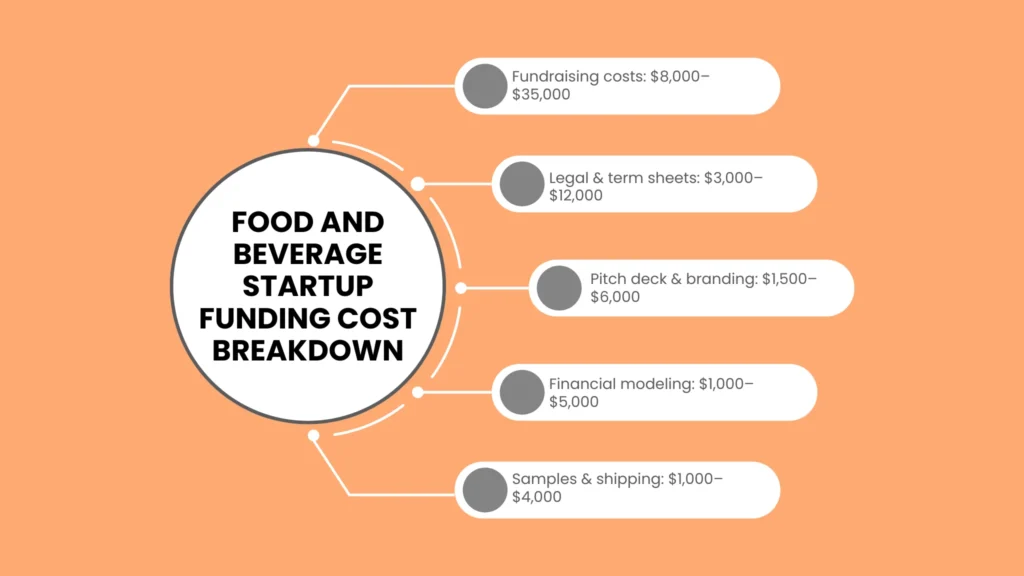
A typical Pre-Seed or Seed fundraising round costs between $8,000 and $35,000 in upfront legal, design, and administrative fees.
Estimated Fundraising Expense Breakdown
| Expense Category | Estimated Cost Range | Key Details and Components |
| Legal & Term Sheet Drafting | $3,000 – $12,000 | SAFE agreements, convertible notes, equity docs, and state filings. |
| Pitch Deck Design & Branding | $1,500 – $6,000 | Professional visual deck, financial model graphics, and leave-behinds. |
| Financial Modeling & Valuation | $1,000 – $5,000 | Fractional CFO services to build 3-year unit economic projections. |
| Sample Production & Shipping | $1,000 – $4,000 | Sending product tasting kits and temperature-controlled samples to investors. |
| Data Room & Admin Software | $500 – $2,000 | Secure document hosting, cap table software, and investor CRM tools. |
| Travel & Pitch Event Fees | $1,000 – $6,000 | Attending CPG trade shows, pitch competitions, and in-person investor meets. |
| Total Estimated Fundraising Cost | $8,000 – $35,000 | Total capital required to prepare and execute an early funding round. |
Critical Food and Beverage Startup Funding Requirements
Investors evaluate physical product brands strictly on risk mitigation, manufacturing viability, and customer demand. Satisfying these core food and beverage startup funding requirements increases your chances of closing a round.
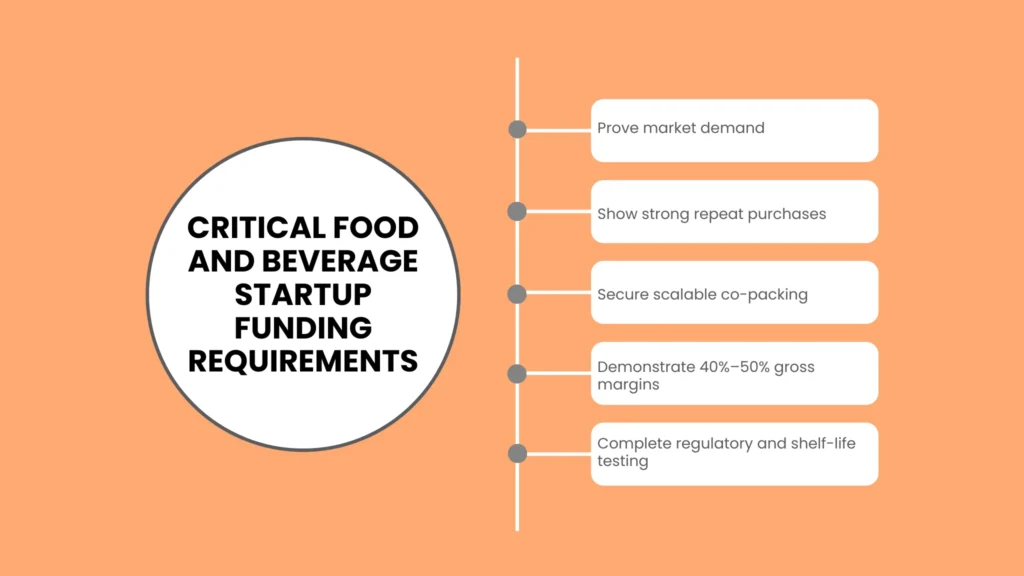
1. Proof of Market Validation and Traction
Investors want clear evidence that consumers love your product. Key metrics include:
Strong repeat purchase rates on direct-to-consumer (DTC) channels.
High sales velocity per store per week (SPTW) in initial retail test locations.
Pre-orders, waitlists, or signed letters of intent (LOIs) from regional distributors and retail buyers.
2. Scalable Co-Packing and Supply Chain Infrastructure
Investors rarely fund brands that hand-bake products in a residential or small commercial kitchen long term. You must present a confirmed relationship with an audited co-packer capable of scaling production without quality drop-offs.
3. Clear Unit Economics and Gross Margins
Your financial model must demonstrate a path to at least 40% to 50% gross margin at scale. Investors examine your bill of materials (BOM), shipping logistics, distributor margins (typically 25% to 30%), and retailer margins (typically 35% to 40%) to verify profitability.
4. Regulatory Compliance and Shelf-Life Testing
Food products must comply with local and federal regulations. You need formal lab reports confirming shelf-life stability, standardized Nutrition Facts panels, FDA facility registrations, and allergen control procedures.
How to Raise Your First Round Step by Step
If you are evaluating how to fund a food startup, follow this structured process to move efficiently from initial outreach to money in the bank.
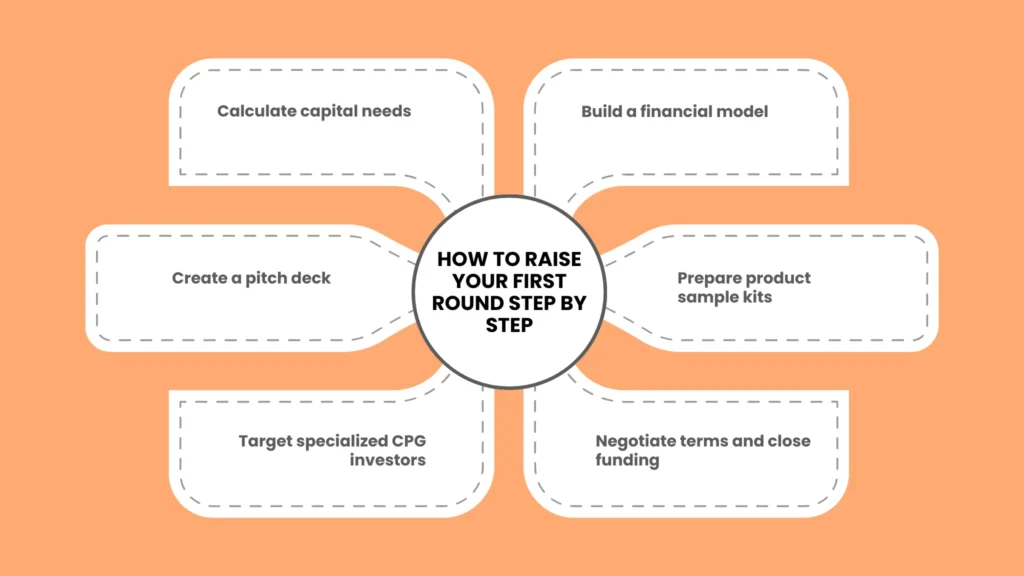
Step 1: Determine Your Exact Capital Needs
Calculate how much runway you need to reach your next major valuation milestone (such as expanding into 500 retail doors or reaching $1M in annual recurring revenue). Most early-stage rounds aim for 18 to 24 months of operational runway.
Step 2: Assemble Your Financial Model and Data Room
Prepare a clean data room containing your corporate incorporation documents, IP filings, co-packer agreements, ingredient supplier contracts, and a 3-year financial model. Ensure your model clearly shows how investor funds accelerate revenue growth.
Step 3: Refine Your Pitch Deck and Sample Kits
Your pitch deck should tell a compelling story across 10 to 12 slides:
The Problem: The consumer gap or outdated ingredient profile in current market options.
The Solution: Your product’s unique formulation, taste profile, and brand positioning.
Market Size: Total addressable market (TAM) for your category.
Traction: Sales growth, retail doors, and customer retention metrics.
Unit Economics: Cost to produce vs. retail price breakdown.
The Ask: Capital being raised and exact deployment plans.
Prepare professional sample boxes containing cold-pack insulation (if needed), branded press sheets, and fresh product samples to mail to interested investors immediately following initial pitch calls.
Step 4: Build a Targeted CPG Investor List
Avoid reaching out to generic tech investors who do not understand physical supply chains or retail distribution. Target angel groups, CPG-focused venture funds, and industry founders who actively back food and beverage brands. Seek warm introductions through fellow founders, trade association networks, or accelerator directors.
Step 5: Execute Pitch Meetings and Sample Delivery
Lead pitch calls with your brand story, consumer traction, and velocity metrics. Follow up meetings immediately by mailing product samples so investors can experience your taste, texture, and packaging firsthand.
Step 6: Issue Investment Instruments and Close
Use standardized fundraising structures like Simple Agreements for Future Equity (SAFEs) or Convertible Notes for early rounds. These instruments streamline the process, reduce legal fees, and defer formal valuation negotiations until a larger institutional Series A round.
Overcoming Key Fundraising Challenges
Early-stage food founders frequently face specific fundraising obstacles:
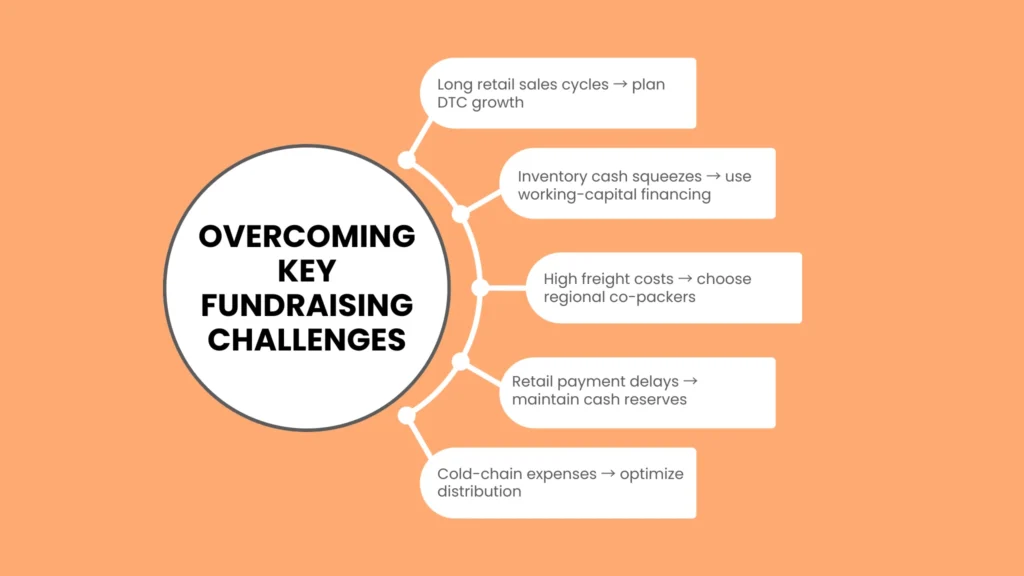
Long Sales Cycles with Retail Buyers: Retail category reviews happen only once or twice a year. Solution: Show investors a realistic timeline that pairs retail expansion with consistent direct-to-consumer or regional specialty store sales.
Inventory Cash Flow Squeezes: Retailers and distributors often demand 30- to 60-day payment terms (Net 30/60). Solution: Allocate a portion of your raised capital to purchase order (PO) financing or inventory credit lines to maintain healthy working capital.
High Freight and Cold-Chain Logistics Costs: Shipping liquid or perishable goods erodes margins quickly. Solution: Partner with regional co-packers close to your primary distribution hubs to minimize freight distances.
Final Thoughts: Securing Capital for Growth
Understanding food and beverage startup funding gives emerging founders a strategic edge in a competitive market. By proving consumer demand, managing manufacturing costs, and approaching specialized CPG investors with clear unit economics, you can secure the capital required to scale.
Maintain clean financial records, invest in professional product packaging, and focus on retail sales velocity. Consistent execution and capital efficiency will turn your early funding round into a foundation for long-term category leadership. For comprehensive business plan templates, financial modeling tools, and startup growth guides, explore additional resources at reliablestartup.com.
Frequently Asked Questions
How much equity should I give up in my first funding round?
Founders typically dilute between 10% and 20% of their company equity during a Pre-Seed or Seed round. Retaining ownership early ensures you keep enough equity to incentivize future investors and key executive hires as you scale.
Should I use a SAFE or a Convertible Note to raise my first round?
SAFEs (Simple Agreements for Future Equity) are widely preferred for early-stage food rounds. They reduce legal expenses, convert automatically into equity during a future priced round, and eliminate complex debt interest terms.
What is the average valuation for an early-stage food startup?
Valuations depend on current revenue, sales velocity, brand differentiation, and market size. Early Pre-Seed food brands raising $100,000 to $500,000 often carry post-money valuation caps between $2 million and $5 million.
Can I raise capital before securing retail distribution?
Yes. Many early-stage food brands raise Pre-Seed capital based on strong direct-to-consumer traction, successful local farmers’ market sales, or strategic partnerships with regional specialty stores.