Best Stabilizer for Smooth Ice Cream Texture: 2026 Guide

For a smooth standard dairy base, start with locust bean gum, or choose a complementary blend if you want more control over body and melt. If icy homemade scoops keep disappointing you, the stabilizer can help, but it cannot fix every recipe or freezer problem. The right choice changes for cold-process recipes, gelato, or a long storage period. You can match the ingredient to your process and the texture you want, then test it in a small batch. That keeps you from changing several parts of a recipe at once.
As you compare options, pay attention to how each one hydrates and what it adds to the mix. A stabilizer that works well in a heated dairy base may not suit a cold mix. Storage also matters: repeated warming can make even a good frozen dessert turn coarse. A little careful weighing and mixing matters more than adding a large amount of any one gum.
Key Takeaways
- Locust bean gum is a strong starting point for a standard dairy base.
- Guar, carrageenan, xanthan, and CMC each bring different benefits and limits.
- Cold-process recipes need gums that can hydrate without heat.
- Weigh stabilizer by the full mix weight, not by spoonful.
- Steady freezer storage helps protect texture after churning.
How Do Stabilizers Make Ice Cream Feel Smooth?
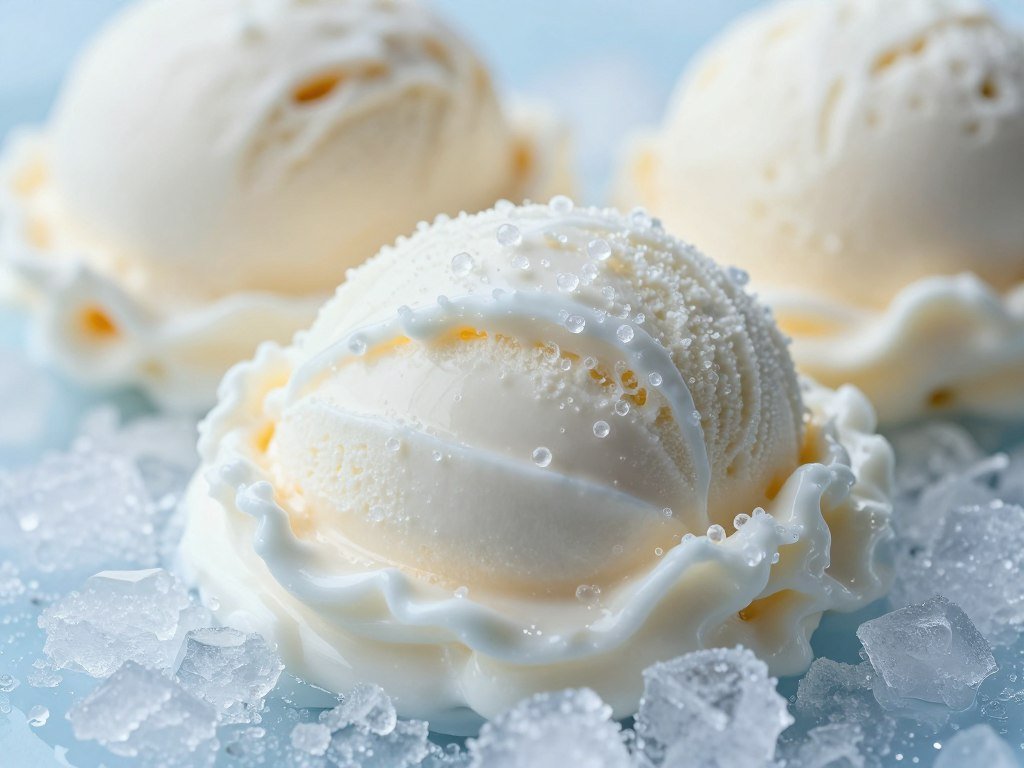
Stabilizers make the unfrozen portion of a mix thicker, which slows water movement and helps limit coarse crystals. The serum phase is the unfrozen liquid portion of ice cream that surrounds ice crystals, fat, and air. That change can improve creaminess and help the dessert resist a watery melt.
Ice crystals below about 40 microns are small enough to feel smooth rather than icy. A thickened mix slows water from reaching growing crystals, but the stabilizer does not stop freezing or remove water. Its effect depends on the full recipe and how the mix is handled.
Mix viscosity and the creamy impression
Viscosity means how easily a liquid flows. When stabilizers raise the mix’s viscosity, the liquid can hold ingredients in place and create a fuller impression on your tongue. That added body may also slow melting, though too much thickening can make a frozen dessert feel heavy.
Fat, sugar, air, and water all shape the result. Sugar lowers the freezing point, while churning breaks up ice as the mix freezes and brings in air. A chemist’s explanation of ice cream texture covers how these parts work together.
Ice crystals during freezing and storage
Freezing creates ice crystals as water turns solid. Fast freezing and steady churning help keep those crystals small during this first stage. Storage brings a different risk: crystals can grow after the ice cream has already frozen.
That later change is recrystallization. One form, called Ostwald ripening, happens when water moves from smaller crystals to larger ones. Those larger crystals can make the texture feel coarse, even if the first churn produced a smooth result.
Greater serum-phase viscosity slows water movement toward growing crystals, but it cannot control every part of freezing and storage.
A smooth starting texture still depends on controlling the freezer conditions after churning.
Best Stabilizer for Smooth Ice Cream Texture: Which Option Fits Your Recipe?
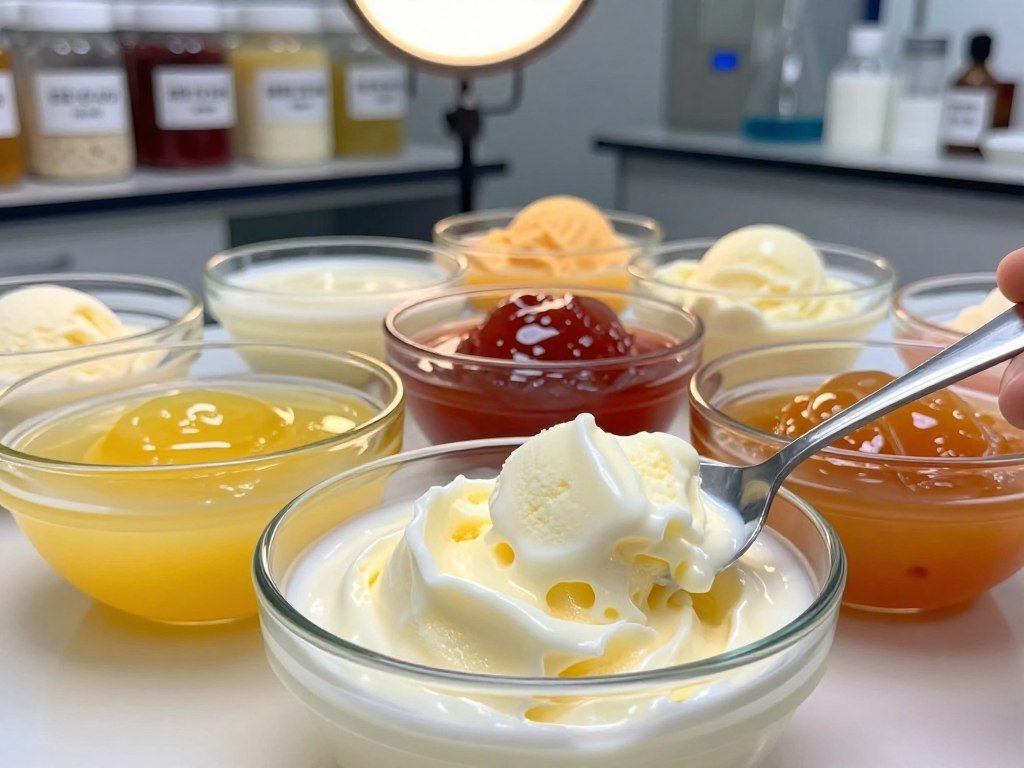
For a standard dairy mix, LBG is the strongest single-gum starting point, while a blend offers more control over separate texture goals. Locust bean gum, guar gum, cellulose gum, and carrageenan are common stabilizers in regular ice cream. The best fit depends on whether you want body, melt control, or less watery separation.
LBG needs heat to hydrate, so it does not fit every process. It is commonly used at 1.0-2.0 grams per kilogram of mix and needs hydration at 80°C. Carrageenan has a smaller role and a typical amount of 0.1-0.2 grams per kilogram.
| Option | Main contribution | Handling needs | Main drawback |
|---|---|---|---|
| LBG | Body and crystal control | Heat for hydration | Not suited to every cold mix |
| Guar gum | Mix thickness and body | Cold-soluble; disperse evenly | Can feel chewy when overused |
| Carrageenan | Whey control in dairy | Use with a primary gum | Not a main thickener alone |
| Xanthan gum | Thickening in cold mixes | Measure with care | Can feel ropey or slimy |
| CMC | Body and water control | Cold-soluble; disperse evenly | May not suit every texture |
Blends can balance body, melt, and whey control better than one gum alone. Sodium alginate is a more specialized choice when you want high mix viscosity or storage performance. At 0.2%, it produced the greatest increase in mix viscosity in one test; a 0.2% blend of sodium alginate and κ-carrageenan, at a 9:1 ratio, scored highest overall after 16 weeks.
These tested conditions do not make sodium alginate the best pick for every base. The main stabilizers ice cream makers use each have a distinct handling need, and a longer ingredient list does not guarantee a better result. Choose by the texture and process you want, not by the longest ingredient list.
What Makes Locust Bean Gum a Strong Ice Cream Choice?
LBG’s performance depends partly on how much of its galactomannan is soluble and how many impurities remain in the powder. Galactomannan is the part of the bean gum that thickens a mix. A high-purity grade often contains 80-85% galactomannan, while a lower-grade powder can contain only 72%.
More soluble galactomannan and fewer impurities can produce higher viscosity. That can make one sample behave differently from another, even when both packages say locust bean gum. The name alone does not tell you how the powder will perform.

Galactomannan purity and viscosity
Purity affects how much of the powder can work in the liquid. Solubility matters too, since the galactomannan must hydrate to build viscosity. A higher-viscosity sample may thicken your mix more, but that does not automatically create better ice cream.
The best result still depends on the recipe and the mouthfeel you want. A rich base may already feel full, while another mix may need more body. Too much viscosity can leave a heavy impression instead of a clean, creamy one.
When LBG fits your base
LBG is a useful starting point when you can heat a standard dairy base and want a single gum. Carob bean gum is another name for locust bean gum, so the two names refer to the same ingredient. Look for clear information about purity and how the grade performs after hydration.
When comparing grades, ask whether the galactomannan level is stated and whether the powder disperses well in your process. Check the finished mix, not just how thick a sample looks in a cup. Judge an LBG grade by its behavior in the full mix, not by viscosity alone.
When Should You Pair Guar Gum With LBG or Tara?
Pairing guar with LBG can build body while letting the two gums reinforce each other. Guar gum is chemically similar to locust bean gum, and the pair can thicken a dairy mix. This can help when LBG alone leaves the body lighter than you want.
For 1,000 grams of mix, one example uses 0.8 gram LBG and 0.4 gram guar gum. Treat that as a starting formula, not a fixed rule for every recipe. Guar can make the base chewy or elastic if you add too much.
Guar gum adds body to an LBG base
A small amount of guar can add thickness and support the body built by LBG. The two gums have related structures, so their effects can work together. Still, each one changes the mix, and a rich cream base may need less extra body than a leaner mix.
Use the blend as a measured test in your own recipe. If the finished ice cream feels sticky or takes on a lasting chew, reduce the guar in the next batch. Keep the rest of the formula steady so you can judge the change.
Tara gum as a simpler alternative
Tara gum is another seed gum with functional qualities similar to LBG. It can serve as a simpler alternative when you do not want to combine two gums. A typical amount is 1-3 grams per 1,000 grams of mix.
Tara needs heat for full hydration, around 80°C. That makes it a better fit for a heated recipe than a cold-process base. Choose tara when you want a simpler gum option and can heat the mix.
What Does Carrageenan Do in Dairy Ice Cream?
If a heated dairy mix leaks a clear watery layer as it melts, LBG alone may not solve the problem. That separation is called wheying-off: a clear watery serum layer separates from the rest of the ice cream during melting. A small amount of κ-carrageenan can help control it.
κ-carrageenan at 0.1-0.15 grams per kilogram is used alongside LBG in heated dairy mixes. It interacts with milk proteins and helps hold the serum phase in the mix. Its job differs from the main gum’s role in body and crystal control.
Preventing whey separation
Milk proteins can help form the mix’s structure, but a heated dairy base may still release watery liquid as it melts. LBG can thicken the mix without preventing that separation on its own. Adding a small amount of carrageenan addresses a different problem.
The clear layer can be easy to spot on the plate or at the bottom of a serving dish. It is not the same as a large ice crystal or a thin mix. Those defects call for different changes, so notice when the water appears.
Using κ-carrageenan as a partner gum
κ-carrageenan works as a partner rather than a stand-alone thickener in this use. The low amount supports whey control, while the primary gum supplies more of the mix’s body. Using it alone would not replace the broader effects of a main stabilizer.
Keep the roles distinct when you build a dairy blend. The extra gum is there to help the melted mix stay together, not to take over crystal control. Use κ-carrageenan for whey control as part of a balanced dairy blend, not as a substitute for the primary gum.
Which Stabilizers Work in a Cold-Process Mix?
For a cold-process base, guar gum and CMC are straightforward options, while xanthan is useful only when measured carefully. Guar gum and CMC can dissolve in cold mixes, so you do not need to heat the base for them. Xanthan also works without heat, but too much can make the mouthfeel unpleasant.
Disperse each powder evenly before it hydrates. A gum clump may stay dry inside while the outside turns thick, leaving uneven texture. The amounts below are starting ranges by mix weight.
| Option | Amount per kilogram | Cold-process suitability | Texture contribution | Main caution |
|---|---|---|---|---|
| Guar gum | 1.0-2.0 g | Cold-soluble | Body and thickness | Can feel chewy if overused |
| Xanthan gum | 0.5-1.0 g | Works without heat | Strong thickening | Measure carefully |
| CMC | 1.0-2.0 g | Cold-soluble | Body and water control | Needs even dispersion |
Guar gum at 1.0-2.0 grams per kilogram and CMC at the same range suit cold-process recipes. Xanthan gum is used at 0.5-1.0 grams per kilogram. Above about 1 gram per kilogram, it can create a ropey, slimy mouthfeel.
That narrow limit makes xanthan convenient but easy to overdo. A recipe with lots of fruit or water may need a different balance than one based on cream. Start at the lower end of the suitable dose and assess the finished mouthfeel before increasing it.
What Can You Use Instead of Gums?
Gelatin, starch, and egg yolks are useful alternatives when gums do not fit your ingredient preferences or desired texture. Gelatin is animal-derived and can add body and an elastic feel. Starches and yolks suit heated bases, though each changes the flavor and texture in its own way.
Gelatin needs a cold bloom of at least 30 minutes, then dissolves at 60°C. A common range is 5.0-10.0 grams per kilogram of mix. The amount you choose should match the texture you want, not simply the thickness of the uncooked mix.
Gelatin for body and ice-crystal control
At 7-10 grams per kilogram, gelatin gives a more elastic texture. A 3-5 gram amount per kilogram is more typical for hard-pack ice cream. Bloom the gelatin in cold liquid before heating the base, then stir until it dissolves.
Gelatin can help add body, but it does not make the base taste like a gum-free version of the same recipe. Its elastic quality may be welcome in one style and too noticeable in another. Also, gelatin is not suitable for vegetarian recipes.
Starches and egg yolks for traditional bases
Cornstarch, tapioca starch, and potato starch are familiar thickeners. They are typically used at 0.5-1% of the mix weight and need heat to thicken. Starch can make a base feel fuller, though too much may leave a pasty finish.
Egg yolks make a traditional custard base, often with 4-6 yolks per liter. They add richness and a distinct flavor as well as thickening the mix during cooking. That taste is part of the appeal of custard-style ice cream, but it can cover delicate flavors.
Choose the ingredient based on the base you already plan to cook. Gelatin suits a recipe that can take an elastic body, while starch and egg yolks bring their own familiar qualities. Match the alternative to both the texture you want and the base’s heating step.
Are Commercial Stabilizer Blends Worth Considering?
A premixed stabilizer blend can save you from designing and weighing a multi-gum formula from scratch. These products may combine several stabilizers with carriers, such as sugar or dextrose, to create complementary effects. That can make testing easier when you are still learning how each gum changes a mix.
Product directions apply to that blend, not to every stabilizer formula. Modernist Pantry Perfect Ice Cream contains guar gum, dextrose, and carrageenan standardized with potassium chloride. Its instructions give a use range of 0.2-0.4% by weight.
What a premixed blend can simplify
A premix can spare you from sourcing and balancing each gum on its own. The carrier also helps spread a small amount through the mix. That is useful when you make small batches, where tiny weights can be hard to measure.
The blend’s exact ingredients still matter. Two products may contain different gums, carriers, or activation needs, even if both are sold for ice cream. Read the ingredient list and use the product’s stated purpose to judge whether it fits your recipe.
Reading one blend’s use directions
Perfect Ice Cream’s directions call for dry-mixing the blend with sugar and heating the recipe to 180°F. Those directions describe that product, not a universal method for other stabilizers. A blend with different ingredients may need another amount or heating step.
Keep the product’s directions with the recipe notes for that batch. If you change the mix or use a different premix, recheck the amount and method. Follow the directions for the blend you actually buy, since its carrier and activation method are part of the formula.
How Much Stabilizer Should You Use?
Calculate stabilizer by weight of the whole mix, then scale the grams to your batch size. One gram per 1,000 grams of mix equals 0.1%. A 0.5% dose in a 1,000-gram mix equals 5 grams.
Blend two or three stabilizers only when their effects complement each other, and keep total gum below 0.5%. Traditional Italian gelato often uses 0.3-0.5% of a commercial stabilizer blend. That range describes a commercial blend, not a required dose for every homemade gelato.
Convert a percentage into grams
Use the full mix weight as your starting number. Then turn the target percentage into grams with a simple calculation:
- Weigh the complete mix in grams.
- Select the blend’s target percentage by weight.
- Convert the percentage to grams of stabilizer.
- Weigh the stabilizer precisely before mixing.
For example, a 1,000-gram mix at 0.3% needs 3 grams of stabilizer. A 500-gram mix at the same percentage needs 1.5 grams. Keep the percentage and batch weight clear in your notes.
Weighing a small batch accurately
Small doses can be hard to measure with a spoon. Powder density varies, and a packed spoon holds more than a loosely filled one. A scale accurate to 0.01 gram gives you better control for small batches.
Round measurements only when your scale cannot show the needed amount. Do not add extra powder to compensate for uncertainty, since too much can make the mix gummy. For a small batch, weigh the stabilizer rather than estimating it by spoonful.
How Do You Disperse and Hydrate Stabilizers Properly?
Mix the powder thoroughly with sugar or another dry ingredient before it touches the liquid base. This spreads the stabilizer so it does not form stubborn clumps. Add the dry blend gradually while whisking the liquid.
Vigorous whisking or blending helps distribute the powder through the mix. The right hydration method depends on the ingredient, so use heat when the gum needs it and a cold method when it does not. Mixing well is a separate step from hydration.
Disperse the powder without clumps
Pour the dry blend slowly into moving liquid instead of dumping it in one spot. Keep whisking as you add it, or use a blender if the recipe can handle the extra air. Scrape the sides and bottom so powder does not stick there.
Clumps can hold dry powder inside and create uneven thickness. If you spot lumps, blend the mix before it rests. A smooth-looking liquid is easier to heat or chill evenly.
Hydrate the mix and let it age
Follow the ingredient’s own hydration needs. Some stabilizers need heat to become fully active, while cold-soluble gums can hydrate without cooking. Do not assume that one method fits every powder or premix.
After hydration, let a hard-pack ice cream mix age for 4-24 hours at 4°C before freezing. This resting time gives the mix a chance to develop its intended body. Give a hard-pack mix 4-24 hours at 4°C to age before churning.
Which Stabilizer Blends Fit Hard-Pack Ice Cream and Gelato?
Hard-pack ice cream benefits from a three-gum blend, while gelato can use a lighter LBG-and-guar formula. The amounts below are starting formulations for those styles, not one dose for every mix. Your recipe’s fat, water, and target body still shape the result.
The hard-pack blend uses more LBG and guar than the gelato base. κ-carrageenan is included at a lower amount in both styles, with an optional version for gelato. Keep the amounts tied to each kilogram of mix.
| Style | LBG | Guar gum | κ-carrageenan |
|---|---|---|---|
| Hard-pack ice cream | 1.5 g/kg | 1.0 g/kg | 0.15 g/kg |
| Gelato, no optional gum | 0.8-1.0 g/kg | 0.5 g/kg | None |
| Gelato, with optional gum | 0.8-1.0 g/kg | 0.5 g/kg | 0.1 g/kg |
For hard-pack ice cream, combine 1.5 grams of LBG, 1.0 gram of guar gum, and 0.15 gram of κ-carrageenan per kilogram. The gelato version uses 0.8-1.0 gram of LBG and 0.5 gram of guar per kilogram. Add 0.1 gram of κ-carrageenan per kilogram only when you choose that option.
These formulas give you a practical place to begin, not a promise of the same texture in every base. Test the blend in the full recipe and note how it melts and scoops. Adjust a starting blend only after checking its performance in the complete recipe.
Can You Make Smooth Ice Cream Without Stabilizers?
Yes, you can make ice cream without stabilizers, especially when you plan to serve it soon after churning. A fresh batch can be enjoyable before storage has time to change its texture. It may become icier if it goes through repeated freezing and thawing.
Skipping stabilizers works best when you accept a shorter window for smooth texture. Philadelphia-style ice cream is an eggless example. Sugar and dextrose lower the freezing point, but they do not replace control of crystal growth during storage.
You can skip added stabilizers in these situations:
- You plan to serve freshly churned ice cream promptly.
- You are comfortable with a rustic or icier texture.
- You are making a custard-style base with egg yolks.
- You adjust sugar or dextrose as part of the recipe.
Custard can add body through egg yolks, while a Philadelphia-style base leaves them out. Sugar also changes freezing behavior, so a small change can affect how firm the mix feels. Neither choice stops water from moving between crystals during long or uneven storage.
A stabilizer-free recipe can suit a dinner party or a small batch you expect to finish quickly. It is less suited to a tub that gets warmed, returned to the freezer, and served over several weeks. Skip stabilizers when immediate serving matters more than holding a perfectly smooth texture through repeated freezing.
How Can You Fix Icy, Gummy, or Watery Ice Cream?
An icy, gummy, or watery result points to different problems, so diagnose the defect before changing the formula. Start with the texture you can see and feel. Adding more gum is not the answer to every flaw.
Too much stabilizer can make ice cream gummy, while high viscosity can reduce overrun. Overrun is the percentage increase in volume from air incorporated during churning. A very thick mix may hold less air and melt with a heavy feel.
Icy texture and large crystals
Icy texture can come from a slow freeze, uneven mix, or temperature changes during storage. Check the recipe’s water balance and the freezer process before adding more stabilizer. For the next batch, change one process step, such as chilling the mix fully before churning.
Gumminess and a heavy melt
Excessive chew often points to too much gum or too much total viscosity. Guar at a high concentration can create a chewy, elastic texture. Lower the stabilizer amount in a measured step, then check whether the mix takes in more air.
More viscosity can raise perceived creaminess and slow melting, but it can also cut overrun. That trade-off may leave the ice cream dense and heavy rather than light. Avoid adding another gum until you know which part of the blend caused the texture.
Water separation during melting
A clear watery layer during melting suggests separation, not simply large crystals. Check whether the recipe contains a dairy mix and whether the stabilizer blend suits that base. A measured partner ingredient may help, but first make sure the powder dispersed evenly.
Keep a note of the batch weight, gum amount, churn, and storage conditions. Then change one variable at a time so you can tell whether the texture actually improved.
How Do You Read Stabilizers on an Ice Cream Label?
An ingredient list tells you the relative order of ingredients by weight, not the exact amount of each one. The FDA lists food ingredients from greatest to least weight. That order can help you compare labels, but it does not give a percentage breakdown.
A stabilizer helps manage water and crystal growth; an emulsifier supports the fat-and-air structure. Some products use both types of ingredient. The names below are examples of stabilizers or thickeners used in food.
| Ingredient | Label-order meaning | Stabilizer or thickener role |
|---|---|---|
| Gelatin | Higher means more weight than later items | Adds body and thickening |
| Pectin | Listed before items with less weight | Helps thicken and manage water |
| Guar gum | Position shows relative ingredient weight | Thickens and adds body |
| Carrageenan | Appears in descending weight order | Supports texture and dairy stability |
| Xanthan gum | Earlier means greater weight than later items | Thickens the mix |
Gelatin, pectin, guar gum, carrageenan, and xanthan gum are among the FDA’s examples of stabilizers and thickeners. A gum near the end of a list has less weight than items above it, but the label does not reveal its exact dose.
Emulsifiers help keep fat and air in a stable structure as ice cream freezes. Stabilizers focus more on water movement and crystal growth. Read the name and its position on the label, then decide whether the ingredient fits your preferences.
How Much Does Freezer Storage Affect Shelf Life?
Temperature stability is a major factor in whether ice cream stays smooth over time. Recrystallization rises quickly above -14°C, and repeated temperature cycling speeds texture loss. A good stabilizer can slow that damage, but it cannot undo warming.
At -26.1°C, ice cream showed only slight texture loss after 16 weeks; at -13.3°C, it turned coarse after two weeks. In freezer cycles between -9.4°C and -15°C, detectable iciness appeared in four weeks. Objectionable iciness followed in three to ten weeks.
Temperature swings and crystal growth
Repeated warming and refreezing, called temperature cycling, gives water more chances to move between crystals. Even a brief warm spell can soften the edges of the ice cream, then refreezing can leave larger crystals. A steady cold freezer slows that process.
Keep the tub toward the back, where the temperature tends to stay more stable than near the door. For a related look at how temperature shifts affect frozen food, see this guide to frozen vegetable storage. Its freezer advice also stresses the value of steady cold storage.
What a stabilizer can and cannot protect
A CMC blend with 1.5 grams per kilogram, plus 0.5 gram of guar and 0.15 gram of κ-carrageenan per kilogram, suits a 4-8 week shelf life. It is not intended for a retail run that needs six months of storage stability. A longer storage goal calls for a different formulation and tighter handling.
Use these three habits to protect your batch:
- Keep the freezer cold and steady.
- Avoid leaving the container out before refreezing it.
- Store the tub toward the back rather than in the door.
A stabilizer can slow texture damage, but it cannot make repeated warming and refreezing harmless.
Leave the tub out only long enough to serve what you need. A stabilizer can slow texture damage, but it cannot make repeated warming and refreezing harmless.
Conclusion
For a standard dairy base, LBG is a strong first choice when your priority is a smooth, clean texture. Cold-process mixes and recipes meant for longer storage may need a different fit. Your process and the time you plan to keep the batch matter as much as the gum.
Weigh a small batch accurately, then write down the mix, amount, and result. Note how it scoops and melts after churning, not just how thick it looks in the bowl. Start with a measured small batch, note its texture after churning, and adjust only after you have tasted it.
FAQ
Can I use a kitchen teaspoon instead of a scale?
A scale is more reliable than a kitchen teaspoon for small stabilizer doses. Powder density varies, and the way you fill or pack a spoon changes its weight. A scale with 0.01-gram accuracy helps you measure tiny amounts more closely. If you only have a spoon, do not assume one spoonful weighs the same across different gums or blends.
Can xanthan gum replace locust bean gum one-for-one?
No, xanthan gum does not have a fixed one-for-one swap for locust bean gum. The two gums hydrate and thicken in different ways, so the same weight may create a different body or melt. Xanthan can also feel ropey or slimy when you use too much. Test a small batch and change the amount in measured steps.
Does a stabilizer make ice cream last forever?
No, a stabilizer cannot make ice cream last forever or keep it smooth through every storage condition. It can slow texture damage by limiting water movement and crystal growth. Repeated warming and refreezing still encourage larger crystals and an icy feel. Keep your container cold and steady, and serve only what you plan to eat.
Can I use stabilizers in fruit ice cream?
Yes, stabilizers can help fruit ice cream, especially when the fruit adds a lot of water. Calculate the dose against the weight of the complete mix, including fruit, dairy, sugar, and other ingredients. Disperse the powder evenly before it hydrates, so the mix does not develop clumps. Start with a small test batch to check the fruit’s effect.
What is the difference between a stabilizer and an emulsifier?
A stabilizer helps manage water and crystal growth, while an emulsifier supports the fat-and-air structure. Both can affect how ice cream feels, but they do different jobs in the mix. Some commercial blends combine stabilizers and emulsifiers, so read the ingredient list to see what the product contains. One type does not automatically replace the other.
Is locust bean gum the same as carob bean gum?
Yes, carob bean gum is another name for locust bean gum. Both names refer to the same ingredient, which is made from the seeds of the carob tree. You may see either name on a package or recipe. The label name can differ, but the ingredient’s role in the mix remains the same.
About The Author