Bidding for Municipal Tyre Collection Contracts: A Practical Guide to Winning Public Sector Tenders
Winning a municipal tyre collection contract offers waste management firms, haulers, and recycling operators a predictable, multi-year revenue stream. Unlike private commercial accounts that fluctuate with seasonal demand, local governments generate a steady volume of end-of-life tyres from municipal fleets, public works yards, transfer stations, and illegal dumping cleanups. However, securing a government tyre contract bid requires navigating strict regulatory compliance, transparent pricing models, and detailed procurement procedures.
Municipalities issue these contracts to ensure scrap tyres are removed safely, tracked accurately, and processed at permitted facilities rather than left in landfills or illegal stockpiles. For contractors, success depends on demonstrating operational reliability, environmental compliance, and competitive, transparent pricing within a formal Request for Proposals (RFP) or Invitation to Bid (ITB) framework.
Understanding How Municipal Tyre Collection Contracts Work
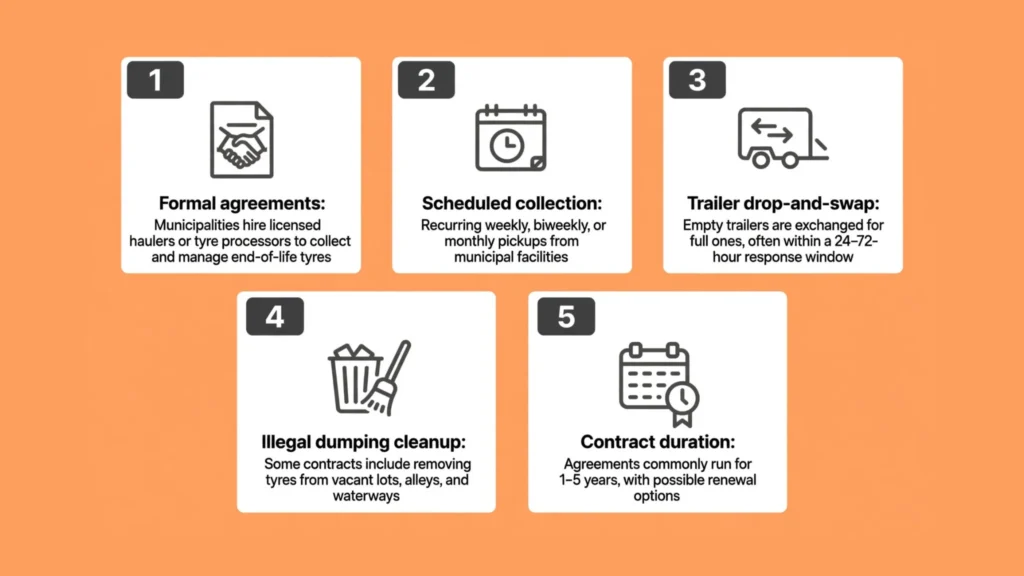
A municipal tyre collection contract is a formal agreement between a local government entity—such as a city, county, or regional waste authority and a licensed waste hauler or tyre processor.
A clear business plan helps recycling operators define their collection model, processing capacity, operating costs, and long-term revenue strategy.
Public sector waste tyre contracts generally fall into three operational models:
Scheduled Route Collection: The contractor picks up tyres on a recurring schedule (weekly, biweekly, or monthly) from municipal fleet maintenance garages, public works depots, and county transfer stations.
On-Call Trailer Drop-and-Swap: The contractor stations empty 48-foot or 53-foot dry van trailers or roll-off containers at designated municipal drop-off sites. Once full, the municipality notifies the contractor to swap the loaded trailer for an empty one within a specified response window, often 24 to 72 hours.
Illegal Dumping and Abatement Support: Some tenders require the contractor to assist code enforcement or public works crews with ad-hoc cleanups of illegally dumped tyres in alleys, vacant lots, or waterways.
Where to Find Public Sector Waste Tyre Tenders
Unlike private contracts built on cold outreach, public sector procurement relies on open, advertised bidding to guarantee fairness and taxpayer value.
Understanding how to source tyres from municipal drop-off sites and other collection channels can help contractors identify reliable supply opportunities and build stronger local partnerships.
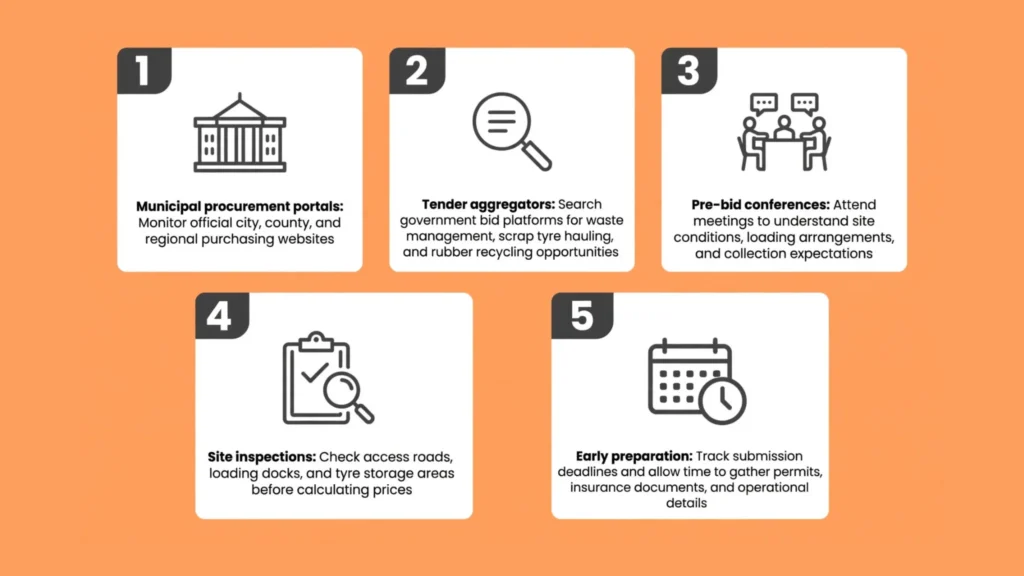
Municipal Procurement Portals: Most cities and counties publish active solicitations on their official purchasing websites or regional e-procurement platforms.
State and National Tender Aggregators: Government bid aggregators compile RFPs across hundreds of jurisdictions, allowing haulers to filter by commodity codes related to waste management, scrap tyre hauling, and rubber recycling.
Pre-Bid Conferences and Site Walks: Many municipalities host mandatory or optional pre-bid meetings at their transfer stations or fleet yards. Attending these sessions allows you to inspect access roads, loading docks, and typical tyre storage conditions before locking in your rates.
Core Requirements in an RFP for Waste Tyres
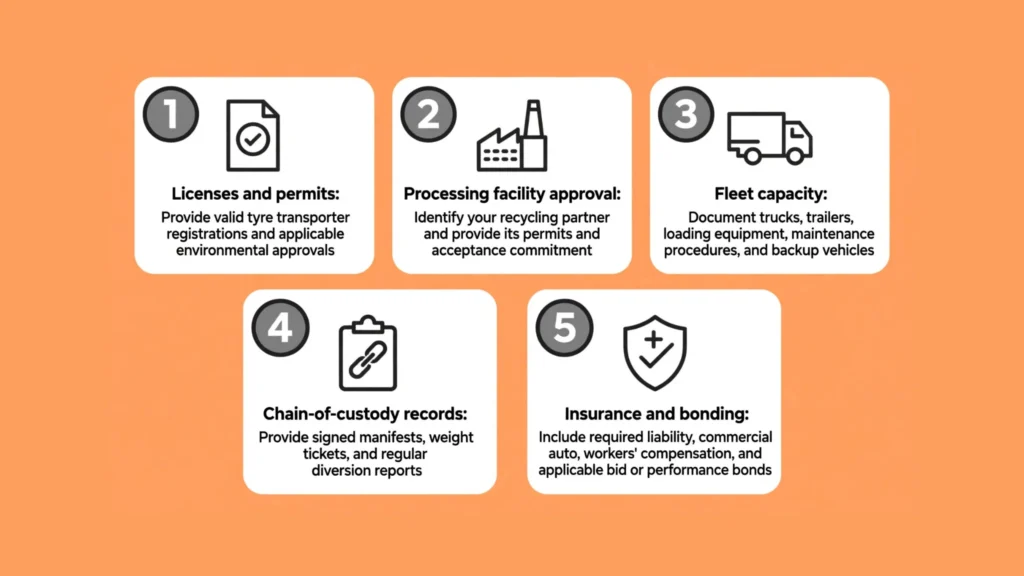
When evaluating a government tyre contract bid, procurement officers prioritize risk mitigation alongside cost. A low price will not win a contract if your company lacks the legal authority to transport or process scrap tyres. Almost every RFP for waste tyres requires proof of the following qualifications:
1. Waste Hauler Licenses and Environmental Permits
Contractors must hold active state, provincial, or regional scrap tyre transporter registrations.
Operators planning to establish their own recycling operations should also understand the licensing, facility requirements, and environmental compliance rules involved in setting up a tyre recycling business.
If you haul to a third-party facility, the municipality will require copies of that processor’s permits and a letter of commitment confirming they will accept the contracted volume.
2. Fleet Capacity and Equipment Standards
Procurement teams want assurance that your equipment can handle peak volumes without service delays. Proposals typically ask for an inventory of trucks, trailers, liftgates, and mobile loading equipment, along with maintenance protocols and backup vehicle availability in case of mechanical breakdowns.
3. Manifesting and Chain-of-Custody Reporting
Governments face strict audit requirements to prove that taxpayer-funded waste does not end up in unauthorized dumps. Your bid must explain how you track every load from pickup to final processing. Standard requirements include:
Providing signed waste tyre manifests or weight tickets for every pickup.
Submitting monthly or quarterly diversion reports detailing total tonnage or unit counts by tyre type.
- Contractors considering in-house processing can also evaluate the equipment, capacity, and infrastructure needed to operate a processing facility that meets their expected collection volumes.
4. Insurance and Bonding
Public sector tenders carry higher insurance thresholds than typical commercial jobs. Expect requirements for commercial general liability, commercial auto liability with pollution coverage, workers’ compensation, and occasionally a bid bond (typically 5% of the estimated contract value) or a performance bond upon award.
How to Structure Pricing for a Government Tyre Contract Bid
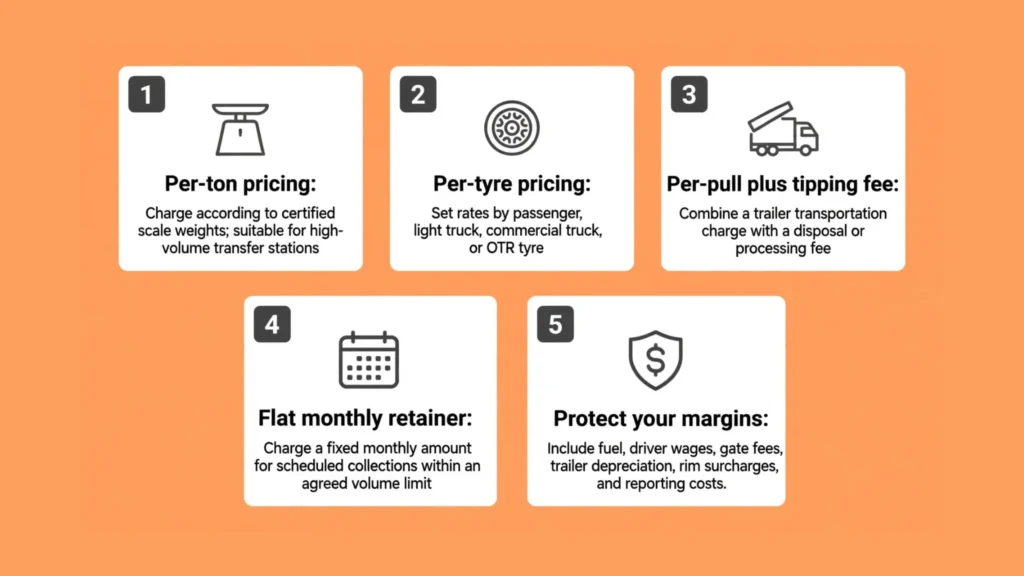
Pricing is often the single most heavily weighted factor in municipal evaluations, especially in sealed-bid tenders where the lowest responsive, responsible bidder wins. Understanding how municipalities structure their pricing sheets prevents costly miscalculations.
| Pricing Structure | How It Works | Best Suited For | Key Risk to Watch |
| Per-Ton (Weight-Based) | Billed based on certified scale tickets at the transfer station or processing plant. | High-volume transfer stations and mixed tyre loads. | Wet tyres holding rainwater or mud can skew weight estimates if the city budgets by unit count. |
| Per-Tyre (Unit-Based) | Fixed rate per passenger, light truck, commercial truck, or off-the-road (OTR) tyre. | Municipal fleet yards with predictable vehicle sizes. | Counting large loads manually takes labor; mixed loads create disputes over size classifications. |
| Per-Pull Plus Tipping Fee | A flat transportation fee per trailer swap plus a pass-through or fixed rate per ton disposed. | Drop-and-swap trailer arrangements at remote drop-off sites. | Underutilized trailers (half-full pulls) can reduce margin if minimum load rules are not defined. |
| Flat Monthly Retainer | Fixed monthly fee covering scheduled pickups up to an agreed volume cap. | Small municipalities with steady, low-to-moderate tyre generation. | Sudden surges from community amnesty events can erode profits without overage clauses. |
When calculating your rates, factor in more than just fuel and driver wages. Include gate fees at the recycling facility, trailer depreciation, surcharge structures for tyres still mounted on rims, and administrative labor for monthly municipal reporting.
Step-by-Step Guide to Preparing a Winning Bid

Approaching a public sector tender systematically reduces the risk of disqualification on technicalities.
Review the Solicitation Document Thoroughly: Read the entire RFP or ITB upon release. Note the submission deadline, mandatory forms, insurance limits, and whether the award is based solely on lowest price or a “best value” scoring rubric that weighs experience and sustainability.
Submit Clarification Questions Before the Deadline: Every public tender includes a formal Q&A window. If the solicitation does not specify whether tyres will be de-rimmed, stacked, or loose, or if historical volume data is missing, submit written questions. The municipality will publish answers as an official addendum visible to all bidders.
Verify Subcontractor and End-Market Compliance: Double-check that your destination recycling facility has no open environmental violations. Municipalities routinely verify permit statuses with state environmental agencies during bid evaluation.
Draft a Clear Operational Plan: For RFPs that score technical proposals, write concise, specific sections explaining your dispatch workflow, response times for full trailers, contingency plans for severe weather or equipment failure, and quality control for weight tickets.
Audit All Mandatory Forms and Signatures: Public procurement offices strictly enforce administrative rules. Missing notarizations, unsigned addenda acknowledgments, or incomplete non-collusion affidavits can result in immediate rejection before your pricing is ever opened.
Common Mistakes That Disqualify Bidders
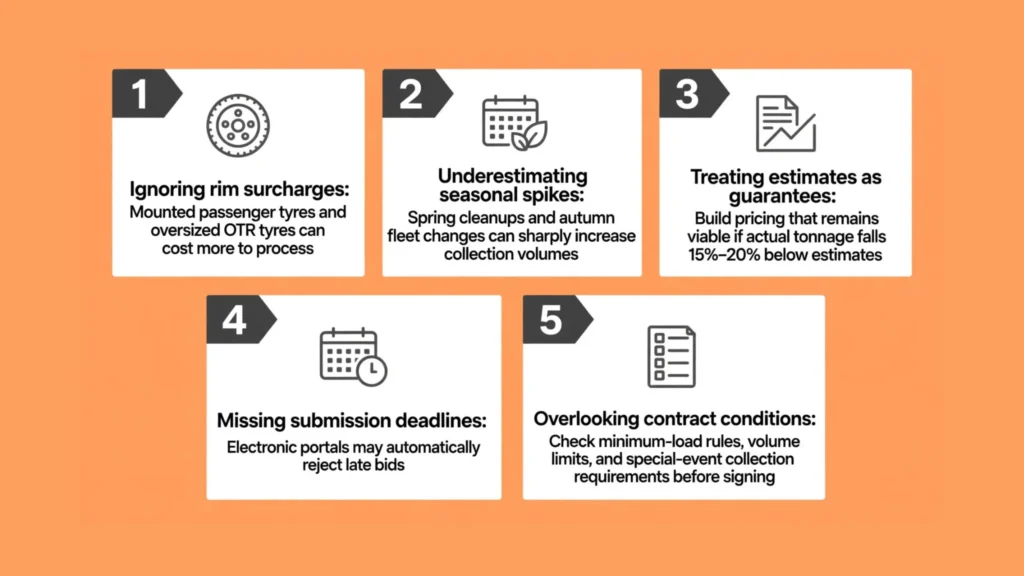
Even experienced waste haulers lose winnable municipal contracts due to preventable errors during the bidding process:
Ignoring Rim and Contamination Surcharges: Passenger tyres on steel rims and heavy off-the-road (OTR) equipment tyres cost significantly more to process than standard loose passenger tyres. Failing to price separate line items for rims or oversized tyres can force you to absorb heavy losses.
Underestimating Seasonal Volume Spikes: Municipal tyre volumes rarely stay flat all year. Spring cleanups, community tyre amnesty days, and autumn fleet changeovers can double monthly volumes. Ensure your fleet and trailer pool can handle peak surges without missing contract response times.
Assuming Historical Estimates Are Guarantees: Most municipal tenders state that historical tonnage figures are estimates only and do not guarantee minimum volumes. Build your pricing model so your fixed overhead is covered even if actual volumes come in 15% to 20% below estimates.
Late Submissions: Electronic procurement portals lock automatically at the exact deadline timestamp. Submitting even one minute late usually results in automatic disqualification.
Frequently Asked Questions
Do I need to own a tyre recycling plant to bid on a municipal collection contract?
No. Many municipalities award contracts to licensed scrap tyre haulers who partner with permitted third-party recyclers or processors. However, you will need to identify your destination facility in your bid and provide proof of their operating permits and capacity commitment.
How long do municipal tyre collection contracts typically last?
Most local government contracts run for an initial term of one to three years, frequently accompanied by two or three one-year renewal options at the municipality’s discretion. Multi-year agreements often allow for annual rate adjustments tied to a Consumer Price Index (CPI) or fuel surcharge schedule.
What is the difference between an RFP and an ITB in waste tyre procurement?
An Invitation to Bid (ITB) or Invitation for Bids (IFB) focuses primarily on price; the contract goes to the lowest bidder who meets all baseline licensing and equipment requirements. A Request for Proposals (RFP) uses a weighted scoring system that evaluates technical approach, past municipal experience, environmental diversion methods, and operational capacity alongside cost.
How do municipalities verify that collected tyres are actually recycled?
Contractors must maintain a strict paper or digital trail using state-approved scrap tyre manifests and certified weigh-scale tickets. Every load leaving a municipal yard must match a corresponding receiving ticket from a licensed recycling, retreading, or energy-recovery facility.
What happens if a municipality’s tyre volume is higher than estimated?
In most unit-price or per-ton contracts, higher volume simply results in higher billings at your contracted unit rate. However, if the surge is caused by a special event like a county-wide tyre collection day, contracts usually require the municipality to give advance notice so you can stage extra trailers.
Are performance bonds required for waste tyre tenders?
Smaller municipal contracts may only require proof of commercial insurance, while larger county or regional agreements often require a bid bond at submission and a performance bond (covering 50% to 100% of the annual contract value) upon award to protect the city against contractor default.
Final Thoughts
Securing a municipal tyre collection contract comes down to preparation, regulatory transparency, and disciplined pricing. Public sector buyers look for partners who remove compliance headaches, keep municipal yards clear on schedule, and provide airtight documentation for every tyre hauled.
By verifying your permits early, clarifying operational assumptions during the Q&A period, and accounting for tyre sizes, rims, and seasonal surges in your pricing, you can submit competitive bids that protect both taxpayer value and your profit margins.
About The Author