Playground Safety Surfacing: Specifications and Buyers
Choosing, specifying, or supplying playground flooring comes down to two non-negotiable priorities: preventing severe head injuries from falls and ensuring unobstructed wheelchair access. Whether you are evaluating vendors for a municipal park or managing operations inside a rubber playground surfacing business, understanding technical compliance standards, material lifecycles, and installation requirements separates a safe, durable play environment from an expensive liability.
Falls are the leading cause of playground-related injuries, which means safety surfacing is the single most critical investment on any play site. Playground surfacing buyers must look beyond surface color and initial purchase price to evaluate impact attenuation, accessibility ratings, sub-base drainage, and long-term maintenance costs.
Core Safety Standards and ASTM Fall Height Requirements
Every commercial playground project in North America is governed by strict performance benchmarks established by ASTM International and the U.S. Consumer Product Safety Commission (CPSC). Any reputable rubber playground surfacing business builds its product specifications around three primary standards.
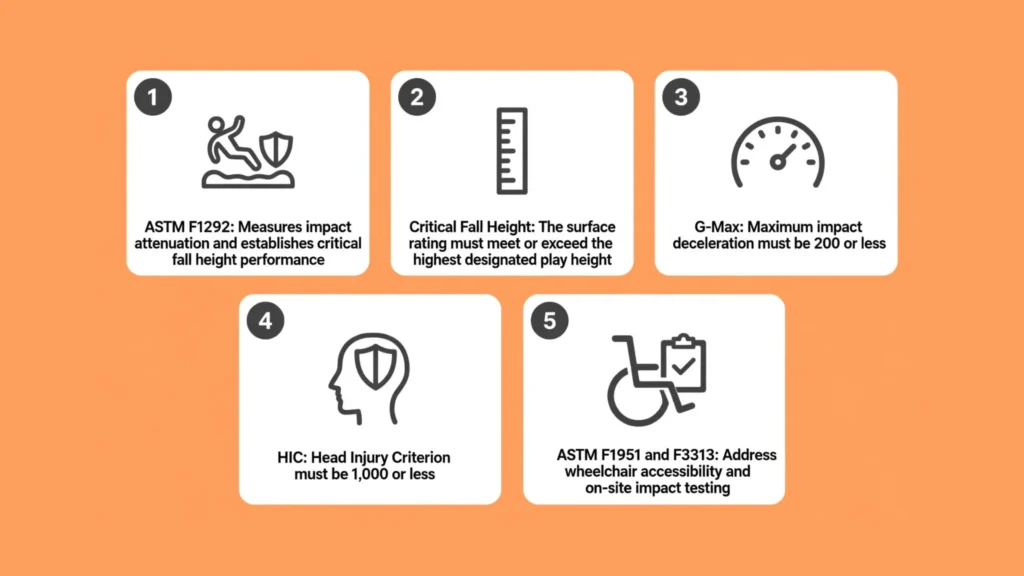
ASTM F1292: Impact Attenuation and Critical Fall Height
ASTM F1292 is the standard specification for impact attenuation of surfacing materials within the use zone of playground equipment. In plain terms, it measures how well a surface absorbs the shock of a child’s head hitting the ground.
Critical Fall Height (CFH): This is the maximum height from which a life-threatening head injury would not be expected to occur. The surfacing system’s rated critical fall height must equal or exceed the highest designated play surface on the equipment.
G-Max Score: Measures the maximum deceleration (shock) experienced during an impact. To pass ASTM F1292, a surface must record a G-Max score of 200 or less.
Head Injury Criterion (HIC): Measures both the intensity and duration of an impact. A passing surface must achieve an HIC score of 1,000 or less.
ASTM F1951: Wheelchair Accessibility
Under the Americans with Disabilities Act (ADA), public playgrounds must provide accessible routes connecting required play components. The accessible playground surfacing requirements explain the technical provisions for ground surfaces, including firmness, stability, slopes, and wheelchair accessibility.
ASTM F1951 tests the amount of work required to propel a wheelchair across a surface in both straight lines and turns. Unitary rubber surfaces consistently pass this standard with minimal effort, whereas loose-fill materials require ongoing raking and compaction to remain compliant.
ASTM F3313: Field Impact Testing
While ASTM F1292 verifies a material’s rating in a laboratory, ASTM F3313 governs field testing using a portable Triax missile device. Playground surfacing buyers increasingly require post-installation field testing to confirm that the on-site crew poured or installed the rubber to the exact thickness needed for the equipment’s fall height.
Primary Types of Rubber Playground Surfacing

Commercial buyers and contractors typically work with three distinct unitary rubber systems, alongside loose-fill rubber alternatives. Each offers specific structural advantages depending on site conditions and budget.
Poured in Place Rubber (PIP)
Poured in place rubber is the gold standard for custom commercial playgrounds, schools, and inclusive parks. It is a seamless, two-layer system mixed and troweled directly on-site.
Base Layer (Cushion): Made from 100% recycled SBR (styrene-butadiene rubber) buffings bound with polyurethane. The thickness of this layer is customized—typically ranging from 1.5 inches to over 5 inches—to meet the exact ASTM fall height requirement of the adjacent equipment.
Wear Layer (Top Coat): A 3/8-inch to 1/2-inch cap composed of virgin EPDM (ethylene propylene diene monomer) or TPV (thermoplastic vulcanizate) granules mixed with an aliphatic or aromatic polyurethane binder. This layer provides UV resistance, color vibrancy, and slip resistance.
Interlocking Rubber Tiles
Rubber playground tiles are factory-molded squares (commonly 24″ x 24″) manufactured under controlled heat and pressure. They feature underside pedestals or waffle grids that compress upon impact to absorb shock.
Installation: Tiles are adhered to a concrete or asphalt sub-base using polyurethane glue, connected via interlocking pins, or locked together with beveled edge reducers.
Advantage: Because they are factory-cured, tile thickness and density are uniform. If a section is vandalized or damaged, individual tiles can be replaced without patching a seamless floor.
Bonded Rubber Mulch
Bonded rubber mulch bridges the gap between loose-fill aesthetics and unitary performance. It consists of shredded recycled rubber tires mixed with a polyurethane binder and troweled on-site into a single, porous layer. This application demonstrates how recycled rubber in construction materials can give discarded tires a useful second life.
Appearance: Closely mimics natural wood mulch while eliminating scatter, decomposition, and annual top-offs.
Application: Often used in nature-themed playgrounds, walking trails, and around lower-height equipment where a rustic look is preferred over bright EPDM colors.
Loose-Fill Rubber Mulch
Made from 100% recycled, wire-free tire nuggets, loose-fill rubber offers the highest fall-height protection per inch of depth compared to wood fiber or sand. Recycled tire materials also create commercial opportunities, particularly through selling crumb rubber for playgrounds and other rubber-based applications.
However, because the nuggets displace under swings and slide exits, it requires containment borders and frequent raking to maintain proper depth and ADA accessibility.
Comparison of Playground Surfacing Systems
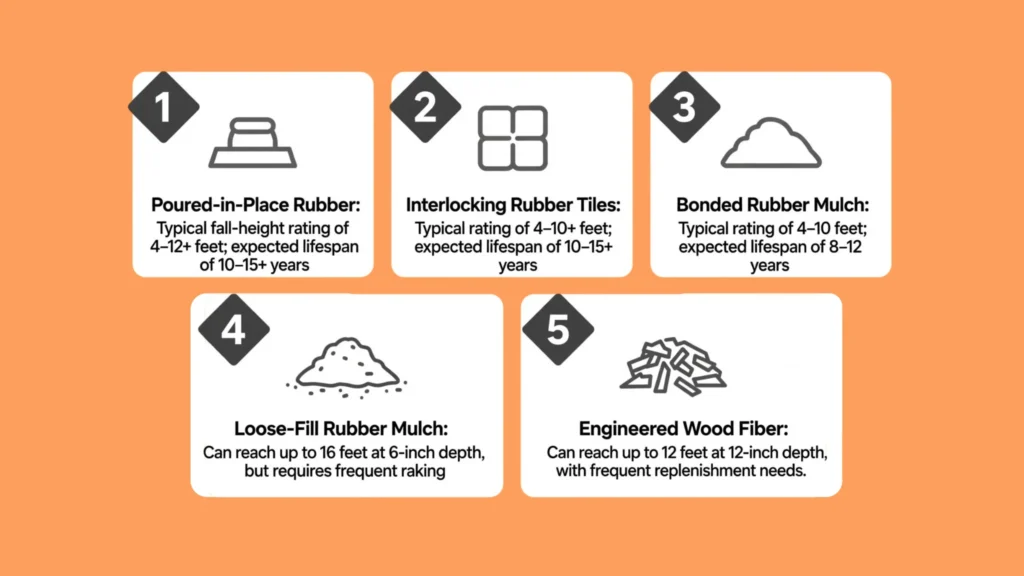
Evaluating material options side by side helps playground surfacing buyers align project specs with long-term operational budgets.
| Surfacing Type | Typical Fall Height Rating | ADA Accessibility | Upfront Cost | Maintenance Demands | Expected Lifespan |
| Poured in Place Rubber | 4 ft to 12+ ft (customizable) | Excellent (Seamless) | High | Low (periodic cleaning, recoating) | 10–15+ years |
| Interlocking Rubber Tiles | 4 ft to 10+ ft (varies by thickness) | Very Good (minimal seams) | High | Low (individual tile replacement) | 10–15+ years |
| Bonded Rubber Mulch | 4 ft to 10 ft | Good (textured surface) | Moderate–High | Low–Moderate (top-coat resealing) | 8–12 years |
| Loose-Fill Rubber Mulch | Up to 16 ft (at 6-inch depth) | Fair (requires constant raking) | Moderate | High (raking, containment checks) | 10+ years (with top-offs) |
| Engineered Wood Fiber (EWF) | Up to 12 ft (at 12-inch depth) | Fair (compaction needed) | Low | Very High (annual replenishment) | 1–3 years per cycle |
Key Specifications Every Buyer Must Verify
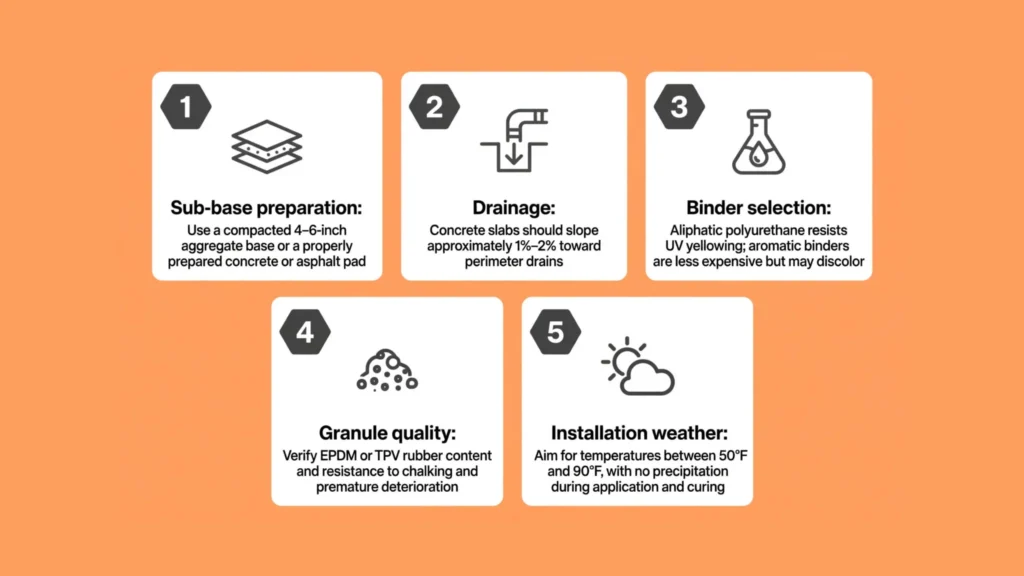
When reviewing bids or drafting RFPs, overlooking installation details can lead to premature delamination, cracking, or failed safety audits.
1. Sub-Base Construction and Drainage
Rubber surfacing is porous, meaning water drains straight through the wear and cushion layers. However, the sub-base beneath it dictates whether that water clears the site or pools under the rubber.
Compacted Aggregate Base: A 4-to-6-inch layer of crushed stone (such as #57 stone topped with stone dust) compacted to at least 95% Proctor density. This is cost-effective and naturally permeable, provided the surrounding soil drains well.
Concrete or Asphalt Pad: Offers superior long-term dimensional stability and prevents sub-base shifting. Concrete slabs must be sloped at a minimum of 1% to 2% toward perimeter drains, and concrete must cure for at least 28 days before rubber installation.
2. Aliphatic vs. Aromatic Binders
The polyurethane binder holds the rubber granules together and represents one of the biggest hidden quality differences in a rubber playground surfacing business quote.
Aromatic Binders: Less expensive and structurally strong, but they amber (turn yellow/brown) when exposed to UV sunlight. On dark colors like black or forest green, this ambering is barely noticeable. On light blues, grays, or bright yellows, it noticeably alters the color within months.
Aliphatic Binders: UV-stable and non-yellowing. They cost significantly more upfront but preserve true color clarity for years, making them essential for light or vibrant EPDM color blends.
3. EPDM vs. TPV Granules
Both EPDM and TPV are synthetic rubbers used in the top wear layer of poured-in-place systems. EPDM is the traditional industry standard with proven elastic recovery. TPV (thermoplastic vulcanizate) offers enhanced UV stability and color retention, resisting chalking and hardening in high-sunlight regions. Regardless of the polymer chosen, buyers should verify that the granules are virgin material with high rubber content rather than heavily chalk-filled compounds that crumble prematurely.
4. Weather Windows During Installation
On-site poured rubber relies on a chemical reaction between the polyurethane binder and atmospheric moisture. Installers require ambient and surface temperatures generally between 50°F and 90°F, with zero precipitation during application and curing. Installing in extreme cold, excessive humidity, or direct scorching heat can cause foaming, weak bonding, or tacky surfaces.
Operational Insights for a Rubber Playground Surfacing Business
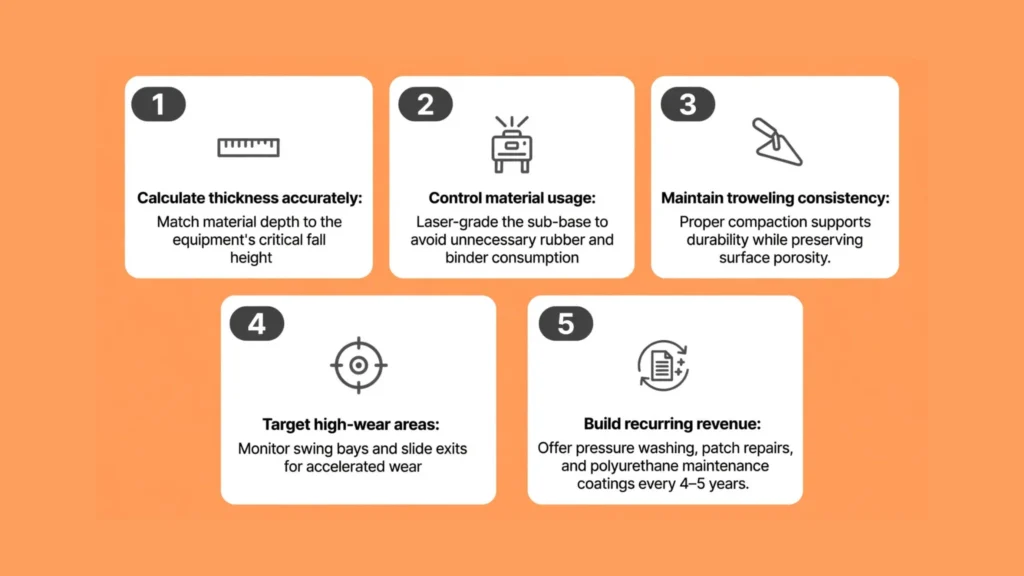
For contractors, estimators, and entrepreneurs operating a rubber playground surfacing business, profitability and reputation hinge on precision estimating and disciplined quality control. Entrepreneurs interested in the supply side can also explore how to start a tire recycling business to turn discarded tires into commercially valuable rubber materials.
Accurate Thickness Calculations: Misjudging sub-base grading by even half an inch across a 5,000-square-foot playground can consume hundreds of extra pounds of SBR rubber and polyurethane binder, wiping out job margins. Laser-grading the sub-base before pouring protects both material budgets and ASTM fall height compliance.
Wear-Layer Troweling Technique: Compaction density during hand-troweling determines surface durability. Under-compacted EPDM sheds granules rapidly under heavy foot traffic, while over-compacted areas lose porosity and create puddles.
Lifecycle Service Contracts: Offering scheduled maintenance packages—including pressure washing, high-wear patch repairs (such as under swings and at slide exits), and roll-on polyurethane top-coating every 4 to 5 years—creates recurring revenue while extending the client’s surfacing investment.
Common Mistakes Playground Surfacing Buyers Make
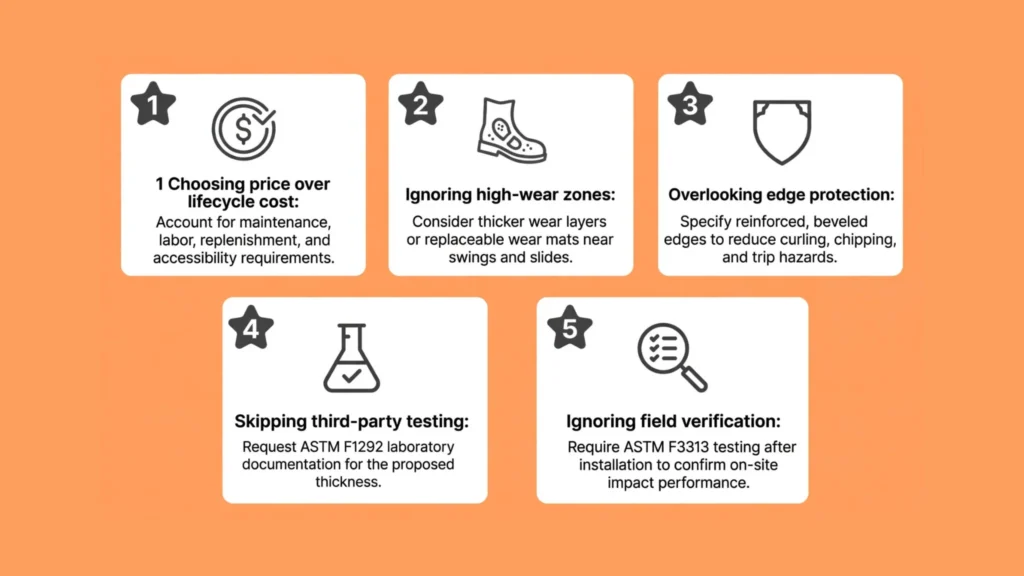
Choosing Price Over Total Cost of Ownership: Loose-fill wood fiber looks inexpensive on day one, but factoring in annual material top-offs, labor for raking, and ADA compliance monitoring often makes poured in place rubber more economical over a 10-year horizon.
Ignoring High-Wear Zones: Swing bays and slide exits endure intense friction. Buyers should specify thicker wear layers (up to 3/4 inch) or replaceable rubber wear mats in these zones during initial construction.
Overlooking Perimeter Edge Details: Unprotected rubber edges can curl or chip over time. Specifying thickened, beveled edges turned down into a concrete curb or compacted stone trench ensures a flush, trip-free transition.
Skipping Third-Party Testing: Relying solely on a manufacturer’s brochure instead of requiring certified ASTM F1292 lab documentation for the exact proposed thickness—and ASTM F3313 field testing upon completion—leaves facility owners exposed to liability.
Frequently Asked Questions
How thick does poured in place rubber need to be for playground safety?
The required thickness depends directly on the critical fall height of the playground equipment. A 4-foot fall height typically requires around 1.75 to 2 inches of total thickness, whereas an 8-foot fall height generally requires 3.5 to 4 inches, and a 12-foot fall height can require 5 inches or more. Always verify thickness against the manufacturer’s certified ASTM F1292 test reports.
How long does rubber playground surfacing last?
Well-installed poured in place rubber and interlocking rubber tiles typically last 10 to 15 years or longer, depending on foot traffic, UV exposure, and climate. Applying a polyurethane maintenance coat every 4 to 5 years helps lock down surface granules and extend the functional lifespan.
Does rubber playground surfacing get too hot in the sun?
Like asphalt or dark concrete, rubber surfacing absorbs heat in direct sunlight, and darker colors like black or dark green retain more warmth than lighter shades. Choosing lighter EPDM blends (such as tan, light blue, or gray) and incorporating shade sails or trees over play structures significantly reduces surface temperatures.
Can poured in place rubber be installed over existing concrete or asphalt?
Yes. Existing concrete or asphalt provides an ideal sub-base, provided it is structurally sound, free of major heaving cracks, clean, and sloped properly for drainage. Minor cracks are typically routed and filled, and a primer coat is applied before installing the SBR cushion layer.
How do you clean and maintain rubber playground surfacing?
Routine maintenance involves blowing off leaves and debris, removing weeds along perimeter edges, and washing the surface periodically with mild soap and water or a low-pressure washer (keeping nozzle pressure below 1,500 PSI to avoid dislodging granules). Harsh petroleum-based solvents should never be used, as they break down the polyurethane binder.
What is the difference between poured in place rubber and bonded rubber mulch?
Poured in place rubber uses a two-layer system with a shock-absorbing SBR base and a smooth, colorful EPDM top layer. Bonded rubber mulch is a single-layer system made from shredded recycled tire rubber mixed with binder, creating a textured, natural wood-mulch appearance at a slightly lower price point.
Final Thoughts
Whether you are specifying safety flooring for a community park or building operational excellence inside a rubber playground surfacing business, success comes down to aligning technical specifications with real-world site demands. Prioritizing verified ASTM fall height ratings, proper sub-base drainage, UV-stable aliphatic binders, and reinforced high-wear zones ensures a playground surface that remains safe, accessible, and visually appealing for over a decade.
About The Author