Vehicle Rental Business Ideas: 6 Profitable Models 2026
This guide explores six vehicle rental business ideas in the USA, from peer-to-peer car sharing business USA via Turo ($0–$5K startup) to luxury specialty rentals and franchise operations ($50K–$250K+). Each model offers different profit margins (5–40%), break-even timelines (weeks to 36 months), and capital requirements. Success depends on niche differentiation, local market demand, and matching the model to your available capital and time commitment. With the US car rental market worth $37.88 billion and growing, these car rental startup ideas provide viable pathways for entrepreneurs at any experience level.
Vehicle rental business ideas are transforming how entrepreneurs generate income from depreciating assets. The car rental market in the USA is worth $37.88 billion and growing at 4.6% annually. If you’re considering entering this space, you have multiple pathways to profitability from peer-to-peer car sharing business USA models to luxury fleet operations.
This guide breaks down six viable vehicle rental business ideas, how much they cost to start, and which model aligns with your capital and lifestyle.
What Are Vehicle Rental Business Ideas?
Vehicle rental business ideas refer to different ways entrepreneurs monetize vehicles by renting them to customers. Instead of selling cars, you generate recurring revenue by allowing people to use your vehicles for days, weeks, or months.
The appeal is straightforward: vehicles depreciate anyway. A car rental startup ideas turns depreciation into profit. You buy vehicles strategically, rent them consistently, and sell them at the right time. This cycle repeats, generating passive income.
Consistent demand drives growth. Tourists, business travelers, locals needing temporary transportation, and people whose vehicles are being serviced all need rentals. Also this makes vehicle rental business ideas attractive for entrepreneurs with various capital levels.
Six Proven Vehicle Rental Business Ideas with Startup Costs and ROI
| Model | Startup Cost | Annual Revenue/Vehicle | Profit Margin | Time to Break Even | Best For |
|---|---|---|---|---|---|
| Peer-to-Peer (Car Sharing Business USA) | $0–$5K | $12K–$18K | 65–75% | Weeks | Side hustlers |
| Traditional Independent | $10K–$50K | $18K–$36K | 5–10% | 18–36 months | Full-time ops |
| Specialty/Luxury | $25K–$100K | $50K–$100K | 20–40% | 12–24 months | Niche players |
| B2B Partnership | $15K–$40K | $20K–$40K | 8–12% | 12–18 months | Relationship builders |
| Franchise | $50K–$250K | $30K–$60K | 5–15% (after fees) | 24–36 months | Risk-averse |
| Subscription Model | $20K–$50K | $25K–$50K | 15–25% | 18–24 months | Brand builders |
1. Peer-to-Peer Car Sharing Business USA: The Turo Model
How it works: List your vehicles on Turo, a peer car rental platform. Turo handles bookings, insurance, and payments. You keep 65–75% of rental fees.
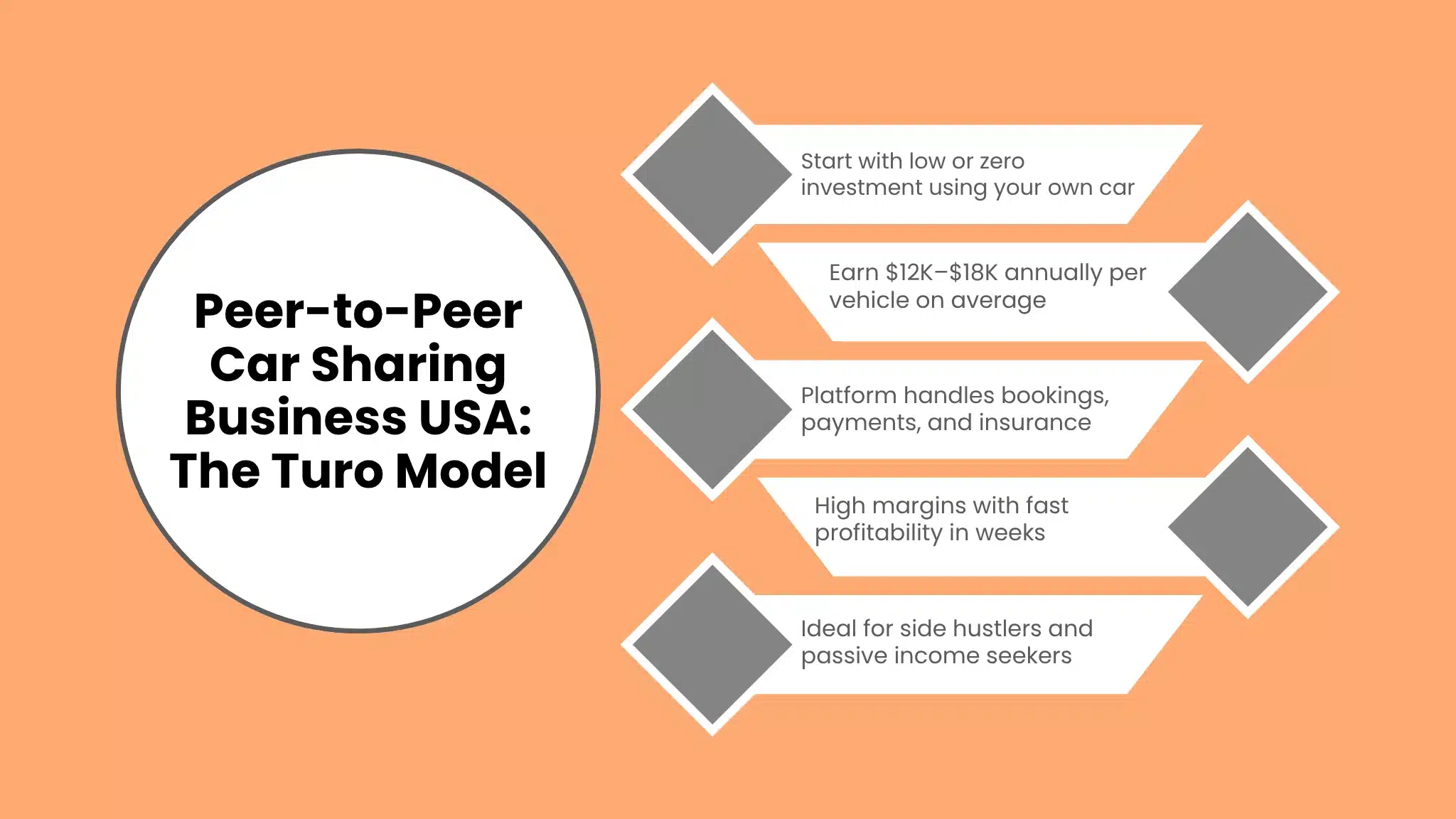
Startup cost: $0–$5,000. Start with a car you already own or invest $15,000–$25,000 in a reliable used vehicle.
Revenue potential: Median hosts earn $12,000–$18,000 annually per vehicle. Luxury or specialty vehicles earn significantly more. Nearly a third of Turo trips start at airports.
Pros:
- Minimal upfront investment
- Platform handles marketing and customer acquisition
- Insurance included (up to $750,000 third-party liability)
- No physical location needed
- Start part-time
Cons:
- Higher vehicle wear and tear
- Turo takes 25–35% commission
- Limited pricing control
- You handle scheduling coordination
Best for: Side hustlers, owners with extra vehicles, passive income seekers.
Profitability timeline: Weeks to months.
2. Traditional Independent Car Rental Startup Ideas: The Full-Control Model
How it works: Buy vehicles, secure a physical location, manage bookings, handle insurance, and coordinate maintenance. You own the entire customer relationship.
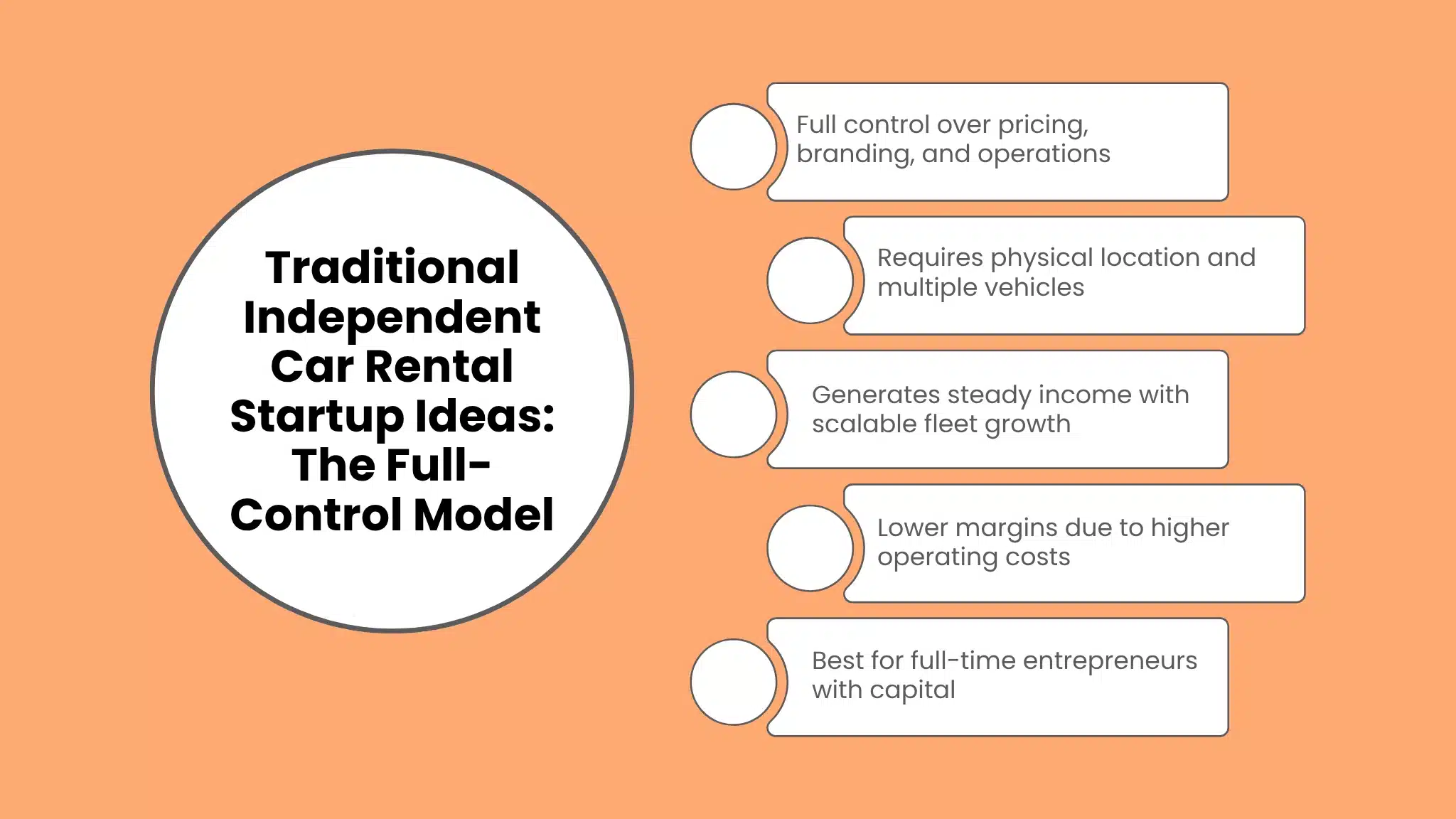
Startup cost: $10,000–$50,000. Vehicles ($15K–$30K each), commercial insurance ($1.5K–$3K annually per vehicle), location setup ($2K–$10K), and technology ($500–$2K).
Revenue potential: Average net profit margin is 5–10% after operating costs. Three cars generating $150 daily could net $1,500–$3,000 monthly.
Pros:
- Full control over pricing and branding
- Multiple revenue streams (GPS rentals, insurance, delivery services)
- No platform commission splitting
- Scalable operation
Cons:
- High operating costs
- Capital intensive
- Requires operational expertise
- Customer service demands
Best for: Entrepreneurs with capital and operational experience.
Profitability timeline: 18–36 months.
3. Specialty and Luxury Vehicle Rental Business Ideas: The Niche Play
How it works: Offer high-end, exotic, or specialty vehicles—Ferraris, Lamborghinis, classic cars, or premium RVs. Moreover, customers pay premium prices for specialized experiences.
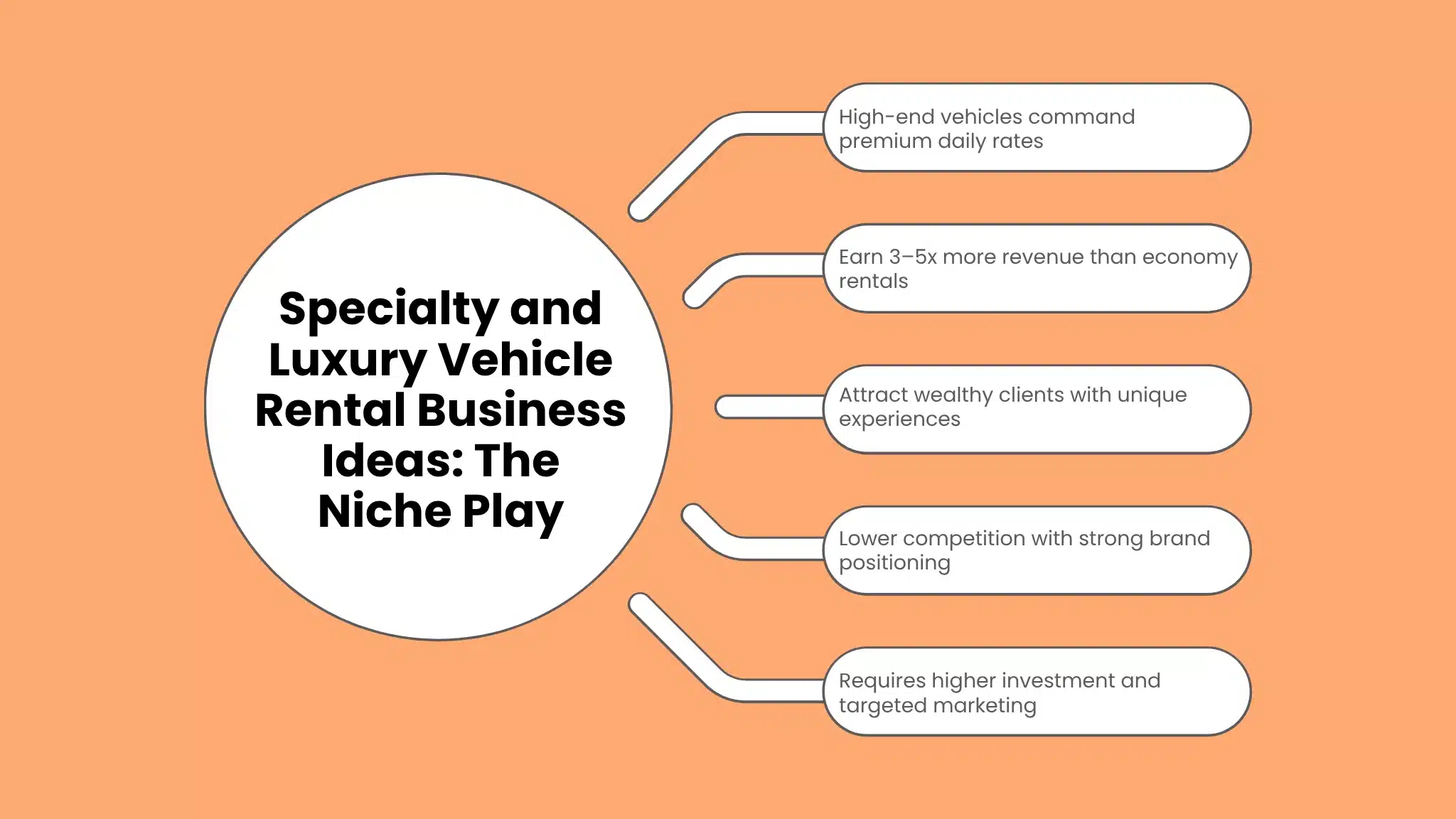
Startup cost: $25,000–$100,000+ per vehicle. A single luxury car costs $50K–$80K but generates 3–5x higher daily rates.
Revenue potential: 20–40% net profit margins. Two luxury cars can outperform ten economy cars in revenue.
Pros:
- Less competition
- Wealthy customers with lower price sensitivity
- Strong brand positioning
- Higher customer loyalty
Cons:
- Smaller market
- Requires sophisticated marketing
- Higher insurance and maintenance
- Needs affluent connections
Best for: Founders with luxury market connections and strong marketing skills.
Profitability timeline: 12–24 months.
4. Corporate Vehicle Leasing Business: The B2B Partnership Model
How it works: Partner with car dealerships, insurance companies, or businesses providing replacement vehicles. Businesses pay you monthly for steady vehicle access.
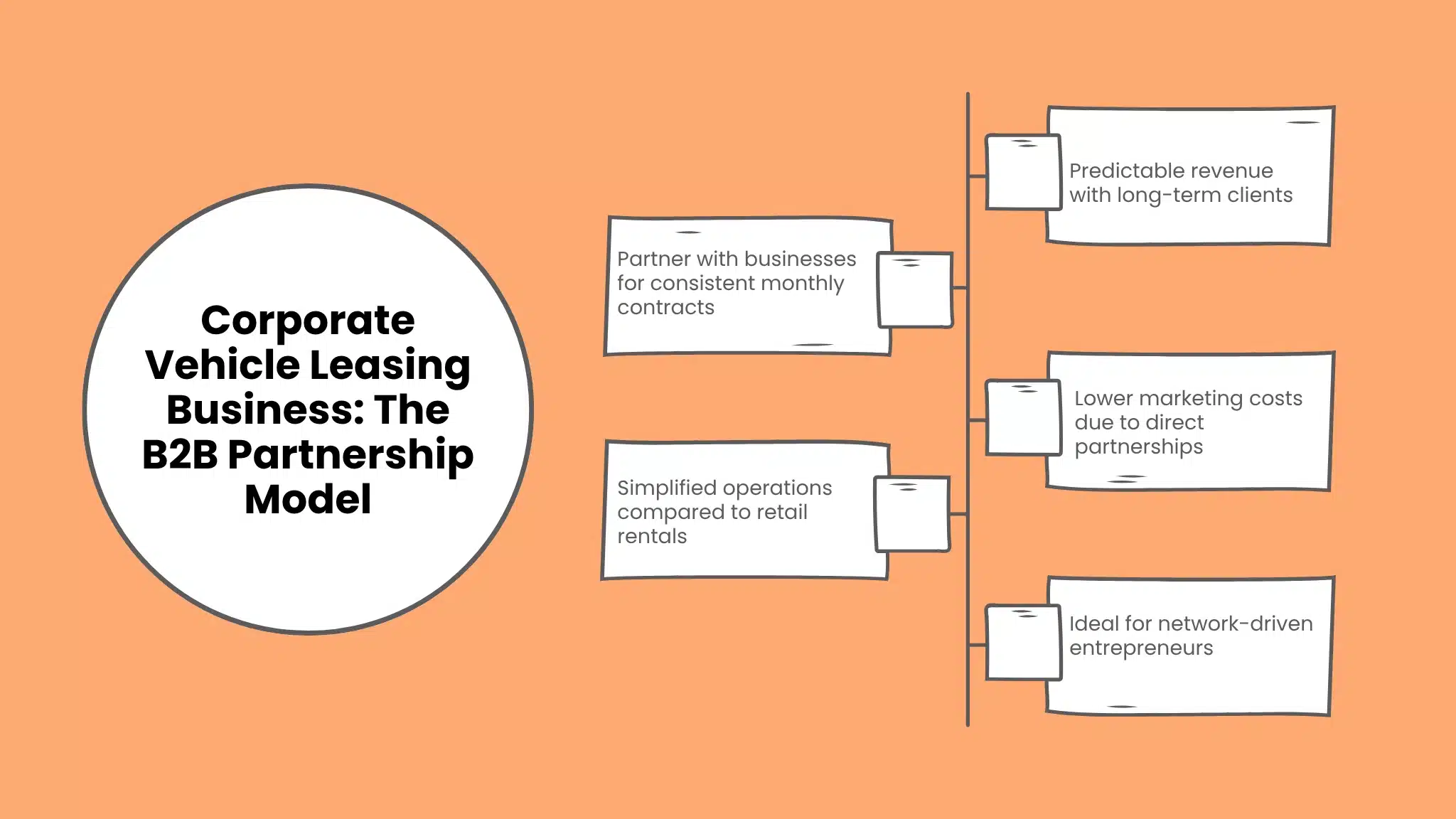
Startup cost: $15,000–$40,000. Partnerships reduce fleet size needs.
Revenue potential: Estimated 8–12% net profit margins with recurring, predictable revenue.
Pros:
- Stable, long-term customers
- Lower marketing costs
- Predictable utilization
- Simpler operations
Cons:
- Lower per-rental rates
- Price-sensitive corporate clients
- Longer sales cycles
- Less pricing flexibility
Best for: Relationship builders with B2B networks and stability-focused operators.
Profitability timeline: 12–18 months.
5. Car Rental Startup Ideas via Franchise: The Turnkey Approach
How it works: Buy franchising rights to brands like Enterprise, Hertz, or Budget. Operate under their brand, following their systems.
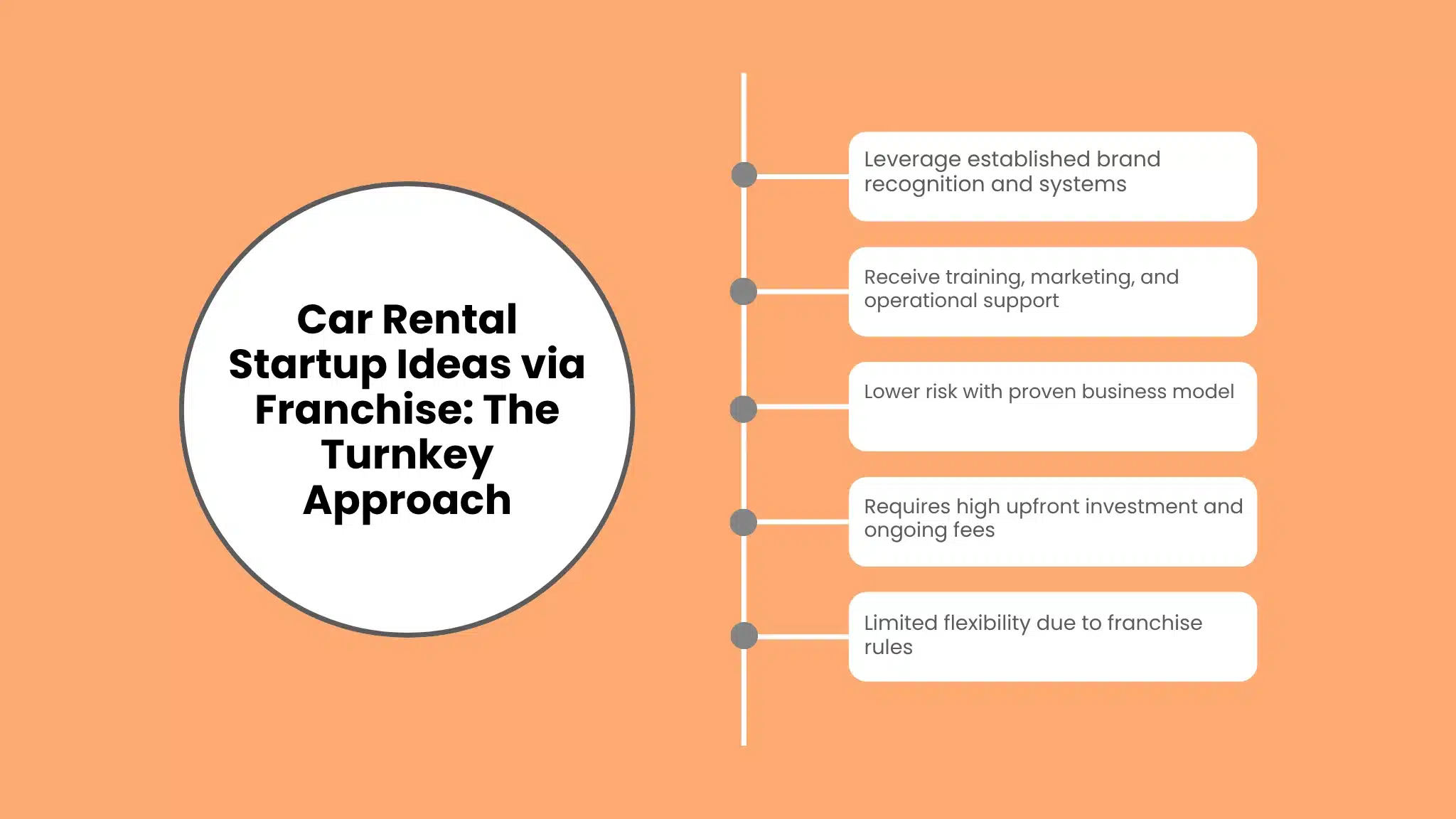
Startup cost: $50,000–$250,000+. Includes franchise fees, vehicles, and location setup.
Revenue potential: Lower failure rates but you split profit with the franchisor (10–15% of revenue goes to fees).
Pros:
- Brand recognition drives volume
- Proven systems and training
- Marketing support
- Lower operational risk
Cons:
- High upfront and ongoing costs
- Restricted pricing
- Limited business control
- Brand constraints
Best for: Capital-rich entrepreneurs preferring proven systems over full autonomy.
Profitability timeline: 24–36 months.
6. Subscription-Based Vehicle Rental Business Ideas: The Membership Model
How it works: Customers pay $500–$2,000 monthly for unlimited or reserved vehicle access. An emerging lifestyle play for premium customers.
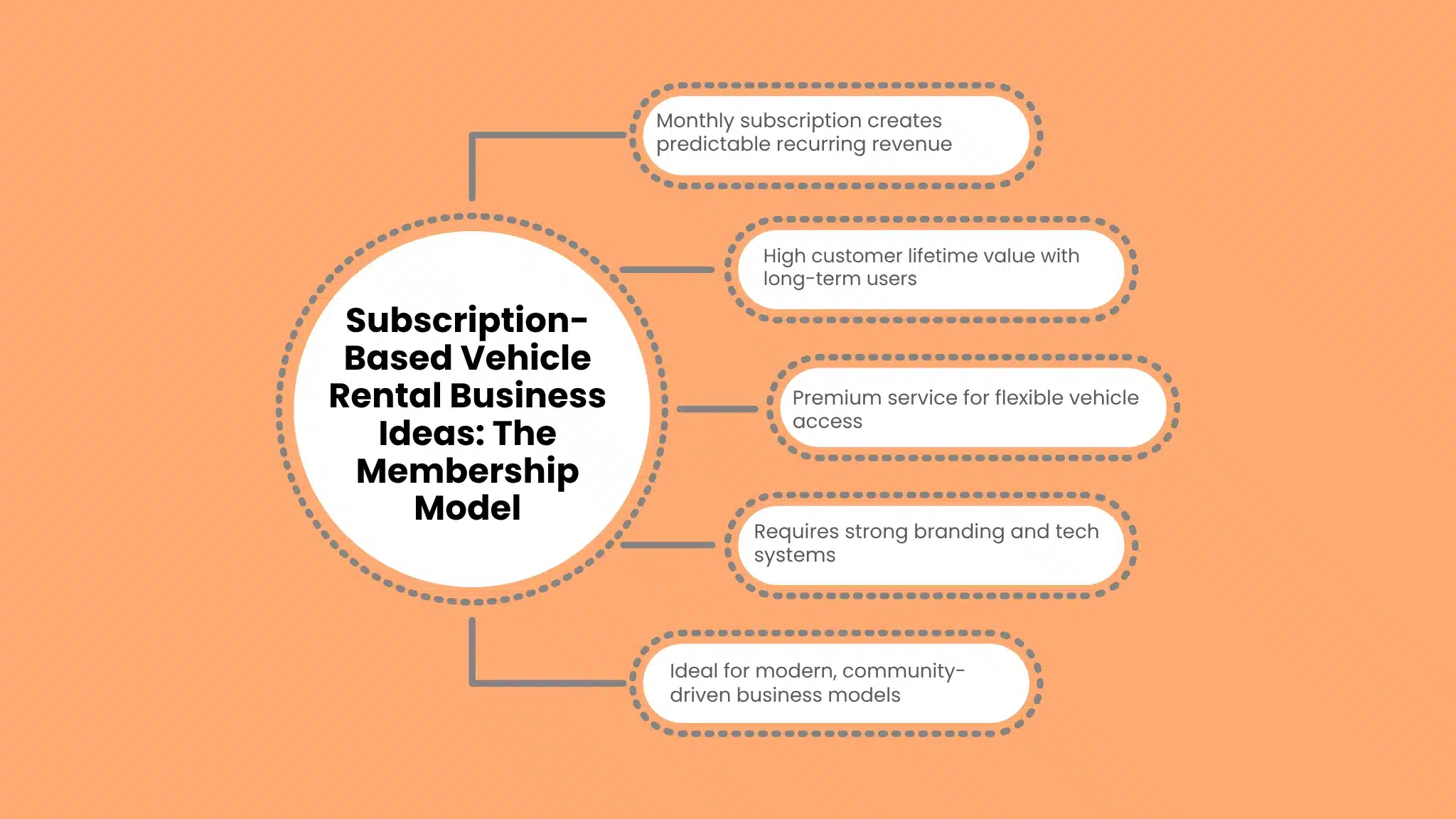
Startup cost: $20,000–$50,000. Includes 4–6 vehicles and membership platform.
Revenue potential: Estimated 15–25% net margins with predictable recurring revenue and high customer lifetime value.
Pros:
- Predictable recurring revenue
- Higher customer lifetime value
- Lower churn through commitment
- Premium brand opportunity
Cons:
- Smaller addressable market
- Requires significant brand investment
- Platform costs
- High customer acquisition costs
Best for: Brand builders, tech-savvy operators, and community-focused founders.
Profitability timeline: 18–24 months.
Choosing Your Vehicle Rental Business Ideas
Your choice depends on capital available, time commitment, and local market opportunity.
Under $5K: Peer car rental via Turo. No location needed, minimal overhead.
$10K–$40K: Traditional independent or B2B partnerships.
$50K+: Specialty niches, franchises, or subscriptions.
Part-time: Peer-to-peer or specialty rentals.
Full-time: Traditional independent, B2B, or subscription.
Competitive markets: Differentiate through specialty vehicles or subscription models. Don’t compete on price alone.
Conclusion
Vehicle rental business ideas range from $0 to $250K+ in startup costs. Profitability timelines vary from weeks to 36 months. Success depends on matching your model to capital, operational capacity, and local market demand.
The most successful operations are niche players who differentiate through specialty vehicles, premium experiences, or predictable revenue. Don’t compete on price alone. Instead, identify underserved customer segments and build defensible businesses.
Start with market research. Talk to 10 potential customers about their needs, willingness to pay, and demand volume. Validate assumptions before committing capital. If you want more ideas for business visit Reliable Startup.
Frequently Asked Questions
What is the cheapest vehicle rental business idea to start with?
Peer car rental via Turo is the cheapest option. Start with zero capital if you already own a vehicle. If buying specifically for this, budget $15,000–$25,000 for a reliable used car.
How much money can you make from vehicle rental business ideas?
Earnings vary by model. Turo hosts average $12,000–$18,000 annually per vehicle. Specialty rentals generate $50,000–$100,000+ annually from 2–3 vehicles. Traditional independent rentals with 3–5 vehicles net $18,000–$60,000 annually after costs.
Do you need a physical location for car sharing business USA operations?
No. Peer-to-peer models don’t require physical locations. Subscription and specialty models operate digitally with customer pickup/dropoff. Traditional rentals benefit from airport or tourist proximity.
What is the fastest way to make money with car rental startup ideas?
Peer car rental (Turo) shows returns within weeks. Specialty vehicles and B2B partnerships break even in 12–18 months due to higher margins and predictable revenue.
Can you combine multiple vehicle rental business ideas into one operation?
Yes. Many successful operators start with Turo, then transition to specialty niches. Others combine B2B partnerships with consumer rentals. Start with one model, validate it, then expand strategically.